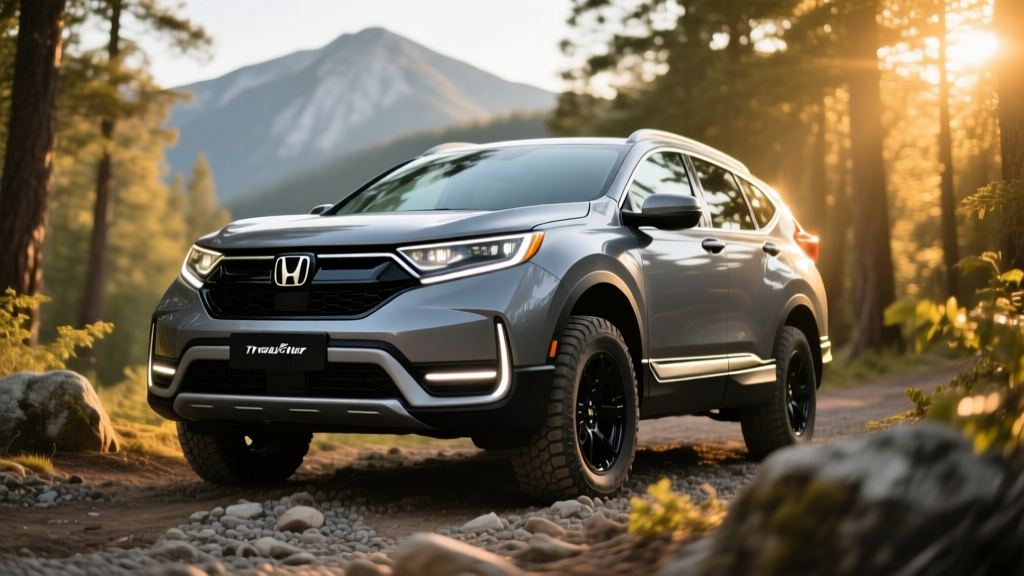
The Honda CR-V Hybrid TrailSport occupies a narrow but compelling lane: a rugged-styled compact SUV with legitimate all-wheel-drive hardware, real hybrid efficiency, and no plug required. For buyers who want the TrailSport's all-terrain aesthetic and enhanced traction without committing to a full electric vehicle or a plug-in hybrid, this is Honda's answer. Below, we break down the 2026 CR-V Hybrid TrailSport's real-world fuel economy, powertrain specifics, battery longevity, pricing, and whether the hybrid or a competing PHEV/EV makes more sense for your driveway.
HEV vs. PHEV: What the CR-V TrailSport Actually Is
Before examining specs, it's critical to understand what you're buying. The 2026 Honda CR-V Hybrid TrailSport is a conventional hybrid electric vehicle (HEV), not a plug-in hybrid (PHEV). That distinction drives everything from how you fuel it to what tax incentives apply.
| Feature | HEV (CR-V Hybrid TrailSport) | PHEV (e.g., Toyota RAV4 Prime) | BEV (e.g., Tesla Model Y) |
|---|---|---|---|
| Plug-in charging required? | No — regenerative braking charges battery | Yes — plug in for electric-only range | Yes — plug in for all driving |
| Electric-only range | None (motor assists gas engine) | ~42 miles typical | 280–330+ miles |
| Gas engine | Yes (2.0L 4-cyl) | Yes (2.5L 4-cyl typical) | None |
| Federal tax credit (§30D) | Not eligible | Up to $7,500 (if sourcing/income rules met) | Up to $7,500 (if sourcing/income rules met) |
| Home charging install needed | No | Recommended (Level 2) | Required (Level 2 strongly recommended) |
| Typical combined efficiency | 40 MPG combined | 94 MPGe (electric) / 38 MPG (gas) | 120+ MPGe |
The CR-V Hybrid TrailSport generates its own electricity through regenerative braking and the gasoline engine. You never plug it in. You simply fill up at a gas station and drive. The hybrid system recaptures energy during deceleration and uses it to assist acceleration, reducing fuel consumption — especially in stop-and-go city driving where hybrids shine brightest.
Fuel Economy: EPA Ratings and Real-World MPG
The 2026 Honda CR-V Hybrid with AWD carries an EPA-estimated 40 MPG city / 34 highway / 37 combined rating per fueleconomy.gov. The TrailSport trim, with its all-terrain tires and slightly increased ride height, may see a marginal reduction — expect approximately 39 city / 33 highway / 36 combined based on Honda's published specs and the typical 1 MPG penalty for aggressive tire compounds.
| Driving Scenario | EPA Estimate (AWD Hybrid) | Real-World Expectation |
|---|---|---|
| City (stop-and-go) | 40 MPG | 41–44 MPG (hybrids often beat EPA in city) |
| Highway (70 mph steady) | 34 MPG | 31–34 MPG (aero drag limits regen benefit) |
| Combined (55/45 mix) | 37 MPG | 35–39 MPG depending on terrain and climate |
| Cold weather (below 32°F) | Not rated separately | 30–34 MPG combined (engine runs more for cabin heat) |
Why hybrids often exceed EPA in the city: Conventional hybrids recapture kinetic energy during braking and low-speed driving, converting it to electric assist. In heavy traffic, the engine shuts off frequently, and the electric motor handles launches. On the highway, the gas engine does most of the work with less regenerative opportunity, narrowing the advantage over a conventional gas model.
With a 15.3-gallon fuel tank, the CR-V Hybrid TrailSport delivers roughly 540–560 miles of real-world combined range between fill-ups — meaning most drivers will visit a gas station once every two to three weeks.
Powertrain and Performance Specs
| Specification | 2026 CR-V Hybrid TrailSport |
|---|---|
| Engine | 2.0L DOHC Atkinson-cycle 4-cylinder |
| Electric motors | Dual-motor hybrid system (front + rear AWD) |
| Combined system horsepower | 204 hp |
| Combined system torque | 247 lb-ft |
| Transmission | Direct-drive (e-CVT, no traditional gears) |
| Drivetrain | Real Time AWD™ with torque vectoring |
| 0–60 mph | ~7.6 seconds (est.) |
| Towing capacity | 1,500 lbs |
| Ground clearance | 8.3 inches (TrailSport-tuned) |
| Cargo volume (behind rear seats) | 36.3 cu ft |
| Cargo volume (rear seats folded) | 76.5 cu ft |
Honda's two-motor hybrid system pairs the 2.0L Atkinson-cycle engine with a propulsion motor and a generator motor. In most low-speed and city scenarios, the vehicle operates primarily on electric power, with the engine acting as a generator to keep the small hybrid battery charged. At highway speeds, a lock-up clutch mechanically connects the engine to the wheels for optimal efficiency.
The TrailSport trim adds Honda's Real Time AWD with an intelligent rear-axle torque distribution system. Unlike some competitors that use a simple mechanical coupling, Honda's system can route up to 50% of available torque to the rear axle and distribute it side-to-side, improving traction on loose surfaces. The TrailSport also features unique 18-inch Berlina Black wheels wrapped in all-terrain tires, retuned suspension damping, and orange recovery hooks — functional upgrades beyond mere appearance.
Hybrid Battery: Size, Longevity, and Warranty
The CR-V Hybrid uses a compact ~1.06 kWh lithium-ion battery pack mounted beneath the rear cargo floor. This is intentionally small: conventional hybrids don't store large amounts of energy. The battery's job is to buffer regenerative energy and provide short bursts of electric assist, not to power the vehicle independently over long distances.
Honda Hybrid Battery Warranty
- Hybrid battery coverage: 8 years / 100,000 miles (10 years / 150,000 miles in CARB states including CA, NY, MA, and others)
- Powertrain warranty: 5 years / 60,000 miles
- Capacity threshold: Honda covers the battery if it falls below functional operational limits (not a specific percentage like some EV warranties)
- Out-of-warranty replacement cost: Estimated $2,000–$3,500 for the hybrid battery pack (significantly less than a full EV battery replacement)
Real-world battery longevity: Honda's hybrid systems have proven highly durable. The two-motor architecture places less stress on individual cells compared to the heavier cycling demands of a PHEV or BEV. Many Honda hybrid owners report 150,000+ miles with minimal degradation. Because the battery is small and the system manages state-of-charge within a narrow, conservative window (typically 40–80% SoC), cycle life is extended substantially.
If a replacement is ever needed out of warranty, the cost is a fraction of what a full EV battery swap would require — typically $2,000 to $3,500 including labor at a Honda dealership, versus $10,000–$20,000+ for a BEV pack.
TrailSport Off-Road Capability: What's Real
The TrailSport badge has drawn criticism in some Honda models for being primarily cosmetic. The CR-V Hybrid TrailSport is a notable exception. Here's what's genuinely functional:
- All-terrain tires: The TrailSport rides on Continental CrossContact A/T tires that provide measurably better grip on dirt, gravel, and snow compared to the standard all-season rubber on Sport and EX-L trims.
- 8.3 inches of ground clearance: Competitive with the Subaru Forester Wilderness (9.2 in.) and Toyota RAV4 TRD Off-Road (8.6 in.) for most trail scenarios.
- AWD torque vectoring: Honda's Real Time AWD can send torque to the wheel with the most grip, which matters on uneven terrain where wheels lift or lose contact.
- Underbody protection: Steel skid plates cover the oil pan and fuel tank area.
- Retuned dampers: Firmer compression settings improve control on washboard roads and reduce body pitch on inclines.
What it does not have: a low-range transfer case, locking differentials, or the approach/departure angles of a body-on-frame SUV. This is a soft-roader built for fire roads, snow-covered driveways, and campsite access — not rock crawling. For the vast majority of buyers considering a compact SUV with some adventure capability, the TrailSport's hardware is appropriate and genuinely useful.
Pricing, Trims, and Tax Credit Eligibility
The 2026 Honda CR-V Hybrid is available in four trims, with the TrailSport positioned as the adventure-oriented option:
| Trim | MSRP (AWD) | Key Additions Over Base |
|---|---|---|
| Sport Hybrid AWD | $37,695 | Base hybrid: 18" wheels, heated seats, Honda Sensing suite |
| Sport-L Hybrid AWD | $40,695 | Leather seats, power tailgate, wireless charging |
| Sport Touring Hybrid AWD | $43,195 | Bose audio, panoramic moonroof, heated rear seats, navigation |
| TrailSport Hybrid AWD | $41,395 | All-terrain tires, steel skid plates, retuned suspension, orange recovery hooks, TrailSport interior trim |
Federal tax credit: The CR-V Hybrid TrailSport does not qualify for the IRS §30D Clean Vehicle Credit. That credit applies only to plug-in electric vehicles (BEVs and PHEVs) with sufficient battery capacity. Conventional hybrids like this one are excluded. Per IRS guidelines, only vehicles that can be plugged in and meet battery sourcing, MSRP, and buyer income requirements are eligible for up to $7,500.
Some states offer modest rebates for conventional hybrids, but these vary widely by jurisdiction and are often $500–$1,000 at most. Check your state energy office or dealer for current local programs. The hybrid's advantage is that its lower purchase price (compared to a PHEV or BEV) often offsets the absence of a federal credit over a 5-year ownership period.
CR-V Hybrid TrailSport vs. PHEV and EV Alternatives
Who Should Choose the CR-V Hybrid TrailSport?
Choose this hybrid if:
- You don't have access to home or workplace charging (apartment, street parking, no garage outlet)
- You want maximum range flexibility — 550+ miles per tank, no charging stops
- You drive in extreme cold regularly (hybrid range is barely affected vs. 20–40% BEV range loss)
- You want off-road capability without the weight and cost penalty of a heavy battery pack
- Your budget is $38K–$44K and you want AWD standard
Consider a PHEV (e.g., Toyota RAV4 Prime) if:
- You can install a Level 2 charger at home and your daily commute is under 40 miles
- You want to drive most weekdays on electricity and take gas-powered road trips on weekends
- You qualify for the $7,500 federal tax credit (income, MSRP, and battery sourcing requirements apply)
Consider a full EV (e.g., Tesla Model Y, Hyundai Ioniq 5) if:
- You have reliable home charging (Level 2)
- Your daily driving is under 250 miles and you're comfortable planning DC fast-charging stops on road trips
- You want the lowest per-mile fuel cost ($0.04–$0.06/mile vs. $0.12–$0.14/mile for the hybrid)
- You want to qualify for the full federal tax credit and potentially state EV rebates
Pros
- 40 MPG city — excellent for a compact AWD SUV
- No plug-in charging required — zero infrastructure investment
- Genuine off-road hardware (A/T tires, skid plates, torque-vectoring AWD)
- 550+ mile total range eliminates range anxiety entirely
- Proven Honda hybrid reliability with 8–10 year battery warranty
- Low battery replacement cost ($2K–$3.5K) vs. EVs
- Spacious 36.3 cu ft cargo area with no battery intrusion
Cons
- No electric-only driving — always burns some gasoline
- Not eligible for the $7,500 federal tax credit
- Highway MPG (33–34) less impressive than city (39–40)
- 1,500-lb towing limit is modest for the segment
- e-CVT drone under hard acceleration (no traditional gear shifts)
- TrailSport premium over Sport trim ($3,700) is substantial
5-Year Ownership Cost Snapshot
To put the CR-V Hybrid TrailSport's economics in context, here's a 5-year/75,000-mile cost estimate compared to the gas-only CR-V EX-L AWD and a representative BEV:
| Cost Factor (5 yr / 75K mi) | CR-V Hybrid TrailSport AWD | CR-V EX-L Gas AWD | BEV (e.g., Model Y LR) |
|---|---|---|---|
| Purchase price (MSRP) | $41,395 | $38,695 | $46,630 |
| Federal tax credit | $0 | $0 | Up to $7,500* |
| Fuel / energy cost | ~$7,200 (gas at $3.40/gal) | ~$9,600 (gas at $3.40/gal) | ~$3,000 (electric at $0.15/kWh) |
| Maintenance | ~$2,800 | ~$3,500 | ~$1,500 |
| Est. insurance (5 yr) | ~$8,500 | ~$7,800 | ~$9,500 |
| 5-year net cost | ~$59,895 | ~$59,595 | ~$53,130 |
*Federal credit eligibility depends on buyer income, battery sourcing, and MSRP caps per current IRS §30D rules. State incentives not included.
The hybrid TrailSport's fuel savings over the gas model (~$2,400 over 5 years) nearly offset its higher purchase price. Against a BEV, the hybrid avoids the higher insurance premiums and charging infrastructure costs but can't match the per-mile energy savings. The right choice depends on your charging access, daily mileage, and whether you value the TrailSport's off-road hardware.
Frequently Asked Questions
How many MPG does the Honda CR-V Hybrid TrailSport get?
The 2026 CR-V Hybrid TrailSport AWD achieves approximately 39 MPG city / 33 highway / 36 combined. In real-world city driving with frequent stops, many owners report 41–44 MPG thanks to aggressive regenerative braking. Highway driving at 75+ mph drops efficiency to 30–33 MPG.
Do I need to plug in the CR-V Hybrid TrailSport?
No. The CR-V Hybrid TrailSport is a conventional hybrid (HEV). Its small lithium-ion battery charges entirely through regenerative braking and the gasoline engine. You fuel it exclusively at gas stations — no plug, no home charger, no charging app required.
Is the CR-V Hybrid TrailSport reliable, and what does battery replacement cost?
Honda's two-motor hybrid system has a strong reliability track record across the Accord, Civic, and CR-V lineups. The hybrid battery is warranted for 8 years/100,000 miles (10 years/150,000 miles in CARB states). Out-of-warranty replacement is estimated at $2,000–$3,500 — far less than a full EV battery. Many Honda hybrid batteries last 150,000+ miles with minimal degradation due to conservative state-of-charge management.
Does the CR-V Hybrid TrailSport qualify for any tax credit?
It does not qualify for the federal IRS §30D Clean Vehicle Credit, which is reserved for plug-in vehicles (BEVs and PHEVs). Some states offer small hybrid rebates ($500–$1,000), but these vary by jurisdiction. Check with your dealer or state energy office for current local programs.
How does the TrailSport compare to the RAV4 Hybrid Woodland Edition?
Toyota's RAV4 Hybrid Woodland Edition is the closest competitor: similar price (~$38,500), AWD, all-terrain tires, and ~39 MPG combined. The CR-V TrailSport offers more cargo space (36.3 vs. 37.6 cu ft — comparable), a more refined interior, and slightly better highway manners. The RAV4 has a marginal edge in city MPG and a longer track record with the hybrid AWD system. Both are strong choices; test-drive both if possible.
Can the CR-V Hybrid TrailSport tow a small trailer?
Yes, with a 1,500-pound maximum towing capacity — adequate for a small utility trailer, a pair of dirt bikes, or a lightweight pop-up camper. It's not suited for boats or larger campers. For comparison, the gas-only CR-V AWD also rates at 1,500 lbs, and the RAV4 Hybrid matches it.