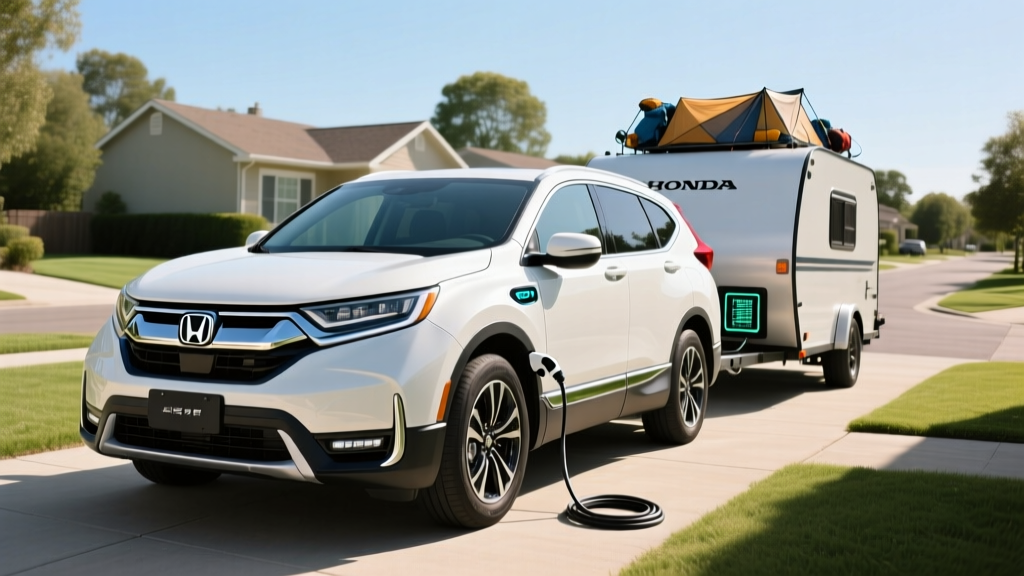
If you're researching the Honda CR-V Hybrid towing capacity, the short answer is 1,000 pounds across all trims. That number won't move a large camper, but it covers small utility trailers, a pair of dirt bikes, or a lightweight pop-up. What matters more for most buyers is how the CR-V Hybrid balances that towing figure with 40 MPG combined, standard all-wheel drive, and a proven two-motor hybrid system that requires no plug-in charging.
This guide covers the 2026 Honda CR-V Hybrid (the conventional HEV, not a plug-in) with exact EPA fuel economy figures, powertrain specs, real-world efficiency observations, battery warranty details, and how it compares to a PHEV or full EV for buyers weighing their options.
Towing Capacity and What You Can Actually Pull
Honda rates the 2026 CR-V Hybrid at 1,000 lbs maximum towing capacity when properly equipped. This applies to all three Hybrid trims: Sport, Sport-L, and Sport Touring. By contrast, the non-hybrid gas CR-V with the 1.5L turbo and AWD is rated for 1,500 lbs.
| Specification | CR-V Hybrid (AWD) | CR-V Gas (AWD 1.5T) |
|---|---|---|
| Max Towing Capacity | 1,000 lbs | 1,500 lbs |
| Combined Horsepower | 204 hp | 190 hp |
| Combined Torque | 247 lb-ft | 179 lb-ft |
| EPA Combined MPG | 40 MPG | 28 MPG |
| Drivetrain | AWD (standard) | AWD (optional) |
| Starting MSRP | $36,395 | $33,395 |
The hybrid's lower tow rating comes down to thermal management. The two-motor hybrid system generates additional heat under sustained heavy loads, and Honda conservatively limits the rating to protect the power electronics and battery. The 247 lb-ft of combined torque is actually higher than the gas model, so low-speed pulling feels strong — the limitation is sustained highway-grade towing, not initial acceleration.
What 1,000 lbs covers in practice:
- Small 4×8 utility trailer loaded with mulch or lumber (~800-1,000 lbs)
- Lightweight pop-up camper (many weigh 800-1,200 lbs — check your specific model)
- Two dirt bikes on a single-rail trailer (~700-900 lbs total)
- Small aluminum boat with trailer (~900-1,100 lbs — borderline)
What it does not cover: Any hard-sided travel trailer, most boat-and-trailer combinations over 14 feet, horse trailers, or car-hauler trailers. If you need 3,500+ lbs, you're looking at a midsize truck or a body-on-frame SUV.
Fuel Economy: EPA Ratings vs Real-World MPG
The 2026 CR-V Hybrid AWD carries an EPA rating of 40 MPG combined, split as 43 city / 36 highway. This is one of the more efficient compact hybrid SUVs on the market, and the city-heavy rating reflects how conventional hybrids recapture braking energy in stop-and-go driving.
| Driving Cycle | EPA Rating | Real-World Expectation |
|---|---|---|
| City | 43 MPG | 40–46 MPG (hybrids often exceed EPA in city) |
| Highway | 36 MPG | 33–38 MPG (depends on speed and terrain) |
| Combined | 40 MPG | 37–42 MPG (varies by driving mix) |
Real-world context: Conventional hybrids like the CR-V tend to beat their EPA city numbers in moderate-temperature, low-speed urban driving because regenerative braking is maximized. Highway efficiency drops because there's less regen opportunity and aerodynamic drag dominates. In cold weather (below 35°F), expect a 5–10% reduction across the board as the engine runs more frequently to provide cabin heat and maintain battery temperature.
For comparison, the gas-only CR-V AWD is rated at 28 MPG combined — a 12 MPG gap that translates to roughly $500–$700 per year in fuel savings at 15,000 miles annually and $3.50/gallon, depending on your local fuel prices.
Powertrain: How the Two-Motor Hybrid System Works
The CR-V Hybrid uses Honda's fourth-generation two-motor hybrid system, which operates primarily as a series hybrid at low speeds and switches to a parallel configuration at highway cruising. Here's the breakdown:
- Engine: 2.0L Atkinson-cycle 4-cylinder, 145 hp / 134 lb-ft
- Drive motor: 181 hp / 247 lb-ft (electric)
- Generator motor: Starts the engine, generates electricity, and smooths power delivery
- Combined system output: 204 hp / 247 lb-ft
- Transmission: Direct-drive (no traditional gearbox — the engine connects via a lock-up clutch at highway speed)
- Battery: ~1.06 kWh lithium-ion (small buffer, recharged by engine and regen)
Unlike a plug-in hybrid (PHEV), the CR-V Hybrid's battery is small and charges exclusively through regenerative braking and the gasoline engine. There is no charge port, no plug, and no electric-only driving range to manage. You fuel it like a normal car and the hybrid system handles the rest.
The driving feel is distinctly electric at low speeds — the drive motor provides instant torque from a stop, and the engine often stays off below ~45 mph unless you demand hard acceleration. At highway speeds, the lock-up clutch engages and the engine drives the wheels directly, which is more efficient than converting mechanical energy to electrical and back again.
HEV vs PHEV vs EV: Which Powertrain Fits You?
The CR-V Hybrid is a conventional hybrid (HEV). Honda does not currently offer a CR-V plug-in hybrid in the US market. Here's how the three electrified options compare for compact SUV buyers:
| Factor | HEV (CR-V Hybrid) | PHEV (e.g., Toyota RAV4 Prime) | BEV (e.g., Hyundai Ioniq 5) |
|---|---|---|---|
| Plug-in charging? | No | Yes (Level 2, ~2.5 hrs) | Yes (Level 2 + DC fast) |
| Electric-only range | None (motor assists) | ~42 miles | 250–310 miles |
| Home charging needed? | No | Recommended | Essential |
| Fuel/energy cost per mile | ~$0.09 | ~$0.04 electric / $0.09 gas | ~$0.04–$0.06 |
| Federal tax credit (§30D) | Not eligible | Up to $7,500* | Up to $7,500* |
| Upfront price premium | +$1,500–$3,000 | +$5,000–$8,000 | +$5,000–$15,000 |
| Best for | No home charging, simplicity | Short commute + road trips | Home charging + low running cost |
Choose the CR-V Hybrid (HEV) if: You don't have access to home or workplace charging, you want better fuel economy without changing your fueling habits, and you prefer a lower purchase price. The hybrid premium over the gas model pays back in roughly 3–4 years for most drivers.
Choose a PHEV if: You have Level 2 charging at home, your daily commute is under 40 miles (covering most trips on electricity), but you still want gas-engine range for road trips without charging-network dependency.
Choose a BEV if: You have reliable home charging, you want the lowest per-mile energy cost and minimal maintenance, and your typical trips fall within the vehicle's range (or you're comfortable planning DC fast-charge stops on road trips).
Pricing, Trims, and Tax Credit Eligibility
The 2026 Honda CR-V Hybrid is offered in three trims, all with standard AWD:
- Sport: $36,395 MSRP (includes destination)
- Sport-L: $38,395 MSRP (adds leather-trimmed seats, power liftgate)
- Sport Touring: $41,395 MSRP (adds navigation, Bose audio, wireless CarPlay/Android Auto, heated rear seats)
Federal Tax Credit Status
The conventional CR-V Hybrid does not qualify for the IRS §30D Clean Vehicle Credit. That credit applies only to plug-in electric vehicles (PHEVs and BEVs) with sufficient battery capacity and compliant battery sourcing. The CR-V Hybrid's ~1 kWh battery falls well below the §30D threshold.
Some states offer separate hybrid incentives — check your state energy office or IRS §30D guidelines for current rules. Eligibility for any plug-in credit depends on MSRP caps, buyer income limits, and battery mineral sourcing requirements that change annually.
Battery Warranty, Lifespan, and Replacement Cost
Hybrid battery longevity is consistently a top concern for first-time hybrid buyers. Honda covers the CR-V Hybrid's battery pack with a 8-year / 100,000-mile warranty (extended to 10 years / 150,000 miles in California Air Resources Board states, which include CA, CO, CT, ME, MD, MA, NJ, NY, OR, RI, VT, WA, and others adopting CARB standards).
The warranty guarantees the battery will retain sufficient capacity to operate the hybrid system as designed. In practice, Honda's lithium-ion hybrid batteries have shown strong longevity. Because the battery is small (~1 kWh) and the system keeps it within a narrow state-of-charge window (never fully charging or fully depleting it), degradation is minimal. Many Honda hybrid owners report no meaningful battery capacity loss at 150,000+ miles.
Out-of-warranty replacement cost: If the hybrid battery does require replacement beyond the warranty period, expect $2,500–$4,500 for a new OEM pack including labor. Refurbished packs are available for $1,500–$2,500. This is significantly less than a full EV battery replacement because the pack is much smaller.
For context, fueleconomy.gov lists the CR-V Hybrid with an annual fuel cost of approximately $1,350 at 15,000 miles per year, compared to $1,950 for the gas AWD model — a $600/year savings that more than offsets the hybrid premium over a typical ownership period.
Real-World Ownership: What to Expect
Beyond the spec sheet, here's what matters in daily use:
No behavior change required. You never plug it in. The hybrid system manages battery charge automatically. You drive it, fuel it, and service it like any other car. Maintenance intervals are identical to the gas CR-V — the hybrid system has no user-serviceable components.
Towing reduces fuel economy significantly. Expect 20–25 MPG when towing near the 1,000-lb limit, depending on trailer aerodynamics and terrain. The hybrid system still provides a benefit over the gas model under tow because the electric motor handles low-speed load, but the advantage narrows at highway speed.
Cold-weather fuel economy drops. In sustained sub-freezing temperatures, the engine runs more often for cabin heat and battery warmth. Expect 34–37 MPG combined in winter vs. 40+ in moderate temperatures. This is normal for all hybrids and is less severe than the range loss experienced by full EVs in cold weather.
Cargo and interior space are unchanged. The hybrid battery is packaged under the cargo floor and does not reduce cargo volume. The CR-V Hybrid offers 36.3 cu ft behind the rear seats and 76.5 cu ft with seats folded — identical to the gas model.
Pros
- 40 MPG combined with no plug-in charging required
- 247 lb-ft torque gives confident low-speed acceleration
- Standard AWD on all hybrid trims
- Proven hybrid system with strong battery longevity track record
- 8-yr/100,000-mi battery warranty (10 yr in CARB states)
- Same cargo volume as gas model
Cons
- 1,000-lb tow rating limits utility (gas model rated for 1,500 lbs)
- No federal tax credit eligibility
- Hybrid trims start $3,000 higher than gas equivalents
- Highway MPG (36) lags city (43) — less benefit for highway-heavy commuters
- No plug-in hybrid CR-V option in the US
Frequently Asked Questions
Can the Honda CR-V Hybrid tow a small camper trailer?
It depends on the camper's weight. The CR-V Hybrid is rated for 1,000 lbs. Many lightweight pop-up campers weigh 800–1,200 lbs, so some will fall within the limit and others will not. Check your specific trailer's GVWR (gross vehicle weight rating) and loaded tongue weight. Hard-sided travel trailers almost always exceed 1,000 lbs and are not compatible.
How many MPG does the CR-V Hybrid actually get?
The EPA rates it at 43 city / 36 highway / 40 combined. Real-world results vary: many owners report 42–46 MPG in city driving and 33–37 on the highway. Cold weather and towing reduce these figures. Over a full tank of mixed driving, 38–42 MPG is typical.
Does the CR-V Hybrid need to be plugged in?
No. The CR-V Hybrid is a conventional HEV (hybrid electric vehicle), not a plug-in. It has no charge port. The battery recharges through regenerative braking and the gasoline engine. You fuel it at a gas station like any other car.
Is the CR-V Hybrid reliable?
Honda's two-motor hybrid system has been in production since 2014 (Accord Hybrid) and is now in its fourth generation. It is widely regarded as one of the more reliable hybrid systems on the market. The battery carries an 8-year/100,000-mile warranty (10 years in CARB states), and real-world data shows these batteries routinely last 150,000+ miles without significant degradation.
Does the CR-V Hybrid qualify for any tax credit?
Not the federal §30D Clean Vehicle Credit — that applies only to plug-in vehicles (PHEVs and BEVs). Some states or local utilities offer hybrid purchase incentives or reduced registration fees, but these vary by jurisdiction. Check your state energy office for current programs. Per IRS guidelines, only vehicles with plug-in capability and sufficient battery capacity qualify for the federal credit.
What is the CR-V Hybrid battery replacement cost?
Out-of-warranty replacement runs $2,500–$4,500 for a new OEM battery pack with labor. Refurbished options are available for $1,500–$2,500. However, given the narrow state-of-charge operating window and Honda's track record, most owners never need a replacement during typical ownership.
Should I get the CR-V Hybrid or the gas model?
If you drive 12,000+ miles per year in mixed or city-heavy conditions, the Hybrid's $3,000 premium pays back in roughly 3–4 years through fuel savings, and you get more torque, standard AWD, and a quieter low-speed driving experience. If you primarily drive highway miles at sustained speed, tow frequently near the 1,500-lb gas model limit, or plan to keep the vehicle under 3 years, the gas model may make more financial sense.
For buyers who need more than 1,000 lbs of towing, Honda's hybrid system isn't the answer — consider a body-on-frame SUV or midsize truck. But for the vast majority of compact SUV buyers who tow occasionally and commute daily, the CR-V Hybrid's 40 MPG combined, proven reliability, and zero-change ownership experience make it one of the strongest hybrid options in its segment. Check fueleconomy.gov for the latest official efficiency data and compare it directly against competitors.