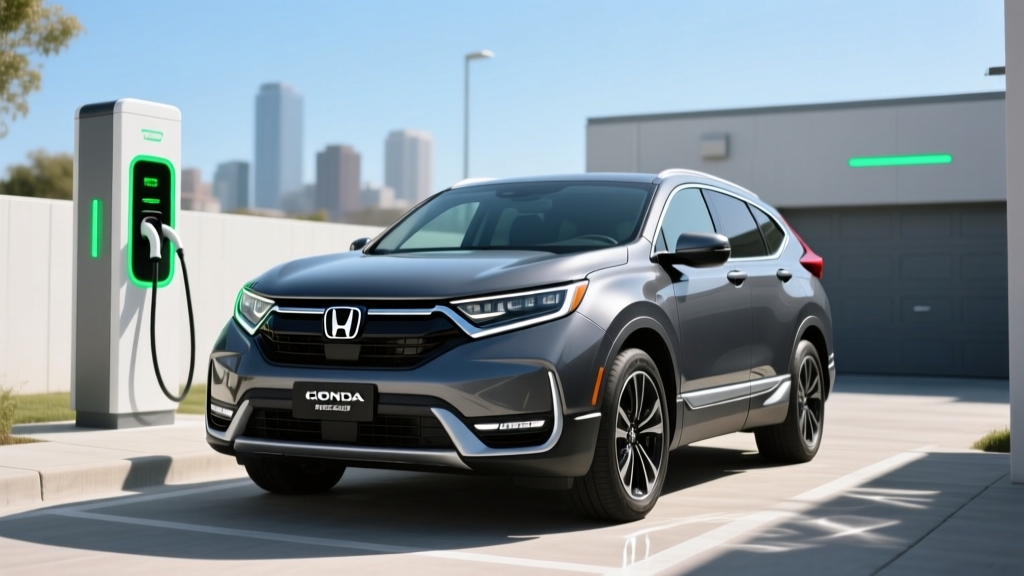
If you're shopping for a compact SUV and have your eye on the Honda CR-V, you've likely noticed it's offered in three flavors: a traditional gas model, a conventional hybrid (HEV), and—new for the current generation—a plug-in hybrid (PHEV). The big question many buyers ask: does a Honda CR-V Hybrid qualify for a tax credit?
The short answer depends entirely on which version you choose. The conventional CR-V Hybrid (HEV) does not qualify for any federal purchase tax credit. The CR-V Plug-In Hybrid (PHEV), however, may qualify for up to $7,500 under IRS §30D—provided you meet income, MSRP, and battery-sourcing requirements. Let's unpack exactly how this works, what the real-world numbers look like, and which CR-V powertrain actually makes financial sense in 2026.
HEV vs PHEV: Understanding the Two CR-V Hybrid Options
Before we tackle tax-credit eligibility, it's critical to understand the difference between Honda's two electrified CR-V models, because the IRS treats them very differently.
Conventional Hybrid (HEV) — CR-V Hybrid
How it works: A small battery (typically ~1.1 kWh) is recharged by the gasoline engine and regenerative braking. You never plug it in. The electric motor assists the engine to boost fuel economy.
Tax credit: Does NOT qualify for the federal §30D credit. It is not a plug-in vehicle.
Plug-In Hybrid (PHEV) — CR-V Plug-In Hybrid
How it works: A larger battery (~17–18 kWh usable) can be charged from a wall outlet or charging station, providing a meaningful electric-only driving range before the gas engine kicks in.
Tax credit: MAY qualify for up to $7,500 under §30D if all eligibility criteria are met.
This distinction is where many buyers get tripped up. Dealers may advertise "CR-V Hybrid" broadly, but only the plug-in variant has any pathway to federal incentive money.
Federal Tax Credit Eligibility: The §30D Rules for 2026
The federal clean vehicle credit under IRS §30D applies to new plug-in electric vehicles and fuel-cell vehicles. Conventional hybrids (HEVs) that cannot be plugged in are categorically excluded.
2026 §30D Requirements for the CR-V Plug-In Hybrid
- MSRP cap: SUVs must have an MSRP at or below $80,000. All current CR-V PHEV trims clear this threshold.
- Buyer income cap: Modified adjusted gross income (MAGI) must not exceed $150,000 (single), $225,000 (head of household), or $300,000 (joint filers).
- Battery sourcing: A percentage of critical minerals and battery components must be sourced from the U.S. or free-trade-agreement partners. These thresholds increase annually, and mid-year changes can affect eligibility.
- Point-of-sale transfer: Eligible buyers can transfer the credit to the dealer at purchase, reducing the purchase price directly rather than waiting for a tax refund.
- Final assembly: Vehicle must undergo final assembly in North America. Honda's Indiana plant assembles many CR-V models, but verify the specific VIN using the NHTSA VIN decoder.
Important: Tax-credit eligibility for specific PHEV models can change mid-year as battery-sourcing rules tighten. Always verify with your tax professional and check the IRS's current eligible-vehicle list before purchasing.
Bottom line on the conventional CR-V Hybrid: It does not qualify for the §30D federal tax credit. No exceptions. It is not a plug-in vehicle, and the IRS credit is exclusively for plug-in electric and fuel-cell vehicles.
Fuel Economy: EPA MPG and Real-World Numbers
Whether you're considering the HEV or PHEV, fuel economy is likely a top priority. Here's how the 2026 Honda CR-V Hybrid lineup stacks up, based on EPA data.
| Model | City MPG | Highway MPG | Combined MPG | Electric-Only Range |
|---|---|---|---|---|
| CR-V Hybrid (HEV) AWD | 40 | 34 | 37 | N/A |
| CR-V Plug-In Hybrid (PHEV) FWD | — | — | ~39 (charge-sustaining) | ~34 miles |
| CR-V Gas (AWD, baseline) | 27 | 32 | 29 | N/A |
Real-World MPG vs. EPA Sticker
One of the pleasant surprises with conventional hybrids is that they often exceed their EPA city rating in real-world stop-and-go driving. That's because city driving maximizes regenerative braking and electric-motor assist. In our experience and owner reports, the CR-V Hybrid (HEV) can deliver 38–42 MPG in mixed city driving, particularly in warm weather. Highway driving at sustained 70+ mph is where hybrids lose their advantage—expect closer to 32–34 MPG on long interstate trips.
For the PHEV, the 34-mile electric-only range is ideal for daily commutes under 30 miles. If you charge nightly at home, you may go weeks without visiting a gas station. Once the battery is depleted, the PHEV operates as a conventional hybrid with roughly 38–39 MPG combined in charge-sustaining mode.
Powertrain Specs: What's Under the Hood
| Specification | CR-V Hybrid (HEV) | CR-V Plug-In Hybrid (PHEV) |
|---|---|---|
| Engine | 2.0L Atkinson-cycle 4-cyl | 2.0L Atkinson-cycle 4-cyl |
| Combined System Horsepower | 204 hp | ~204–212 hp |
| Electric Motor | Dual-motor (drive + generator) | Dual-motor (drive + generator) |
| Battery (usable) | ~1.1 kWh (Li-ion) | ~17.0 kWh (Li-ion) |
| Level 1 Charging (120V) | N/A | ~12–14 hours (0–100%) |
| Level 2 Charging (240V) | N/A | ~2.5–3 hours (0–100%) |
| DC Fast Charging | N/A | Not available |
| Drivetrain | AWD (standard) | FWD (standard) |
| 0–60 mph (est.) | ~7.6 sec | ~7.5 sec |
A notable trade-off: the CR-V PHEV is currently offered in front-wheel drive only, while the conventional CR-V Hybrid comes standard with all-wheel drive. If you live in a snowy climate or need the traction, this may influence your decision.
Battery Warranty, Reliability, and Replacement Cost
Hybrid battery longevity remains one of the most common concerns among buyers transitioning from a conventional gas vehicle. Here's what Honda provides:
Honda Hybrid Battery Warranty
- HEV battery: 8 years / 100,000 miles (10 years / 150,000 miles in CARB states including CA, NY, MA, and others)
- PHEV battery: 8 years / 100,000 miles (10 years / 150,000 miles in CARB states)
- Warranty coverage: Covers battery capacity loss below a defined threshold (typically ~70% state of health) and defects
How Long Do Honda Hybrid Batteries Actually Last?
Honda's hybrid systems, particularly the two-motor e:HEV architecture, have proven quite durable in real-world use. Owner reports and reliability data suggest that Honda hybrid batteries routinely last 150,000–200,000+ miles before significant degradation. The CR-V Hybrid has been on sale globally for several years, and large-scale battery failure reports are rare.
Should you need an out-of-warranty replacement, expect a cost in the range of $2,000–$4,000 for the HEV battery pack, and potentially $6,000–$9,000 for the larger PHEV battery. Refurbished and third-party replacement options are increasingly available at lower prices. For context, a hybrid battery replacement is roughly comparable to a transmission replacement on a conventional vehicle—something most owners never need.
Pricing Breakdown: MSRP and True Cost After Credits
| Trim / Model | Approx. MSRP (2026) | Federal Tax Credit | Effective Price |
|---|---|---|---|
| CR-V Hybrid Sport (AWD) | ~$36,000 | $0 | ~$36,000 |
| CR-V Hybrid Sport Touring (AWD) | ~$41,000 | $0 | ~$41,000 |
| CR-V Plug-In Hybrid (FWD) | ~$42,000–$45,000 | Up to $7,500* | ~$34,500–$37,500* |
*Tax credit eligibility depends on buyer income, battery sourcing, and final assembly requirements. Verify with your tax professional and the current IRS eligible vehicle list before purchasing.
When the PHEV qualifies for the full $7,500 credit, its effective price can undercut the fully loaded CR-V Hybrid Sport Touring—while offering electric-only commuting and a smoother, quieter daily drive. This is the scenario where the PHEV becomes the clear financial winner.
Advantages of the CR-V Hybrid (HEV)
- Standard AWD — better in snow and rain
- No charging needed — fill up and go
- Lower starting MSRP on base trims
- Proven long-term reliability track record
- 37 MPG combined without any behavior change
Advantages of the CR-V Plug-In Hybrid (PHEV)
- Potential $7,500 federal tax credit
- ~34 miles of electric-only driving for commutes
- Significantly lower fuel cost if charging at home
- Smoother, quieter electric-first driving experience
- Can still road-trip with no range anxiety
CR-V Hybrid vs. PHEV vs. Full EV: Which Is Right for You?
The CR-V lineup covers three distinct use cases. Here's a practical decision framework:
Choose the CR-V Hybrid (HEV) if:
- You need AWD for snow, mountains, or unpaved roads
- You cannot charge at home (apartment, street parking, no garage)
- You want maximum simplicity with no plug-in routine
- Your budget is under $40,000 and you want a well-equipped AWD SUV
Choose the CR-V Plug-In Hybrid (PHEV) if:
- Your daily commute is under 35 miles round-trip
- You can install a Level 2 charger at home (240V outlet or hardwired)
- You qualify for the §30D tax credit based on income and sourcing
- You want EV-like daily driving with a gas backup for road trips
Choose a Full EV (like the Honda Prologue or Tesla Model Y) if:
- You want zero gasoline expenses and minimal maintenance
- You have reliable home charging and access to DC fast-charging networks
- You want the full $7,500 credit with fewer sourcing restrictions (varies by model)
- Your typical trips fall within 250–300 miles, or you're comfortable planning charging stops
Frequently Asked Questions
Does the conventional Honda CR-V Hybrid qualify for any federal tax credit?
No. The conventional CR-V Hybrid (HEV) does not qualify for the federal §30D clean vehicle credit. This credit is exclusively available for plug-in electric vehicles and fuel-cell vehicles. The HEV has no plug and cannot be charged externally, making it ineligible regardless of price or income.
Does the Honda CR-V Plug-In Hybrid qualify for the $7,500 tax credit?
It may, depending on several factors. The CR-V PHEV must meet battery-sourcing requirements (critical minerals and components from the U.S. or FTA partners), the buyer must fall under income caps ($150K single / $300K joint), and the vehicle's MSRP must be at or below $80,000 (which it is). Eligibility can change mid-year, so verify the specific VIN and current IRS guidance before committing.
How many MPG does the Honda CR-V Hybrid get in real-world driving?
The EPA rates the CR-V Hybrid AWD at 40 city / 34 highway / 37 combined. In real-world driving, many owners report 38–42 MPG in city and suburban conditions where regenerative braking is maximized. Highway-only driving at 75+ mph may yield 31–34 MPG. Cold weather can reduce efficiency by 5–10%.
How far can the CR-V Plug-In Hybrid go on electric power alone?
The CR-V PHEV delivers approximately 34 miles of electric-only range on a full charge, enough for most daily commutes. After the battery is depleted, it operates as a conventional hybrid with roughly 38–39 MPG combined.
Can the CR-V Plug-In Hybrid use DC fast chargers?
No. The CR-V PHEV supports Level 1 (120V) and Level 2 (240V) AC charging only. A full charge on Level 2 takes approximately 2.5–3 hours. Most PHEV owners charge overnight at home, which is sufficient given the relatively small battery.
Is the Honda CR-V Hybrid reliable, and what does a battery replacement cost?
Honda's hybrid powertrain has a strong reliability record. The hybrid battery is warrantied for 8 years/100,000 miles (10 years/150,000 miles in CARB states). Out-of-warranty HEV battery replacement costs approximately $2,000–$4,000; PHEV battery replacement is estimated at $6,000–$9,000. Most hybrid batteries last well beyond 150,000 miles.
Are there any state incentives for the CR-V Hybrid?
Some states offer rebates or incentives for hybrid vehicles, though most state-level EV programs focus on plug-in vehicles. A few states provide reduced registration fees or HOV-lane access for hybrids. Check your state's energy or environmental agency website for current programs, as these vary widely and change frequently.
Disclaimer: Federal tax-credit rules under §30D are subject to change. Battery-sourcing thresholds tighten annually, and specific vehicle eligibility can shift mid-year. Always confirm current eligibility via the IRS website and consult a qualified tax professional before making a purchase decision. MSRP figures are approximate and may vary by dealer and model year.