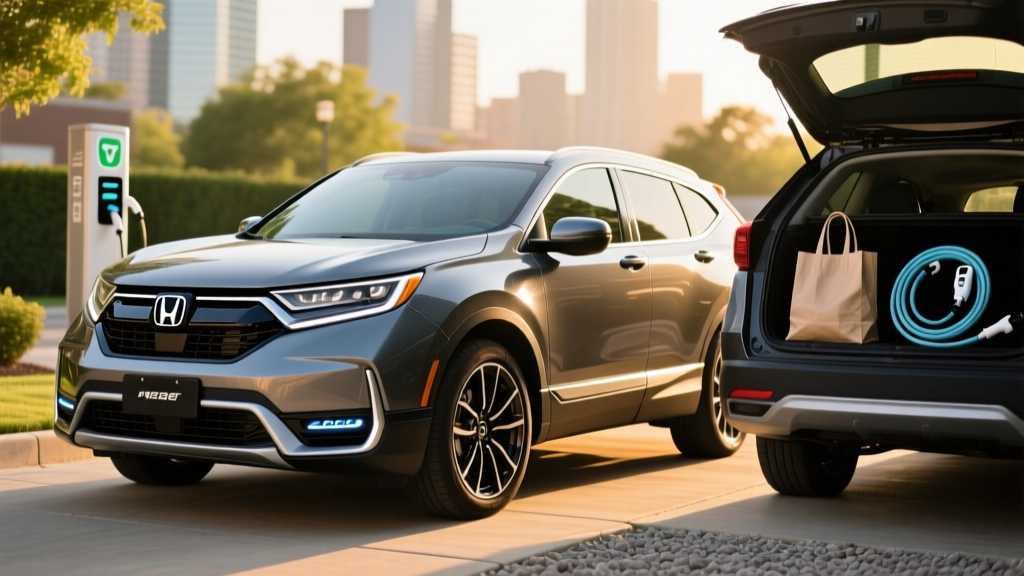
The Honda CR-V has long been the compact SUV benchmark, and the Hybrid Sport trim sits in a sweet spot that many buyers overlook. It pairs a proven two-motor hybrid system with sport-tuned styling and standard all-wheel drive — all without requiring a single plug. For 2026, the CR-V Hybrid Sport continues with the sixth-generation platform that debuted for 2023, now fully matured with real-world reliability data and a clear ownership proposition.
If you're researching the CR-V Hybrid Sport, you're likely weighing it against plug-in hybrids like the Toyota RAV4 Prime or full EVs like the Hyundai Ioniq 5. This guide breaks down exactly what the Hybrid Sport delivers — and where it falls short — so you can decide whether a conventional hybrid, a PHEV, or a battery-electric vehicle is your best move.
CR-V Hybrid Sport at a Glance: Key Specs
| Specification | 2026 Honda CR-V Hybrid Sport |
|---|---|
| Powertrain Type | Conventional Hybrid (HEV) — no plug required |
| Engine | 2.0L Atkinson-cycle 4-cylinder + dual electric motors |
| Combined Horsepower | 204 hp (146 hp engine + 181 hp drive motor) |
| Combined Torque | 247 lb-ft (electric motor peak) |
| Drivetrain | AWD standard (rear-mounted electric motor) |
| Transmission | Direct-drive (no traditional gearbox) |
| EPA MPG (City / Hwy / Combined) | 40 / 34 / 37 |
| Fuel Tank Capacity | 14.0 gallons |
| Total Driving Range | ~518 miles (EPA combined) |
| 0–60 mph | ~7.6 seconds |
| Cargo Volume (behind 2nd row) | 36.3 cu ft |
| Towing Capacity | 1,000 lbs |
| Base MSRP | $37,295 (including destination) |
| Hybrid Battery Warranty | 8 years / 100,000 miles |
Fuel Economy: EPA Ratings vs. Real-World MPG
The EPA rates the 2026 CR-V Hybrid Sport AWD at 40 mpg city, 34 mpg highway, and 37 mpg combined. These figures come from fueleconomy.gov and reflect the AWD configuration standard on the Hybrid Sport.
| Driving Scenario | EPA Rating | Real-World Expectation |
|---|---|---|
| City | 40 MPG | 38–44 MPG (hybrids often exceed EPA in stop-and-go) |
| Highway (70 mph) | 34 MPG | 30–33 MPG (aero drag reduces hybrid advantage) |
| Combined | 37 MPG | 34–39 MPG (varies with driving mix) |
| Cold Weather (below 32°F) | Not rated | 30–34 MPG combined (engine runs more for cabin heat) |
Conventional hybrids like the CR-V shine in city driving, where regenerative braking and electric-only low-speed operation cut fuel use dramatically. On long highway stretches, the advantage narrows because the gasoline engine does most of the work at sustained speeds. In real-world mixed driving, expect to land between 34 and 39 mpg combined — right around the EPA figure. Heavy-footed drivers or those in mountainous terrain may see the low 30s.
One ownership advantage worth noting: the CR-V Hybrid uses a direct-drive system rather than a traditional CVT or geared transmission. This means smooth, linear acceleration with no shift shock — and fewer mechanical components to maintain over the vehicle's life.
HEV vs. PHEV vs. EV: Which Powertrain Fits You?
A common question when shopping the CR-V lineup is whether the Hybrid Sport (a conventional HEV) is enough — or whether you should look at a plug-in hybrid or a full battery-electric vehicle. Here's a clear breakdown:
| Factor | HEV (CR-V Hybrid Sport) | PHEV (e.g., RAV4 Prime) | BEV (e.g., Ioniq 5) |
|---|---|---|---|
| Plug-in Required? | No | Yes (for EV range) | Yes |
| Electric-Only Range | ~1 mile at low speed | 35–42 miles typical | 250–320+ miles |
| Fuel/Energy Cost | Gasoline only | Electricity + gasoline | Electricity only |
| Home Charging Needed? | No | Strongly recommended | Essential |
| Federal Tax Credit (§30D) | Not eligible | Up to $7,500 (if sourcing/income rules met) | Up to $7,500 (if sourcing/income rules met) |
| Upfront Price Premium | Low (~$1,500 over gas model) | High (~$7,000–$10,000 over gas) | Highest (varies widely) |
| Best For | No home charging access; want simplicity | Home charging + short commutes | Home charging + commitment to electric |
Choose the CR-V Hybrid Sport (HEV) if: You don't have access to home or workplace charging, you want a lower upfront cost, and you're satisfied with strong fuel economy without changing your refueling habits. The Hybrid Sport works exactly like a gas car — you fill it at the station and go — but you'll visit that station significantly less often.
Look at a PHEV instead if: You can install a Level 2 charger at home, your daily commute is under 40 miles round-trip, and you want to drive mostly on electricity while keeping a gas engine for road trips. The Toyota RAV4 Prime or the Hyundai Tucson PHEV are the CR-V Hybrid's closest plug-in competitors.
Consider a full EV if: You have reliable home charging, your daily driving is under 250 miles, and you want to eliminate gasoline entirely. The Hyundai Ioniq 5, Tesla Model Y, and Ford Mustang Mach-E are the CR-V's electric alternatives in this size class.
Powertrain Deep Dive: How the CR-V Hybrid System Works
The CR-V Hybrid Sport uses Honda's fourth-generation two-motor hybrid system. Here's how it functions in practice:
- At low speeds and from a stop: The vehicle runs primarily on the electric drive motor, drawing from a small lithium-ion battery pack (~1.1 kWh usable). This delivers instant torque and silent operation in parking lots and city traffic.
- During acceleration: Both the 2.0L engine and the electric motor work together, combining for 204 hp and a muscular 247 lb-ft of torque from the electric motor. The result is confident merging and passing.
- At steady highway speeds: The gasoline engine directly drives the front wheels via a lock-up clutch, operating in its most efficient range. The electric motor assists as needed.
- During braking and deceleration: Regenerative braking captures kinetic energy and sends it back to the battery. The steering-wheel paddles let you select from three regen levels, though the CR-V does not offer true one-pedal driving like a full EV.
The AWD system uses a rear-mounted electric motor that engages automatically when front-wheel slip is detected or when extra traction is needed. Unlike mechanical AWD systems with a driveshaft, this setup adds minimal weight and parasitic loss — which is why the AWD Hybrid Sport only loses about 3 mpg combined versus its FWD sibling.
Pricing, Trims, and Tax Credit Eligibility
The 2026 Honda CR-V Hybrid Sport starts at $37,295 including destination. Honda positions the Hybrid Sport as the sport-appearance value trim, with the Hybrid Sport-L and Hybrid Sport Touring sitting above it:
| Trim | MSRP (AWD) | Key Additions |
|---|---|---|
| Hybrid Sport | $37,295 | Blacked-out accents, 18" wheels, 9" touchscreen, wireless CarPlay/Android Auto, heated front seats |
| Hybrid Sport-L | $39,995 | Leather-trimmed seats, power liftgate, wireless phone charger |
| Hybrid Sport Touring | $43,295 | Bose 12-speaker audio, panoramic moonroof, heated rear seats, navigation, Honda Sensing 2.0 enhancements |
Federal Tax Credit Status
The CR-V Hybrid Sport is a conventional hybrid (HEV), which means it does not qualify for the federal §30D clean vehicle tax credit. That credit — up to $7,500 — applies only to plug-in electric vehicles (PHEVs and BEVs) that meet battery sourcing, MSRP cap, and buyer income requirements per current IRS rules.
Tax credit bottom line: The CR-V Hybrid Sport is ineligible for the federal EV tax credit. Some states offer hybrid-specific rebates or HOV lane access — check your state's energy office or AFDC state incentive database for current programs. Tax rules change frequently; consult a tax professional before making purchase decisions based on incentive eligibility.
Battery Warranty, Reliability, and Replacement Costs
Honda Hybrid Battery Warranty: 8 years or 100,000 miles (whichever comes first). In California Air Resources Board (CARB) states, coverage extends to 10 years / 150,000 miles. This warranty covers defects and capacity loss below a functional threshold — typically defined as the battery's inability to hold sufficient charge to operate the hybrid system.
How Long Will the Hybrid Battery Last?
Honda's hybrid battery packs in the CR-V are small (~1.1 kWh usable) and operate within a narrow state-of-charge window — typically between 40% and 80%. This shallow cycling is far less stressful on lithium-ion cells than the deep cycles in a full EV, which is why hybrid batteries routinely last 150,000–200,000+ miles before needing replacement.
Real-world data from Honda's previous-generation hybrids (Accord Hybrid, Insight) supports this: widespread battery failures before 100,000 miles are rare. The sixth-generation CR-V Hybrid has been on sale since 2023, and as of 2026, there are no widespread reports of premature battery degradation.
Battery Replacement Cost
If the hybrid battery does need replacement out of warranty, expect to pay between $2,000 and $4,000 for a new OEM pack including labor. This is significantly less than a full EV battery replacement ($10,000–$20,000+), because the CR-V's hybrid battery is small and modular. Third-party refurbished packs may be available for $1,200–$2,500 as the platform ages.
Overall Reliability
Honda's hybrid powertrain has earned strong reliability marks. The 2.0L Atkinson-cycle engine is naturally aspirated (no turbo), reducing complexity. The direct-drive system eliminates the conventional transmission — one of the most failure-prone components in any vehicle. IIHS ratings and NHTSA data should be checked for the latest crash-test and reliability scores as they're published for the 2026 model year.
Driving Impressions and Practical Ownership
The CR-V Hybrid Sport drives like a well-sorted compact SUV with an efficiency bonus. The 204-hp combined output is adequate for daily driving — highway merging is confident, and the electric motor's instant torque makes the CR-V feel quicker than its 7.6-second 0–60 time suggests around town. The sport-tuned suspension on the Hybrid Sport is slightly firmer than the gas-only CR-V trims, giving it composed handling without harshness.
On the practical side, the Hybrid Sport offers the same 36.3 cu ft of cargo space behind the second row as the gas CR-V — no battery-pack intrusion into the load floor. The 14.0-gallon fuel tank yields over 500 miles of total range, meaning fuel stops on road trips are infrequent. However, the 1,000-lb towing capacity is modest; if you need to tow a small trailer, the gas-only CR-V (1,500 lbs) or a body-on-frame SUV is a better fit.
The Honda Sensing suite (adaptive cruise control, lane-keeping assist, automatic emergency braking, traffic sign recognition) is standard across all trims. This is an SAE Level 2 driver-assistance system — it does not drive the car for you. You must keep your hands on the wheel and eyes on the road at all times.
Pros and Cons
Pros
- 40 mpg city — excellent for a compact AWD SUV
- No plug required; zero change to refueling habits
- Standard AWD with no significant MPG penalty
- Strong cargo space (36.3 cu ft) — no hybrid compromise
- 8-year/100,000-mile hybrid battery warranty
- Proven Honda reliability with simple powertrain design
- Sport styling differentiates from rental-lot CR-Vs
Cons
- No federal tax credit eligibility (HEV, not PHEV/BEV)
- Highway MPG drops to ~30–33 in real-world 70+ mph driving
- Only 1,000-lb towing capacity
- No true one-pedal driving mode
- Base price ~$4,000 more than equivalent gas-only CR-V EX
- Cabin noise under hard acceleration (engine drone)
Frequently Asked Questions
How many MPG does the CR-V Hybrid Sport get?
The EPA rates the 2026 CR-V Hybrid Sport AWD at 40 mpg city, 34 mpg highway, and 37 mpg combined. In real-world mixed driving, most owners report 34–39 mpg combined. City driving tends to exceed the EPA estimate thanks to regenerative braking; sustained highway driving at 70+ mph typically falls below it.
Does the CR-V Hybrid Sport need to be plugged in?
No. The CR-V Hybrid Sport is a conventional hybrid (HEV). It charges its small battery pack through regenerative braking and the gasoline engine. You never plug it in — you simply refuel at a gas station like any other car.
Does the CR-V Hybrid Sport qualify for a tax credit?
No. The federal §30D clean vehicle credit applies only to plug-in vehicles (PHEVs and BEVs). The CR-V Hybrid Sport is a conventional hybrid and is not eligible. Some state-level incentives may apply — check your state's energy office for current programs.
How long will the CR-V Hybrid battery last?
Honda covers the hybrid battery for 8 years / 100,000 miles (10 years / 150,000 miles in CARB states). Based on Honda's track record with previous hybrid models, these batteries typically last 150,000–200,000+ miles before significant degradation. The shallow charge-discharge cycles in a hybrid are far gentler on lithium-ion cells than the deep cycles in a full EV.
What does a CR-V Hybrid battery replacement cost?
Out-of-warranty replacement runs approximately $2,000–$4,000 for a new OEM pack with labor. This is far less than a full EV battery replacement because the CR-V's hybrid battery is small (~1.1 kWh usable). Refurbished packs may become available at lower cost as the platform ages.
Hybrid vs. PHEV vs. EV — which should I choose?
Choose the CR-V Hybrid Sport (HEV) if you lack home charging access and want strong fuel economy with no lifestyle changes. Choose a PHEV (like the RAV4 Prime) if you can charge at home and want 35–42 miles of electric commuting with a gas backup. Choose a full EV (like the Ioniq 5 or Model Y) if you have home charging and want zero gasoline use with 250+ miles of range.
Is the CR-V Hybrid Sport good for road trips?
Yes. With a 14.0-gallon tank and 37 mpg combined, you can expect roughly 500+ miles between fill-ups. The AWD system handles rain and light snow confidently. The main limitation is the 1,000-lb towing capacity — if you're hauling a camper, you'll need a different vehicle.
The Verdict: Who Should Buy the CR-V Hybrid Sport?
The 2026 Honda CR-V Hybrid Sport is the right choice for buyers who want a practical, fuel-efficient compact SUV without the complexity or cost of a plug-in vehicle. Its 40 mpg city rating, standard AWD, and strong cargo utility make it one of the most sensible daily drivers in the segment. The lack of a federal tax credit stings compared to PHEV competitors, but the lower upfront price and zero charging-infrastructure requirements often offset that advantage over five years of ownership.
If you can charge at home and want to commute on electricity, a PHEV will save more on fuel. If you're ready to go fully electric, a BEV will eliminate gas entirely. But for the majority of SUV buyers who simply want to spend less at the pump without plugging in, the CR-V Hybrid Sport is among the best in its class — and it's built to last.