Quick Verdict: The 2026 Honda CR-V Hybrid Sport at a Glance
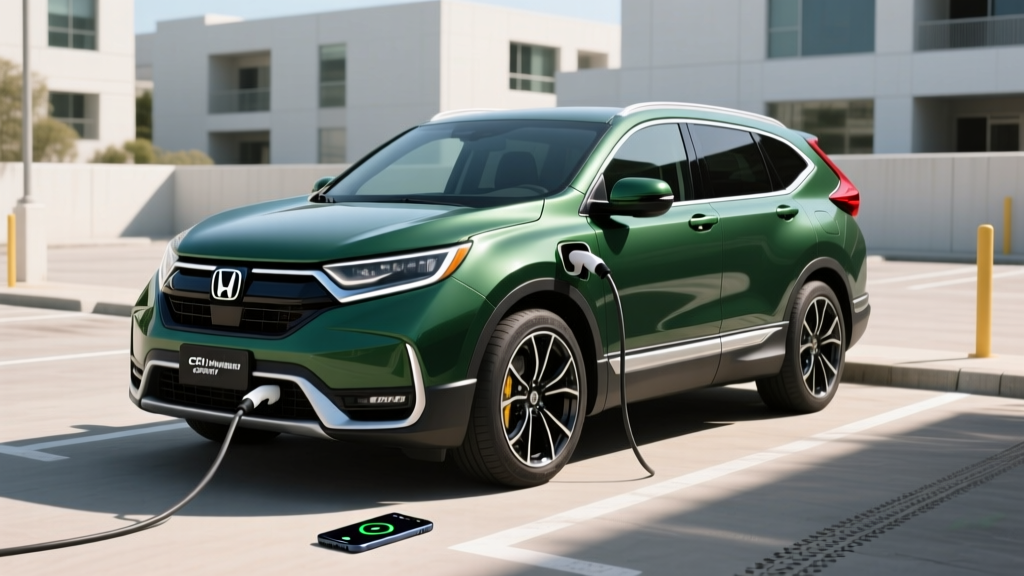
The 2026 Honda CR-V Hybrid Sport occupies a deliberate middle ground: it delivers meaningful fuel savings over a gas-only compact SUV without requiring you to plug in, change your driving habits, or worry about charging infrastructure. With an EPA-estimated 40 MPG combined and a 204-horsepower dual-motor hybrid powertrain, it is one of the most efficient vehicles in its class — and one of the few that actually tends to beat its EPA rating in real-world city driving.
This is a conventional hybrid (HEV), not a plug-in hybrid (PHEV). That distinction matters for buyers comparing it against the Toyota RAV4 Prime or Hyundai Tucson PHEV. You will never plug the CR-V Hybrid Sport into a wall. It generates and recovers all its own electricity through regenerative braking and its gasoline engine. If you want electric-only commuting, this is not the vehicle. If you want a set-it-and-forget-it efficiency upgrade over a gas SUV, it is one of the strongest options on the market.
| Spec | Value |
|---|---|
| Powertrain | 2.0L Atkinson-cycle 4-cyl + 2 electric motors (e-CVT) |
| Combined Horsepower | 204 hp |
| Combined Torque | 247 lb-ft (electric motor peak) |
| Drivetrain | AWD (standard on Sport Hybrid) |
| EPA MPG (City / Hwy / Combined) | 43 / 36 / 40 |
| Fuel Tank Capacity | 14.0 gallons |
| Total Driving Range | ~560 miles |
| 0–60 mph | ~7.8 seconds |
| Cargo Volume (rear seats up / down) | 36.3 / 76.5 cu ft |
| Hybrid Battery Warranty | 8 years / 100,000 miles |
| Base MSRP (AWD) | ~$37,500 (est.) |
HEV vs PHEV vs EV: Which Powertrain Fits You?
Before evaluating the CR-V Hybrid Sport's specifics, it helps to understand where it sits in the electrified-vehicle spectrum. Honda currently offers the CR-V as a conventional hybrid only in the U.S. — there is no CR-V plug-in hybrid variant stateside.
| Factor | HEV (CR-V Hybrid Sport) | PHEV (e.g., RAV4 Prime) | BEV (e.g., Ioniq 5) |
|---|---|---|---|
| Plug in required? | No | Yes (for EV range) | Yes (always) |
| Electric-only range | 0 miles (EV mode at low speed only) | 30–42 miles typical | 250–350+ miles |
| City MPG advantage | Strong (regen-heavy) | Excellent (electric-first) | N/A (MPGe only) |
| Highway efficiency | Moderate (engine-dominant) | Moderate once battery depleted | Good but drops at high speed |
| Home charging needed | No | Recommended (Level 2) | Essential (Level 2) |
| Upfront cost premium | $1,500–$2,500 over gas | $5,000–$8,000 over gas | $8,000–$15,000+ |
| Federal tax credit | Not eligible | Up to $7,500 (§30D) | Up to $7,500 (§30D) |
| Best for | No home charger, simplicity | Short commute + home charger | Home charger + daily EV driving |
The CR-V Hybrid Sport is the right choice if you lack access to home or workplace charging, want minimal complexity, and primarily drive a mix of city and highway miles. If you have a garage with a 240V outlet and a commute under 35 miles, a PHEV like the RAV4 Prime may save more fuel — but at a higher purchase price. If you have reliable home charging and want zero tailpipe emissions, a full BEV is the next step up.
Fuel Economy: EPA Ratings and Real-World MPG
The 2026 Honda CR-V Hybrid Sport carries EPA ratings of 43 MPG city, 36 MPG highway, and 40 MPG combined with standard all-wheel drive. These numbers are sourced from fueleconomy.gov and apply to the AWD Sport Hybrid trim.
| Driving Condition | EPA MPG | Real-World Expectation |
|---|---|---|
| City | 43 | 42–48 MPG (hybrids often exceed EPA in stop-and-go) |
| Highway (70 mph steady) | 36 | 33–37 MPG (engine runs more at sustained speed) |
| Combined | 40 | 38–44 MPG depending on route mix |
| Cold weather (below 30°F) | — | 34–38 MPG (engine runs longer for cabin heat) |
| Towing (1,000 lb max) | — | 25–30 MPG (significant drop under load) |
Why Hybrids Often Beat Their EPA City Rating
Conventional hybrids like the CR-V Sport benefit disproportionately from city driving. Every stop activates regenerative braking, which recovers kinetic energy and stores it in the hybrid battery. The electric motors then handle initial acceleration from a stop — the most fuel-intensive part of any drive cycle. In moderate-temperature city driving with frequent stops, owners regularly report 44–48 MPG, exceeding the 43 MPG EPA city figure.
Highway driving tells a different story. At sustained speeds above 65 mph, the gasoline engine does most of the work. The electric motors assist during passing maneuvers and gentle grades, but aerodynamic drag dominates. Expect 33–37 MPG on long interstate trips, which is still strong for a 3,600-pound AWD crossover but below the combined rating.
In cold weather, fuel economy drops noticeably. The 2.0L Atkinson-cycle engine must run longer to generate cabin heat (the CR-V Hybrid does not use a heat pump, unlike some full EVs). Expect a 10–15% reduction in winter months in northern climates.
Powertrain Deep Dive: How Honda's Two-Motor Hybrid Works
The CR-V Hybrid Sport uses Honda's fourth-generation two-motor hybrid system, pairing a 2.0-liter Atkinson-cycle four-cylinder engine with two electric motors mounted in the transmission housing. Combined output is 204 horsepower and 247 lb-ft of torque, routed to all four wheels through an electronically controlled continuously variable transmission (e-CVT).
Unlike Toyota's Hybrid Synergy Drive, which blends engine and motor power through a planetary gearset, Honda's system operates primarily in one of three modes:
- EV Drive: Battery powers the propulsion motor; engine is off. Used at low speeds and gentle acceleration (roughly 0–25 mph with light throttle).
- Hybrid Drive: Engine spins a generator motor that feeds electricity to the propulsion motor. The engine is not mechanically connected to the wheels. This covers most city and suburban driving.
- Engine Drive: A lock-up clutch mechanically connects the engine to the front wheels at highway cruising speeds (roughly 45–80 mph), where the engine operates at its most efficient RPM range.
The result is seamless operation that feels more like an EV in city driving than a traditional gasoline car. There are no fixed gear shifts. Acceleration from a stop is immediate thanks to electric motor torque, and the engine only audibly revs under hard acceleration demands.
The 0–60 mph time of approximately 7.8 seconds places the CR-V Hybrid Sport in the middle of its competitive set — quicker than the base gas CR-V but a full second behind the Toyota RAV4 Hybrid and well behind the RAV4 Prime's 5.7-second sprint.
Pricing, Trims, and Tax Credit Eligibility
The 2026 Honda CR-V Hybrid is available in three trims: Sport, Sport-L, and Sport Touring. All come standard with AWD.
- Sport Hybrid: ~$37,500 MSRP — 18-inch wheels, 9-inch touchscreen, wireless Apple CarPlay/Android Auto, heated front seats, Honda Sensing ADAS suite
- Sport-L Hybrid: ~$40,200 MSRP — leather-trimmed seats, power liftgate, wireless phone charging, heated steering wheel
- Sport Touring Hybrid: ~$43,500 MSRP — Bose 12-speaker audio, panoramic moonroof, ventilated front seats, hands-free liftgate, upgraded 19-inch wheels
Does the CR-V Hybrid Qualify for a Federal Tax Credit?
No. The conventional CR-V Hybrid Sport does not qualify for the federal §30D Clean Vehicle Credit. Under current IRS rules, only plug-in electric vehicles (PHEVs and BEVs) with a minimum battery capacity of 7 kWh and plug-in charging capability are eligible. A conventional HEV like the CR-V Hybrid, which charges its battery solely through regenerative braking and the onboard engine, does not meet this threshold.
Some states and utilities offer rebates or incentives for conventional hybrids, but these vary widely by jurisdiction. Check your state energy office or local utility for current programs. Do not rely on dealer assertions about credit eligibility — verify directly against IRS Publication 5984 and your tax professional.
Battery Longevity, Warranty, and Replacement Costs
The CR-V Hybrid Sport uses a lithium-ion hybrid battery pack positioned under the cargo floor. Unlike full EVs with 70–100 kWh batteries, the CR-V's hybrid battery is small — approximately 1.1 kWh of usable capacity. Its job is to buffer energy recovered from braking and supply short bursts of electric power, not to store long-range energy.
Honda Hybrid Battery Warranty
- Coverage: 8 years / 100,000 miles (whichever comes first)
- California-emissions states: 10 years / 150,000 miles in states that follow CARB standards (CA, CO, CT, DE, ME, MD, MA, NJ, NY, OR, RI, VT, WA)
- What's covered: Battery capacity loss below a manufacturer-defined threshold, cell/module failure, hybrid system components (inverter, electric motors, e-CVT)
- What's not covered: Damage from accidents, flooding, unauthorized modifications, or 12V auxiliary battery (covered under separate 3-year/36,000-mile warranty)
How Long Will the Hybrid Battery Actually Last?
Real-world data from Honda's previous-generation hybrid systems (Insight, Accord Hybrid, prior CR-V Hybrid) shows that lithium-ion hybrid batteries routinely last 150,000–200,000+ miles before significant degradation. Because the battery is small and the system never fully charges or fully depletes it (operating in a narrow state-of-charge window of roughly 40–60%), cell stress is minimal compared to a full EV battery.
The most common failure mode is gradual capacity loss over 10–15 years, which reduces the time the vehicle can spend in EV Drive mode but does not render the car undrivable. The engine simply runs more frequently.
Battery Replacement Cost
If the hybrid battery fails outside warranty, replacement costs typically range from $2,500 to $4,000 including parts and labor at a Honda dealer. Independent hybrid specialists may offer refurbished battery packs for $1,500–$2,500. This is substantially less than a full EV battery replacement ($8,000–$20,000+), which is one reason buyers choose conventional hybrids over BEVs for long-term cost predictability.
Reliability, Safety, and the Honda Sensing Suite
Honda's hybrid powertrain has a strong reliability track record. The two-motor system has fewer moving parts than a conventional automatic transmission (no torque converter, no multi-speed gearset), and the e-CVT design eliminates shift-related wear. IIHS and NHTSA ratings for the current-generation CR-V have consistently placed it among the top-rated compact SUVs for crash safety.
The Honda Sensing suite is standard on every CR-V Hybrid trim and includes:
- Adaptive Cruise Control with Low-Speed Follow
- Lane Keeping Assist and Road Departure Mitigation
- Collision Mitigation Braking System (forward AEB with pedestrian detection)
- Traffic Sign Recognition
- Blind Spot Information with Rear Cross Traffic Monitor (Sport-L and above)
Important clarity: Honda Sensing is an SAE Level 2 driver-assistance system. It can manage steering, acceleration, and braking simultaneously under certain conditions, but the driver must remain fully attentive with hands on the wheel at all times. This is not autonomous or self-driving capability.
Who Should Buy the 2026 CR-V Hybrid Sport — and Who Shouldn't
Choose the CR-V Hybrid Sport if:
- You do not have access to home or workplace charging
- Your driving is a mix of city and highway with no single dominant pattern
- You want fuel savings without changing any habits (no plugging in, no route planning)
- You value AWD for snow/rain climates without the efficiency penalty of a gas AWD SUV
- You plan to own the vehicle 8–12 years and want predictable long-term maintenance costs
Look elsewhere if:
- You have a short commute and home charging — a PHEV (RAV4 Prime, Tucson PHEV) would save more fuel on electric-only miles
- You want zero tailpipe emissions — consider a BEV like the Hyundai Ioniq 5 or Tesla Model Y
- You need maximum towing capacity — the CR-V Hybrid is rated for only 1,000 lbs; the gas CR-V manages 1,500 lbs, and a body-on-frame SUV far more
- You prioritize acceleration — the 7.8-second 0–60 time is adequate but not sporty; the RAV4 Prime does it in 5.7 seconds
Pros
- 40 MPG combined EPA — often exceeds in city driving
- Standard AWD across all hybrid trims
- Spacious cargo area (36.3 cu ft) with no battery intrusion
- Smooth, EV-like acceleration feel in city driving
- Strong reliability history; low battery replacement cost vs BEV
- Comprehensive Honda Sensing safety suite standard
Cons
- No federal tax credit eligibility (HEV, not PHEV)
- Highway MPG drops to 33–37 in real-world use
- 1,000-lb towing limit is class-lowest
- Cold-weather fuel economy drops 10–15% without a heat pump
- Engine drone under hard acceleration (e-CVT characteristic)
- Sport trim lacks premium features found in Sport Touring
Frequently Asked Questions
How many MPG does the 2026 Honda CR-V Hybrid Sport get?
The EPA rates it at 43 MPG city, 36 MPG highway, and 40 MPG combined. In real-world city driving with frequent stops, many owners report 44–48 MPG. Highway-only trips at 70+ mph tend to yield 33–37 MPG. Cold weather reduces these figures by roughly 10–15%.
Does the CR-V Hybrid need to be plugged in?
No. The CR-V Hybrid Sport is a conventional hybrid (HEV). Its battery recharges through regenerative braking and the gasoline engine. There is no plug, no charging cable, and no requirement for any charging infrastructure.
How far can the CR-V Hybrid drive on electric power alone?
Only very short distances at low speeds (typically under 1 mile below 25 mph with light throttle). The hybrid battery is too small (~1.1 kWh) to sustain meaningful electric-only driving. For electric-only commuting range, you need a PHEV or a full BEV.
Is the hybrid battery reliable, and what does replacement cost?
Honda's hybrid batteries have proven durable, commonly lasting 150,000–200,000+ miles. The battery is warrantied for 8 years/100,000 miles (10 years/150,000 miles in CARB states). Out-of-warranty replacement runs $2,500–$4,000 at a dealer, or $1,500–$2,500 through independent hybrid specialists.
Does the 2026 CR-V Hybrid qualify for any tax credits?
It does not qualify for the federal §30D Clean Vehicle Credit, which is limited to plug-in vehicles (PHEVs and BEVs). Some state or utility programs may offer hybrid incentives, but these vary by location. Check your state energy office for current offerings.
CR-V Hybrid Sport vs Sport-L vs Sport Touring — which trim?
The Sport (~$37,500) provides the best value with identical powertrain and MPG across all trims. The Sport-L (~$40,200) adds leather and a power liftgate. The Sport Touring (~$43,500) adds premium audio, ventilated seats, and a moonroof. Fuel economy and performance are identical — the choice is purely about comfort features.
How does the CR-V Hybrid compare to the Toyota RAV4 Hybrid?
The RAV4 Hybrid XLE AWD is rated at 39 MPG combined — 1 MPG less than the CR-V Hybrid Sport. The RAV4 offers slightly more rear-seat legroom and a 1,500-lb tow rating vs the CR-V's 1,000 lbs. The CR-V Hybrid has a more refined powertrain feel in city driving. Both are strong choices; the decision often comes down to styling preference and dealer pricing in your area.