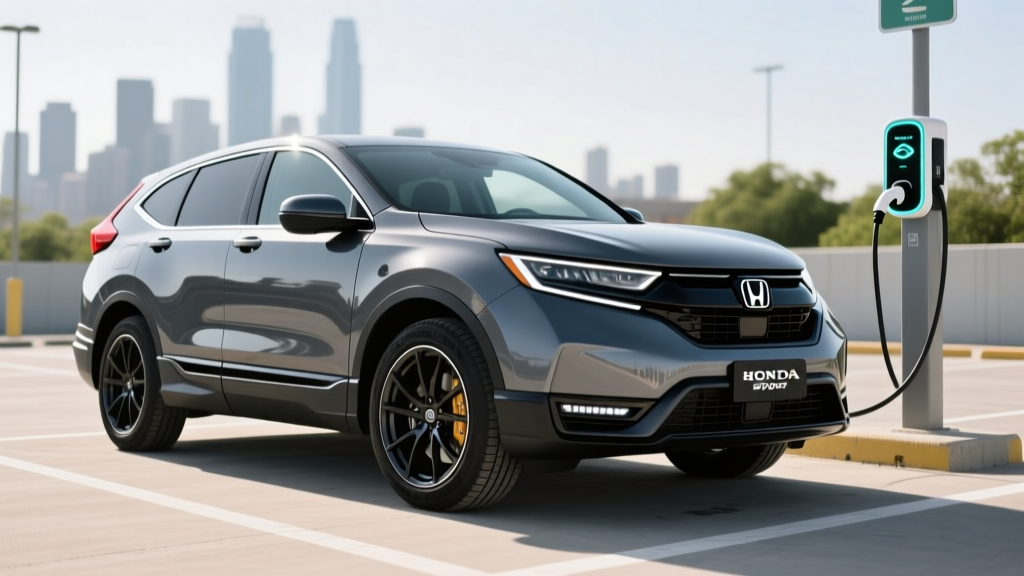
The 2025 Honda CR-V Hybrid Sport sits in a sweet spot for buyers who want electrified efficiency without ever plugging in. As a conventional hybrid (HEV), it captures regenerative energy on the fly, squeezing out an EPA-rated 40 MPG combined while offering the cargo space and ride comfort the CR-V line is known for. But with plug-in hybrids and affordable EVs proliferating in 2026, is a standard hybrid still the right call? Here's the data-driven breakdown.
2025 Honda CR-V Hybrid Sport: Key Specifications
| Specification | Detail |
|---|---|
| Powertrain | 2.0L Atkinson-cycle 4-cyl + 2 electric motors (e-CVT) |
| Combined Horsepower | 204 hp / 247 lb-ft torque |
| EPA MPG (City / Hwy / Combined) | 43 / 36 / 40 (FWD); 40 / 34 / 37 (AWD) |
| Fuel Tank Capacity | 15.3 gallons |
| Total Driving Range | ~612 miles (FWD combined) |
| 0–60 mph | ~7.6 seconds |
| Cargo Volume (rear seats up / down) | 36.3 / 76.5 cu ft |
| Towing Capacity | 1,000 lbs |
| Hybrid Battery Warranty | 8 years / 100,000 miles |
| Base MSRP (Sport FWD) | $36,195 (plus $1,395 destination) |
| Federal Tax Credit | Not eligible (§30D applies to PHEVs/BEVs only) |
Fuel Economy: EPA Ratings vs. Real-World MPG
| Driving Condition | EPA Rating (FWD) | Real-World Expectation |
|---|---|---|
| City | 43 MPG | 42–47 MPG (hybrids excel in stop-and-go) |
| Highway | 36 MPG | 33–36 MPG (less regen benefit at sustained speed) |
| Combined | 40 MPG | 37–43 MPG (varies with driving mix and climate) |
Honda's two-motor hybrid system is one of the best in the compact SUV segment for a reason: it behaves more like an EV in city driving than a traditional gas car. Below ~45 mph, the electric motors do most of the propulsion work, with the gas engine acting primarily as a generator. This is why you'll often exceed the EPA city figure in real-world commuting — something you can't say about most gas-only vehicles.
On the highway, the engine takes over direct drive via a lock-up clutch, which is efficient but doesn't benefit from regenerative braking the way city driving does. Expect highway MPG to dip closer to 33–35 if you're running 75+ mph or tackling hilly terrain. In cold weather (below 30°F), expect a 5–10% efficiency hit across the board as the engine runs more often for cabin heat and battery conditioning.
Hybrid (HEV) vs. Plug-In Hybrid (PHEV): What's the Difference?
The 2025 CR-V Hybrid Sport is a conventional hybrid (HEV) — it does not plug in. Honda does not currently offer a plug-in hybrid (PHEV) version of the CR-V in the U.S. market. Here's how the two architectures compare:
Conventional Hybrid (HEV)
- No plug-in required — charges via regenerative braking and the gas engine
- Small battery (~1–2 kWh usable) — not designed for electric-only driving
- Consistent efficiency regardless of charging access
- No federal tax credit under IRS §30D
- Lower upfront cost than a PHEV
Plug-In Hybrid (PHEV)
- Plugs in to charge a larger battery (typically 12–25 kWh)
- 25–45 miles of electric-only range before the gas engine kicks in
- Requires home or workplace charging access for full benefit
- May qualify for up to $7,500 federal tax credit (subject to MSRP, income, and battery-sourcing rules)
- Higher purchase price; heavier due to larger battery
If you can charge at home and your daily commute is under 35 miles, a PHEV like the Toyota RAV4 Prime or Hyundai Tucson PHEV might save you more fuel. But if you lack reliable charging access — apartment dwellers, street parkers, frequent road-trippers — the CR-V Hybrid Sport's no-plug approach is genuinely the lower-friction choice.
Powertrain Deep Dive: How Honda's Two-Motor Hybrid Works
The CR-V Hybrid pairs a 2.0-liter Atkinson-cycle four-cylinder engine (145 hp on its own) with a two-motor electric drive system producing a combined 204 hp and 247 lb-ft of torque. The system operates in three modes:
- EV Drive: Battery powers the electric motors alone (low-speed, light-load situations).
- Hybrid Drive: The gas engine spins a generator to feed electricity to the drive motor; battery supplements as needed.
- Engine Drive: At highway cruising speeds, a lock-up clutch connects the engine directly to the wheels for mechanical efficiency.
The e-CVT transmission is not a traditional belt-and-pulley CVV — it's a fixed-ratio gearset managed by the electric motors, which eliminates the rubber-band drone associated with older CVTs. Acceleration is linear and responsive, with the 0–60 mph sprint completing in roughly 7.6 seconds. That's not fast by EV standards, but it's competitive for the segment and adequate for merging and passing.
The available Real Time AWD system uses a rear-mounted electric motor to send torque to the rear wheels when slip is detected or under hard acceleration. AWD trims lose about 3 MPG combined (37 vs. 40) — a modest penalty for all-weather confidence.
Pricing, Trims, and Tax Credit Eligibility
The 2025 CR-V Hybrid is available across multiple trims. Here's the MSRP breakdown (destination included):
- Sport (FWD): ~$37,590
- Sport (AWD): ~$39,090
- Sport-L (FWD/AWD): ~$40,190–$41,690
- Sport Touring (AWD standard): ~$42,890
Because the CR-V Hybrid is a conventional HEV — not a plug-in — it does not qualify for the federal §30D Clean Vehicle Credit. That credit, worth up to $7,500 at the point of sale, applies only to new BEVs and PHEVs that meet battery-component and critical-mineral sourcing requirements, MSRP caps ($80,000 for SUVs), and buyer income limits.
Some states offer separate incentives for hybrids, but these are increasingly rare as policy focus shifts to zero-emission vehicles. Check your state's energy or DMV website for current programs. For most buyers, the CR-V Hybrid's value proposition rests on its fuel savings rather than tax incentives.
Battery Warranty, Longevity, and Replacement Cost
The CR-V Hybrid uses a lithium-ion battery pack mounted under the cargo floor. Unlike EV batteries, hybrid batteries are relatively small (~1.3 kWh total capacity) and operate in a narrow state-of-charge window — typically between 40% and 80%. This partial-cycling strategy is one of the main reasons hybrid batteries tend to outlast their warranties without significant degradation.
Honda's track record with hybrid battery longevity is strong. The company's hybrid systems in the Accord and CR-V have shown minimal reported failures within the first 100,000 miles. If a replacement is needed out of warranty, expect to pay between $2,000 and $4,000 for a new OEM battery pack, with refurbished units available for $1,000–$2,000. Independent hybrid specialists in major metro areas can often perform the swap in under two hours.
For context, Honda's official CR-V Hybrid page notes that the hybrid system is designed to last the life of the vehicle with normal maintenance. There's no scheduled battery replacement interval.
Who Should Choose the CR-V Hybrid Sport?
Choose the CR-V Hybrid Sport if:
- You lack access to home or workplace EV charging (apartment, street parking)
- You want 40 MPG without changing your refueling habits
- You prioritize cargo space (36.3 cu ft) and a comfortable ride over sporty handling
- You drive 12,000–15,000 miles/year and want ~$500 in annual fuel savings
- You plan to keep the vehicle 8+ years (well within the battery warranty)
Consider a PHEV or EV instead if:
- You can install a Level 2 charger at home and commute under 35 miles daily (a PHEV covers most trips on electricity)
- You want zero tailpipe emissions for daily driving (look at the Hyundai Ioniq 5, Tesla Model Y, or Ford Mustang Mach-E)
- You want to claim the $7,500 federal tax credit to offset a higher purchase price
- You drive mostly short city trips where an EV's per-mile cost is lowest
Pros and Cons
Pros
- 40 MPG combined with no plug-in hassle
- Strong city efficiency — often exceeds EPA in stop-and-go
- 204 hp feels responsive; no CVT drone
- Generous cargo space (76.5 cu ft with seats folded)
- 8-year/100,000-mile hybrid battery warranty
- Available AWD with minimal MPG penalty
- Standard Honda Sensing suite (adaptive cruise, lane-keeping, auto emergency braking)
Cons
- No federal tax credit (HEV, not PHEV/BEV)
- 1,000-lb towing limit is low for the class
- Highway MPG drops noticeably above 75 mph
- Infotainment on Sport trim lacks wireless CarPlay/Android Auto (USB only)
- No plug-in hybrid variant available in the U.S.
- Road noise is noticeable on coarse pavement
Frequently Asked Questions
How many MPG does the 2025 Honda CR-V Hybrid Sport get?
The FWD model is EPA-rated at 43 city / 36 highway / 40 combined. The AWD version drops to 40 / 34 / 37. In real-world city driving, many owners report 42–47 MPG thanks to the hybrid system's regenerative braking advantage. Highway-only driving at 75+ mph may yield 33–35 MPG.
Does the CR-V Hybrid need to be plugged in?
No. The CR-V Hybrid is a conventional HEV. Its small lithium-ion battery charges entirely through regenerative braking and the gas engine. You refuel it like any other car — at a gas station.
Is there a plug-in hybrid (PHEV) version of the CR-V?
Not in the U.S. market. Honda offers the CR-V e:PHEV in China and Europe, but as of 2026, no plug-in variant is sold in North America. If you want a compact SUV PHEV, consider the Toyota RAV4 Prime (42 miles electric-only), Hyundai Tucson PHEV (33 miles), or Mitsubishi Outlander PHEV (38 miles).
How long will the CR-V Hybrid battery last?
Honda warranties the hybrid battery for 8 years / 100,000 miles (10 years / 150,000 miles in CARB states). Real-world data from Honda's hybrid fleet suggests most batteries last 150,000+ miles without significant degradation, thanks to the narrow state-of-charge operating window. Replacement costs range from $2,000–$4,000 if needed out of warranty.
Does the 2025 CR-V Hybrid qualify for any tax credit?
No. The federal §30D Clean Vehicle Credit applies only to plug-in electric vehicles (BEVs and PHEVs) that meet battery-sourcing, MSRP, and buyer-income requirements. Conventional hybrids like the CR-V Hybrid are not eligible. Some states may offer minor hybrid incentives — check your state energy office for current programs.
Hybrid vs. EV: Which should I buy?
If you have reliable home charging, drive under 250 miles between stops, and want the lowest per-mile operating cost, a full EV (like the Ioniq 5 or Model Y) will save more money over time. If you lack charging access, take frequent long road trips, or want to minimize upfront cost and behavioral change, the CR-V Hybrid is a pragmatic choice that still cuts fuel bills by ~30% versus the gas-only CR-V.
How does the CR-V Hybrid compare to the Toyota RAV4 Hybrid?
The EPA's side-by-side comparison tool shows both are closely matched: the RAV4 Hybrid rates at 41 MPG combined vs. the CR-V's 40 MPG. The RAV4 offers a PHEV variant (the Prime) for buyers who want plug-in capability. The CR-V Hybrid counters with slightly more cargo space and a more refined ride. Both carry strong hybrid battery warranties.
Sources: EPA Fuel Economy, Honda CR-V Hybrid Official Page, IRS Clean Vehicle Credit (§30D). Pricing reflects 2025 model-year MSRP as published; verify with your local dealer for current incentives and availability.