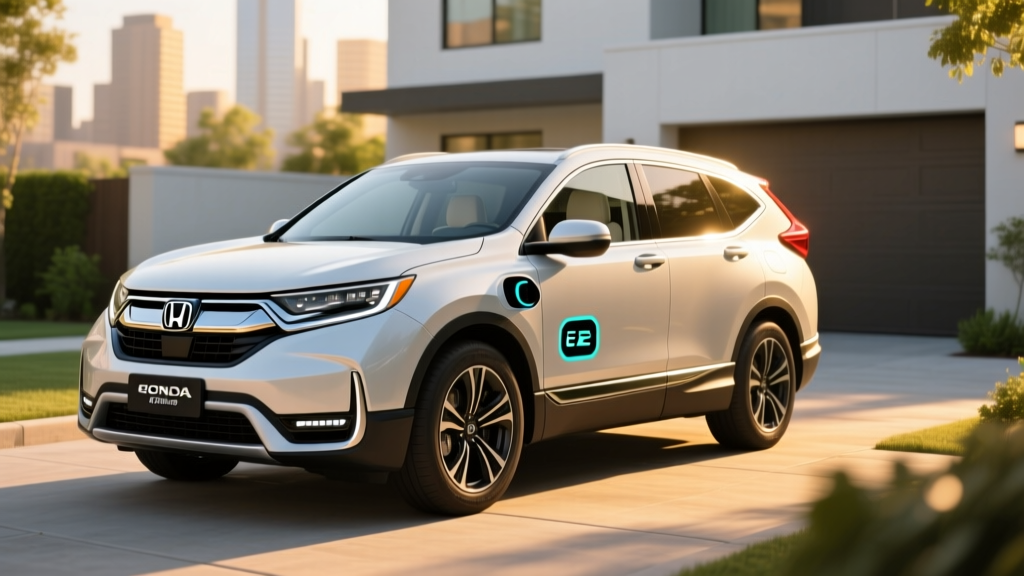
The Honda CR-V Hybrid has quietly become the default pick in the compact crossover segment — not because it does anything flashy, but because its two-motor hybrid system delivers consistent fuel economy, strong low-end torque, and the practicality buyers actually want. For the 2026 model year, Honda continues with the sixth-generation CR-V Hybrid lineup, keeping the proven 2.0-liter Atkinson-cycle powertrain and refining the tech and safety package. This Honda CR-V Hybrid review breaks down every number that matters: real-world MPG versus the EPA sticker, trim-level pricing, battery longevity, and whether this HEV makes more sense for your garage than a plug-in hybrid or a full EV.
2026 Honda CR-V Hybrid at a Glance
| Spec | Value |
|---|---|
| Powertrain | 2.0L Atkinson 4-cyl + 2-motor hybrid system |
| Combined Output | 204 hp / 247 lb-ft torque |
| Drivetrain | FWD standard; AWD available |
| EPA Fuel Economy (AWD) | 43 city / 36 highway / 40 combined MPG |
| EPA Fuel Economy (FWD) | 43 city / 36 highway / 40 combined MPG |
| Fuel Tank Capacity | 14.5 gallons |
| Total Driving Range | ~580 miles (EPA combined estimate) |
| Cargo Volume | 39.3 cu ft (rear seats up) / 76.5 cu ft (folded) |
| Towing Capacity | 1,000 lbs |
| Hybrid Battery Warranty | 8 years / 100,000 miles |
| Base MSRP (Sport Hybrid) | $36,395 |
| Top Trim MSRP (Sport Touring Hybrid AWD) | $42,895 |
HEV vs. PHEV vs. EV: Which CR-V Powertrain Fits You?
Before getting into the numbers, it's worth clarifying what the CR-V Hybrid actually is — because Honda's naming can trip up first-time hybrid shoppers.
Conventional Hybrid (HEV) — The CR-V Hybrid
The CR-V Hybrid is a conventional hybrid electric vehicle (HEV). It does not plug in. The 1.3 kWh lithium-ion traction battery charges itself through regenerative braking and the gasoline engine. You refuel at a gas station, exactly like a conventional car. There is no electric-only driving range to manage and no charging equipment to install.
Plug-In Hybrid (PHEV) — Not Available for the CR-V in the U.S.
Unlike the Toyota RAV4 Prime, Honda does not currently offer a CR-V plug-in hybrid in the United States. The CR-V e:PHEV exists in European and Chinese markets with a ~65-mile electric-only range and a 17.7 kWh battery, but American buyers cannot purchase it. If you want a plug-in compact SUV from Honda, you would need to look at the discontinued Clarity PHEV (used market only) or cross-shop competitors.
Battery Electric Vehicle (BEV) — The Honda Prologue
Honda's all-electric offering in this size class is the Prologue, built on GM's Ultium platform with an EPA range of up to 296 miles. It requires home charging infrastructure and relies on public DC fast charging for road trips. It qualifies for the full §30D federal tax credit of up to $7,500, subject to income caps, MSRP limits, and battery-sourcing requirements.
Bottom line: The CR-V Hybrid is for buyers who want significantly better fuel economy than a gas-only CR-V (which returns 29 MPG combined with AWD) without changing their fueling habits at all. No plug, no range planning, no charger install.
Fuel Economy: EPA Numbers vs. Real-World MPG
| Drivetrain | City MPG | Highway MPG | Combined MPG |
|---|---|---|---|
| FWD | 43 | 36 | 40 |
| AWD | 43 | 36 | 40 |
Source: EPA Fuel Economy Guide
One of the defining traits of Honda's two-motor hybrid system is that it actually favors city driving. The electric motors handle low-speed propulsion while the gasoline engine primarily acts as a generator — only engaging directly at higher cruising speeds. This is why the city rating (43 MPG) substantially exceeds the highway rating (36 MPG).
Real-World MPG Expectations
In mixed driving, most CR-V Hybrid owners report landing between 37 and 42 MPG combined, which tracks closely with the EPA estimate. However, your results will shift based on conditions:
- City-heavy commuting (sub-45 mph): 42–46 MPG is common. The hybrid system thrives in stop-and-go traffic where regenerative braking recaptures energy constantly.
- Sustained highway cruising (70–80 mph): Expect 33–36 MPG. Aerodynamic drag dominates, and the engine engages more directly, reducing the hybrid advantage.
- Cold weather (below 35°F): Expect a 10–15% drop, landing around 34–36 MPG combined. The engine runs more often to generate cabin heat and warm the catalytic converter.
- Mountainous terrain: Climbing passes will tank your instantaneous MPG, but regenerative braking on descents partially recovers the deficit. Net effect is roughly 35–38 MPG for a mountain-heavy trip.
The CR-V Hybrid is one of the few vehicles where you'll consistently beat the EPA city estimate in actual urban driving — a rarity that makes it exceptional for commuters.
Powertrain Deep Dive: Honda's Two-Motor Hybrid System
The 2026 CR-V Hybrid uses Honda's fourth-generation two-motor hybrid system, which operates differently from the planetary-gear setups found in Toyota hybrids. Here's how the components break down:
- Engine: 2.0-liter Atkinson-cycle inline-4, producing 146 hp and 134 lb-ft on its own. The Atkinson cycle sacrifices some low-end power for superior thermal efficiency.
- Drive Motor: 181 hp / 247 lb-ft electric motor that handles the majority of propulsion duties, especially at low and medium speeds.
- Generator Motor: A second motor that primarily generates electricity from the engine to feed the drive motor or charge the battery.
- Combined System Output: 204 hp (limited by total system power flow, not a simple addition of engine + motor).
- Traction Battery: ~1.3 kWh lithium-ion pack (non-plug-in HEV configuration). This is small by design — it buffers energy for acceleration assist and regen capture, not for sustained electric driving.
What makes this system feel different from competitors is its direct-drive clutch. Above roughly 45 mph in steady-state cruising, a lockup clutch mechanically connects the engine to the front wheels, bypassing the electrical conversion loop. This eliminates the efficiency penalty of converting mechanical energy to electrical and back again — the exact scenario where Toyota's e-CVT can lose efficiency on the highway.
Acceleration is genuinely brisk for a compact SUV: 0–60 mph arrives in approximately 7.6 seconds (AWD). That's over a second quicker than the gas-only CR-V AWD (roughly 8.8 seconds) and competitive with the Toyota RAV4 Hybrid (7.4 seconds). The electric motor's instant torque delivery makes the CR-V Hybrid feel particularly responsive around town.
Pricing, Trims, and Tax Credit Eligibility
The 2026 Honda CR-V Hybrid is offered in three trims, all of which include the hybrid powertrain as standard (there is no non-hybrid version of these trims):
- Sport Hybrid (FWD): $36,395 MSRP — includes 19-inch wheels, 9-inch touchscreen, wireless Apple CarPlay/Android Auto, heated front seats, Honda Sensing suite.
- Sport Hybrid (AWD): $37,895 MSRP — adds torque-vectoring AWD with 50/50 front-rear torque distribution capability.
- Sport-L Hybrid (AWD): $39,695 MSRP — leather-trimmed seats, power liftgate, heated steering wheel, wireless phone charger.
- Sport Touring Hybrid (AWD): $42,895 MSRP — Bose 12-speaker audio, navigation, panoramic moonroof, hands-free power liftgate, front parking sensors, low-speed braking control.
Does the CR-V Hybrid Qualify for a Federal Tax Credit?
No. Under current IRS §30D rules, the federal clean vehicle credit applies exclusively to plug-in electric vehicles (BEVs and PHEVs) with a minimum battery capacity of 7 kWh. The CR-V Hybrid's ~1.3 kWh battery does not meet this threshold. There is no federal tax credit for conventional (non-plug-in) hybrids as of 2026.
Some states offer their own hybrid incentives or HOV-lane access for HEVs — check your state's department of energy or DMV for specifics. However, these programs are increasingly shifting their focus to plug-in vehicles.
For context, the gas-only CR-V EX AWD starts at roughly $35,395 — making the hybrid premium approximately $2,500 at the Sport AWD trim. At 40 MPG combined versus 29 MPG for the gas AWD model, a driver covering 15,000 miles annually at $3.50/gallon would save roughly $630 per year in fuel, recouping the hybrid premium in about 4 years. If gas prices climb, that payback shortens considerably.
Reliability, Battery Longevity, and Replacement Costs
Hybrid battery anxiety is the single most common concern among first-time hybrid buyers, so let's address it with specifics.
| Item | Coverage |
|---|---|
| Hybrid Battery Warranty | 8 years / 100,000 miles (10 years / 150,000 miles in CARB states) |
| Powertrain Warranty | 5 years / 60,000 miles |
| Bumper-to-Bumper Warranty | 3 years / 36,000 miles |
| Hybrid Battery Replacement Cost (out of warranty) | $3,000–$4,500 (estimated, parts + labor) |
| Expected Hybrid Battery Lifespan | 150,000–200,000+ miles based on industry data |
Honda's hybrid system is among the most proven on the market. The CR-V Hybrid's lithium-ion traction battery is small (~1.3 kWh), which means it undergoes shallow charge-discharge cycles — typically cycling between 20% and 80% state of charge rather than full 0–100% sweeps. This shallow-cycling approach dramatically reduces degradation stress and is a primary reason hybrid batteries routinely outlast 150,000 miles without meaningful capacity loss.
For comparison, the Toyota RAV4 Hybrid's battery follows a similar philosophy and has demonstrated exceptional longevity in fleet data. The Honda system's smaller battery also means lower replacement cost if failure does occur outside warranty — typically $3,000–$4,500 including labor at a dealership, versus $5,000–$8,000+ for larger PHEV or BEV packs.
Honda's hybrid components have also earned strong reliability marks from Consumer Reports and J.D. Power. The IIHS has rated the CR-V as a Top Safety Pick+ when equipped with specific headlights, adding confidence for family buyers.
Daily Driving, Cargo, and Practicality
The CR-V Hybrid's cargo area measures 39.3 cubic feet behind the rear seats — identical to the gas-only CR-V, since the compact hybrid battery is packaged under the rear floor without intruding into the cargo space. Fold the 60/40 split rear seats and you get 76.5 cubic feet, enough for furniture-store runs or camping gear.
Rear-seat legroom remains generous at 41.0 inches, and the floor is flat — no transmission tunnel hump — which makes the middle seat usable for a third adult on shorter trips.
The Honda Sensing safety suite comes standard on every hybrid trim and includes:
- Adaptive cruise control with low-speed follow
- Lane-keeping assist and road-departure mitigation
- Collision-mitigation braking with pedestrian detection
- Traffic-sign recognition
- Blind-spot monitoring with rear cross-traffic alert (Sport-L and above)
Note that Honda Sensing is an SAE Level 1 driver-assist system — it provides steering and speed support but requires full driver attention at all times. It is not a hands-free or semi-autonomous driving system like GM's Super Cruise or Ford's BlueCruise.
Who Should Buy the CR-V Hybrid — and Who Shouldn't
Pros
- 40 MPG combined EPA, with real-world city driving often exceeding 43 MPG
- No plug required — zero behavior change from a gas car
- Strong low-end electric torque makes it feel quicker than its 204 hp suggests
- Cargo and interior space identical to gas CR-V
- Proven hybrid system with 8-year/100,000-mile battery warranty
- AWD available on all trims
Cons
- No federal tax credit (HEV, not a plug-in)
- Highway MPG (36) trails city MPG (43) — less ideal for road-trip-heavy drivers
- Towing limited to 1,000 lbs (vs. 1,500 lbs for gas CR-V)
- No PHEV option in the U.S. for buyers wanting electric-only commuting
- Top-trim pricing ($42,895) enters luxury-compact territory
Decision Framework: CR-V Hybrid vs. Alternatives
- Choose the CR-V Hybrid if: You want 40+ MPG without plugging in, you mostly drive in city/suburban conditions, you need AWD for weather, and you want a proven powertrain with minimal long-term maintenance risk.
- Choose a PHEV (e.g., Toyota RAV4 Prime) if: You have home charging access, your commute is under 40 miles round-trip, and you want to drive mostly on electricity while keeping a gas engine for road trips. The RAV4 Prime offers 42 miles of electric-only range and qualifies for partial federal credits depending on battery sourcing.
- Choose a full EV (e.g., Honda Prologue, Hyundai Ioniq 5) if: You have reliable home Level 2 charging, your daily driving is under 250 miles, you want zero tailpipe emissions, and you want the full $7,500 federal tax credit (if eligible under §30D income and sourcing rules).
- Stick with the gas CR-V if: Your budget is tight, you drive very low annual miles (under 8,000), and the $2,500 hybrid premium doesn't pencil out within your ownership timeline.
Frequently Asked Questions
How many MPG does the 2026 Honda CR-V Hybrid get?
The EPA rates the CR-V Hybrid at 43 city / 36 highway / 40 combined MPG for both FWD and AWD configurations. In real-world city-heavy driving, many owners report 42–46 MPG. Highway-only trips at 75+ mph typically yield 33–36 MPG.
Does the Honda CR-V Hybrid need to be plugged in?
No. The CR-V Hybrid is a conventional hybrid (HEV), not a plug-in hybrid (PHEV). Its small traction battery charges through regenerative braking and the gasoline engine. You only refuel at a gas station.
Is there a Honda CR-V plug-in hybrid (PHEV)?
Not in the United States as of the 2026 model year. Honda sells a CR-V e:PHEV in Europe and China with approximately 65 miles of electric-only range, but it is not available to American buyers. The closest domestic alternative is the Toyota RAV4 Prime (42 miles electric-only).
How long will the CR-V Hybrid battery last, and what does replacement cost?
Honda warranties the hybrid battery for 8 years/100,000 miles (10 years/150,000 miles in CARB-emission states). Based on industry data for similar shallow-cycle lithium-ion hybrid batteries, expected lifespan is 150,000–200,000+ miles. Out-of-warranty replacement costs approximately $3,000–$4,500 including parts and labor.
Does the CR-V Hybrid qualify for any federal tax credit?
No. The IRS §30D clean vehicle credit applies only to plug-in vehicles (BEVs and PHEVs) with at least 7 kWh of battery capacity. The CR-V Hybrid's ~1.3 kWh battery does not qualify. Some state-level hybrid incentives may exist — check your state energy office for current programs.
Is the CR-V Hybrid slower than the gas-only CR-V?
No — it's noticeably quicker. The hybrid's electric motor delivers instant torque, resulting in a 0–60 mph time of approximately 7.6 seconds (AWD), compared to roughly 8.8 seconds for the gas-only CR-V AWD. The hybrid also feels more responsive in stop-and-go traffic.
Can the CR-V Hybrid tow?
Yes, but with a reduced rating. The CR-V Hybrid is rated to tow up to 1,000 lbs, compared to 1,500 lbs for the gas-only CR-V. This is sufficient for a small utility trailer or a pair of dirt bikes, but not for a loaded camping trailer or boat.