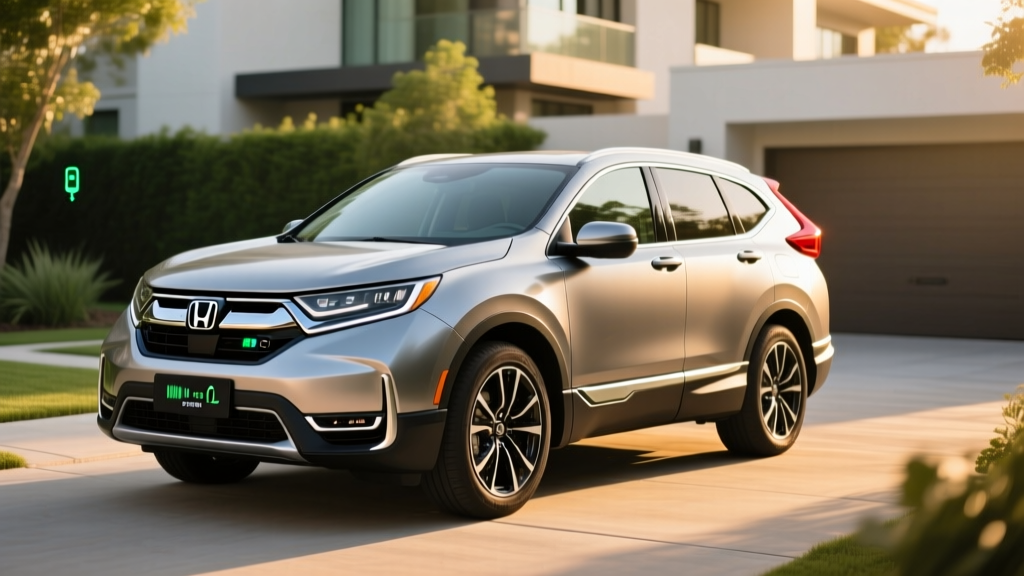
The Honda CR-V Hybrid has quietly become one of the most popular electrified compact SUVs in America, and for good reason. The 2026 Honda CR-V Hybrid powertrain pairs a 2.0-liter Atkinson-cycle four-cylinder engine with a two-motor hybrid system to deliver 204 combined horsepower and an EPA-estimated 40 MPG combined — all without ever needing to plug in. For buyers who want meaningful fuel savings without changing their refueling habits or worrying about charging infrastructure, the CR-V Hybrid occupies a compelling middle ground between a conventional gas SUV and a full battery-electric vehicle.
This guide breaks down the powertrain engineering, real-world fuel economy, battery longevity, ownership economics, and whether the CR-V Hybrid is the right electrified choice for your daily driving needs.
How the Honda CR-V Hybrid Powertrain Works
The 2026 CR-V Hybrid uses Honda's fourth-generation two-motor hybrid system, a series-parallel architecture that differs significantly from traditional torque-converter automatics or simple belt-driven mild hybrids. Here's how it operates across different driving scenarios:
- EV Drive: At low speeds and light loads, the CR-V runs purely on electric power from its lithium-ion battery pack, with the gasoline engine shut off entirely.
- Hybrid Drive: During moderate acceleration, the engine acts as a generator, powering the electric drive motor while excess energy charges the battery.
- Engine Drive: At steady highway cruising speeds, a lockup clutch mechanically connects the engine to the front wheels for maximum efficiency — bypassing the electric motors entirely.
- Regenerative Braking: Deceleration and braking recapture kinetic energy back into the battery, reducing brake wear and improving city fuel economy.
The result is a system that seamlessly blends electric and gasoline propulsion without the driver ever needing to think about it. There is no plug, no range anxiety, and no behavioral change required — you simply fuel up at any gas station as you always have.
Fuel Economy: EPA Ratings vs. Real-World MPG
Fuel efficiency is the headline reason most buyers choose the CR-V Hybrid, and the EPA numbers are strong. According to fueleconomy.gov, the 2026 CR-V Hybrid achieves:
| Drivetrain | City | Highway | Combined |
|---|---|---|---|
| FWD (Sport Hybrid) | 43 MPG | 36 MPG | 40 MPG |
| AWD (Sport Touring Hybrid) | 40 MPG | 34 MPG | 37 MPG |
Real-world expectations: Hybrid fuel economy behaves differently than gas-only vehicles. Because the electric motor handles low-speed driving and regenerative braking recaptures energy in stop-and-go traffic, the CR-V Hybrid actually achieves higher MPG in city driving than on the highway — the opposite of most gas cars. In real-world testing, owners who do predominantly urban and suburban driving often report matching or slightly exceeding the EPA city figure of 40-43 MPG.
However, highway-heavy commutes at 75+ MPH will push real-world fuel economy closer to 32-34 MPG for AWD models. Cold weather (below 30°F) typically reduces hybrid efficiency by 5-10% due to increased engine warm-up time and reduced battery performance. Expect an honest annual average of 35-39 MPG for mixed driving in the AWD configuration, which is the most popular setup.
Powertrain Specs and Performance
| Engine | 2.0L DOHC Atkinson-cycle inline-4 |
| Engine Power | 145 hp @ 6,100 rpm |
| Electric Drive Motor | 181 hp / 247 lb-ft torque |
| Combined System Output | 204 hp / 247 lb-ft torque |
| Transmission | e-CVT (no traditional gears) |
| Drivetrain | FWD standard; Real Time AWD available |
| 0-60 MPH | ~7.6 seconds (est.) |
| Towing Capacity | 1,000 lbs |
| Hybrid Battery | Lithium-ion (approx. 1.1 kWh usable) |
The key performance insight here is that the electric drive motor — not the gasoline engine — does the heavy lifting for acceleration. The 247 lb-ft of torque from the electric motor is available from zero RPM, giving the CR-V Hybrid surprisingly responsive off-the-line feel in city driving. The gasoline engine's 145 hp primarily serves as a generator at lower speeds and only directly drives the wheels during steady highway cruising.
The e-CVT (electronic continuously variable transmission) is not a belt-and-pulley CVT like those found in some competitors. Instead, Honda's system uses the two electric motors and a lockup clutch to create a direct-drive feel at highway speeds, eliminating the "rubber-band" drone that plagues lesser CVT designs.
Battery Longevity, Warranty, and Replacement Costs
Honda covers the hybrid battery pack with a 10-year / 150,000-mile warranty in CARB states (California and states that follow CARB emissions standards) and an 8-year / 100,000-mile warranty in all other states. This covers defects and capacity loss below functional thresholds.
Battery longevity is consistently the top concern among hybrid shoppers, and the data is reassuring. The CR-V Hybrid's lithium-ion battery pack is relatively small (~1.1 kWh usable) and is managed by Honda's thermal control system to avoid the deep charge/discharge cycles that accelerate degradation. The battery never fully charges or fully depletes during normal operation — it operates in a narrow state-of-charge window (roughly 40-80%) that maximizes cycle life.
Real-world battery lifespan: Based on data from Honda's earlier hybrid systems (Insight, Accord Hybrid) and industry-wide hybrid battery performance, most CR-V Hybrid battery packs should last well beyond 150,000 miles with minimal capacity loss. Hybrid batteries experience far less stress than full EV batteries because they cycle through a much smaller portion of their total capacity.
Replacement cost: If the hybrid battery does need replacement outside of warranty, expect to pay between $2,000 and $4,000 for a new OEM battery pack including labor at a Honda dealership. Third-party refurbished or reconditioned battery packs are available for approximately $1,000 to $2,000. This is dramatically less expensive than a full EV battery replacement, which can exceed $10,000-$15,000.
Pricing, Trims, and Tax Credit Eligibility
The 2026 Honda CR-V Hybrid is available in two trims in the U.S. market:
| Trim | MSRP (incl. destination) | Drivetrain |
|---|---|---|
| Sport Hybrid | ~$36,350 | FWD or AWD |
| Sport Touring Hybrid | ~$41,350 | AWD only |
Federal tax credit: The Honda CR-V Hybrid is a conventional hybrid (HEV), not a plug-in hybrid or battery-electric vehicle. It does not qualify for the federal §30D Clean Vehicle Credit of up to $7,500. That credit applies only to plug-in vehicles with sufficient battery capacity (≥7 kWh for PHEVs, ≥16 kWh for EVs). The CR-V Hybrid's ~1.1 kWh battery falls well below that threshold.
Some states may offer modest incentives for conventional hybrids, but these vary widely and are generally small (a few hundred dollars at most). Check your state's energy office or DMV for current programs. The real financial benefit of the CR-V Hybrid comes from fuel savings, not tax incentives.
Cost-per-mile comparison: At 37 MPG combined and $3.50/gallon regular unleaded, the CR-V Hybrid costs approximately $0.095 per mile in fuel. A comparable gas-only compact SUV at 28 MPG combined costs roughly $0.125 per mile. Over 15,000 miles per year, that's a savings of approximately $450 annually or $2,250 over five years — enough to offset the hybrid premium within a few years of ownership.
CR-V Hybrid vs. PHEV vs. Full EV: Which Is Right for You?
The CR-V Hybrid sits in a specific niche within the electrified vehicle landscape. Here's a practical decision framework:
- You don't have access to home or workplace charging
- You want fuel savings with zero lifestyle changes
- Your budget is under $42,000
- You drive 12,000-20,000 miles/year in mixed city/highway
- You want proven reliability and low maintenance costs
- You can charge at home (Level 1 or 2)
- Your daily commute is under 40 miles round-trip
- You want to drive mostly on electricity with a gas backup
- You qualify for the $7,500 federal tax credit
- You're willing to pay a higher upfront price
- You have reliable Level 2 home charging
- You want to eliminate gas entirely
- Your daily driving is under 250 miles
- You want maximum tax credits and lowest per-mile cost
- You're comfortable with public charging on road trips
The honest reality: for most American drivers who lack home charging access or who frequently take long road trips, the CR-V Hybrid offers the most practical path to meaningful fuel savings. You get 30-40% better fuel economy than a gas-only CR-V without ever thinking about charging, range, or plugs.
Reliability, Safety, and Ownership Experience
Honda's hybrid powertrain has been in production since the early 2000s, and the fourth-generation system in the current CR-V benefits from two decades of refinement. The two-motor design eliminates the traditional transmission entirely — there are no gears, belts, or torque converters to fail. The e-CVT architecture has fewer moving parts than a conventional automatic, which translates to lower long-term maintenance costs.
The 2026 CR-V carries top safety ratings from both the NHTSA (5-Star Overall) and the IIHS (Top Safety Pick+ when equipped with specific headlights). All trims include Honda Sensing as standard — a Level 2 driver-assistance suite with adaptive cruise control, lane-keeping assist, collision mitigation braking, and traffic sign recognition.
Maintenance advantages: The hybrid system actually reduces wear on several components. Regenerative braking means the friction brakes are used less frequently, often lasting 80,000-100,000+ miles before pad replacement. The gasoline engine runs less often and under more optimal conditions, which can extend oil change intervals and reduce long-term engine wear.
Pros and Cons
- 40 MPG combined (FWD) — class-leading efficiency
- No plug-in required — zero behavior change
- 204 hp with strong low-end electric torque
- 10-year/150k-mile hybrid battery warranty (CARB states)
- Top safety ratings (NHTSA 5-Star, IIHS TSP+)
- Spacious interior with 36.3 cu-ft cargo (rear seats up)
- Lower brake and engine wear vs. gas-only models
- No PHEV option — can't drive on electric only for extended distances
- 1,000-lb towing limit (lower than some gas competitors)
- AWD drops combined MPG to 37
- No federal tax credit eligibility
- Highway MPG trails city MPG significantly
- Sport Touring trim pushes past $41,000
- Engine can drone under hard acceleration (e-CVT character)
Frequently Asked Questions
How many MPG does the Honda CR-V Hybrid actually get in real driving?
The EPA rates the FWD CR-V Hybrid at 43 city / 36 highway / 40 combined, and the AWD at 40/34/37. In real-world mixed driving, most owners report 35-39 MPG in the AWD model. City-heavy drivers often match or slightly exceed the EPA city figure because hybrids are most efficient in stop-and-go traffic where regenerative braking and electric-only mode dominate.
Does the Honda CR-V Hybrid need to be plugged in?
No. The CR-V Hybrid is a conventional hybrid (HEV) that charges its own battery through regenerative braking and the gasoline engine. You never plug it in. If you want a Honda SUV that plugs in, Honda currently does not offer a PHEV version of the CR-V in the U.S.
How long will the CR-V Hybrid battery last and what does replacement cost?
Honda warranties the hybrid battery for 8 years/100,000 miles (10 years/150,000 miles in CARB states). Based on historical Honda hybrid data, most batteries last well beyond 150,000 miles. Out-of-warranty replacement costs approximately $2,000-$4,000 for a new OEM pack, or $1,000-$2,000 for a refurbished unit.
Does the CR-V Hybrid qualify for any federal tax credit?
No. The federal §30D Clean Vehicle Credit requires a plug-in vehicle with a battery capacity of at least 7 kWh. The CR-V Hybrid's ~1.1 kWh battery does not qualify. Only plug-in hybrids (PHEVs) and battery-electric vehicles (BEVs) are eligible for federal purchase incentives. Check IRS.gov for current rules.
Is the CR-V Hybrid better than the gas-only CR-V?
For most buyers, yes — if the hybrid premium (roughly $1,500-$2,500 over equivalent gas trims) fits your budget. The hybrid delivers 30-40% better fuel economy, stronger low-speed acceleration from electric torque, quieter operation at low speeds, and reduced brake wear. The fuel savings typically pay back the price premium within 3-5 years for drivers covering 15,000 miles annually.
How does the CR-V Hybrid compare to the Toyota RAV4 Hybrid?
The Toyota RAV4 Hybrid (219 hp, 41 MPG combined AWD) is the CR-V Hybrid's closest competitor. The RAV4 Hybrid has slightly more horsepower and a higher towing capacity (1,750 lbs), while the CR-V Hybrid offers a more refined interior, slightly better cargo space, and a more natural-feeling e-CVT. Both are excellent choices with proven reliability records — the decision often comes down to styling preference and dealer pricing in your area.