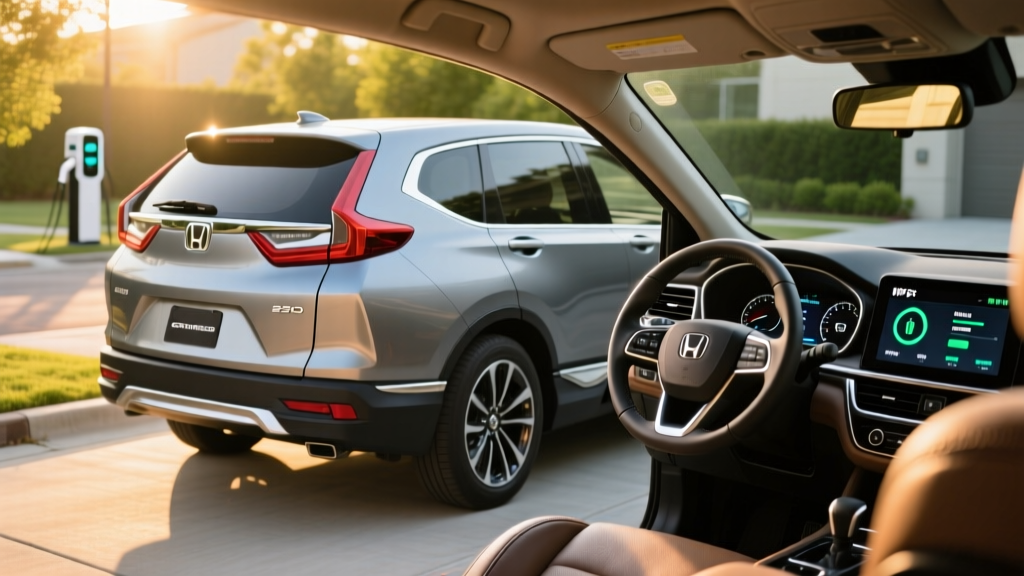
The Honda CR-V Hybrid has quietly become the default choice for compact SUV buyers who want electric-like efficiency without ever plugging in. For the 2026 model year, Honda continues offering its proven two-motor hybrid system across the Sport, Sport-L, and Sport Touring trims — delivering EPA-estimated fuel economy that rivals sedans while maintaining the cargo space and all-wheel-drive capability that SUV buyers demand.
If you've been searching for a Honda hybrid CR-V, this guide covers everything you need to decide: exact EPA mileage figures, real-world fuel economy expectations, powertrain specifications, trim pricing, battery warranty details, and how this hybrid stacks up against plug-in alternatives and full EVs.
Honda CR-V Hybrid Fuel Economy: EPA Numbers and Real-World MPG
The 2026 Honda CR-V Hybrid uses the fourth generation of Honda's two-motor hybrid system, pairing a 2.0-liter Atkinson-cycle four-cylinder engine with two electric motors. The result is EPA-estimated fuel economy that leads the compact hybrid SUV segment.
| Drivetrain | City MPG | Highway MPG | Combined MPG |
|---|---|---|---|
| FWD (Sport, Sport-L) | 43 | 36 | 40 |
| AWD (Sport, Sport-L, Sport Touring) | 40 | 34 | 37 |
Source: fueleconomy.gov
Real-World MPG vs. EPA Sticker
Hybrid vehicles typically exceed their EPA city estimates in stop-and-go traffic because regenerative braking recaptures energy that gas-only cars waste as heat. Owners consistently report 41–45 MPG in city driving with the FWD CR-V Hybrid. Highway driving is a different story: at sustained 70–75 mph speeds, expect 32–35 MPG with AWD, as aerodynamic drag reduces the hybrid system's advantage. In cold weather (below 30°F), fuel economy can dip 10–15% as the engine runs more frequently to heat the cabin and warm up the catalytic converter.
Hybrid (HEV) vs. Plug-In Hybrid (PHEV): What Honda Actually Offers
One of the most common points of confusion for shoppers is whether the Honda CR-V Hybrid needs to be plugged in. It does not. The CR-V Hybrid is a conventional hybrid (HEV), meaning it generates all its electricity internally through regenerative braking and the gasoline engine. There is no plug, no charging cable, and no electric-only driving range to manage.
| Feature | Honda CR-V Hybrid (HEV) | Typical Compact PHEV SUV (e.g., Toyota RAV4 Prime) |
|---|---|---|
| Plug-in charging required? | No | Yes (Level 1 or Level 2) |
| Electric-only range | None (EV assist only at low speeds) | 35–42 miles |
| Battery size | ~1.1 kWh (small buffer) | 18.1 kWh |
| Federal tax credit (§30D) | Not eligible | Up to $7,500 (if eligible) |
| Combined MPG (gas only) | 37–40 MPG | 38–40 MPG (after battery depleted) |
| Home charging install needed? | No | Yes ($500–$2,000 for Level 2) |
| Starting MSRP (2026) | ~$36,395 | ~$44,000+ |
Honda does not currently offer a CR-V plug-in hybrid in the U.S. market. If you need electric-only commuting capability, you'll need to look at competitors like the Toyota RAV4 Prime or consider a full battery-electric vehicle (BEV).
Powertrain Specs: Engine, Motors, and Horsepower
The 2026 CR-V Hybrid's two-motor system is engineered for smoothness rather than outright speed. Here's the complete powertrain breakdown:
| Engine | 2.0L Atkinson-cycle DOHC 4-cylinder |
| Engine horsepower | 145 hp @ 6,100 rpm |
| Electric motors | Two-motor system (propulsion + generator) |
| Propulsion motor output | 181 hp / 247 lb-ft torque |
| Combined system output | 204 hp |
| Transmission | Electronic continuously variable (e-CVT) |
| Drivetrain options | FWD or Real Time AWD™ |
| 0–60 mph (estimated) | ~7.6 seconds |
| Towing capacity | 1,000 lbs |
| Fuel tank | 14.0 gallons |
| Total driving range (AWD) | ~518 miles (EPA combined) |
The two-motor system operates primarily in EV mode at low speeds and light loads, seamlessly engaging the gasoline engine for highway cruising or hard acceleration. Unlike some hybrid systems that use a planetary gearset (like Toyota's), Honda's system uses a lock-up clutch to create a direct mechanical connection between the engine and wheels at highway speeds, improving efficiency during sustained cruising.
2026 Honda CR-V Hybrid Trims and Pricing
Honda positions the hybrid as the premium powertrain option, available exclusively in the sport-oriented trims. The gas-only CR-V is offered in LX and EX trims at lower price points.
| Trim | Drivetrain | MSRP | Key Features |
|---|---|---|---|
| Sport Hybrid | FWD | $36,395 | 19" wheels, 9" touchscreen, wireless Apple CarPlay/Android Auto, heated front seats |
| Sport Hybrid | AWD | $37,895 | Same as FWD + Real Time AWD |
| Sport-L Hybrid | FWD | $38,895 | Leather-trimmed seats, power tailgate, wireless phone charger |
| Sport-L Hybrid | AWD | $40,395 | Same as FWD + Real Time AWD |
| Sport Touring Hybrid | AWD (std) | $42,895 | Bose 12-speaker audio, navigation, heated steering wheel, hands-free power tailgate, Honda Sensing® suite with low-speed braking control |
Destination charge adds approximately $1,350 to all trims. Dealer markups vary by region — in high-demand metro areas, expect to pay $1,000–$3,000 above MSRP for the Sport Touring Hybrid.
Does the Honda CR-V Hybrid Qualify for a Federal Tax Credit?
No. The Honda CR-V Hybrid is a conventional HEV, not a plug-in vehicle. Under IRS §30D rules, the federal clean vehicle credit (up to $7,500) applies only to battery-electric vehicles (BEVs) and plug-in hybrids (PHEVs) that meet specific battery capacity, critical-mineral sourcing, MSRP, and buyer income requirements. Since the CR-V Hybrid has no plug and a battery far below the 4 kWh minimum threshold, it does not qualify for any federal EV tax credit. Some states may offer minor incentives for hybrid purchases — check your state's energy office for current programs.
Battery Warranty, Reliability, and Replacement Cost
Hybrid battery longevity is the single most common concern among first-time hybrid buyers. Honda addresses this with a robust warranty and a track record of battery durability.
Honda Hybrid Battery Warranty
- Hybrid battery warranty: 8 years / 100,000 miles (10 years / 150,000 miles in CARB states including CA, NY, MA, and others that follow California emissions standards)
- Powertrain warranty: 5 years / 60,000 miles
- Limited vehicle warranty: 3 years / 36,000 miles
- Hybrid system components covered: Battery module, electric motors, inverter, DC-DC converter
Honda's hybrid battery packs are significantly smaller (~1.1 kWh) than those in full EVs (60–100 kWh), which means fewer cells, less thermal stress, and lower replacement costs. Based on long-term data from previous-generation CR-V Hybrids and Honda Accord Hybrids, the battery modules rarely require full replacement within the warranty period. Honda's system maintains a generous charge buffer — the battery never fully charges or fully depletes — which dramatically extends cell life.
If replacement is needed out of warranty, expect costs in the range of $2,000–$3,500 for the battery module (parts and labor), substantially less than the $10,000–$20,000 that large EV battery replacements can cost. Third-party hybrid battery refurbishment services can sometimes reduce this to $1,000–$1,800.
Real-World Ownership: Who Should Buy the CR-V Hybrid?
The Honda CR-V Hybrid occupies a specific niche that doesn't fit every buyer. Here's a practical decision framework:
Choose the Honda CR-V Hybrid If:
- You want 37–40 MPG combined without changing any habits — no plugs, no charging apps, no range planning
- Your daily driving is a mix of city errands and highway commuting
- You need AWD for snow or rain but don't want the fuel penalty of a gas-only AWD SUV
- You plan to own the vehicle 8–12 years and want proven hybrid reliability
- You lack access to home or workplace charging (apartment dwellers, street parkers)
Look at a Plug-In Hybrid (PHEV) Instead If:
- Your daily commute is under 40 miles round-trip and you can charge at home
- You want to drive on electricity most days and only use gas for road trips
- You want to qualify for the federal §30D tax credit (up to $7,500)
Consider a Full EV (BEV) Instead If:
- You have reliable Level 2 home charging and your daily driving is under 250 miles
- You want zero tailpipe emissions and the lowest per-mile fuel cost (~$0.04–$0.06/mi on residential electricity)
- You want access to HOV lanes and maximum federal/state incentives
How the CR-V Hybrid Compares to Key Rivals
The compact hybrid SUV segment is competitive. Here's how the CR-V Hybrid stacks up against its two most direct competitors on the metrics that matter:
| Spec | Honda CR-V Hybrid Sport AWD | Toyota RAV4 Hybrid XLE AWD | Hyundai Tucson Hybrid SEL AWD |
|---|---|---|---|
| EPA Combined MPG | 37 | 39 | 38 |
| Combined HP | 204 | 219 | 226 |
| 0–60 mph | ~7.6 sec | ~7.4 sec | ~7.1 sec |
| Cargo (behind rear seats) | 36.3 cu ft | 37.6 cu ft | 38.7 cu ft |
| Starting MSRP (AWD) | $37,895 | $35,425 | $36,490 |
| Hybrid Battery Warranty | 8 yr / 100k mi | 10 yr / 150k mi | 10 yr / 100k mi |
| Towing Capacity | 1,000 lbs | 1,750 lbs | 2,000 lbs |
The Toyota RAV4 Hybrid leads on EPA fuel economy and starting price, while the Tucson Hybrid offers more horsepower and cargo space. The CR-V Hybrid's advantages are its interior material quality, refined ride tuning, and Honda's strong resale value — the CR-V historically retains 55–60% of its value after five years, according to industry depreciation data.
Pros
- Class-leading 43 MPG city (FWD) in real-world stop-and-go driving
- Refined, quiet powertrain transitions — engine engagement is nearly imperceptible
- Spacious cabin with premium materials in Sport-L and Touring trims
- Standard Honda Sensing® safety suite across all trims
- Strong resale value and proven hybrid reliability track record
- No charging infrastructure required — ideal for apartment dwellers
Cons
- No PHEV variant available in the U.S. — no electric-only range or federal tax credit
- Towing capacity limited to 1,000 lbs (RAV4 Hybrid tows 1,750 lbs)
- AWD models drop to 37 MPG combined — still good but behind RAV4 Hybrid AWD's 39
- Sport Touring trim pushes past $44,000 with destination, entering luxury-adjacent pricing
- Hybrid system prioritizes efficiency over acceleration — not the quickest in the segment
Frequently Asked Questions
How many MPG does the Honda CR-V Hybrid actually get?
The EPA rates the 2026 CR-V Hybrid at 43 city / 36 highway / 40 combined for FWD models, and 40 city / 34 highway / 37 combined for AWD models. In real-world driving, city mileage often exceeds the EPA estimate (41–45 MPG is common), while sustained highway driving at 70+ mph typically yields 32–35 MPG for AWD models. Cold weather reduces efficiency by approximately 10–15%.
Does the Honda CR-V Hybrid need to be plugged in?
No. The CR-V Hybrid is a conventional hybrid (HEV). It charges its small battery pack internally through regenerative braking and the gasoline engine. You fuel it exactly like a regular gas car — just fill up at any gas station. There is no plug, no charging cable, and no electric-only driving mode to manage.
Is the Honda CR-V Hybrid reliable?
Honda's two-motor hybrid system has been in production since 2014 (Accord Hybrid) and is now in its fourth generation. The system has demonstrated strong long-term reliability with few widespread failure patterns. The hybrid battery is warrantied for 8 years/100,000 miles (10 years/150,000 miles in CARB states). Honda's hybrid components are simpler than a traditional automatic transmission — there are no gear shifts, no torque converter, and fewer moving parts subject to wear.
What does it cost to replace the CR-V Hybrid battery?
Out-of-warranty hybrid battery replacement typically costs $2,000–$3,500 including parts and labor at a Honda dealership. Third-party hybrid specialists may offer refurbished battery modules for $1,000–$1,800. Full replacement is uncommon within the first 150,000 miles based on historical data from Honda's hybrid fleet. The 1.1 kWh battery pack is far smaller and less expensive than a full EV battery.
Does the Honda CR-V Hybrid qualify for any tax credit?
The CR-V Hybrid does not qualify for the federal §30D clean vehicle credit because it is not a plug-in vehicle. The IRS requires a minimum battery capacity of 4 kWh and plug-in capability — the CR-V Hybrid's ~1.1 kWh battery and lack of a charging port make it ineligible. Some states may offer modest rebates or incentives for hybrid purchases; check your state energy office or the Alternative Fuels Data Center for state-specific programs.
Should I buy the CR-V Hybrid or wait for a CR-V PHEV?
Honda has not announced a U.S.-market CR-V plug-in hybrid as of early 2026. While Honda sells a CR-V e:PHEV in China and Europe, the company has not confirmed plans to bring it stateside. If you need plug-in hybrid capability now, the Toyota RAV4 Prime (42 miles electric-only, eligible for up to $7,500 federal credit) is the closest competitor. If a PHEV CR-V matters to you, monitor Honda's U.S. press site for announcements — but don't delay a purchase indefinitely for an unconfirmed model.
How does the CR-V Hybrid compare to a full EV like the Hyundai Ioniq 5?
These serve fundamentally different use cases. The CR-V Hybrid costs less upfront ($36,395 vs. ~$42,000+ for an Ioniq 5), requires no charging infrastructure, and has unlimited range with gas station stops. The Ioniq 5 offers ~300 miles of EPA range, lower per-mile fuel costs (electricity vs. gasoline), and qualifies for up to $7,500 in federal tax credits. If you have home Level 2 charging and daily driving under 250 miles, a BEV delivers lower operating costs. If you lack charging access or regularly drive 300+ miles between stops, the CR-V Hybrid is the more practical choice.
For the latest EPA fuel economy data, visit fueleconomy.gov. For current federal tax credit rules, consult the IRS clean vehicle credit page. Pricing and specifications are based on Honda's published 2026 model-year data and are subject to change.