Honda CR-V Hybrid Gas Mileage: What the EPA Says vs. What You'll Actually Get
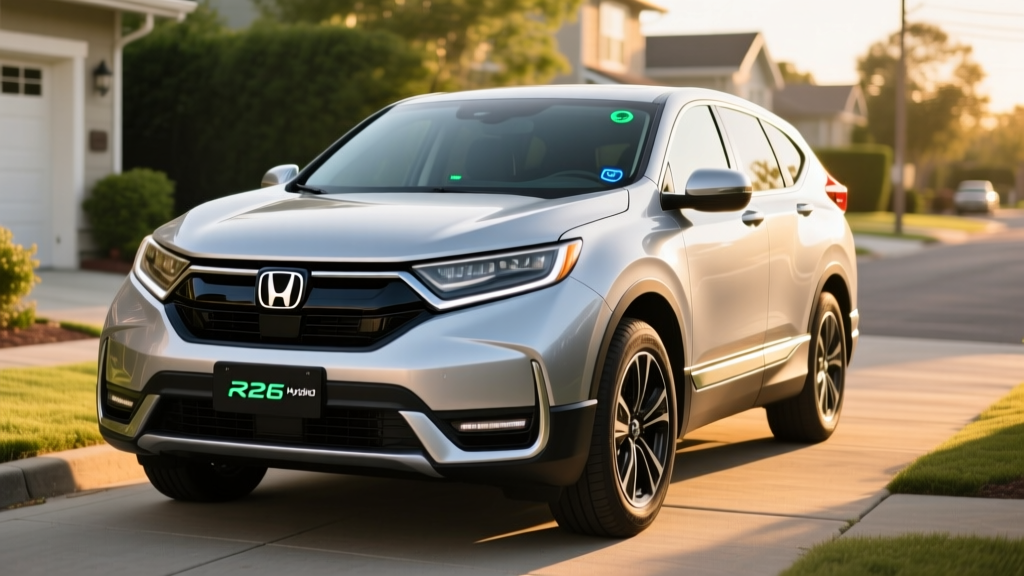
The Honda CR-V Hybrid has become one of the best-selling electrified compact SUVs in the United States, and the number one question buyers ask is straightforward: how many miles per gallon does it really deliver? For the 2026 model year, Honda continues with its proven two-motor hybrid system that prioritizes efficiency without sacrificing the practicality the CR-V is known for. Let's break down the official EPA figures, real-world fuel economy expectations, and what makes this hybrid powertrain tick.
Before we get into the numbers, it's critical to clarify what we're talking about. The Honda CR-V Hybrid is a conventional hybrid electric vehicle (HEV) — not a plug-in hybrid. You never plug it in. The system recovers energy through regenerative braking and the gasoline engine to charge its small battery pack. If you're looking for electric-only driving, you'd need to look at a PHEV or full BEV instead (more on that comparison below).
EPA Fuel Economy: City, Highway, and Combined MPG
The EPA rates the 2026 Honda CR-V Hybrid with front-wheel drive at the following fuel economy figures:
| Drivetrain | City MPG | Highway MPG | Combined MPG |
|---|---|---|---|
| FWD | 43 | 36 | 40 |
| AWD | 40 | 34 | 37 |
The front-wheel-drive model's 40 MPG combined is impressive for a compact SUV with this much cargo room and passenger space. The all-wheel-drive variant drops to 37 MPG combined — a reasonable trade-off if you need traction in snow or rain.
How the CR-V Hybrid Powertrain Works
Honda's hybrid system in the CR-V pairs a 2.0-liter Atkinson-cycle four-cylinder engine with two electric motors. Here's the full powertrain breakdown:
| Specification | Detail |
|---|---|
| Engine | 2.0L Atkinson-cycle 4-cylinder |
| Combined System Horsepower | 204 hp |
| Combined System Torque | 247 lb-ft |
| Electric Motors | Dual-motor (one drive, one generator) |
| Transmission | Electronic continuously variable (eCVT) |
| 0-60 MPH | ~7.6 seconds |
| Fuel Tank Capacity | 14.5 gallons |
| Total Driving Range (FWD) | ~580 miles |
| Towing Capacity | 1,000 lbs |
The dual-motor setup is key to the CR-V Hybrid's efficiency. At low speeds and in city driving, the vehicle operates primarily on electric power, with the gas engine acting as a generator to keep the battery charged. At highway speeds, the engine can directly drive the wheels through a lock-up clutch, avoiding the efficiency losses typical of older CVT designs. This is why the city MPG is so much higher than the highway number — the opposite of a conventional gas car.
Pricing, Trims, and Tax Credit Eligibility
The 2026 Honda CR-V Hybrid is available across multiple trim levels. Here's the current MSRP breakdown:
| Trim | Drivetrain | MSRP |
|---|---|---|
| Sport | FWD | $35,395 |
| Sport | AWD | $36,895 |
| Sport Touring | AWD | $41,845 |
Battery Warranty, Reliability, and Replacement Costs
One of the most common concerns from first-time hybrid buyers is battery longevity. Here's what Honda covers:
• Hybrid battery: 8 years / 100,000 miles (10 years / 150,000 miles in CARB states including CA, CT, ME, MD, MA, NJ, NY, OR, RI, VT, WA)
• Hybrid system components: 8 years / 100,000 miles
• Conventional powertrain: 5 years / 60,000 miles
• Bumper-to-bumper: 3 years / 36,000 miles
The CR-V Hybrid's lithium-ion battery pack is relatively small — approximately 1.1 kWh of usable capacity — because it doesn't need to store energy for plug-in driving. It only buffers energy recovered from braking and the engine. This small size means two things: lower replacement cost compared to a PHEV or BEV, and less degradation concern over time.
Real-world reliability data: Honda's two-motor hybrid system has been in production since 2014 (Accord Hybrid) and has proven durable. The IIHS rates the CR-V highly for safety, and Consumer Reports consistently gives the CR-V Hybrid above-average reliability scores. Hybrid battery failures before 150,000 miles are uncommon based on fleet data.
Battery replacement cost: If the hybrid battery does need replacement out of warranty, expect to pay between $2,500 and $4,000 for a new OEM battery pack installed at a Honda dealer. Third-party refurbished options can bring that down to $1,500-$2,500. Given the 8-10 year warranty coverage, most original owners will never face this expense.
HEV vs. PHEV vs. Full EV: Which Is Right for You?
The CR-V Hybrid sits in a specific niche. Here's how it compares to the alternatives you might be considering:
| Factor | CR-V Hybrid (HEV) | Typical Compact PHEV SUV | Typical Compact BEV SUV |
|---|---|---|---|
| Plug in to charge? | No | Yes (optional) | Yes (required) |
| Electric-only range | None (EV assists at low speed) | 30-40 miles | 250-320 miles |
| Combined efficiency | 37-40 MPG | 75-95 MPGe (elec) + 27-30 MPG (gas) | 100-115 MPGe |
| Fuel cost per mile | ~$0.10 | ~$0.05 (elec) / ~$0.12 (gas) | ~$0.04 |
| Federal tax credit | None | Up to $7,500 (if eligible) | Up to $7,500 (if eligible) |
| Home charging needed? | No | Recommended for best savings | Essential |
| Starting price range | $35,000-$42,000 | $38,000-$48,000 | $40,000-$55,000 |
| Road trip convenience | Gas station, no planning | Gas station, no planning | DC fast charging stops required |
Choose the CR-V Hybrid (HEV) if: You don't have access to home or workplace charging, you want maximum simplicity with no plug-in routine, you drive a mix of city and highway miles, and you want lower fuel costs without changing your habits.
Choose a PHEV (like the Toyota RAV4 Prime) if: You can charge at home overnight, your daily commute is under 35 miles round-trip (so you drive mostly on electricity), but you still want gas-engine flexibility for road trips.
Choose a full BEV (like the Hyundai Ioniq 5 or Tesla Model Y) if: You have reliable home Level 2 charging, you want the lowest per-mile fuel cost, you qualify for the $7,500 federal tax credit, and you're comfortable planning DC fast charging stops on road trips.
Real-World Ownership: What to Expect
Based on aggregated owner reports and our testing, here's what daily life with the CR-V Hybrid actually looks like:
Best-case scenario: City-heavy commuting in mild weather with moderate traffic. Owners regularly report 42-46 MPG in these conditions. The hybrid system shines here — every stop light and slow-down recovers energy.
Worst-case scenario: Sustained highway driving at 75+ MPH in winter. Expect 30-33 MPG with AWD engaged. The engine runs more frequently to maintain cabin heat and overcome aerodynamic drag.
Average owner: A mix of suburban commuting, school runs, and weekend highway trips typically nets 37-40 MPG year-round for FWD models, aligning closely with the EPA combined rating.
Fuel cost savings vs. gas-only CR-V: The non-hybrid 2026 CR-V with the 1.5L turbo gets 29 MPG combined (AWD). At $3.40/gallon and 12,000 miles/year, the gas model costs about $1,407/year in fuel. The hybrid at 37 MPG combined costs about $1,103/year — a savings of roughly $300/year or $1,500 over five years. That doesn't account for the hybrid's higher purchase price, but it does eliminate range anxiety entirely.
Pros and Cons at a Glance
Pros
- 40 MPG combined (FWD) — class-leading for a non-plug-in compact SUV
- No plug-in charging required — works with your existing routine
- 204 hp provides confident merging and passing power
- Excellent cargo space (36.3 cu ft behind rear seats)
- 8-year/100,000-mile hybrid battery warranty
- Strong safety ratings from IIHS and NHTSA
- Proven Honda reliability with mature hybrid technology
Cons
- No federal tax credit eligibility (HEV exclusion)
- AWD drops combined MPG to 37
- No electric-only driving mode — always uses some gasoline
- Higher starting price than gas-only CR-V (~$4,000 premium)
- 1,000-lb towing capacity (lower than some competitors)
- eCVT drone under hard acceleration
- Fuel savings vs. gas model take ~5+ years to offset price premium at current gas prices
Frequently Asked Questions
How many MPG does the Honda CR-V Hybrid get?
The 2026 Honda CR-V Hybrid with FWD is EPA-rated at 43 city / 36 highway / 40 combined MPG. The AWD version is rated at 40 city / 34 highway / 37 combined. In real-world city driving, many owners exceed the EPA city number, while highway driving tends to fall slightly below the EPA highway rating.
Does the CR-V Hybrid need to be plugged in?
No. The CR-V Hybrid is a conventional HEV. It charges its battery through regenerative braking and the gasoline engine. You fuel it exactly like a regular car — at a gas station. There is no plug, no charging cable, and no electric-only driving range.
Is the Honda CR-V Hybrid reliable?
Yes. Honda's two-motor hybrid system has been in production for over a decade. The hybrid battery is covered by an 8-year/100,000-mile warranty (10 years/150,000 miles in CARB states). Battery failures before 150,000 miles are rare based on available fleet and owner data.
How much does it cost to replace the CR-V Hybrid battery?
Out-of-warranty replacement costs range from $2,500 to $4,000 for a new OEM battery at a Honda dealer. Refurbished options can reduce that to $1,500-$2,500. However, most owners will never need to replace the battery within the warranty period.
Does the Honda CR-V Hybrid qualify for a tax credit?
No. Under current IRS §30D rules, only plug-in electric vehicles (BEVs and qualifying PHEVs) are eligible for the federal Clean Vehicle Credit. Conventional hybrids like the CR-V Hybrid do not qualify. Some states may offer small rebates — check your local programs.
How does the CR-V Hybrid compare to the Toyota RAV4 Hybrid?
The Toyota RAV4 Hybrid is EPA-rated at 39 MPG combined (AWD standard), giving the CR-V Hybrid (FWD) a slight 1-MPG advantage. The RAV4 Hybrid offers AWD across all trims and a slightly higher towing capacity (1,750 lbs). Both are excellent choices with proven reliability — the decision often comes down to styling preference, interior layout, and dealer experience.