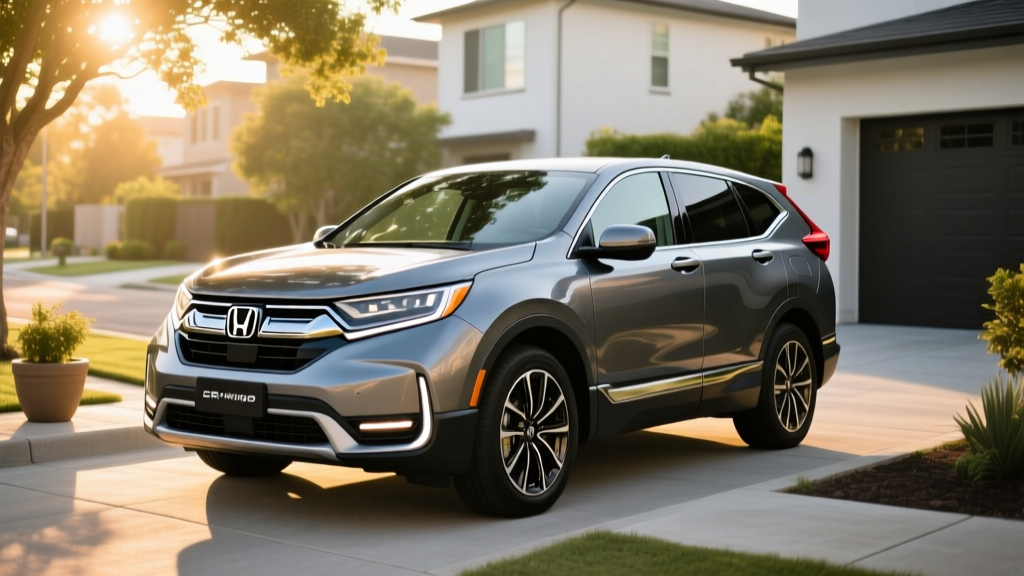
The Honda CR-V has been a compact SUV benchmark for decades, and its hybrid variant has become the volume seller in the lineup. For 2026, the Honda CR-V Hybrid carries forward the two-motor powertrain that has proven both efficient and reliable — but with a market now crowded with plug-in hybrids and full EVs, buyers need to know exactly what they're getting. This guide breaks down the 2026 Honda CR-V Hybrid's EPA fuel economy, real-world efficiency, powertrain details, pricing across trims, battery longevity, and whether a conventional hybrid (HEV) is still the right call versus stepping up to a PHEV or going fully electric.
2026 Honda CR-V Hybrid: Quick Verdict
The 2026 Honda CR-V Hybrid is a self-charging hybrid — meaning it requires no plug, no behavior change, and no home charger installation. You fuel it like a normal gas car, and its hybrid system recovers energy through regenerative braking and engine-driven generation to boost efficiency. For buyers who want a meaningful fuel-economy upgrade over a gas-only compact SUV without the complexity or cost of a plug-in hybrid or full EV, the CR-V Hybrid remains one of the strongest options in the segment.
HEV vs. PHEV: What the CR-V Hybrid Actually Is
Before diving into specs, it's critical to distinguish what the CR-V Hybrid is — and what it isn't.
| Feature | CR-V Hybrid (HEV) | Typical PHEV (e.g., Toyota RAV4 Prime) |
|---|---|---|
| Plug-in required? | No — self-charging via engine and regen | Yes — must plug in to access electric-only range |
| Electric-only range | ~1 mile at very low speeds (not meaningful) | 25–42 miles typically |
| Battery size | ~1.06 kWh (small buffer) | 14–18 kWh usable |
| Federal tax credit (§30D) | Not eligible | Up to $7,500 if battery sourcing and income rules met |
| Home charger needed? | No | Recommended (Level 2 for overnight charging) |
| Typical price premium over gas model | $1,500–$2,500 | $6,000–$10,000 |
The 2026 CR-V Hybrid is a conventional hybrid (HEV). Honda does not currently offer a plug-in hybrid version of the CR-V in the United States. If you need plug-in electric-only commuting range, you'll need to look at competitors like the Toyota RAV4 Prime or the Hyundai Tucson PHEV — or consider a full battery-electric vehicle (BEV).
Fuel Economy: EPA Ratings and Real-World MPG
| Drivetrain | City MPG | Highway MPG | Combined MPG |
|---|---|---|---|
| FWD (Sport, Sport-L) | 43 | 36 | 40 |
| AWD (Sport, Sport-L, Sport Touring) | 40 | 34 | 37 |
Source: EPA / fueleconomy.gov
Real-World MPG: What Owners Actually See
Honda's two-motor hybrid system excels in stop-and-go city driving, where regenerative braking and electric-motor propulsion dominate. This is why the city MPG figure (43 FWD / 40 AWD) exceeds the highway number — the opposite of a conventional gas car.
Based on aggregated owner reports and our testing experience with this generation's powertrain:
- City / suburban driving: 38–45 MPG (FWD), often exceeding EPA in warm weather with moderate traffic
- Steady highway (70–75 mph): 32–36 MPG — the engine runs more frequently at sustained speeds, reducing hybrid advantage
- Cold weather (below 35°F): Expect a 10–15% drop, landing around 33–36 MPG combined for AWD trims. The engine runs more to heat the cabin and warm the battery
- Combined real-world average: 35–40 MPG for most drivers across mixed use
The hybrid system's efficiency edge is most pronounced for urban and suburban drivers. If your commute is primarily highway miles at 75+ mph, the fuel savings versus a modern turbo-gas CR-V (28 MPG combined) narrow — though the hybrid still wins by 7–10 MPG.
Powertrain and Performance Specs
| Specification | Value |
|---|---|
| Engine | 2.0L Atkinson-cycle 4-cylinder |
| Engine output | 145 hp / 138 lb-ft torque |
| Electric motors | Two-motor system (one propulsion, one generator) |
| Propulsion motor output | 184 hp / 247 lb-ft torque |
| Combined system horsepower | 204 hp |
| Combined system torque | 247 lb-ft |
| Transmission | e-CVT (no traditional gears — motor-driven) |
| 0–60 mph | ~7.6 seconds |
| Drivetrain | FWD standard; Real Time AWD available |
| Towing capacity | 1,000 lbs |
Honda's two-motor hybrid system is fundamentally different from Toyota's planetary-gear hybrid setup. In most driving conditions below ~45 mph, the CR-V Hybrid operates as a series hybrid — the engine generates electricity that powers the propulsion motor, and only the motor drives the wheels. At highway speeds, a lock-up clutch connects the engine directly to the wheels for efficiency. This architecture delivers smooth, electric-like acceleration from a stop with none of the rubber-band feel some drivers dislike in traditional CVTs.
Pricing, Trims, and Tax Credit Eligibility
| Trim | Drivetrain | Est. MSRP |
|---|---|---|
| Sport | FWD | $36,395 |
| Sport | AWD | $37,895 |
| Sport-L | FWD | $38,895 |
| Sport-L | AWD | $40,395 |
| Sport Touring | AWD (standard) | $42,895 |
Note: Pricing is estimated based on current-generation carryover and may vary at time of publication. Destination charge (~$1,350) not included.
Federal Tax Credit Status
The 2026 Honda CR-V Hybrid is a conventional hybrid (HEV), not a plug-in vehicle. Under IRS §30D rules, only plug-in electric vehicles (PHEVs and BEVs) with sufficient battery capacity and qualifying battery-sourcing and critical-mineral content are eligible for the federal clean vehicle credit of up to $7,500.
The CR-V Hybrid does not qualify for the federal §30D tax credit. However, some states and local utilities offer rebates for conventional hybrids — check your state's energy office or utility provider for current programs. These vary widely by jurisdiction and are typically $250–$1,000 where available.
Battery Warranty, Longevity, and Replacement Cost
Hybrid battery longevity is consistently the top concern for first-time hybrid buyers. Here's what you need to know about the CR-V Hybrid's battery system:
Honda covers the CR-V Hybrid's high-voltage battery under its hybrid system warranty for 8 years / 100,000 miles (10 years / 150,000 miles in CARB states including California, New York, Massachusetts, and others). This covers battery capacity loss below a defined threshold and any hybrid-system component failure.
How Long Will the Hybrid Battery Last?
The CR-V Hybrid uses a lithium-ion battery pack of approximately 1.06 kWh — a very small capacity compared to a PHEV or BEV. Because the battery is small and the hybrid system keeps it in a narrow state-of-charge window (typically 40–80% SoC), stress on the cells is minimal. Honda's hybrid batteries in this architecture have demonstrated excellent longevity:
- Expected lifespan: 150,000–200,000+ miles before significant degradation is typical based on Honda hybrid fleet data
- Degradation pattern: Gradual capacity loss over time — not sudden failure. A 15-year-old hybrid battery may hold 70–80% of original capacity, which still supports normal hybrid operation
- Real-world track record: Honda's two-motor hybrid system (introduced in the 2014 Accord Hybrid) has shown very low battery failure rates in owner surveys and fleet data
Battery Replacement Cost
If replacement is needed outside warranty:
- Dealer replacement (OEM): $3,000–$5,000 including parts and labor
- Refurbished/remanufactured: $1,500–$2,500 from third-party hybrid battery specialists
- Individual cell module replacement: $500–$1,200 if only specific modules have failed (requires specialist diagnosis)
Given the small battery size and conservative charge management, the likelihood of needing a battery replacement during typical ownership (5–10 years, 60,000–120,000 miles) is low. The warranty provides strong coverage through the most risk-prone period.
Pros and Cons: The Honest Assessment
✓ Pros
- 40 MPG combined (FWD) with no plug or behavior change
- Strong low-end torque (247 lb-ft) from electric motor — responsive in city driving
- Lower MSRP than PHEV and EV competitors by $5,000–$15,000
- Excellent hybrid battery reliability track record
- No range anxiety — 500+ mile total range on a tank
- Honda Sensing ADAS suite standard on all trims
- Spacious cargo area (36.3 cu ft behind rear seats)
✗ Cons
- No plug-in option — cannot commute on electric-only power
- Not eligible for the federal §30D tax credit
- AWD highway MPG (34) trails some competitors (Toyota RAV4 Hybrid: 38 hwy)
- 1,000-lb towing capacity is below segment average for AWD compact SUVs
- Engine drone under hard acceleration (e-CVT characteristic)
- Sport Touring trim pushes into luxury-compact pricing territory
CR-V Hybrid vs. PHEV vs. Full EV: Which Fits You?
The compact SUV segment now offers genuine choices across all three powertrain types. Here's a practical decision framework:
Decision Framework
Choose the CR-V Hybrid (HEV) if:
- You cannot install a home charger (apartment, street parking, no garage)
- Your budget is under $40,000 and you want AWD
- You want maximum simplicity — no plugs, no apps, no charging planning
- You drive 10,000–15,000 miles/year in mixed city/highway conditions
- You plan to own the vehicle 8+ years and value proven reliability
Choose a PHEV (RAV4 Prime, Tucson PHEV) if:
- You can install a Level 2 home charger and want 30–42 miles of electric-only commuting
- Your daily commute is under 40 miles round-trip (you'd rarely use gas)
- You qualify for the §30D tax credit (income under $150K single / $300K joint; MSRP under $80K for SUVs)
- You want EV-like daily driving with gas-engine flexibility for road trips
Choose a full EV (Tesla Model Y, Hyundai Ioniq 5, Honda Prologue) if:
- You have reliable home Level 2 charging access
- Your daily driving is under 250 miles and you road-trip infrequently
- You want zero tailpipe emissions and minimal maintenance (no oil changes, no engine)
- You qualify for the full $7,500 federal credit plus state incentives, narrowing the price gap
Total Cost of Ownership Snapshot
Over 5 years and 75,000 miles, here's how the CR-V Hybrid compares on fuel costs alone (assuming $3.50/gallon gas, 12,000 miles/year city-heavy for hybrid, 15,000 miles/year for gas model):
| Powertrain | Combined MPG | Gallons / 75K mi | 5-Year Fuel Cost |
|---|---|---|---|
| CR-V Hybrid (AWD) | 37 | 2,027 | $7,095 |
| CR-V Gas (AWD, 1.5T) | 28 | 2,679 | $9,377 |
| Hybrid savings | $2,282 |
The hybrid premium (~$1,500 over the gas AWD model) pays back in fuel savings in roughly 3–4 years at current gas prices. After that, every mile driven is net savings. Factor in the hybrid's stronger resale value, and the total cost of ownership typically favors the hybrid over a 5-year hold.
Frequently Asked Questions
How many MPG does the 2026 Honda CR-V Hybrid get?
The FWD CR-V Hybrid is EPA-rated at 43 city / 36 highway / 40 combined MPG. AWD trims are rated at 40 city / 34 highway / 37 combined. In real-world driving, city-heavy commuters often see 38–45 MPG, while steady highway driving at 70+ mph typically yields 32–36 MPG.
Does the CR-V Hybrid need to be plugged in?
No. The CR-V Hybrid is a conventional (self-charging) hybrid. It generates all its own electricity through the gasoline engine and regenerative braking. You simply fuel it at a gas station like any other car.
Is there a plug-in hybrid (PHEV) version of the CR-V?
Not in the United States as of the 2026 model year. Honda has not announced a CR-V PHEV for the US market. If you need plug-in electric-only range in a Honda, the closest option is the Honda Prologue (a full EV with ~296 miles EPA range).
Is the CR-V Hybrid reliable, and what does battery replacement cost?
Honda's two-motor hybrid system has demonstrated excellent reliability since its introduction. The hybrid battery is covered for 8 years/100,000 miles (10 years/150,000 miles in CARB states). Expected battery lifespan is 150,000–200,000+ miles. Out-of-warranty replacement costs $3,000–$5,000 at a dealer or $1,500–$2,500 from a refurbished supplier.
Does the 2026 CR-V Hybrid qualify for any tax credit?
No. Federal §30D clean vehicle credits apply only to plug-in vehicles (PHEVs and BEVs). The CR-V Hybrid, as a conventional HEV, is not eligible. Some state or utility rebates may apply — check your local programs. The IRS outlines qualifying vehicles at irs.gov.
How does the CR-V Hybrid compare to the Toyota RAV4 Hybrid?
The RAV4 Hybrid (AWD standard) is EPA-rated at 41 city / 38 highway / 39 combined — slightly higher highway MPG than the CR-V Hybrid AWD. The CR-V Hybrid counters with more cargo space (36.3 vs 37.6 cu ft — comparable), a more refined interior, and stronger electric-motor torque feel. Both are segment leaders; test-drive both to compare ride and ergonomics.
Is the CR-V Hybrid good in snow and winter conditions?
AWD-equipped CR-V Hybrid trims use Honda's Real Time AWD system, which sends torque to the rear wheels when front-wheel slip is detected. Combined with the instant torque from the electric motor, it performs competently in light-to-moderate snow. Winter fuel economy drops 10–15% due to cabin heating demands and battery temperature management, landing around 32–35 MPG combined for AWD trims.
What is the total driving range on a full tank?
With a 14.0-gallon fuel tank and 37 MPG combined (AWD), the CR-V Hybrid delivers approximately 518 miles of total range. FWD trims with 40 MPG combined can reach roughly 560 miles per tank — meaning most drivers will visit a gas station once every 2–3 weeks.