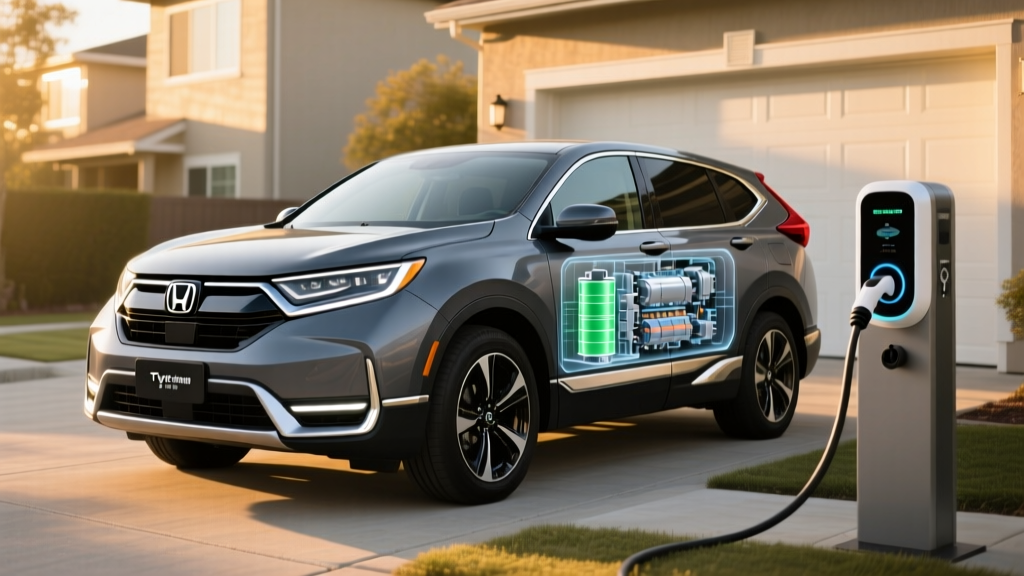
The Honda CR-V has long been the default compact SUV for practicality-minded buyers, and the hybrid variant continues to anchor the lineup for the 2025 model year. With a two-motor hybrid system delivering 204 combined horsepower and an EPA-estimated 40 MPG combined (for front-wheel-drive trims), the 2025 Honda CR-V Hybrid targets drivers who want meaningful fuel savings without altering their fueling habits. No plug required, no range anxiety — just a conventional hybrid (HEV) that sips fuel, especially in city driving.
But how does the CR-V Hybrid stack up against its plug-in hybrid (PHEV) competitors, full electric SUVs, and even its own turbocharged gas sibling? This guide breaks down every number that matters — EPA MPG, real-world fuel economy, powertrain specs, warranty coverage, and total cost of ownership — so you can decide whether the CR-V Hybrid is the right electrified SUV for your driveway.
Hybrid vs. PHEV vs. Gas: Where the CR-V Hybrid Fits
Before diving into specs, it's essential to clarify what the 2025 CR-V Hybrid is — and what it isn't. The CR-V Hybrid is a conventional hybrid electric vehicle (HEV). It pairs a 2.0-liter Atkinson-cycle gasoline engine with two electric motors and a small lithium-ion battery pack (approximately 1.06 kWh). The battery recharges exclusively through regenerative braking and the gasoline engine. You never plug it in.
This is fundamentally different from a plug-in hybrid (PHEV) like the Toyota RAV4 Prime or Hyundai Tucson PHEV, which carries a larger battery (typically 15–20 kWh), offers 30–42 miles of electric-only driving, and requires plugging in to realize its full efficiency advantage. The CR-V lineup does not currently offer a PHEV variant in the United States.
HEV vs. PHEV — Key Differences
| Feature | CR-V Hybrid (HEV) | Typical Compact PHEV |
|---|---|---|
| Plug-in charging | No — never plugs in | Yes — Level 1 or Level 2 |
| Battery size | ~1.06 kWh | 15–20 kWh |
| Electric-only range | ~1 mi (low-speed assist only) | 30–42 mi |
| EPA combined MPG | 37–40 MPG | 35–40 MPG (gas mode); 94+ MPGe (charge-sustaining + EV) |
| Federal tax credit (§30D) | Not eligible | Up to $7,500 if eligible |
| Price premium over gas | ~$1,500–$2,000 | ~$5,000–$9,000 |
Powertrain and Performance: 204 HP, Two-Motor Hybrid System
Honda's fourth-generation two-motor hybrid system powers every 2025 CR-V Hybrid. Here's how the hardware breaks down:
- Engine: 2.0-liter DOHC Atkinson-cycle 4-cylinder, producing 145 hp and 134 lb-ft of torque
- Drive motors: Two electric motors (one primarily a generator, one a traction motor) producing a combined 181 hp and 247 lb-ft of torque
- Combined system output: 204 hp and 247 lb-ft of torque
- Transmission: Electronically controlled continuously variable transmission (eCVT) — no traditional gears or belts; uses a lock-up clutch for direct engine drive at highway speeds
- Drivetrain: Front-wheel drive (FWD) standard; available Real Time AWD with a rear-mounted drive motor on Sport Touring Hybrid
The electric motors provide immediate torque from a stop, which gives the CR-V Hybrid a responsive, punchy feel in city driving that belies its 204-hp rating. The 0–60 mph sprint takes approximately 7.6 seconds — competitive with the turbocharged 1.5L gas CR-V (which produces 190 hp) and noticeably quicker off the line in stop-and-go traffic thanks to electric motor torque fill.
| Specification | 2025 Honda CR-V Hybrid |
|---|---|
| Combined HP | 204 hp |
| Combined Torque | 247 lb-ft |
| Engine | 2.0L Atkinson-cycle I4 |
| Battery | ~1.06 kWh lithium-ion |
| 0–60 mph | ~7.6 sec |
| Drivetrain | FWD (standard) / Real Time AWD (available) |
| Towing Capacity | 1,000 lbs |
| Cargo Volume | 36.3 cu ft (behind rear seats) / 76.5 cu ft (max) |
| Base MSRP | $34,650 (Sport Hybrid FWD) |
Fuel Economy: EPA Ratings and Real-World MPG
Fuel economy is the headline reason buyers choose the CR-V Hybrid over its gasoline counterpart. Here's the official EPA data from fueleconomy.gov:
| Drivetrain | City | Highway | Combined |
|---|---|---|---|
| FWD Hybrid | 43 MPG | 36 MPG | 40 MPG |
| AWD Hybrid | 40 MPG | 34 MPG | 37 MPG |
| Gas CR-V (1.5T) FWD | 29 MPG | 34 MPG | 30 MPG |
| Gas CR-V (1.5T) AWD | 27 MPG | 32 MPG | 29 MPG |
Real-world MPG — what to actually expect: Hybrids like the CR-V tend to exceed their EPA city rating in stop-and-go traffic because regenerative braking recaptures energy that a gas car wastes as heat. Owners frequently report 42–46 MPG in urban commuting during mild weather. Highway driving is a different story: at sustained 70–80 mph speeds, the electric motor contributes less and the engine does most of the work, so expect 33–36 MPG on the highway (FWD). Cold weather reduces efficiency by roughly 5–10% due to increased engine idling for cabin heat and reduced battery efficiency.
For a driver covering 15,000 miles per year in mixed driving, the FWD CR-V Hybrid saves approximately 135 gallons of gasoline annually compared to the gas CR-V — roughly $450–$550 per year at current fuel prices, depending on your region.
Pricing, Trims, and Tax Credit Eligibility
The 2025 CR-V Hybrid is available in two trims:
- Sport Hybrid (FWD or AWD): Starting at $34,650 (FWD) / $36,150 (AWD), including $1,350 destination charge
- Sport Touring Hybrid (AWD standard): Starting at $40,850, including destination
The Sport Hybrid adds sport-tuned suspension, 19-inch alloy wheels, black exterior accents, and Honda's full suite of infotainment features. The Sport Touring Hybrid layers on leather-trimmed seats, a Bose 12-speaker audio system, wireless Apple CarPlay/Android Auto, heated rear seats, a hands-free power tailgate, and Honda Sensing with low-speed braking assist.
Federal Tax Credit: Not Eligible
Under IRS §30D rules, the federal clean vehicle credit (up to $7,500) applies only to plug-in electric vehicles and fuel-cell vehicles. Conventional hybrids like the CR-V Hybrid do not qualify. However, the hybrid's lower purchase price — roughly $5,000–$8,000 less than a comparable compact PHEV — and strong fuel economy often result in a lower total cost of ownership over five years even without a tax credit.
Some states and utilities offer rebates or incentives for hybrid purchases, though these are less common than EV incentives. Check your state energy office or local utility for current programs.
Battery Warranty, Reliability, and Replacement Cost
Battery longevity is the top concern for hybrid buyers, and Honda addresses it with robust coverage:
Honda Hybrid Battery Warranty
- Hybrid battery: 8 years / 100,000 miles (10 years / 150,000 miles in CARB states including CA, NY, MA, and others)
- Hybrid system components: 8 years / 100,000 miles (power control unit, electric motors, wiring)
- Powertrain warranty: 5 years / 60,000 miles
- New vehicle limited warranty: 3 years / 36,000 miles
Honda's hybrid system has proven durable in real-world use. The CR-V Hybrid's small 1.06 kWh battery undergoes shallow charge-discharge cycles — it rarely drops below 20% or charges above 80% state of charge — which dramatically extends cell life compared to full EV batteries that cycle through wider ranges. Reports of premature hybrid battery failure in the CR-V are rare.
If a replacement is needed outside warranty, a new OEM hybrid battery pack for the CR-V Hybrid typically costs between $2,000 and $4,000 including labor — a fraction of the $10,000–$20,000 cost associated with full EV battery replacement. Third-party reconditioned packs may be available for less as the vehicle ages.
For reliability ratings, the IIHS has historically named the CR-V a Top Safety Pick+, and Honda's hybrid powertrain consistently earns above-average reliability scores from major consumer testing organizations.
2025 CR-V Hybrid vs. the Competition
The compact hybrid SUV segment is competitive. Here's how the CR-V Hybrid compares to key rivals:
| Model | Type | Combined MPG | HP | Starting MSRP |
|---|---|---|---|---|
| Honda CR-V Hybrid | HEV | 37–40 | 204 | $34,650 |
| Toyota RAV4 Hybrid | HEV | 39–41 | 219 | $33,575 |
| Toyota RAV4 Prime | PHEV | 38 (gas) / 94 MPGe | 302 | $44,415 |
| Hyundai Tucson Hybrid | HEV | 38 | 226 | $33,985 |
| Ford Escape Hybrid | HEV | 39–42 | 210 | $34,490 |
| Kia Sportage Hybrid | HEV | 38–43 | 227 | $31,090 |
The RAV4 Hybrid edges the CR-V slightly in EPA combined MPG and horsepower, while the Tucson and Sportage offer competitive efficiency at lower starting prices. The CR-V Hybrid differentiates itself with class-leading cargo volume (36.3 cu ft behind the second row), Honda Sensing safety tech as standard equipment, and strong resale value. If you need plug-in electric range and qualify for the §30D tax credit, the RAV4 Prime makes a compelling case — but at a $10,000 higher starting price that only partially offsets with incentives.
Driving Impressions and Daily Ownership
The CR-V Hybrid's two-motor system operates seamlessly. Under light acceleration and at low speeds, the vehicle runs primarily on electric power, drawing from and recharging the small battery continuously. Under harder acceleration, the engine engages to assist or directly drive the wheels via a lock-up clutch at highway cruising speeds — eliminating the droning "rubber band" effect typical of older CVTs.
Regenerative braking is progressive and natural. The steering-wheel-mounted paddle shifters let you select from three levels of regen intensity, though even the strongest setting doesn't provide true one-pedal driving (the vehicle will creep at low speeds). The transition from regen to friction braking is smooth — a common trouble spot in lesser hybrid systems.
Real-world ownership considerations:
- Fuel tank: 14.0 gallons — expect 500–560 miles of real-world range per tank (FWD)
- Maintenance: Honda's hybrid system requires no special maintenance beyond standard oil changes, tire rotations, and brake fluid service. Brake pad life is often extended due to regenerative braking
- Insurance: Typically 5–10% higher than the gas CR-V due to higher vehicle cost, but lower than full EVs
- Winter driving: AWD availability and strong low-speed traction make the CR-V Hybrid a solid winter choice; expect a 5–10% MPG reduction in sub-freezing temperatures
Who Should Buy the CR-V Hybrid — And Who Shouldn't
Decision Framework
Choose the CR-V Hybrid if:
- You drive 12,000–20,000 miles/year, especially with significant city or suburban stop-and-go driving
- You don't have access to home or workplace charging (no plug needed)
- You want 35–40+ MPG without changing your fueling routine
- You value cargo space (36.3 cu ft) and Honda's safety reputation
- You want a modest price premium (~$1,500 over gas) with quick payback through fuel savings
Look at a PHEV instead if:
- You have reliable home Level 2 charging and a commute under 35 miles round-trip
- You qualify for the §30D federal tax credit (income and sourcing requirements apply)
- You want to drive mostly electric daily with gas-engine backup for road trips
Look at a full EV instead if:
- You have home charging and your daily driving stays under 250 miles
- You want zero tailpipe emissions and the lowest per-mile fuel cost
- You're ready to plan road trips around DC fast-charging infrastructure
Pros
- 40 MPG combined (FWD); often exceeds EPA in city driving
- No plug-in charging required — zero lifestyle change
- 204 hp feels responsive thanks to electric torque fill
- Class-leading cargo volume (36.3 cu ft)
- Strong 8-year/100,000-mile hybrid battery warranty
- Modest price premium over gas model (~$1,500)
Cons
- No PHEV option — can't drive on electric-only for commutes
- Not eligible for federal §30D tax credit
- Highway MPG drops to 34–36 (AWD/FWD) at sustained speeds
- AWD only available on top Sport Touring trim ($40,850)
- 1,000-lb towing capacity — limited for trailers or boats
- No spare tire (tire repair kit standard)
Frequently Asked Questions
How many MPG does the 2025 Honda CR-V Hybrid get?
The FWD CR-V Hybrid earns an EPA-estimated 43 city / 36 highway / 40 combined MPG. The AWD version drops slightly to 40 city / 34 highway / 37 combined. In real-world city driving, many owners report 42–46 MPG, while highway-heavy driving at 75+ mph yields 33–36 MPG.
Does the CR-V Hybrid need to be plugged in?
No. The CR-V Hybrid is a conventional hybrid (HEV). Its small lithium-ion battery recharges through regenerative braking and the gasoline engine. You fuel it exactly like a standard gas car — at a gas station.
How far can the CR-V Hybrid drive on electric power alone?
The CR-V Hybrid can operate on electric-only power for very short distances (roughly 1 mile) at low speeds, such as in a parking lot or stop-and-go traffic. It does not have a meaningful electric-only range like a PHEV. The electric motor primarily assists the gasoline engine to improve fuel economy and responsiveness.
Is the CR-V Hybrid reliable, and what does battery replacement cost?
Honda's hybrid system has a strong reliability track record, and the CR-V Hybrid's battery is covered by an 8-year/100,000-mile warranty (10 years/150,000 miles in CARB states). If replacement is needed out of warranty, expect to pay $2,000–$4,000 for an OEM pack including labor — significantly less than full EV battery replacement.
Does the 2025 CR-V Hybrid qualify for any tax credit?
No. Under current IRS §30D rules, the federal clean vehicle credit applies only to plug-in electric vehicles (BEVs and PHEVs) and fuel-cell vehicles. Conventional hybrids are not eligible. Some state or utility programs may offer incentives for hybrids — check local resources.
CR-V Hybrid vs. RAV4 Hybrid — which is better?
The Toyota RAV4 Hybrid offers slightly more horsepower (219 vs. 204) and a marginal MPG advantage (39–41 vs. 37–40 combined). The CR-V Hybrid counters with more cargo space (36.3 vs. 37.6 cu ft is comparable, but Honda's interior packaging is more versatile), standard Honda Sensing safety tech, and often stronger resale value. Both are excellent choices — test-drive both to compare ride quality and infotainment preference.
How long will a CR-V Hybrid battery last?
Honda's hybrid batteries are engineered for the life of the vehicle. The shallow charge-discharge cycles (the battery rarely drops below 20% or above 80% state of charge) minimize degradation. Most Honda hybrid batteries outlast 150,000+ miles with minimal capacity loss. The 8-year/100,000-mile warranty provides a safety net, extended to 10 years/150,000 miles in CARB states.