2025 Honda CR-V Hybrid Crash Rating: IIHS and NHTSA Scores
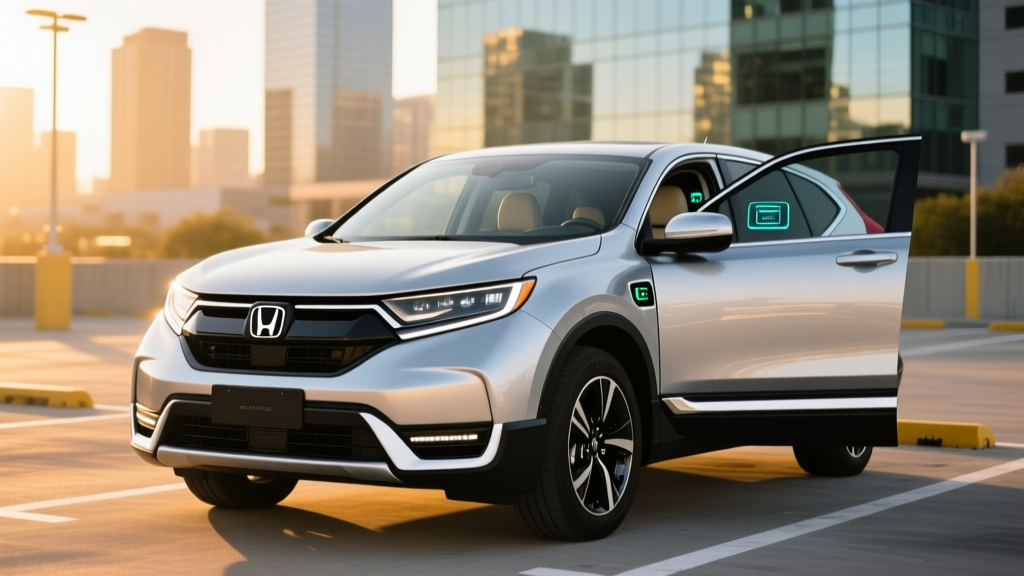
For hybrid SUV shoppers weighing safety alongside fuel economy, the 2025 Honda CR-V Hybrid delivers on both fronts. The Insurance Institute for Highway Safety (IIHS) named the 2025 CR-V Hybrid a TOP SAFETY PICK when equipped with specific headlights, earning top-tier marks across every crashworthiness test. The National Highway Traffic Safety Administration (NHTSA) awarded it an overall 5-Star Safety Rating, including 5 stars in frontal crash, side crash, and rollover evaluations.
These scores matter because they reflect real structural protection — not just the presence of airbags. Honda's ACE (Advanced Compatibility Engineering) body structure distributes crash forces across a wider area, and the CR-V Hybrid's standard Honda Sensing suite includes collision mitigation braking, road departure mitigation, adaptive cruise control, and lane-keeping assist.
• IIHS: TOP SAFETY PICK (all crashworthiness tests: Good)
• NHTSA Overall: ★★★★★ (5/5 stars)
• NHTSA Frontal Crash: 5 stars | Side Crash: 5 stars | Rollover: 4 stars
• Standard: Honda Sensing ADAS suite (SAE Level 2 driver assist — requires active driver supervision)
HEV vs. PHEV: What the CR-V Hybrid Actually Is
Before diving into MPG and ownership costs, it's critical to understand what the 2025 CR-V Hybrid is — and what it isn't. This is a conventional hybrid electric vehicle (HEV), not a plug-in hybrid (PHEV). You never plug it in. The small lithium-ion battery recharges through regenerative braking and the gasoline engine.
| Feature | HEV (CR-V Hybrid) | PHEV (e.g., Toyota RAV4 Prime) | BEV (e.g., Tesla Model Y) |
|---|---|---|---|
| Plugs in to charge? | No | Yes | Yes |
| Electric-only range | ~1 mi (low-speed assist) | 25–42 mi typical | 250–330 mi |
| Battery size | ~1.1 kWh (buffer) | 14–18 kWh usable | 60–82 kWh usable |
| Home charger needed? | No | Recommended (Level 2) | Required |
| Federal tax credit (§30D)? | No | Up to $7,500 (if eligible) | Up to $7,500 (if eligible) |
| Range anxiety risk | None — gas backup | Minimal | Moderate on road trips |
If you're cross-shopping and wondering about a CR-V PHEV — Honda does not currently sell a plug-in CR-V in the U.S. market. The e:FCEV and Clarity PHEV are discontinued. For a plug-in hybrid compact SUV, you'd look at competitors like the Toyota RAV4 Prime or the Hyundai Tucson PHEV.
Fuel Economy: EPA MPG and Real-World Numbers
The 2025 Honda CR-V Hybrid pairs a 2.0-liter Atkinson-cycle four-cylinder engine with two electric motors, producing a combined 204 horsepower. According to fueleconomy.gov, the AWD CR-V Hybrid achieves:
| Metric | City | Highway | Combined |
|---|---|---|---|
| MPG | 40 | 34 | 37 |
| Range (14.0-gal tank) | 560 mi | 476 mi | 518 mi |
Real-world expectations: Honda's hybrid system excels in city driving where the electric motors handle low-speed propulsion and regenerative braking recovers energy at every stop. Many owners report 38–42 MPG in mixed suburban driving, occasionally exceeding the EPA city estimate. On sustained highway trips at 75+ mph, expect 31–33 MPG — the gasoline engine carries the full load at higher speeds, where hybrids lose their electric-motor advantage. In cold weather (below 30°F), the engine runs more frequently for cabin heat, dropping observed economy to 33–35 MPG combined.
Compared to the gas-only 2025 CR-V AWD (28 MPG combined), the hybrid saves roughly 2.7 gallons per 100 miles. At $3.30/gallon, that's approximately $890 in annual fuel savings for a driver covering 15,000 miles — enough to recoup the hybrid's modest price premium in 2–3 years.
Powertrain, Performance, and Driving Impressions
The CR-V Hybrid uses Honda's fourth-generation two-motor hybrid system. The setup works like this:
- At low speeds and in city traffic: The gasoline engine acts as a generator, powering the electric drive motor. This gives EV-like smoothness with instant torque.
- At highway cruising: A lock-up clutch connects the engine directly to the wheels for efficient mechanical drive.
- Under hard acceleration: Both the engine and electric motors combine for the full 204 hp output.
- During braking and deceleration: The motors reverse function, acting as generators to recharge the small hybrid battery.
The result is a 0–60 mph time of approximately 7.6 seconds — adequate for merging and passing, though not sporty. The hybrid system's seamless transitions between electric and gas modes are among the smoothest in the segment, with none of the rubber-band CVT drone found in some Toyota hybrids.
Towing capacity is 1,000 pounds across all hybrid trims — suitable for a small trailer or bike rack but not for boat towing. If you need more, the gas-only CR-V AWD can tow up to 1,500 pounds.
Trims, Pricing, and Tax Credit Eligibility
The 2025 CR-V Hybrid is available in four trims, all with standard AWD:
| Trim | MSRP (incl. destination) | Key Features |
|---|---|---|
| Sport | $36,350 | 18" wheels, 7" touchscreen, wireless CarPlay/Android Auto |
| Sport-L | $38,850 | Leather seats, power liftgate, heated front seats |
| Sport Touring | $42,350 | 9" touchscreen, Bose audio, wireless charging, hands-free liftgate |
Battery Warranty, Reliability, and Replacement Cost
Hybrid battery longevity is the top concern for first-time hybrid buyers. Here's what Honda provides:
• Coverage: 8 years / 100,000 miles (10 years / 150,000 miles in CARB states including CA, NY, MA, and others)
• Capacity threshold: Honda warrants the hybrid battery against defects and abnormal capacity loss
• Battery chemistry: Lithium-ion (small-format cells, not the large packs found in BEVs)
• Out-of-warranty replacement cost: $2,500–$4,000 (dealer-installed, including labor)
Long-term reliability outlook: Honda's hybrid system has proven durable across the Accord Hybrid and CR-V Hybrid lineages. Unlike BEV batteries that see daily deep cycles (0–100% SoC), the CR-V Hybrid's small battery operates in a narrow state-of-charge window — typically between 40% and 70% — which dramatically reduces cell degradation. The battery management system (BMS) prevents extreme charge states, and regenerative braking handles most deceleration without stressing the cells.
In practice, Honda hybrid batteries routinely last 150,000–200,000+ miles before requiring replacement. Many original hybrid batteries in 2010s-era Accords and Insights are still in service. The replacement cost, if needed, is a fraction of what a BEV battery swap would cost ($10,000–$20,000+), because the CR-V Hybrid's battery pack is physically small and contains far fewer cells.
General vehicle reliability: Honda carries a strong reputation, and the CR-V platform is one of the brand's highest-volume global products. The hybrid powertrain adds complexity (two motor-generators, power electronics, inverter) but removes others (no traditional alternator, no starter motor, reduced brake wear from regen). Overall maintenance costs tend to be comparable to or slightly lower than the gas-only CR-V.
Who Should Choose the CR-V Hybrid vs. a Full EV or Gas Car?
✓ Choose the CR-V Hybrid if:
- You want 37+ MPG without changing your fueling habits
- You can't install a home charger (apartment, no garage)
- You take frequent long road trips and don't want to plan around chargers
- You live in a region with extreme cold (hybrids lose less range than EVs)
- You want lower total cost than a BEV with zero charging infrastructure dependency
✗ Look at a PHEV or BEV instead if:
- You have home charging and a short commute (a PHEV covers daily miles on electricity alone)
- You want to qualify for the $7,500 federal tax credit (requires a BEV or eligible PHEV)
- You want zero tailpipe emissions on daily driving
- You drive fewer than 40 miles daily and want to eliminate gas purchases entirely
- You want one-pedal driving and the quiet refinement of full electric propulsion
The decision framework is straightforward: If you have reliable home charging access and a predictable commute under 30 miles, a PHEV like the Toyota RAV4 Prime (42 miles electric range) or a BEV like the Hyundai Ioniq 5 (300+ miles) will save more money over five years — especially with the federal tax credit. But if you live in an apartment, take regular 400+ mile road trips, or simply want the lowest-friction upgrade from your current gas SUV, the CR-V Hybrid gives you meaningful fuel savings with zero lifestyle change.
Frequently Asked Questions
How many MPG does the 2025 Honda CR-V Hybrid get in real-world driving?
The EPA rates it at 40 city / 34 highway / 37 combined. Real-world owners typically see 38–42 MPG in suburban and city driving, with highway-only trips at 75 mph dropping to 31–33 MPG. Cold weather (below 30°F) reduces observed economy to roughly 33–35 MPG combined due to increased engine operation for cabin heating.
Does the 2025 CR-V Hybrid need to be plugged in?
No. The CR-V Hybrid is a conventional hybrid (HEV). Its small lithium-ion battery recharges automatically through regenerative braking and the gasoline engine. You fuel it exactly like a regular car — at a gas station. There is no plug, no charging cable, and no home charger required.
Does the 2025 Honda CR-V Hybrid qualify for a federal tax credit?
No. The IRS §30D Clean Vehicle Credit applies only to plug-in vehicles (BEVs and PHEVs) with battery packs of at least 7 kWh. The CR-V Hybrid's ~1.1 kWh battery does not meet this threshold. You will pay full MSRP with no federal purchase incentive. Check your state for any local hybrid incentives.
How long will the CR-V Hybrid battery last, and what does replacement cost?
Honda warranties the hybrid battery for 8 years/100,000 miles (10 years/150,000 miles in CARB states). In practice, these batteries commonly last 150,000–200,000+ miles. If replacement is ever needed, expect $2,500–$4,000 at a Honda dealer — far less than a full EV battery replacement.
How does the CR-V Hybrid compare to the Toyota RAV4 Hybrid?
Both are strong choices. The 2025 RAV4 Hybrid AWD gets a slightly higher 41/38/39 MPG EPA rating and offers a PHEV variant (RAV4 Prime with 42 miles of electric range). The CR-V Hybrid counters with a more refined interior, slightly more cargo space (36.3 vs. 37.6 cu ft behind rear seats — effectively comparable), and standard AWD on every hybrid trim. Safety ratings are comparable, with both earning IIHS Top Safety Pick status. Test-drive both to compare ride quality and seat comfort.
Is the Honda Sensing system self-driving?
No. Honda Sensing is an SAE Level 2 driver-assistance system. It provides adaptive cruise control, lane-centering, and automatic emergency braking, but the driver must remain fully engaged — hands on the wheel, eyes on the road — at all times. It does not drive the vehicle autonomously.