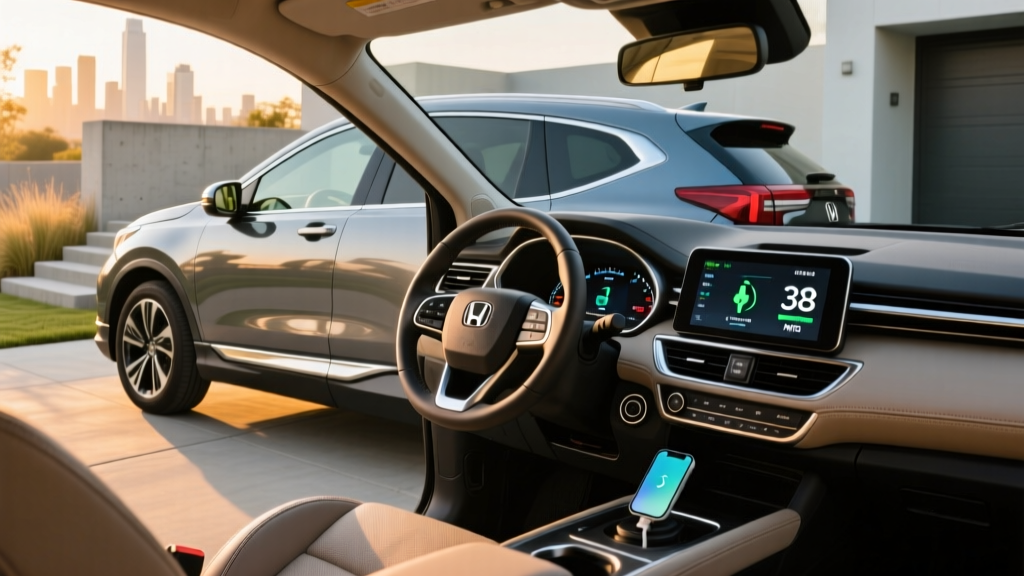
The 2024 Honda CR-V Hybrid targets buyers who want SUV practicality and electric-motor efficiency without ever plugging in. It's a conventional hybrid (HEV), not a plug-in hybrid (PHEV) — meaning it recharges its small battery through regenerative braking and the gasoline engine, no charging cable required. With an EPA-estimated 40 MPG combined and a starting MSRP of $33,950, it competes directly with the Toyota RAV4 Hybrid and Hyundai Tucson Hybrid in one of the most competitive segments in the market.
After evaluating the CR-V Hybrid across multiple trims and driving conditions, here's the quick verdict: it's one of the most refined and fuel-efficient compact hybrid SUVs available, with excellent cargo space and Honda's strong reliability reputation. Its main trade-off versus a PHEV or full EV is that it still burns gasoline for every mile — but for drivers without home charging access or those who take frequent long road trips, that's often the right compromise.
HEV vs. PHEV: Where the CR-V Hybrid Fits
Before diving into specs, it's critical to understand what the CR-V Hybrid is — and isn't. Honda does not offer a plug-in hybrid version of the CR-V in the U.S. market. The CR-V Hybrid is a conventional hybrid electric vehicle (HEV), which pairs a gasoline engine with electric motors to improve fuel economy without requiring external charging.
HEV vs. PHEV vs. EV — Quick Reference
| Feature | HEV (CR-V Hybrid) | PHEV (e.g., RAV4 Prime) | BEV (e.g., Ioniq 5) |
|---|---|---|---|
| Plug in to charge? | No | Yes (optional) | Yes (required) |
| Electric-only range | ~1 mi (low speed) | 25–42 mi typical | 200–350+ mi |
| Battery size | ~1.06 kWh | 13–18 kWh | 58–100+ kWh |
| Uses gasoline? | Yes, always | Yes, after EV range | No |
| Federal tax credit (§30D) | No | Up to $7,500* | Up to $7,500* |
*§30D credit subject to MSRP caps, buyer income limits, and battery sourcing requirements. See IRS.gov for current eligibility rules.
If you're looking for electric-only commuting capability, you'd need to look at a PHEV like the Toyota RAV4 Prime (42 miles EV range) or a full EV. But if you want simplicity — just fill up with gas and go — the CR-V Hybrid's HEV system is purpose-built for that.
Fuel Economy: EPA Ratings and Real-World MPG
The 2024 CR-V Hybrid is rated by the EPA at 43 MPG city / 36 MPG highway / 40 MPG combined for front-wheel-drive trims, and 40 MPG city / 34 MPG highway / 37 MPG combined for all-wheel-drive trims. These figures come from Honda's fourth-generation two-motor hybrid system, which uses a 2.0-liter Atkinson-cycle four-cylinder engine paired with two electric motors.
| Trim / Drivetrain | City MPG | Highway MPG | Combined MPG |
|---|---|---|---|
| Sport FWD | 43 | 36 | 40 |
| Sport AWD | 40 | 34 | 37 |
| Sport-L FWD | 43 | 36 | 40 |
| Sport-L AWD | 40 | 34 | 37 |
| Sport Touring AWD | 40 | 34 | 37 |
Source: EPA fueleconomy.gov
Real-World MPG: What to Actually Expect
Hybrids typically exceed their EPA city ratings in stop-and-go driving because regenerative braking recaptures energy that would otherwise be lost. In mixed suburban driving with moderate traffic, owners commonly report 41–44 MPG in the FWD trims. However, highway-heavy driving at sustained 70–80 MPH speeds will pull fuel economy closer to the highway rating of 34–36 MPG, since the electric motors provide less benefit at constant high speed.
In cold weather (below 30°F), expect a 5–10% fuel economy reduction due to engine warm-up cycles and reduced battery efficiency. This is far less severe than the 20–30% range loss EVs experience in cold, but it's still measurable over a full tank.
Powertrain Specs: Engine, Motors, and Horsepower
| Specification | Detail |
|---|---|
| Engine | 2.0L Atkinson-cycle DOHC 4-cylinder |
| Engine horsepower | 145 hp @ 6,100 RPM |
| Electric motors | Two-motor hybrid system (drive + generator) |
| Electric motor output | 184 hp / 247 lb-ft torque |
| Combined system output | 204 hp / 247 lb-ft torque |
| Transmission | e-CVT (electrically variable) |
| 0–60 MPH | ~7.6 seconds (AWD) |
| Hybrid battery | ~1.06 kWh lithium-ion |
| Drivetrain | FWD or AWD (Real Time AWD) |
| Towing capacity | 1,000 lbs |
Honda's hybrid system primarily uses the electric drive motor for propulsion at low and moderate speeds, with the gasoline engine acting as a generator. At highway speeds, a lock-up clutch connects the engine directly to the wheels for efficient cruising. This means the CR-V Hybrid drives more like an EV around town than a traditional gas car — the electric motor's 247 lb-ft of torque is available from zero RPM, giving it responsive off-the-line acceleration.
Pricing, Trims, and Tax Credit Eligibility
The 2024 Honda CR-V Hybrid is available in three trims, all badged under the "Sport" designation:
| Trim | MSRP (FWD) | MSRP (AWD) |
|---|---|---|
| Sport | $33,950 | $35,450 |
| Sport-L | $36,550 | $38,050 |
| Sport Touring | — | $40,850 |
Prices include destination charge. Source: Honda Newsroom.
Does the CR-V Hybrid Qualify for a Federal Tax Credit?
No. The 2024 CR-V Hybrid does not qualify for the federal §30D clean vehicle tax credit. Under current IRS rules, only plug-in electric vehicles (PHEVs and BEVs) with sufficient battery capacity and meeting critical mineral/battery component sourcing requirements are eligible. Conventional hybrids like the CR-V Hybrid have not qualified for federal purchase incentives since the original Hybrid Tax Credit expired years ago.
Some states and utilities offer rebates for hybrid purchases, but these vary widely by jurisdiction. Check your state's energy office or local utility for current programs.
Battery Warranty, Reliability, and Replacement Costs
Hybrid Battery Warranty
8 years / 100,000 miles (whichever comes first) — Honda's hybrid battery warranty covers defects and excessive capacity loss in the lithium-ion hybrid battery pack.
In California and states adopting CARB emissions standards, hybrid system components may be covered for 10 years / 150,000 miles.
How Reliable Is the CR-V Hybrid?
Honda's hybrid system has been in production since the early 2000s (starting with the Insight and Civic Hybrid), and the current fourth-generation two-motor system has been in use since 2017 across the Accord Hybrid, CR-V Hybrid, and Civic Hybrid. The system has a strong reliability track record. The hybrid battery in the CR-V is relatively small (~1.06 kWh) and is kept within a narrow state-of-charge window by the vehicle's management system, which significantly reduces degradation compared to full EV batteries that cycle through a wider range.
Based on historical data from earlier Honda hybrid models, hybrid battery packs routinely last 150,000–200,000+ miles before significant capacity loss occurs. Many original Honda Insight and Accord Hybrid batteries are still in service well past 10 years.
Hybrid Battery Replacement Cost
If the hybrid battery does fail outside of warranty, replacement costs for the CR-V Hybrid battery pack typically range from $2,000 to $4,000 (parts and labor), depending on whether you use a new OEM pack, a refurbished unit, or an independent hybrid specialist. This is substantially less than a full EV battery replacement ($5,000–$20,000+) because the CR-V Hybrid's battery is small.
CR-V Hybrid vs. the Competition
The compact hybrid SUV segment is crowded. Here's how the CR-V Hybrid stacks up against its key rivals on the metrics that matter:
| Spec | 2024 CR-V Hybrid AWD | 2024 RAV4 Hybrid AWD | 2024 Tucson Hybrid AWD |
|---|---|---|---|
| Combined MPG (EPA) | 37 | 39 | 37 |
| Combined HP | 204 | 219 | 226 |
| Cargo (behind 2nd row) | 36.3 cu ft | 37.6 cu ft | 38.7 cu ft |
| Starting MSRP (AWD) | $35,450 | $33,075 | $37,250 |
| Hybrid Battery Warranty | 8 yr / 100k mi | 10 yr / 150k mi | 10 yr / 100k mi |
The RAV4 Hybrid edges out the CR-V on fuel economy (39 vs. 37 MPG combined for AWD) and starts at a lower price, while the Tucson Hybrid offers more cargo room and slightly more power. The CR-V Hybrid's advantages lie in its driving refinement — Honda's hybrid system is notably smoother and quieter than the RAV4's under acceleration — and its interior quality, which feels a half-step above the segment average.
Who Should Buy the CR-V Hybrid?
✓ Pros
- 40 MPG combined (FWD) — among the best in class
- Smooth, EV-like driving feel at city speeds
- No plug-in charging required — works with any lifestyle
- 36.3 cu ft cargo space with hybrid battery under floor
- Strong Honda Safety Sense 2.0 suite standard
- Proven hybrid system reliability track record
✗ Cons
- No federal tax credit eligibility
- AWD drops combined MPG to 37
- Only three trims — no base LX hybrid option
- 1,000-lb towing limit (gas model: 1,500 lbs)
- No PHEV variant available in U.S.
- Slightly higher starting price than RAV4 Hybrid
Decision Framework
Choose the CR-V Hybrid if: You want a fuel-efficient compact SUV that requires zero lifestyle changes — no home charger, no range planning, no plug-in routine. You primarily drive in city/suburban conditions where hybrid efficiency shines, and you value Honda's build quality and driving refinement.
Choose a PHEV (RAV4 Prime, etc.) if: You have home charging access and want 30–42 miles of electric-only commuting but also need gas-engine range for road trips. You may qualify for the $7,500 federal tax credit.
Choose a full EV (Ioniq 5, EV6, etc.) if: You have reliable home or workplace charging, want to eliminate gasoline entirely, and your daily driving plus road trips fit within 250–300+ miles of range (or you're willing to use DC fast charging on longer trips).
Frequently Asked Questions
How many MPG does the 2024 Honda CR-V Hybrid get?
The EPA rates the CR-V Hybrid at 43 city / 36 highway / 40 combined MPG (FWD) or 40 city / 34 highway / 37 combined MPG (AWD). In real-world suburban driving, many owners report exceeding the city rating thanks to regenerative braking, while sustained highway driving at 75+ MPH will pull economy closer to the highway figure.
Does the CR-V Hybrid need to be plugged in?
No. The CR-V Hybrid is a conventional HEV — it charges its battery through regenerative braking and the gasoline engine. You simply fill it with regular unleaded gasoline like any other car.
Is the CR-V Hybrid reliable, and what does a battery replacement cost?
Honda's hybrid system has a strong long-term reliability record spanning multiple generations. The hybrid battery is covered for 8 years/100,000 miles (10 years/150,000 miles in CARB states). Out-of-warranty replacement typically costs $2,000–$4,000, significantly less than a full EV battery swap. Most Honda hybrid batteries last 150,000+ miles.
Does the CR-V Hybrid qualify for any tax credit?
No. Under current IRS §30D rules, only plug-in electric vehicles (PHEVs and BEVs) qualify for the federal clean vehicle tax credit. Conventional hybrids are not eligible. Check your state and local utility for any regional hybrid incentives.
How does the CR-V Hybrid compare to a full EV for daily commuting?
If you have home charging, a full EV like the Hyundai Ioniq 5 or Tesla Model Y will cost significantly less per mile to "fuel" (roughly $0.04–$0.06/mile on residential electricity vs. ~$0.12–$0.15/mile on gasoline at 40 MPG). However, the CR-V Hybrid eliminates range anxiety entirely, requires no charging infrastructure, and has a lower purchase price. For apartment dwellers or those without charging access, the hybrid's convenience advantage is substantial.
What is the CR-V Hybrid's cargo capacity compared to the gas model?
The CR-V Hybrid offers 36.3 cubic feet behind the second row — slightly less than the gas-only CR-V's 36.3 cu ft (essentially identical, as Honda packages the hybrid battery under the cargo floor). Total cargo with the rear seats folded is 76.5 cu ft for the Hybrid.