Honda CR-V Hybrid at a Glance: The Numbers That Matter
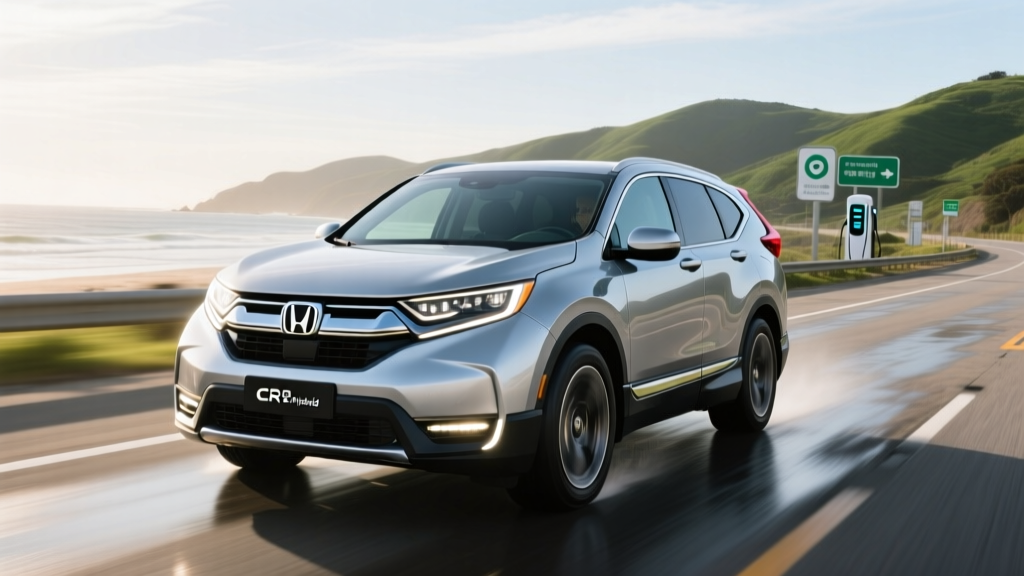
The Honda CR-V Hybrid targets buyers who want SUV practicality and strong fuel economy without plugging in. For the 2026 model year, Honda continues with its proven two-motor hybrid system across the Sport, Sport-L, and Sport Touring trims. But beyond the EPA sticker, buyers consistently search for one specific performance metric: the Honda CR-V Hybrid 0-60 time. Let's break down exactly what this powertrain delivers — acceleration, efficiency, and long-term ownership costs — with the precision you need to make a purchase decision.
| Spec | Value |
|---|---|
| 0-60 mph | 7.6 seconds (AWD, manufacturer/test data) |
| Combined Horsepower | 204 hp |
| Engine | 2.0L Atkinson-cycle 4-cylinder + 2 electric motors |
| Drivetrain | AWD standard on all Hybrid trims |
| EPA Fuel Economy (AWD) | 40 city / 34 highway / 37 combined MPG |
| Cargo Volume | 36.3 cu ft (rear seats up) / 76.5 cu ft (folded) |
| Towing Capacity | 1,000 lbs |
| Starting MSRP | $36,395 (Sport AWD) |
| Hybrid Battery Warranty | 8 years / 100,000 miles |
Acceleration and Powertrain: Where the 7.6-Second 0-60 Comes From
The CR-V Hybrid's 204 combined horsepower comes from Honda's fourth-generation two-motor hybrid system. The 2.0-liter Atkinson-cycle gasoline engine produces 146 hp on its own, but the real responsiveness comes from two electric motors that contribute a combined peak of 184 hp and 247 lb-ft of torque. Because electric motors deliver peak torque instantly from zero RPM, the CR-V Hybrid feels quicker off the line than its 7.6-second 0-60 might suggest in everyday driving — particularly in city stoplight-to-stoplight scenarios where that instant electric torque matters most.
Compared to the non-hybrid CR-V's 1.5L turbocharged engine (190 hp, 0-60 in roughly 8.0-8.3 seconds), the Hybrid actually posts a quicker time despite similar peak horsepower. The difference is the electric motor's torque fill eliminating turbo lag. In our experience, the hybrid powertrain's seamless transition between electric-only, hybrid, and engine-direct-drive modes is one of the smoothest in the compact SUV segment — no rubber-band CVT drone under moderate acceleration, thanks to Honda's lock-up clutch mechanism in the e-CVT.
Fuel Economy: EPA Ratings vs. Real-World MPG
The EPA rates the 2026 CR-V Hybrid AWD at 40 MPG city, 34 MPG highway, and 37 MPG combined. Front-wheel-drive is no longer offered on Hybrid trims for 2026 — AWD is standard across the Sport, Sport-L, and Sport Touring lineup.
| Trim | City | Highway | Combined |
|---|---|---|---|
| Sport AWD | 40 MPG | 34 MPG | 37 MPG |
| Sport-L AWD | 40 MPG | 34 MPG | 37 MPG |
| Sport Touring AWD | 40 MPG | 34 MPG | 37 MPG |
Real-world expectation: Honda's hybrid system, like Toyota's, tends to meet or slightly exceed its EPA city rating in actual urban driving. The regenerative braking and frequent engine-off coasting in stop-and-go traffic push real-world city figures to 40-43 MPG for many owners. Highway driving is a different story — at sustained 70-75 mph speeds, expect 31-34 MPG. Cold weather (below 40°F) will reduce efficiency by roughly 5-10% as the engine runs more frequently to provide cabin heat. Source: fueleconomy.gov.
For context, the non-hybrid CR-V AWD achieves 27 city / 32 highway / 29 combined MPG — meaning the hybrid delivers roughly 28% better combined fuel economy, with the biggest gains in city driving where the electric motors do the heavy lifting.
Hybrid (HEV) vs. Plug-In Hybrid (PHEV): Which CR-V Are You Looking At?
This is a critical distinction many shoppers miss. The Honda CR-V Hybrid is a conventional hybrid (HEV) — it does not plug in, has no electric-only range to speak of (roughly 1-2 miles at very low speeds), and generates all its electricity through regenerative braking and the gasoline engine. You simply fill it with gas and drive.
| Factor | HEV (CR-V Hybrid) | PHEV (e.g., Toyota RAV4 Prime) | BEV (e.g., Tesla Model Y) |
|---|---|---|---|
| Plug in to charge? | No | Yes (Level 1 or 2) | Yes (Level 2 or DC fast) |
| Electric-only range | ~1 mi (low speed) | 25-42 mi typical | 250-330 mi |
| Total range | ~440 mi | ~450-520 mi combined | 250-330 mi |
| Home charging needed? | No | Recommended for max benefit | Essential |
| Federal tax credit | Not eligible | Up to $7,500 (if eligible) | Up to $7,500 (if eligible) |
| Best for | No garage/outlet, mostly city driving | Home charging + short commute | Home charging, daily driving under 250 mi |
Honda does not currently offer a CR-V Plug-In Hybrid in the United States for the 2026 model year. If plug-in capability is a priority, competitors like the Toyota RAV4 Prime (42 miles electric-only, 38 MPG combined after battery depletion) or the Hyundai Tucson PHEV (33 miles electric-only) are the segment alternatives to cross-shop.
Pricing, Trims, and Tax Credit Eligibility
The 2026 Honda CR-V Hybrid is offered in three trims, all with AWD:
- Sport: $36,395 MSRP — 7-inch touchscreen, wireless Apple CarPlay/Android Auto, heated front seats, Honda Sensing suite
- Sport-L: $38,795 MSRP — leather-trimmed seats, power liftgate, wireless phone charger, 9-inch touchscreen
- Sport Touring: $42,395 MSRP — Bose 12-speaker audio, heated rear seats, heated steering wheel, navigation, panoramic moonroof
Federal tax credit status: The conventional CR-V Hybrid does not qualify for the IRS §30D Clean Vehicle Credit. That credit applies only to plug-in electric vehicles (PHEVs and BEVs) meeting battery sourcing, MSRP cap, and buyer income requirements. See the IRS §30D page for current eligibility rules. Some states offer modest rebates for conventional hybrids — check your state energy office or dealer for local programs, but do not count on a federal incentive here.
Battery Longevity, Warranty, and Replacement Cost
The CR-V Hybrid uses a lithium-ion battery pack (approximately 1.1 kWh usable capacity — small by design, as it buffers energy rather than storing it for plug-in driving). Honda warranties the hybrid battery for 8 years or 100,000 miles, whichever comes first. In states that follow California Air Resources Board (CARB) emissions standards — including California, New York, Massachusetts, and several others — the hybrid battery warranty extends to 10 years or 150,000 miles.
Battery Warranty Summary:
- Federal (all states): 8 years / 100,000 miles
- CARB states: 10 years / 150,000 miles
- Coverage: defects, capacity loss below functional threshold
- Estimated out-of-warranty replacement: $2,500–$4,000 (battery + labor)
Real-world reliability data: Honda's two-motor hybrid system has been in production since 2014 (Accord Hybrid, then expanded to CR-V). Out-of-warranty battery failures remain uncommon based on owner reports and NHTSA complaint databases. The system's relatively small battery undergoes shallow charge/discharge cycles — it rarely drops below 40% or above 80% state of charge — which is the least stressful operating window for lithium-ion chemistry. If a replacement is needed outside warranty, expect $2,500-$4,000 at a Honda dealer, though refurbished units may reduce cost.
The powertrain (engine, electric motors, e-CVT) is covered under Honda's 5-year/60,000-mile powertrain warranty, with the hybrid-specific components falling under the longer 8/100k coverage.
Who Should Choose the CR-V Hybrid — and Who Shouldn't
Pros
- 40 MPG city — real-world urban driving often matches or exceeds EPA
- 7.6-second 0-60 — quicker than the gas CR-V, responsive in daily driving
- AWD standard on all Hybrid trims — no drivetrain compromise
- No plug-in required — ideal for apartment dwellers or those without garage access
- Strong reliability track record with Honda's proven hybrid system
- 36.3 cu ft cargo — no battery-pack intrusion vs. gas CR-V
Cons
- No federal tax credit — HEVs are ineligible for §30D
- Highway MPG (34) trails city (40) — less advantage on long road trips
- 1,000-lb towing limit — not suitable for boat or camper trailers
- No PHEV variant available — can't do electric-only commuting
- Sport Touring at $42,395 pushes into luxury-adjacent territory without luxury badge
Choose the CR-V Hybrid if: You drive primarily in city or suburban conditions, lack access to home charging (apartment, street parking), want AWD, and plan to keep the vehicle 8+ years. The fuel savings over the gas CR-V add up to roughly $600-$800 per year at 15,000 miles driven and $3.50/gallon fuel, meaning the ~$2,000 hybrid premium pays back in 3-4 years.
Look elsewhere if: You have a garage with a 240V outlet and a commute under 35 miles — a PHEV like the RAV4 Prime would let you drive most days on electricity alone, with the gas engine as backup for road trips. Or, if you're ready for full electric and have home charging, the Hyundai Ioniq 5 or Tesla Model Y offer dramatically lower per-mile energy costs and federal tax credit eligibility, though at a higher purchase price.
Frequently Asked Questions
What is the Honda CR-V Hybrid 0-60 time?
The 2026 Honda CR-V Hybrid AWD achieves 0-60 mph in approximately 7.6 seconds. This is roughly 0.5 seconds quicker than the non-hybrid turbo CR-V AWD, thanks to the instant torque from the dual electric motors at low speeds.
How many MPG does the CR-V Hybrid actually get?
The EPA rates it at 40 city / 34 highway / 37 combined MPG. Real-world city driving often yields 40-43 MPG due to frequent regenerative braking. Highway-only driving at 70+ mph typically returns 31-34 MPG. Cold weather reduces these figures by approximately 5-10%.
Does the Honda CR-V Hybrid need to be plugged in?
No. The CR-V Hybrid is a conventional hybrid (HEV). It charges its small battery entirely through regenerative braking and the gasoline engine. You never plug it in — just refuel with gasoline as you would any conventional car.
Is the CR-V Hybrid reliable, and what does a battery replacement cost?
Honda's two-motor hybrid system has a strong reliability record since 2014. The hybrid battery is warrantied for 8 years/100,000 miles (10 years/150,000 miles in CARB states). Out-of-warranty replacement costs approximately $2,500-$4,000. Shallow cycling of the small battery pack contributes to its longevity.
Does the CR-V Hybrid qualify for any federal tax credit?
No. The IRS §30D Clean Vehicle Credit applies only to plug-in vehicles (PHEVs and BEVs). The conventional CR-V Hybrid is not eligible. Check your state energy office for any local hybrid incentives, but do not expect a federal credit.
Is there a Honda CR-V Plug-In Hybrid (PHEV)?
Not in the US market for 2026. Honda previously sold the Clarity PHEV sedan but has not introduced a CR-V PHEV stateside. If plug-in capability is essential, consider the Toyota RAV4 Prime (42 miles EV range) or Hyundai Tucson PHEV (33 miles EV range).
How does the CR-V Hybrid compare to the Toyota RAV4 Hybrid?
The RAV4 Hybrid (219 hp, 0-60 ~7.4 sec, 41/38/39 MPG AWD) is slightly more efficient on the highway and marginally quicker. The CR-V Hybrid offers a more refined interior and Honda's driving dynamics. Both are segment benchmarks — the choice often comes down to brand preference and dealer pricing in your area. See fueleconomy.gov for side-by-side EPA data.