Quick Verdict: The Compact Hybrid Benchmark Gets Sharper
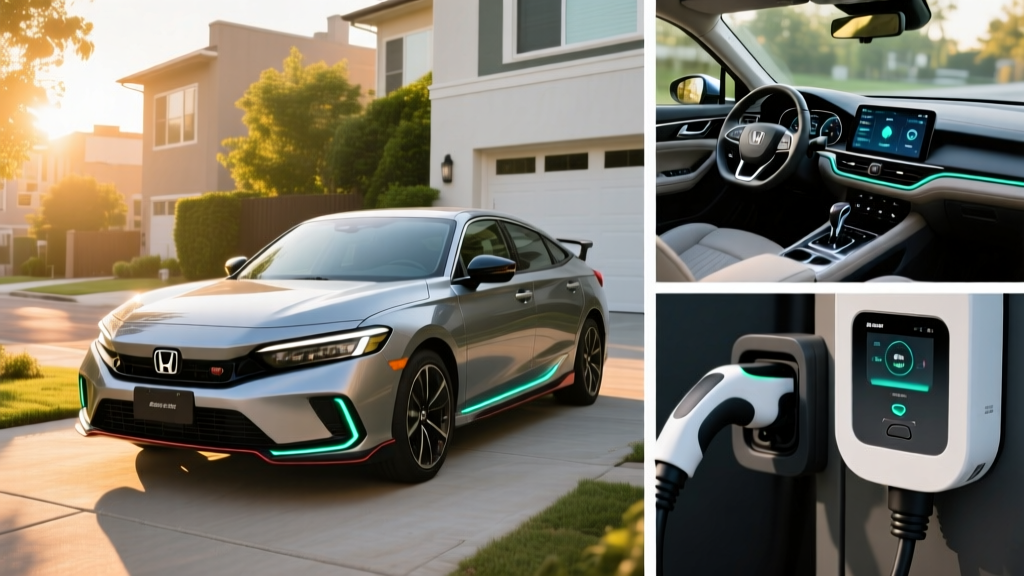
The 2026 Honda Civic Sport Touring Hybrid occupies a rare sweet spot: the fuel economy of a Prius, the driving dynamics Honda is known for, and a premium-equipment Touring trim that punches above its compact-class weight. With an EPA-estimated 49 MPG combined and a 200-horsepower two-motor hybrid powertrain, it delivers efficiency without the penalty of sluggish acceleration or budget-bin interior materials.
For buyers cross-shopping electrified compacts, the Sport Touring Hybrid is a conventional hybrid (HEV)—not a plug-in. You never plug it in. The gasoline engine and regenerative braking handle all battery charging. If you want electric-only commuting, you'll need to look at a PHEV like the Toyota Prius Prime or a full BEV. But if your priority is set-it-and-forget-it efficiency with zero lifestyle changes, this Civic makes a compelling case.
HEV vs. PHEV: What the Civic Sport Touring Hybrid Actually Is
Conventional Hybrid (HEV) — Honda Civic Sport Touring Hybrid: A small lithium-ion battery (roughly 1.1 kWh usable) charged exclusively by the gasoline engine and regenerative braking. No plug. Electric motor assists the engine and enables brief low-speed EV mode. Typical electric-only range: under 1 mile at low speeds.
Plug-In Hybrid (PHEV) — e.g., Toyota Prius Prime: A much larger battery (13.6 kWh) that you plug in to charge. Delivers 39–44 miles of electric-only driving before the gas engine engages. Requires access to charging (home or workplace) to capture full efficiency benefit.
Battery Electric Vehicle (BEV) — e.g., Hyundai Ioniq 6: No gasoline engine. Runs entirely on a large battery pack (54–77+ kWh). Requires regular charging; offers 250–360+ miles of range.
The Civic Sport Touring Hybrid is firmly in the HEV column. Honda's two-motor hybrid system uses the electric motors as the primary drive force in most conditions, with the 2.0-liter Atkinson-cycle engine acting mainly as a generator. At highway cruising speeds, a lock-up clutch connects the engine directly to the wheels for optimal efficiency. This architecture feels more like driving an EV than a traditional gas car, with smooth, linear torque delivery from a stop.
Fuel Economy: EPA Ratings and Real-World MPG
| Driving Cycle | EPA Estimate | Real-World Expectation |
|---|---|---|
| City | 50 MPG | 50–55 MPG (hybrids excel in stop-and-go) |
| Highway | 47 MPG | 43–47 MPG (sustained high speed reduces regen benefit) |
| Combined | 49 MPG | 46–52 MPG depending on driving mix |
Like most hybrids, the Civic Sport Touring Hybrid actually tends to exceed its EPA city estimate in real-world stop-and-go traffic. That's because regenerative braking recaptures energy that a conventional car wastes as heat, and the engine shuts off frequently at low speeds. On the highway, where regen opportunities are minimal and aerodynamic drag dominates, expect figures closer to the low-to-mid 40s—especially above 75 mph or in cold weather when the engine runs more often for cabin heat.
According to fueleconomy.gov, the 2026 Civic Hybrid's combined 49 MPG translates to an estimated annual fuel cost of roughly $1,050 (based on 15,000 miles/year and $3.40/gallon regular unleaded), saving approximately $2,750 in fuel costs over five years compared to the average new vehicle.
Powertrain Specs: Two-Motor Hybrid System
| Specification | 2026 Civic Sport Touring Hybrid |
|---|---|
| Engine | 2.0L DOHC Atkinson-cycle 4-cylinder |
| Hybrid System | Two-motor (drive + generator) |
| Combined System Output | 200 hp / 232 lb-ft torque |
| Transmission | e-CVT (no traditional gears) |
| Drivetrain | Front-wheel drive |
| 0–60 mph | ~7.2 seconds |
| Hybrid Battery | Lithium-ion, ~1.1 kWh (usable) |
| Fuel Tank | 10.6 gallons |
| Total Driving Range | ~519 miles (EPA combined) |
| EPA Combined MPG | 49 MPG |
| Curb Weight | ~3,150 lbs |
The 200-horsepower combined output is a meaningful advantage over competing compact hybrids. The Toyota Corolla Hybrid produces 138 hp; the Hyundai Elantra Hybrid delivers 139 hp. The Civic's torque figure—232 lb-ft available from low RPM thanks to the electric drive motor—makes it genuinely quick off the line and confident during highway passing maneuvers. The e-CVT avoids the rubber-band feel of older CVTs because the electric motor provides direct, linear response without the need for simulated gear shifts.
Sport Touring Trim: What You Get at the Top of the Lineup
The Sport Touring Hybrid sits at the top of the Civic hybrid range. For the 2026 model year, the MSRP is approximately $32,450 (including destination charge). Key equipment includes:
- 10.2-inch digital instrument cluster with hybrid power-flow display
- 9-inch touchscreen with wireless Apple CarPlay and Android Auto
- Bose premium audio system (12 speakers)
- Wireless phone charging pad
- Heated front seats and heated steering wheel
- Leather-trimmed seats
- Honda Sensing suite (adaptive cruise control, lane-keeping assist, collision mitigation, traffic sign recognition)
- 18-inch alloy wheels with matte-black accents
- LED headlights with auto high-beam
- Dual-zone automatic climate control
- Remote engine start via key fob
The Sport Touring's premium equipment positions it against entry-level luxury compacts at a fraction of the price. The trade-off versus the Sport Hybrid (MSRP ~$29,850) is roughly $2,600 for the Bose system, leather, wireless charging, and heated steering wheel—features that meaningfully improve daily comfort.
Battery Warranty, Reliability, and Replacement Cost
Honda Hybrid Battery Warranty: 8 years / 100,000 miles (10 years / 150,000 miles in CARB states including CA, NY, MA, and others that follow California emissions standards). The warranty covers battery capacity below a specified threshold and defects.
Hybrid System Warranty: 8 years / 100,000 miles on hybrid-specific components including the electric motors, power control unit, and e-CVT.
Honda's hybrid powertrains have demonstrated strong long-term reliability. The two-motor system used in the Civic is an evolution of the architecture proven in the Accord Hybrid and CR-V Hybrid, both of which have accumulated years of real-world durability data. Unlike early-generation hybrids from the 2000s, modern lithium-ion hybrid batteries are engineered to last the life of the vehicle under normal use. The small 1.1 kWh battery undergoes shallow charge-discharge cycles (typically operating between 40–80% state of charge), which dramatically reduces degradation compared to a full EV battery that cycles through a wider range.
If a hybrid battery replacement is needed out of warranty, expect a cost in the range of $2,000–$4,000 for the battery pack itself, plus labor. However, individual cell module replacement (rather than the full pack) can reduce this cost. Given Honda's track record and the shallow-cycle design, most owners will never face this expense. According to NHTSA data, hybrid system complaints for current-generation Honda models remain very low relative to the fleet size.
Does the Civic Hybrid Qualify for a Tax Credit?
No. The Honda Civic Sport Touring Hybrid is a conventional hybrid (HEV), not a plug-in vehicle. The federal IRS §30D Clean Vehicle Credit—up to $7,500—applies only to battery electric vehicles (BEVs) and plug-in hybrids (PHEVs) that meet battery sourcing, critical minerals, MSRP caps, and buyer income requirements. Conventional hybrids like the Civic Sport Touring Hybrid do not qualify for the federal credit.
Some states offer modest rebates or reduced registration fees for hybrids, but these vary widely by jurisdiction. Check your state's energy or environmental agency website for current programs. The Civic Hybrid's value proposition rests on fuel savings and low running costs rather than purchase incentives.
Who Should Choose the Civic Sport Touring Hybrid?
Choose the Civic Sport Touring Hybrid if:
- You want maximum fuel economy without changing your fueling habits (no charging needed)
- You drive a mix of city and highway miles and want a car that's efficient in both
- You value premium features (Bose audio, leather, wireless CarPlay) at a compact-car price
- You want more power than competing hybrids offer (200 hp vs. 138–139 hp)
- You live in an apartment or lack access to home/workplace charging
Look at a PHEV instead if:
- You have home charging and a short commute (under 40 miles) and want to drive mostly on electricity
- You want to qualify for the $7,500 federal tax credit (check IRS eligibility rules)
- You want to reduce gasoline use to near-zero on daily drives
Look at a full EV instead if:
- You have reliable home Level 2 charging
- Your daily driving is under 250 miles and you rarely take road trips beyond charger-network coverage
- You want zero tailpipe emissions and minimal drivetrain maintenance
Pros
- 49 MPG combined EPA; often exceeds city estimate in real-world driving
- 200 hp makes it the most powerful compact hybrid available
- Premium Touring equipment at an accessible price point
- No charging infrastructure required—fills up at any gas station
- Strong reliability record; 8–10 year hybrid battery warranty
- Refined, EV-like driving feel from the two-motor system
Cons
- No federal tax credit eligibility (HEV, not PHEV/BEV)
- Highway MPG drops to low 40s at sustained high speeds
- FWD only; no all-wheel-drive option (unlike Toyota Corolla Hybrid AWD)
- Electric-only mode limited to under 1 mile at low speeds
- Touring trim price approaches $33K, overlapping with used EV territory
Frequently Asked Questions
How many MPG does the Honda Civic Sport Touring Hybrid get?
The EPA rates the 2026 Civic Sport Touring Hybrid at 50 MPG city, 47 MPG highway, and 49 MPG combined. In real-world driving, many owners report exceeding the city figure in stop-and-go traffic (50–55 MPG) while highway driving at 75+ mph typically yields 43–47 MPG.
Do I need to plug in the Civic Sport Touring Hybrid?
No. The Civic Sport Touring Hybrid is a conventional hybrid (HEV). The battery charges through the gasoline engine and regenerative braking. There is no plug, no charging cable, and no need for any charging infrastructure.
How far can the Civic Hybrid drive on electric power alone?
Less than 1 mile, and only at low speeds (typically under 25 mph). The small ~1.1 kWh battery is designed for engine assist and regenerative energy capture, not sustained electric driving. For meaningful electric-only range (30–44 miles), a plug-in hybrid like the Prius Prime or a full EV is required.
Is the Honda Civic Hybrid reliable, and what does battery replacement cost?
Honda's two-motor hybrid system has demonstrated strong reliability across the Accord, CR-V, and Civic Hybrid lineups. The hybrid battery is warrantied for 8 years/100,000 miles (10 years/150,000 miles in CARB states). If replacement is needed out of warranty, expect $2,000–$4,000, though the shallow-cycle design means most batteries last the vehicle's lifetime.
Does the Civic Sport Touring Hybrid qualify for any tax credit?
No. The federal IRS §30D Clean Vehicle Credit applies only to plug-in vehicles (BEVs and PHEVs). The Civic Hybrid is a conventional HEV and does not qualify. Some states may offer minor hybrid incentives—check your local jurisdiction.
How does the Civic Hybrid compare to the Toyota Corolla Hybrid?
The Civic Sport Touring Hybrid offers significantly more power (200 hp vs. 138 hp), a more premium interior at the Touring trim level, and a slightly more engaging driving experience. The Corolla Hybrid offers available all-wheel drive and a lower starting price, but its EPA combined MPG (50–52 depending on trim) is only marginally higher. For buyers prioritizing performance and features, the Civic wins; for those prioritizing lowest cost and AWD availability, the Corolla is worth considering.
What is the total driving range of the Civic Sport Touring Hybrid?
With a 10.6-gallon fuel tank and 49 MPG combined EPA rating, the total range is approximately 519 miles per tank. In real-world mixed driving, expect 475–540 miles depending on conditions, driving style, and climate.