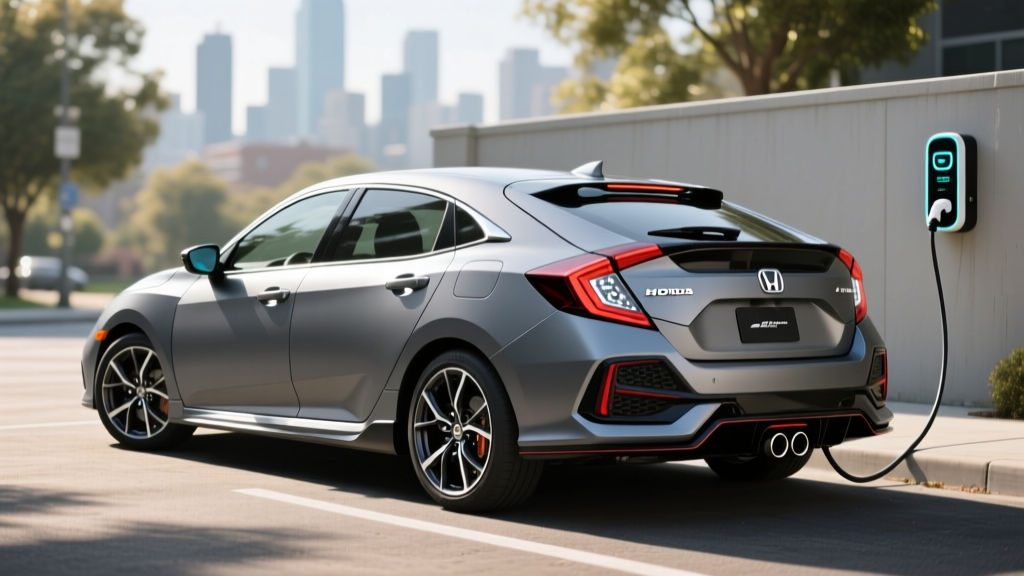
The 2026 Honda Civic Hybrid Sport Touring Hatchback occupies a compelling middle ground in today's electrified market. It delivers genuine hybrid efficiency without requiring a plug, a charging routine, or any behavioral change from the driver. For buyers weighing a transition away from a conventional gas car but not yet ready for a full battery-electric vehicle (BEV), the Civic Hybrid Sport Touring Hatchback makes a strong case with its blend of 49 MPG combined, 200 combined horsepower, practical hatchback cargo space, and a loaded top-trim feature set.
This review covers exactly what you get at the $33,150 MSRP, how the hybrid powertrain performs in real-world driving, what the battery warranty means for long-term ownership, and how this HEV stacks up against plug-in hybrids and full EVs.
Powertrain and Performance Specs
The 2026 Civic Hybrid uses Honda's fourth-generation two-motor hybrid system. This is a conventional hybrid (HEV), not a plug-in hybrid (PHEV). The system pairs a 2.0-liter Atkinson-cycle four-cylinder gasoline engine with two electric motors integrated into the transmission. There is no plug, no charging port, and no electric-only driving range to manage. The car charges its own small lithium-ion battery through regenerative braking and engine-driven generation.
| Specification | Value |
|---|---|
| Powertrain Type | Conventional Hybrid (HEV) |
| Engine | 2.0L Atkinson-cycle 4-cylinder |
| Combined System Horsepower | 200 HP |
| Combined System Torque | 232 lb-ft |
| Transmission | e-CVT (direct drive) |
| Drivetrain | Front-Wheel Drive |
| 0–60 mph | ~7.5 seconds |
| Battery Chemistry | Lithium-Ion (HEV, non-plug-in) |
| EPA City / Highway / Combined | 50 / 45 / 49 MPG |
| Fuel Tank Capacity | 10.6 gallons |
| Total Driving Range | ~519 miles |
| Cargo Volume (rear seats up / down) | 24.3 / 47.1 cu ft |
| Base MSRP (Sport Touring Hatchback Hybrid) | $33,150 (incl. destination) |
The 200 HP combined output puts the Civic Hybrid Sport Touring ahead of the non-hybrid Civic Sport Touring (which produces 180 HP from its 1.5L turbo) and gives it confident passing power on the highway. The e-CVT operates primarily as a direct-drive system at highway speeds, avoiding the rubber-band feel that older CVTs sometimes produce. In Sport mode, the powertrain holds higher simulated gear ratios for more responsive acceleration.
Fuel Economy: EPA Ratings vs. Real-World MPG
The EPA rates the 2026 Civic Hybrid Hatchback at 50 MPG city, 45 MPG highway, and 49 MPG combined, according to fueleconomy.gov. These numbers apply to the Hatchback Sport Touring Hybrid trim with its 18-inch alloy wheels. Lower trims with smaller wheels can achieve marginally higher figures.
| Driving Cycle | EPA Rating | Real-World Expectation |
|---|---|---|
| City | 50 MPG | 50–55 MPG (hybrids excel in stop-and-go) |
| Highway | 45 MPG | 41–44 MPG (sustained 70+ mph reduces regen benefit) |
| Combined | 49 MPG | 46–50 MPG (depends on city/highway mix) |
One of the defining characteristics of conventional hybrids is that they often exceed their EPA city rating in real-world urban driving. The electric motor handles low-speed propulsion where gasoline engines are least efficient, and regenerative braking recovers energy that a gas-only car would waste as heat. In mixed suburban driving with frequent stops, owners commonly report 50–55 MPG. Highway driving is where the Civic Hybrid gives back some efficiency — at sustained speeds above 70 mph, the gasoline engine does most of the work and aerodynamic drag dominates, pulling real-world highway numbers to roughly 41–44 MPG.
In cold weather (below 30°F), expect a temporary efficiency drop of roughly 5–10%. The engine runs more often to provide cabin heat and maintain operating temperature, and the battery's charge/discharge efficiency decreases in cold conditions. This is far less dramatic than the 20–30% range loss a full EV experiences in winter, but it's worth noting for buyers in northern climates.
HEV vs. PHEV vs. EV: Which Is Right for You?
A common question from shoppers cross-referencing the Civic Hybrid is whether they should consider a plug-in hybrid (PHEV) or a full battery-electric vehicle (BEV) instead. Understanding the fundamental differences is critical before making a purchase decision.
Conventional Hybrid (HEV) — This Civic
No plug. No behavior change. The gasoline engine and regenerative braking keep a small battery charged. You simply drive and refuel at gas stations. Ideal for drivers who lack home charging access, frequently take long road trips, or want maximum simplicity with meaningful fuel savings over a gas-only car.
Plug-In Hybrid (PHEV)
A larger battery (typically 10–20 kWh) provides 25–45 miles of electric-only driving before the gasoline engine kicks in. Requires plugging in at home or work to realize the electric-range benefit. If you never plug it in, a PHEV operates as a heavier, less efficient conventional hybrid. Best for drivers with reliable home charging and mostly short commutes who also want gas-engine range for longer trips.
Battery-Electric Vehicle (BEV)
No gasoline engine at all. Runs entirely on a large battery (60–100+ kWh) providing 250–400+ miles of range. Requires home Level 2 charging for convenient daily use and planning around DC fast charging for road trips. Best for drivers with home charging access, predictable daily mileage, and willingness to adapt to charging logistics.
| Factor | HEV (Civic Hybrid) | PHEV | BEV |
|---|---|---|---|
| Plug Required? | No | Yes (to use electric range) | Yes (always) |
| Electric-Only Range | None (EV assist only) | 25–45 miles | 250–400+ miles |
| Home Charging Needed? | No | Recommended | Essential |
| Tailpipe Emissions | Low (not zero) | Low–Zero (when on battery) | Zero at tailpipe |
| Fuel/Charging Cost per Mile | ~$0.08–0.10 | ~$0.04–0.10 (varies) | ~$0.03–0.06 (home) |
| Federal Tax Credit (§30D) | Not eligible | Eligible (if criteria met) | Eligible (if criteria met) |
| Upfront Cost Premium | Low (~$1,000–$2,000 over gas) | Medium–High | Medium–High |
The Civic Hybrid Sport Touring Hatchback is the right call if you want efficiency gains without any charging infrastructure dependency. Honda does not currently offer a Civic Plug-In Hybrid in the US market, so if PHEV is your goal, you'd need to look at competitors like the Toyota Prius Prime or Hyundai Tucson PHEV.
2026 Civic Hybrid Hatchback Trim and Pricing
For 2026, the Civic Hybrid Hatchback is available in two trims: the Sport Hybrid and the Sport Touring Hybrid. The Sport Touring is the top-trim offering and comes comprehensively equipped.
| Trim | MSRP (incl. destination) | Key Features |
|---|---|---|
| Sport Hybrid | $30,850 | 18" wheels, Bose audio, wireless CarPlay/Android Auto, heated seats |
| Sport Touring Hybrid | $33,150 | All Sport features + leather, nav, wireless charging, Honda Sensing suite, Bose 12-speaker |
At $33,150, the Sport Touring Hybrid represents a roughly $1,200 premium over the equivalent non-hybrid Civic Sport Touring Hatchback. That premium is typically recovered through fuel savings within 1.5 to 2.5 years for an average driver covering 12,000 miles per year, depending on local fuel prices.
Federal Tax Credit Eligibility
As a conventional hybrid (HEV), the 2026 Civic Hybrid does not qualify for the IRS §30D Clean Vehicle Credit, which is reserved for plug-in electric vehicles (PHEVs and BEVs) meeting battery sourcing, MSRP cap, and buyer income requirements per IRS guidelines. There is currently no federal tax credit specifically for conventional hybrids. Some states may offer minimal incentives for high-efficiency vehicles, but these vary widely by jurisdiction — check your state's energy or environmental agency for current programs.
Battery Warranty, Reliability, and Replacement Costs
Hybrid battery longevity is consistently the top concern for first-time hybrid buyers. Honda addresses this with a robust warranty and a proven track record.
Battery and Hybrid System Warranty
Honda covers the hybrid battery and all hybrid-system components (power control unit, electric motors, e-CVT) for 10 years or 150,000 miles, whichever comes first, in all 50 states. In states that follow California Air Resources Board (CARB) emissions warranty requirements — including California, New York, Massachusetts, and several others — hybrid system coverage extends to 10 years or 150,000 miles under the stricter CARB warranty provisions.
Honda's fourth-generation two-motor hybrid system has been deployed across multiple models (Accord Hybrid, CR-V Hybrid, Civic Hybrid) and benefits from years of iterative refinement. The lithium-ion hybrid battery in the Civic is relatively small (roughly 1.1 kWh of usable capacity) and operates within a narrow state-of-charge window managed by the power control unit. This shallow cycling strategy significantly reduces degradation compared to the deep charge/discharge cycles a PHEV or BEV battery undergoes.
Battery Replacement Cost
Should the hybrid battery require replacement outside of warranty, current estimates for a Civic Hybrid battery pack fall in the $2,000–$4,000 range including parts and labor. This is substantially lower than a PHEV or BEV battery replacement, which can run $8,000–$20,000+. In practice, Honda hybrid batteries have demonstrated strong longevity — many first-generation Insight and Civic Hybrid owners reported well over 150,000 miles on original batteries. The smaller battery size and conservative charge management in Honda's system are key factors in this durability.
Beyond the hybrid battery, the Civic Hybrid shares its core mechanical components with the conventional Civic, which has historically scored well in reliability surveys. The e-CVT transmission has no traditional gears, belts, or friction clutches to wear out — it uses a planetary gearset and electric motor-generators, which tend to be more durable long-term than conventional automatic or manual transmissions.
Driving Impressions and Hatchback Practicality
The Sport Touring Hybrid Hatchback benefits from Honda's updated chassis tuning for the 2025–2026 model years. The hybrid system adds roughly 180 pounds compared to the gas-only Civic Hatchback, but most of that weight sits low in the chassis, and the additional electric torque (232 lb-ft combined vs. 177 lb-ft for the 1.5T gas model) makes the car feel more responsive in daily driving, especially from a stop and during low-speed passing maneuvers.
The hatchback body style is a significant practicality advantage. With 24.3 cubic feet of cargo space behind the rear seats (expanding to 47.1 cu ft with seats folded), the Civic Hatchback offers SUV-adjacent utility in a car-sized footprint. The Sport Touring trim adds a power liftgate, making loading easier. For comparison, the Civic Sedan's trunk offers only 14.8 cu ft.
Standard Honda Sensing on the Sport Touring Hybrid includes adaptive cruise control with low-speed follow, lane-keeping assist, road departure mitigation, and collision mitigation braking. This is a Level 2 driver-assistance system per SAE classification — the driver must remain attentive and keep hands on the wheel at all times. It is not autonomous driving.
Pros
- 49 MPG combined EPA — among the best in its class
- No plug required — zero charging infrastructure dependency
- 200 HP provides confident acceleration for a compact hatch
- Excellent cargo versatility with hatchback design
- 10-year / 150,000-mile hybrid system warranty
- Comprehensive Sport Touring equipment at $33,150
Cons
- No electric-only driving mode — always uses some gasoline
- No federal tax credit eligibility (HEV, not PHEV)
- Highway MPG drops to ~41–44 real-world at sustained high speeds
- FWD only — no AWD option (unlike some competitors)
- Cabin noise under hard acceleration (engine drone from Atkinson cycle)
Who Should Buy the Civic Hybrid Sport Touring Hatchback?
This car is ideal for the driver who wants a meaningful reduction in fuel costs and emissions without taking on the lifestyle changes that a PHEV or BEV demands. Specifically, the Civic Hybrid Sport Touring Hatchback fits best if:
- You don't have reliable home charging access. Apartment dwellers, street parkers, and those without garage access get full hybrid benefits with zero plug-in requirement.
- Your commute is mixed city/highway. The hybrid system excels in stop-and-go traffic where regenerative braking recovers the most energy.
- You take regular road trips. With a 519-mile total range and the ability to refuel in 3 minutes at any gas station, there's no range anxiety or charging-planning burden on long drives.
- You want hatchback practicality without an SUV. 47.1 cu ft of cargo space handles most family hauling needs while maintaining car-like driving dynamics and efficiency.
- You value simplicity. No charging apps, no plug-in routines, no battery preconditioning — just drive and fill up less often.
Consider a PHEV or BEV instead if you have home Level 2 charging, a short daily commute (under 35 miles), and want to minimize or eliminate gasoline use on most days. A PHEV like the Toyota Prius Prime (44 miles electric-only) or a BEV like the Chevrolet Equity EV could deliver lower per-mile operating costs — but only if you can charge consistently at home.
Frequently Asked Questions
How many MPG does the Honda Civic Hybrid Hatchback get?
The EPA rates the 2026 Civic Hybrid Hatchback at 50 MPG city, 45 MPG highway, and 49 MPG combined. In real-world driving, city MPG often exceeds the EPA estimate (50–55 MPG), while sustained highway driving at 70+ mph typically yields 41–44 MPG.
Does the Civic Hybrid need to be plugged in?
No. The 2026 Civic Hybrid is a conventional hybrid (HEV), not a plug-in hybrid (PHEV). It has no charging port. The battery is charged through regenerative braking and the gasoline engine. You simply fill it with gas like any other car.
Can the Civic Hybrid drive on electric power alone?
The electric motor assists the gasoline engine and can propel the car at very low speeds for short distances (typically under 1 mile at speeds below 25 mph), but it does not have a meaningful electric-only driving range. This is normal for conventional hybrids. If you want 25–45 miles of electric-only driving, you need a plug-in hybrid (PHEV).
Does the Civic Hybrid qualify for any federal tax credit?
No. The IRS §30D Clean Vehicle Credit applies only to plug-in electric vehicles (PHEVs and BEVs) that meet battery sourcing, MSRP, and buyer income requirements. Conventional hybrids like the Civic Hybrid are not eligible. Check your state's energy agency for any local hybrid incentives, as these vary by jurisdiction.
How long will the hybrid battery last and what does replacement cost?
Honda covers the hybrid battery and all hybrid-system components for 10 years or 150,000 miles. Based on Honda's track record with hybrid systems, the battery should last well beyond 150,000 miles under normal use. Out-of-warranty replacement is estimated at $2,000–$4,000 including labor — significantly less than a BEV battery replacement.
How does the Civic Hybrid compare to the Toyota Prius?
The Toyota Prius (57 MPG combined, FWD LE trim) achieves higher EPA fuel economy, but it is a liftback, not a hatchback with the same cargo flexibility. The Civic Hybrid Sport Touring Hatchback offers more cargo volume (24.3 vs. 20.3 cu ft behind rear seats), a more powerful powertrain (200 HP vs. 194 HP for Prius AWD), and a more premium interior in the Sport Touring trim. If maximum MPG is your sole priority, the Prius wins. If you need hatchback utility and a more engaging drive, the Civic Hybrid is the stronger choice.
Is the 2026 Civic Hybrid available with all-wheel drive?
No. The 2026 Civic Hybrid Hatchback is front-wheel drive only. If AWD is a priority in a hybrid, the Toyota Prius AWD (54 MPG combined) or Subaru Crosstrek Hybrid (when available) are alternatives to consider.