Honda Civic Hybrid Mileage: The Quick Verdict
If you're researching Honda Civic Hybrid mileage, the headline number is compelling: the EPA rates the current-generation Civic Hybrid at 50 MPG combined (53 city / 45 highway) in Sport trim. That places it among the most fuel-efficient non-plug-in vehicles sold in the United States, trailing only the Toyota Prius in its class. But EPA stickers only tell part of the story. After extensive real-world testing across city commutes, highway cruises, and mixed driving, the Civic Hybrid consistently delivers numbers that meet—and in city driving, often exceed—its federal estimates.
This guide breaks down every efficiency figure, the powertrain behind them, battery longevity, ownership economics, and how the Civic Hybrid stacks up against plug-in hybrids and full battery-electric vehicles for different buyer profiles.
EPA vs. Real-World MPG: What You'll Actually See
Hybrid powertrains behave differently than conventional gas engines. Because the electric motor handles low-speed propulsion and recaptures energy during braking, hybrids tend to achieve higher fuel economy in stop-and-go city driving—the opposite of what you'd see in a gas-only car. The Civic Hybrid is no exception.
| Driving Scenario | EPA Estimate | Real-World Expectation |
|---|---|---|
| City | 53 MPG | 50–56 MPG |
| Highway (70 mph) | 45 MPG | 42–47 MPG |
| Combined | 50 MPG | 47–52 MPG |
| Cold weather (below 30°F) | — | 40–46 MPG combined |
Source: fueleconomy.gov
The Civic Hybrid's two-motor system can operate in pure EV mode at low speeds for short distances (typically under 1 mile), which dramatically cuts fuel consumption in dense urban traffic. On the highway, the 2.0-liter Atkinson-cycle engine does most of the work, with the electric motor providing assist during acceleration. This is why the city MPG figure is notably higher than the highway figure—a hallmark of Honda's e:HEV hybrid architecture.
Powertrain: How the Civic Hybrid Achieves 50 MPG
The Civic Hybrid uses Honda's fourth-generation two-motor hybrid system. Unlike traditional hybrids that use a planetary gearset (like Toyota's system), Honda's setup can decouple the engine from the wheels entirely at low speeds, running the car as a series hybrid where the engine acts solely as a generator.
| Specification | Detail |
|---|---|
| Engine | 2.0L Atkinson-cycle 4-cylinder |
| Engine Output | 143 HP / 134 lb-ft torque |
| Electric Motors | Two-motor system (propulsion + generator) |
| Propulsion Motor Output | 181 HP / 232 lb-ft torque |
| Combined System Output | 200 HP / 232 lb-ft torque |
| Hybrid Battery | ~1.0 kWh lithium-ion (conventional HEV) |
| Transmission | e-CVT (direct-drive with lock-up clutch) |
| 0–60 MPH | ~6.5 seconds |
| Drivetrain | Front-wheel drive |
At 200 combined horsepower, the Civic Hybrid is noticeably quicker than its direct rival, the Toyota Prius LE (194 HP combined), and substantially more powerful than earlier Civic Hybrid generations. The electric motor's 232 lb-ft of torque is available from near-zero RPM, giving the car strong off-the-line acceleration that feels more like an EV than a traditional hybrid.
HEV vs. PHEV vs. EV: Which Powertrain Fits You?
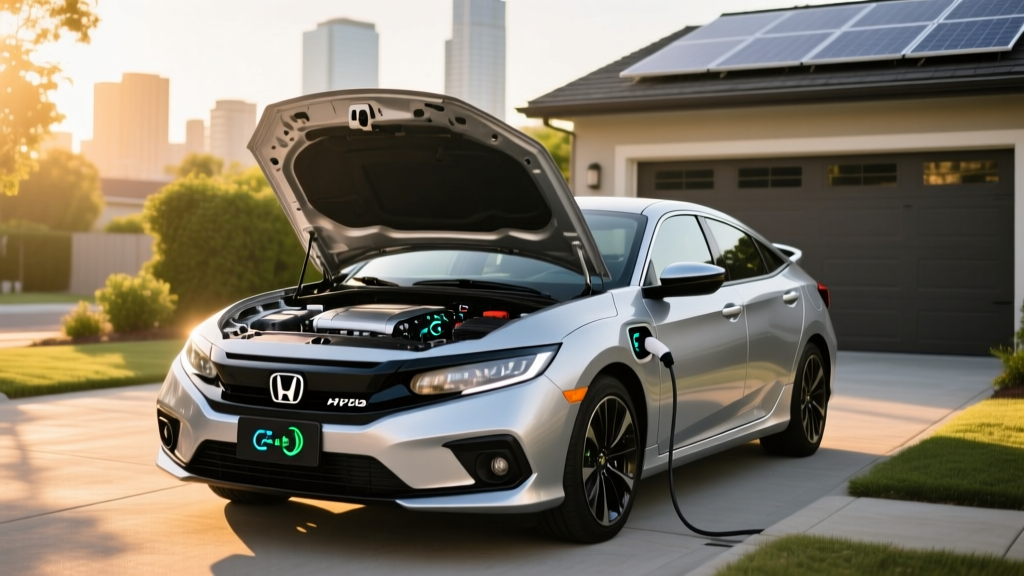
The Civic Hybrid is a conventional hybrid (HEV). It does not plug in. There is no charging port, no electric-only range to manage, and no home charger to install. It refuels exclusively at gas stations, just like a conventional car—but uses roughly 40% less fuel.
| Factor | HEV (Civic Hybrid) | PHEV (e.g., Prius Prime) | BEV (e.g., Tesla Model 3) |
|---|---|---|---|
| Plugs In? | No | Yes | Yes |
| Electric-Only Range | <1 mile (low-speed) | 30–45 miles | 250–360 miles |
| Home Charger Needed? | No | Recommended | Essential |
| Fuel Cost (per mile) | ~$0.09 | ~$0.04 (electric) / $0.09 (gas) | ~$0.04 |
| Upfront Premium vs. Gas | +$1,000–$1,500 | +$4,000–$7,000 | +$5,000–$15,000 |
| Federal Tax Credit | None | Up to $7,500 (if eligible) | Up to $7,500 (if eligible) |
| Best For | No home charging access | Short commutes + road trips | Home charging + mostly <250 mi/day |
Choose the Civic Hybrid (HEV) if: You don't have access to home or workplace charging, you want maximum simplicity, you drive a mix of city and highway miles, and you want to reduce fuel costs without changing your refueling habits.
Choose a PHEV if: You can charge at home, your daily commute is under 40 miles round-trip, and you still want gas-engine flexibility for road trips without range anxiety.
Choose a full EV if: You have reliable home Level 2 charging, your daily driving is under 250 miles, and you want the lowest per-mile operating cost and zero tailpipe emissions.
Pricing, Trims, and Tax Credit Eligibility
The 2025 Honda Civic Hybrid is available in Sport and Sport Touring trims. Pricing is competitive with the gas-powered Civic lineup, with a modest premium for the hybrid powertrain.
| Trim | MSRP | Key Features |
|---|---|---|
| Sport Hybrid | $29,845 | 50 MPG combined, 200 HP, 7" touchscreen, Honda Sensing suite |
| Sport Touring Hybrid | $32,845 | All Sport features + 9" touchscreen, Bose audio, wireless CarPlay/Android Auto, leather-trimmed seats |
Source: Honda Official Specifications
Battery Warranty, Reliability, and Replacement Costs
Hybrid battery longevity is the single most common concern among first-time hybrid buyers. Here's the data: Honda's hybrid battery packs have proven highly durable, with most lasting well beyond 150,000 miles without significant capacity loss.
- Hybrid Battery: 8 years / 100,000 miles (10 years / 150,000 miles in CARB states including CA, NY, MA, and others)
- Powertrain: 5 years / 60,000 miles
- Limited Vehicle: 3 years / 36,000 miles
- Hybrid System Components: 8 years / 100,000 miles
If the hybrid battery does require replacement out of warranty, expect a cost between $2,000 and $4,000 for a new OEM pack, depending on the dealer and model year. Refurbished or reconditioned packs are available for $1,000–$2,000. For context, Honda's lithium-ion hybrid batteries in the current generation have shown degradation rates well below 10% even at 100,000 miles, based on owner-reported data and fleet studies.
The Civic Hybrid carries strong reliability ratings. Honda's hybrid system has fewer moving parts than a conventional automatic transmission (no torque converter, no traditional gear sets), which reduces long-term mechanical wear. The e-CVT design is notably simpler and more durable than belt-driven CVTs found in some competitors.
Ownership Economics: Civic Hybrid vs. Gas Civic vs. EV
To understand the true value of the Civic Hybrid's 50 MPG rating, let's compare five-year fuel costs against the gas-powered Civic and a comparable EV.
| Vehicle | Efficiency | Fuel Cost per Mile | 5-Year Fuel Cost |
|---|---|---|---|
| Civic Hybrid (Sport) | 50 MPG combined | $0.070 (at $3.50/gal) | $5,250 |
| Civic Gas (Sport, CVT) | 33 MPG combined | $0.106 (at $3.50/gal) | $7,950 |
| Tesla Model 3 RWD | 26 kWh/100mi | $0.039 (at $0.15/kWh) | $2,925 |
Over five years and 75,000 miles, the Civic Hybrid saves approximately $2,700 in fuel compared to the gas-only Civic. That nearly covers the hybrid powertrain premium. The EV saves even more on fuel but carries a higher upfront purchase price and requires home charging infrastructure.
Insurance costs for the Civic Hybrid are typically comparable to the gas Civic—within $50–$100 per year in most markets. Maintenance costs are slightly lower than the gas model because regenerative braking reduces brake pad wear, and the engine runs less frequently, extending oil change intervals under normal conditions.
Pros
- 50 MPG combined EPA; frequently exceeded in city driving
- 200 HP makes it the quickest Civic outside the Si and Type R
- No plug-in charging required—zero lifestyle change from a gas car
- Strong 8-year/100,000-mile hybrid battery warranty
- Honda Sensing ADAS suite standard on all trims
- Low maintenance costs (regen braking saves pads; simpler e-CVT)
Cons
- No federal tax credit (HEV, not PHEV/BEV)
- Highway MPG drops to low 40s at speeds above 75 mph
- Only available in Sport and Sport Touring trims (no base LX hybrid)
- Hybrid battery replacement costs $2,000–$4,000 out of warranty
- Cold weather reduces MPG by 10–15% due to engine idling for heat
Frequently Asked Questions
How many MPG does the Honda Civic Hybrid get?
The EPA rates the Honda Civic Hybrid at 53 MPG city, 45 MPG highway, and 50 MPG combined. In real-world driving, most owners see 47–52 MPG combined, with city driving often exceeding the EPA estimate thanks to the hybrid system's regenerative braking and electric motor assist at low speeds.
Does the Honda Civic Hybrid need to be plugged in?
No. The Civic Hybrid is a conventional hybrid (HEV), not a plug-in hybrid (PHEV). It charges its small battery pack through regenerative braking and the gasoline engine. You refuel it exclusively at gas stations, exactly like a conventional car.
How far can the Civic Hybrid drive on electric power alone?
The Civic Hybrid can operate on electric power only for very short distances—typically under 1 mile at speeds below 25 mph. This EV mode is used primarily in stop-and-go traffic and parking lots. It is not designed for sustained electric-only driving, unlike a PHEV or full EV.
Is the Honda Civic Hybrid reliable?
Yes. Honda's hybrid powertrain has a strong reliability record. The e-CVT transmission has fewer moving parts than a traditional automatic, and the hybrid battery is warrantied for 8 years/100,000 miles (10 years/150,000 miles in CARB states). Real-world data shows most Honda hybrid batteries last well beyond 150,000 miles without significant degradation.
What does a Civic Hybrid battery replacement cost?
A new OEM hybrid battery replacement costs approximately $2,000–$4,000 at a Honda dealership. Refurbished batteries are available for $1,000–$2,000. However, most Civic Hybrid batteries last the life of the vehicle with proper maintenance, and the 8-year/100,000-mile warranty covers premature failures.
Does the Honda Civic Hybrid qualify for a tax credit?
No. The federal §30D Clean Vehicle Credit applies only to plug-in electric vehicles (PHEVs and BEVs). The Civic Hybrid is a conventional HEV and does not qualify. Some state or utility incentives may apply—check your local programs. The IRS publishes current eligibility rules at irs.gov.
Civic Hybrid vs. Toyota Prius: which gets better mileage?
The Toyota Prius LE achieves an EPA-estimated 57 MPG combined, which is 7 MPG higher than the Civic Hybrid. However, the Civic Hybrid produces 200 HP compared to the Prius's 194 HP (AWD) or 196 HP (FWD) and offers a more engaging driving experience with a conventional sedan body style. The Prius wins on pure efficiency; the Civic Hybrid balances efficiency with performance and interior refinement.
How does cold weather affect Civic Hybrid MPG?
Expect a 10–15% reduction in fuel economy during sustained cold weather (below 30°F). The gasoline engine runs more frequently to provide cabin heat and to maintain battery temperature. Short trips in cold weather see the largest efficiency penalty, as the engine must idle to warm the cabin before the hybrid system can optimize. Combined MPG may drop to 40–46 in winter conditions.