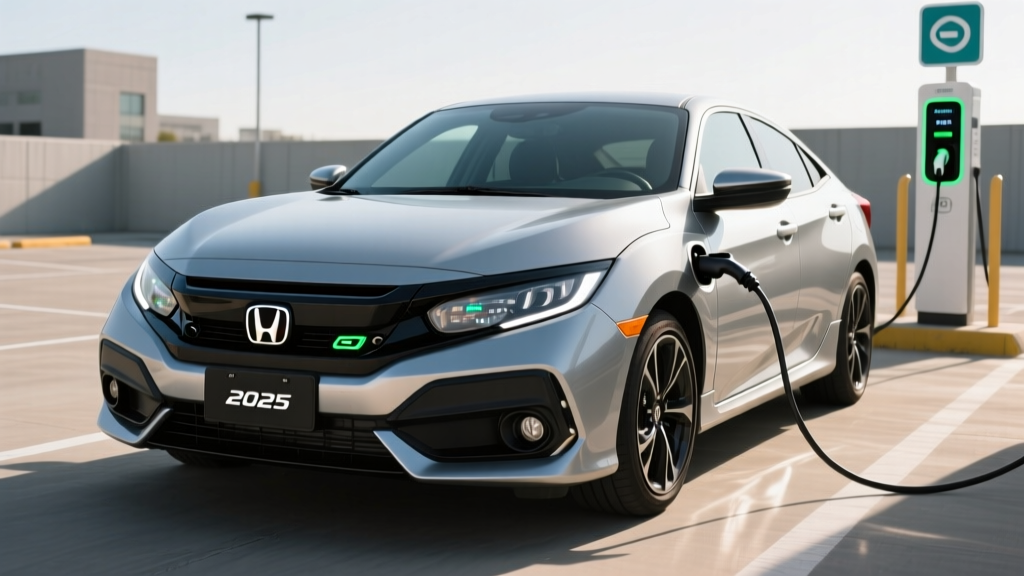
If you've searched for civic hybrid horsepower and landed here, you're likely weighing whether Honda's latest electrified compact sedan has enough punch for daily driving while still delivering the fuel-economy gains hybrids promise. The short answer: the 2025 Honda Civic Hybrid produces 200 combined horsepower and 232 lb-ft of torque from its two-motor system, paired with EPA estimates of up to 50 MPG city / 47 MPG highway / 49 MPG combined. That's a meaningful power bump over the outgoing Civic Hybrid generation and puts it squarely at the top of the compact hybrid segment for both acceleration and efficiency.
This guide covers everything a buyer needs: exact powertrain figures, real-world MPG behavior, how the Civic Hybrid (HEV) compares to plug-in hybrids and full EVs, battery longevity, warranty coverage, pricing, and whether any tax credits apply. No marketing fluff — just the data you need to decide.
Powertrain and Civic Hybrid Horsepower Explained
The 2025 Civic Hybrid uses Honda's fourth-generation two-motor hybrid system. Unlike traditional parallel hybrids that mechanically link the engine to the wheels at all times, this system operates primarily as a series hybrid at low and moderate speeds — the gasoline engine acts as a generator, and the electric drive motor propels the car. At highway speeds, a lock-up clutch connects the 2.0-liter Atkinson-cycle four-cylinder engine directly to the front wheels for efficiency.
| Specification | Value |
|---|---|
| Combined System Horsepower | 200 hp |
| Combined System Torque | 232 lb-ft |
| Gasoline Engine | 2.0L Atkinson-cycle 4-cylinder |
| Engine Output (standalone) | 141 hp / 134 lb-ft |
| Drive Motor Output | 184 hp / 232 lb-ft |
| Transmission | e-CVT (no traditional gears) |
| Drivetrain | Front-wheel drive |
| 0–60 mph (est.) | ~6.5 seconds |
The 200 hp combined figure is significant context. The previous-generation Civic Hybrid (discontinued after 2015 in the U.S.) produced roughly 110 hp combined. The non-hybrid 2025 Civic with the 2.0L naturally aspirated engine makes 158 hp, while the turbocharged 1.5L variant produces 180 hp. So the hybrid isn't a fuel-economy penalty in terms of power — it's actually the most powerful non-Si, non-Type R Civic in the lineup.
Because the electric drive motor handles most acceleration from a stop, the Civic Hybrid feels immediately responsive in city driving. Torque delivery is linear and doesn't require the engine to rev high before the e-CVT engages. Honda's system is closer in character to Toyota's Hybrid Synergy Drive than to a traditional belt-driven mild hybrid, though Honda's approach uses a larger drive motor and a smaller generator motor.
Fuel Economy: EPA Ratings vs. Real-World MPG
Honda publishes two sets of EPA fuel-economy figures depending on trim and wheel size. The Sport Hybrid sedan on 18-inch wheels is rated at 50/47/49 MPG (city/highway/combined), while the Sport Touring Hybrid on 18-inch wheels drops slightly to 49/44/47 MPG due to added weight and equipment. EPA data on fueleconomy.gov confirms these figures for the 2025 model year.
| Trim | City MPG | Highway MPG | Combined MPG |
|---|---|---|---|
| Sport Hybrid Sedan | 50 | 47 | 49 |
| Sport Touring Hybrid Sedan | 49 | 44 | 47 |
Real-World MPG: What Owners Actually See
Hybrids have a well-documented real-world advantage in city and suburban driving. Because regenerative braking recaptures energy during stop-and-go traffic and the engine shuts off at low loads, city MPG often matches or exceeds the EPA sticker. Multiple owner reports and independent tests show the Civic Hybrid consistently hitting 48–54 MPG in mixed suburban driving during moderate temperatures.
However, real-world highway efficiency tends to fall short of the EPA number. At sustained 75–80 mph speeds, the engine is doing most of the work (the electric motor contributes less at constant highway velocity), and aerodynamic drag increases exponentially. Expect 42–45 MPG on the highway during warmer months, and potentially 38–41 MPG in cold weather when the engine runs more frequently to heat the cabin and maintain battery temperature.
HEV vs. PHEV vs. EV: Which Electrified Option Fits You?
The Civic Hybrid is a conventional hybrid (HEV). It does not plug in. It has no electric-only driving range. It charges its small lithium-ion battery pack entirely through regenerative braking and the gasoline engine. This is fundamentally different from a plug-in hybrid (PHEV) or a battery electric vehicle (BEV).
| Feature | HEV (Civic Hybrid) | PHEV (e.g., Toyota Prius Prime) | BEV (e.g., Tesla Model 3) |
|---|---|---|---|
| Plug-In Charging | No | Yes | Yes |
| Electric-Only Range | 0 miles | 25–44 miles (typical) | 250–360+ miles |
| Battery Size | ~1 kWh (buffer) | 10–18 kWh usable | 50–82 kWh usable |
| Home Charging Needed | No | Recommended (Level 2) | Essential (Level 2) |
| Federal Tax Credit (§30D) | Not eligible | Up to $7,500 (if eligible) | Up to $7,500 (if eligible) |
| Fuel Cost per Mile | ~$0.09 (gas) | ~$0.04 (electric) / ~$0.09 (gas) | ~$0.04 (electric) |
| Range Anxiety | None | Minimal | Planning required on trips |
Who Should Choose the Civic Hybrid (HEV)?
The Civic Hybrid is the right pick if you:
- Don't have reliable access to home or workplace charging (apartment dwellers, street parkers)
- Want maximum fuel economy with zero behavioral change — no plugging in, no route planning
- Drive a mix of city and highway miles and want strong MPG in both
- Want a lower purchase price than a PHEV or BEV
- Take frequent long road trips where charging infrastructure may be sparse
Who Should Look at a PHEV Instead?
Consider a PHEV like the Toyota Prius Prime or Hyundai Tucson PHEV if you have home charging and most of your daily driving is under 30–40 miles. You'd commute on electricity alone and only burn gas on longer weekend trips. The trade-off is a higher purchase price and the need for a Level 1 or Level 2 home outlet.
Who Should Go Full BEV?
A battery-electric vehicle makes sense if you have Level 2 home charging, drive under 250 miles daily, want the lowest per-mile fuel cost, and are ready to plan around DC fast charging on road trips. The Civic Hybrid cannot match a BEV's running cost, but it eliminates charging logistics entirely.
Pricing, Trims, and Tax Credit Eligibility
The 2025 Civic Hybrid is available in two trims in the U.S. market:
| Trim | MSRP (incl. destination) |
|---|---|
| Sport Hybrid Sedan | ~$29,845 |
| Sport Touring Hybrid Sedan | ~$32,845 |
Both trims come well-equipped. The Sport Hybrid includes a 7-inch touchscreen, wireless Apple CarPlay/Android Auto, Honda Sensing suite (adaptive cruise, lane-keeping, automatic emergency braking), and dual-zone climate control. The Sport Touring adds a 9-inch touchscreen, wireless phone charging, Bose premium audio, heated leather seats, and a power moonroof.
Federal Tax Credit: Does the Civic Hybrid Qualify?
Some states offer their own hybrid incentives, though these have become rare as programs shift toward plug-in vehicles. Check your state's energy office or department of environmental quality for current programs. Honda occasionally offers manufacturer incentives or low-APR financing on hybrid trims — check Honda's current offers page for details.
Total Cost of Ownership vs. Gas Civic
The Civic Hybrid carries roughly a $1,200–$1,500 price premium over a comparably equipped gas-only Civic. At current national average gas prices (~$3.30/gallon) and 12,000 miles/year, the Hybrid saves approximately $500–$650/year in fuel compared to the 31 MPG combined gas Civic (2.0L CVT). That premium pays back in roughly 2–3 years, after which the savings are pure benefit. Over a 5-year ownership period, expect $2,500–$3,200 in fuel savings versus the non-hybrid model.
Battery Longevity, Warranty, and Replacement Cost
Hybrid battery degradation is a top buyer concern, but the data is reassuring. Honda's lithium-ion hybrid packs are designed with a substantial buffer — the system never fully charges or fully depletes the battery, keeping it in a mid-range state of charge that minimizes chemical stress. Unlike a BEV battery that cycles through 80–100% of its capacity daily, a hybrid battery typically cycles through only 20–40% of its total capacity per drive cycle.
Real-world data from Honda's hybrid fleet (Insight, Accord Hybrid, CR-V Hybrid) shows that most hybrid batteries retain functional capacity well beyond 150,000 miles. Failure before 100,000 miles is uncommon. When replacement is eventually needed out of warranty, a refurbished Civic Hybrid battery pack typically costs $2,000–$3,500 including labor at an independent hybrid specialist, or $3,500–$5,000 at a Honda dealer with a new OEM pack.
For comparison, a full BEV battery replacement (e.g., Tesla Model 3, Chevrolet Bolt) can run $10,000–$18,000. The Civic Hybrid's small battery is a fraction of that cost — a meaningful advantage for long-term ownership peace of mind.
Reliability and Owner Satisfaction
Honda's hybrid powertrain has a strong reliability track record. The two-motor system has fewer moving parts than a conventional automatic transmission (no torque converter, no planetary gearset, no clutch packs to wear), and regenerative braking significantly reduces wear on the friction brake pads and rotors. Many Civic Hybrid owners report brake pad life exceeding 80,000 miles.
The 2025 Civic carries strong safety ratings. The IIHS has historically rated the Civic as a Top Safety Pick, and Honda Sensing comes standard on all trims. NHTSA ratings for the 2025 model year can be checked at nhtsa.gov/ratings.
Common owner praise points include the seamless transition between electric and engine drive (Honda's system is notably smooth compared to some competitors), strong low-end torque from the electric motor, and cabin quietness at low speeds when the engine is off. Criticisms typically center on the e-CVT's drone under hard acceleration (a characteristic of all series-parallel hybrids) and the Sport Touring's slightly firmer ride on 18-inch wheels.
Frequently Asked Questions
How many MPG does the 2025 Civic Hybrid get?
The EPA rates the Sport Hybrid at 50 city / 47 highway / 49 combined MPG. The Sport Touring Hybrid is rated at 49/44/47 MPG. Real-world combined driving typically yields 44–48 MPG in moderate weather, with city driving often exceeding the EPA city number and highway driving falling 3–5 MPG below the sticker.
Does the Civic Hybrid need to be plugged in?
No. The Civic Hybrid is a conventional hybrid (HEV). It charges its battery entirely through regenerative braking and the gasoline engine. There is no plug, no charging cable, and no electric-only driving mode. You fuel it like any other gasoline car.
How much horsepower does the Civic Hybrid have?
The combined system output is 200 horsepower and 232 lb-ft of torque. The 2.0L gasoline engine alone produces 141 hp, while the electric drive motor produces 184 hp. Because the engine and motor operate through different pathways in Honda's two-motor system, the combined peak is 200 hp — not a simple sum of the two.
Is the Civic Hybrid reliable, and what does a battery replacement cost?
Honda's hybrid system has demonstrated strong long-term reliability across multiple model lines. The battery is warrantied for 8 years/100,000 miles (10/150,000 in CARB states). Out-of-warranty replacement costs range from $2,000–$3,500 (refurbished) to $3,500–$5,000 (new OEM). Most hybrid batteries last well beyond 150,000 miles based on fleet data.
Does the Civic Hybrid qualify for any federal tax credit?
No. The federal §30D Clean Vehicle Credit applies only to plug-in electric vehicles (BEVs and PHEVs) with battery capacities of at least 7 kWh. The Civic Hybrid's ~1 kWh battery does not meet this threshold. Some state-level incentives may apply — check your state's energy office.
How does the Civic Hybrid compare to the Toyota Prius?
The 2025 Toyota Prius (non-Prime) is rated at up to 57 MPG combined with 196 hp, giving it a slight edge in fuel economy. The Civic Hybrid counters with 200 hp, a more conventional sedan design, and Honda's driving dynamics. The Prius uses a dedicated hybrid platform with lower ground clearance; the Civic rides on a mainstream compact platform shared with the gas Civic. Both are strong choices — the Prius wins on pure MPG, the Civic on power and interior space.
Can the Civic Hybrid drive on electric power alone?
Only at very low speeds for short distances (typically under 1 mile at parking-lot speeds). The battery is too small (~1 kWh) to sustain electric-only driving at meaningful speeds. This is normal for conventional hybrids — if electric-only commuting is a priority, you need a PHEV or BEV.