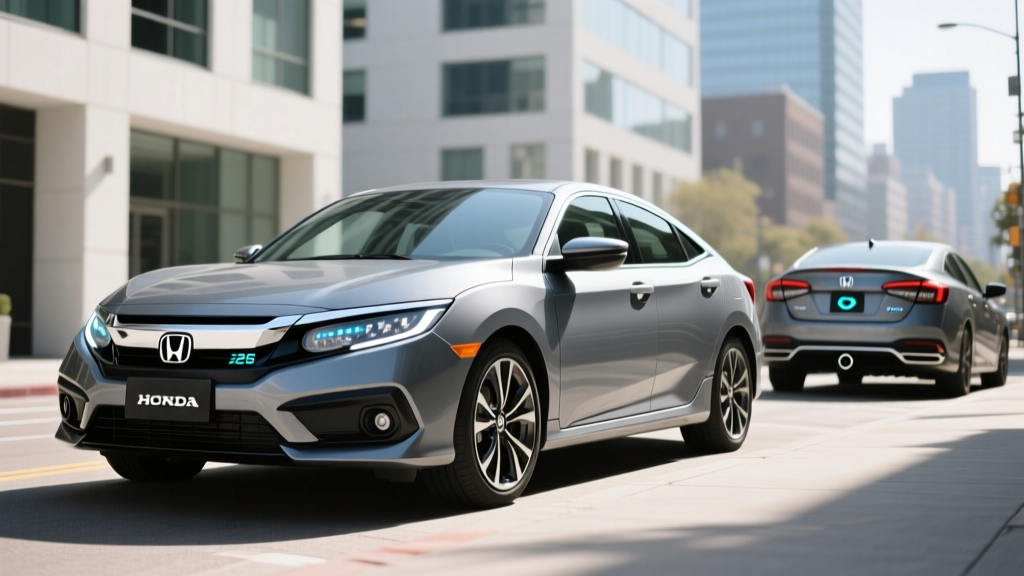
The Honda Civic Hybrid has returned as one of the most fuel-efficient compact sedans on the market, and buyers are rightly asking one question above all others: what kind of gas mileage does it actually deliver in daily driving? For 2026, Honda continues to offer the Civic Hybrid in both sedan and hatchback body styles, pairing a 2.0-liter Atkinson-cycle engine with a two-motor hybrid system that prioritizes electric propulsion at low speeds. The EPA sticker says 49 MPG combined — but as any hybrid owner knows, real-world results depend heavily on where and how you drive.
This guide breaks down every efficiency figure, powertrain specification, and ownership cost you need to evaluate the Civic Hybrid against its competitors, plug-in alternatives, and full EVs. We'll also address the battery longevity question that tops every hybrid buyer's concern list.
2026 Honda Civic Hybrid EPA MPG and Real-World Fuel Economy
The 2026 Honda Civic Hybrid sedan carries an EPA rating of 51 MPG city, 47 MPG highway, and 49 MPG combined. The hatchback variant rates slightly lower at 50/45/47 MPG (city/highway/combined) due to its heavier curb weight and less aerodynamic profile. These figures position the Civic Hybrid at the top of the compact hybrid sedan segment, competing directly with the Toyota Corolla Hybrid (50 MPG combined) and Hyundai Elantra Hybrid (54 MPG combined).
| Body Style / Trim | City MPG | Highway MPG | Combined MPG | Fuel Tank (gal) | Total Range (mi) |
|---|---|---|---|---|---|
| Sedan — Sport Hybrid | 51 | 47 | 49 | 10.6 | ~519 |
| Sedan — Sport Touring Hybrid | 51 | 47 | 49 | 10.6 | ~519 |
| Hatchback — Sport Hybrid | 50 | 45 | 47 | 10.6 | ~498 |
| Hatchback — Sport Touring Hybrid | 50 | 45 | 47 | 10.6 | ~498 |
Source: EPA Fuel Economy Guide (fueleconomy.gov)
Real-World MPG: What to Actually Expect
Hybrids have a well-documented tendency to exceed their EPA city ratings in stop-and-go traffic because regenerative braking recaptures energy that a conventional car wastes as heat. In urban commuting at speeds under 45 mph, Civic Hybrid owners regularly report 52–56 MPG on the trip computer. The two-motor system operates in EV mode extensively at low speeds, with the gasoline engine acting primarily as a generator rather than directly driving the wheels.
Highway driving tells a different story. At sustained 70–80 mph cruising, the aerodynamic drag penalty and reduced regenerative opportunity push real-world highway economy closer to 42–45 MPG. Cold weather (below 35°F) further reduces efficiency by 8–12% because the engine must run more frequently to provide cabin heat and maintain battery temperature. If your commute is predominantly highway miles, expect combined figures closer to 44–46 MPG rather than the 49 EPA sticker.
HEV vs. PHEV: Understanding What the Civic Hybrid Is (and Isn't)
A common source of confusion among shoppers is the difference between a conventional hybrid (HEV) and a plug-in hybrid (PHEV). The 2026 Honda Civic Hybrid is a conventional hybrid (HEV). It has no plug, no external charging capability, and no meaningful electric-only driving range. Honda does not currently offer a Civic PHEV in the United States market.
| Feature | HEV (Civic Hybrid) | PHEV (e.g., Toyota Prius Prime) | BEV (e.g., Tesla Model 3) |
|---|---|---|---|
| Plugs in to charge? | No | Yes | Yes |
| Electric-only range | <1 mile (low-speed only) | 25–44 miles typical | 250–360+ miles |
| Uses gasoline? | Yes — always | Yes — after battery depletes | No |
| Home charging needed? | No | Recommended (Level 1 or 2) | Essential (Level 2) |
| Federal tax credit (§30D) | Not eligible | Up to $7,500 (if eligible) | Up to $7,500 (if eligible) |
| Best for | No home charging access; want simplicity | Short commute + home charging + road trips | Home charging + mostly under 300 mi trips |
The Civic Hybrid's appeal is straightforward: you get exceptional fuel economy with zero change to your refueling habits. You still visit a gas station, but far less often — roughly every 500+ miles instead of every 300–350 miles in a conventional Civic.
Powertrain Specs: Engine, Motors, and Combined Output
Honda's two-motor hybrid system in the 2026 Civic pairs a 2.0-liter Atkinson-cycle inline-4 with an electric propulsion motor and a secondary generator motor. The system operates primarily in EV drive mode at low and moderate speeds, with the gasoline engine spinning the generator motor to produce electricity. At highway speeds, a lock-up clutch engages to let the engine drive the wheels directly for optimal efficiency.
| Specification | Detail |
|---|---|
| Engine | 2.0L Atkinson-cycle DOHC inline-4 |
| Engine horsepower | 146 hp @ 6,000 rpm |
| Engine torque | 134 lb-ft @ 4,500 rpm |
| Electric propulsion motor | 184 hp / 232 lb-ft |
| Total system output | 200 hp / 232 lb-ft |
| Transmission | e-CVT (single-speed direct drive w/ lock-up clutch) |
| Drivetrain | Front-wheel drive |
| Hybrid battery | Lithium-ion, ~1.0 kWh (under rear seats) |
| 0–60 mph (est.) | ~7.5 seconds |
The 200-hp combined output gives the Civic Hybrid noticeably more passing power than the non-hybrid 2.0L Civic (158 hp) and puts it in the same performance ballpark as the 1.5L turbo Civic (180 hp). The electric motor's instant torque delivery makes the car feel responsive in city driving — a welcome side benefit of the hybrid system beyond just fuel savings.
Pricing, Trims, and Tax Credit Eligibility
For 2026, the Honda Civic Hybrid is offered in Sport and Sport Touring trims for both the sedan and hatchback. Pricing starts in the low-$30,000 range.
| Trim | Body Style | MSRP (approx.) |
|---|---|---|
| Sport Hybrid | Sedan | $30,650 |
| Sport Touring Hybrid | Sedan | $34,650 |
| Sport Hybrid | Hatchback | $31,450 |
| Sport Touring Hybrid | Hatchback | $35,450 |
Source: Honda Official Specifications
Does the Civic Hybrid Qualify for a Federal Tax Credit?
No. The 2026 Honda Civic Hybrid is a conventional hybrid (HEV), not a plug-in vehicle. Under IRS §30D (New Clean Vehicle Credit), only battery electric vehicles (BEVs) and plug-in hybrid electric vehicles (PHEVs) with sufficient battery capacity qualify for the federal tax credit of up to $7,500. Conventional hybrids like the Civic Hybrid, Toyota Corolla Hybrid, and Hyundai Elantra Hybrid are not eligible.
- Vehicle must be a BEV or PHEV (not a conventional HEV)
- PHEV must have ≥7 kWh battery capacity
- MSRP cap: $55,000 for sedans, $80,000 for SUVs/trucks/vans
- Buyer income cap: $150K single / $225K head of household / $300K joint (MAGI)
- Battery components and critical minerals must meet phased sourcing requirements
- Credit can be transferred to dealer at point of sale for immediate price reduction
Some states offer their own incentives for conventional hybrids, though these are increasingly rare as state programs shift toward plug-in vehicles. Check your state's energy office or DMV website for any current rebate programs.
Battery Longevity, Warranty, and Replacement Cost
Battery reliability is the single most common concern among first-time hybrid buyers. The Civic Hybrid's lithium-ion hybrid battery is relatively small (~1.0 kWh) and is managed conservatively by Honda's battery management system — it never fully charges or fully depletes, which dramatically reduces stress on the cells and extends cycle life.
In practice, Honda's hybrid batteries have proven durable well beyond the warranty period. The company's hybrid systems date back to the early 2000s Insight and have accumulated millions of fleet miles. Failures before 150,000 miles are uncommon, and many hybrid batteries last the full lifespan of the vehicle (200,000+ miles).
What Does a Hybrid Battery Replacement Cost?
If a replacement is needed out of warranty, a Honda Civic Hybrid battery pack typically costs between $2,000 and $4,000 including labor at a dealership. Independent hybrid specialists and refurbished battery options can reduce this to $1,200–$2,500. For context, this is significantly less than a full EV battery replacement ($8,000–$20,000+) because the hybrid battery is much smaller.
| Item | Detail |
|---|---|
| Battery chemistry | Lithium-ion |
| Battery capacity | ~1.0 kWh |
| Warranty (federal) | 8 yr / 100,000 mi |
| Warranty (CARB states) | 10 yr / 150,000 mi |
| Expected lifespan | 150,000–200,000+ mi |
| Replacement cost (dealer) | $2,000–$4,000 |
| Replacement cost (independent/refurb) | $1,200–$2,500 |
Ownership Economics: Civic Hybrid vs. Gas Civic vs. EV
The Civic Hybrid costs roughly $2,500–$3,500 more than an equivalently trimmed gas-only Civic. At 49 MPG combined versus the gas Civic's ~35 MPG combined, and assuming 15,000 miles driven annually with gasoline at $3.50/gallon, the hybrid saves approximately $430 per year in fuel costs. That means the hybrid premium pays for itself in roughly 6–8 years at current fuel prices — or faster if gas prices rise.
| Vehicle | Combined MPG / MPGe | Annual Fuel/Energy Cost | 5-Year Fuel Cost |
|---|---|---|---|
| Civic 2.0L Gas (non-hybrid) | 35 MPG | $1,500 | $7,500 |
| Civic Hybrid | 49 MPG | $1,071 | $5,355 |
| EV (e.g., Tesla Model 3 RWD, 130 MPGe) | 130 MPGe | ~$600 (varies by electricity rate) | ~$3,000 |
Compared to a full EV, the Civic Hybrid costs more to "fuel" annually but avoids the higher purchase price, home charging installation ($500–$2,000+), and the range-planning required for road trips. The total cost of ownership gap narrows significantly when you factor in EV insurance premiums (typically 15–25% higher), faster EV depreciation in some segments, and the lack of a $7,500 tax credit for the Civic Hybrid.
Pros
- 49 MPG combined — among the best in the compact segment
- 500+ mile range per tank; no charging needed
- 200 hp system output — more responsive than gas Civic
- Proven Honda reliability; conservative battery management
- 8 yr / 100K mi hybrid warranty (10/150K in CARB states)
- No lifestyle change required from a gas car
Cons
- No federal tax credit (HEV, not PHEV/BEV)
- ~$2,500–$3,500 price premium over gas Civic
- Highway MPG drops to ~42–45 real-world at 75+ mph
- No EV-only commuting capability
- FWD only; no AWD option (unlike Toyota Corolla Hybrid)
- Small 10.6-gallon tank means more frequent stops than expected
Who Should Buy the Civic Hybrid — And Who Should Look Elsewhere?
Decision Framework
Choose the Civic Hybrid if:
- You don't have access to home or workplace charging (apartment, street parking)
- You want maximum fuel economy with zero behavior change
- Your commute is city-dominant with frequent stop-and-go traffic
- You take regular road trips and don't want to plan around chargers
- You want Honda's resale value and reliability track record
Choose a PHEV (e.g., Prius Prime) instead if:
- You have home charging and a short commute (under 40 miles)
- You want to drive on electricity most days but keep gas for road trips
- You want to qualify for the $7,500 federal tax credit
Choose a full EV (e.g., Model 3, Ioniq 6) instead if:
- You have reliable Level 2 home charging
- Your daily driving is under 250 miles and you rarely road-trip beyond charger coverage
- You want the lowest per-mile energy cost and zero tailpipe emissions
- You qualify for the full §30D tax credit, narrowing the price gap
Reliability and Safety Ratings
Honda's hybrid powertrain has accumulated a strong reliability record across multiple model lines (Accord Hybrid, CR-V Hybrid, Civic Hybrid). The two-motor system has fewer moving parts than a conventional automatic transmission — there are no gear shifts, no torque converter, and no traditional friction brakes doing all the work (regenerative braking handles most deceleration, extending pad life to 80,000+ miles in many cases).
The 2026 Civic carries top safety ratings from both NHTSA and the IIHS, with Honda Sensing (adaptive cruise control, lane-keeping assist, automatic emergency braking, traffic sign recognition) standard on all trims. Note that Honda Sensing is an SAE Level 1–2 driver-assistance system — it supports the driver but does not replace active attention and hands-on-wheel engagement.
Frequently Asked Questions
How many MPG does the 2026 Honda Civic Hybrid get?
The EPA rates the Civic Hybrid sedan at 51 city / 47 highway / 49 combined MPG. The hatchback rates 50/45/47 MPG. In real-world city driving, many owners report 52–56 MPG. Highway-heavy commutes at 75+ mph typically yield 42–45 MPG.
Does the Honda Civic Hybrid need to be plugged in?
No. The Civic Hybrid is a conventional hybrid (HEV). It charges its small battery entirely through regenerative braking and the gasoline engine. There is no plug, no charging cable, and no need for any external power source.
Is there a plug-in hybrid (PHEV) version of the Civic?
Honda does not offer a Civic PHEV in the US market as of 2026. If you want a plug-in compact hybrid with electric-only commuting range, the closest competitors are the Toyota Prius Prime (44 miles EV range) and the Hyundai Elantra PHEV (if available in your market).
How long will the Civic Hybrid battery last?
Honda's hybrid batteries are designed to last the life of the vehicle. The warranty covers 8 years / 100,000 miles (10 years / 150,000 miles in CARB states). Real-world data from Honda's hybrid fleet suggests most batteries last 150,000–200,000+ miles without requiring replacement.
What does it cost to replace the Civic Hybrid battery?
Dealer replacement runs $2,000–$4,000 including labor. Independent hybrid shops and refurbished battery options can reduce the cost to $1,200–$2,500. This is considerably less than EV battery replacement due to the Civic Hybrid's much smaller (~1.0 kWh) battery pack.
Does the Civic Hybrid qualify for a federal tax credit?
No. Only plug-in vehicles (BEVs and PHEVs) qualify for the IRS §30D New Clean Vehicle Credit. The Civic Hybrid is a conventional HEV and is not eligible for the federal credit. Some state-level programs may offer small incentives for hybrids — check your state's energy office.
Is the Civic Hybrid faster than the regular gas Civic?
Yes, modestly. The hybrid system produces 200 combined horsepower versus 158 hp for the 2.0L gas Civic. The electric motor's instant torque also makes the hybrid feel more responsive in city acceleration, even though the 0–60 mph time (~7.5 seconds) is similar to the turbo 1.5L gas model.
How does the Civic Hybrid compare to the Toyota Corolla Hybrid?
The Corolla Hybrid rates 50 MPG combined (vs. 49 for the Civic Hybrid sedan) and offers available all-wheel drive — something Honda doesn't provide. However, the Civic Hybrid delivers more power (200 hp vs. 138 hp), a more engaging driving experience, and a slightly more premium interior. If AWD is essential for your climate, the Corolla Hybrid wins. If performance and refinement matter more, the Civic Hybrid has the edge.