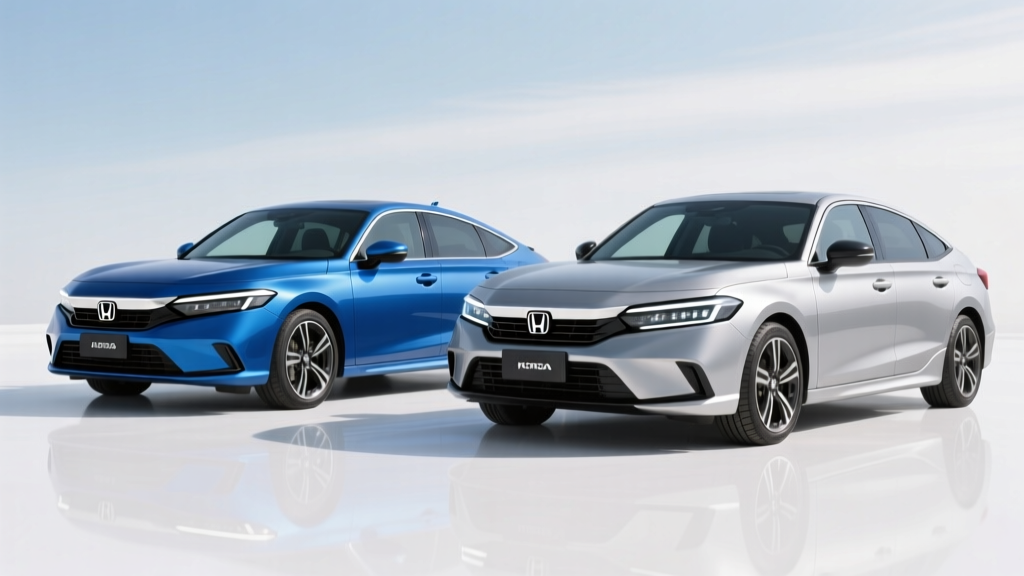
The Honda Civic Hybrid has quickly become one of the most compelling compact sedans for buyers who want serious fuel economy without plugging in. But with Honda rolling the Civic Hybrid out across more trims for 2026 after reintroducing it for 2025, shoppers are asking a practical question: is the newer model worth the premium, or is a leftover 2025 the smarter buy? This Honda Civic Hybrid 2026 vs 2025 breakdown compares EPA fuel economy, powertrain output, pricing, battery warranty coverage, and real-world efficiency so you can decide with hard numbers — not marketing copy.
HEV vs PHEV vs EV: Where the Civic Hybrid Fits
Before comparing model years, it helps to place the Civic Hybrid in the broader electrification landscape. Honda's offering here is a conventional hybrid (HEV), not a plug-in hybrid (PHEV) or battery-electric vehicle (BEV). The distinction matters enormously for your daily routine and your wallet.
| Feature | HEV (Civic Hybrid) | PHEV (e.g., Toyota Prius Prime) | BEV (e.g., Tesla Model 3) |
|---|---|---|---|
| Plug-in charging required? | No | Yes (optional) | Yes (mandatory) |
| Electric-only range | ~1 mile at low speed | 25–45 miles typical | 250–360+ miles |
| Total range | ~550 miles | ~400–500 miles | 250–360+ miles |
| Fuel/energy source | Gasoline only | Gasoline + electricity | Electricity only |
| Home charger needed? | No | Recommended (Level 2) | Essential (Level 2) |
| Federal tax credit (§30D) | Not eligible | Up to $7,500 (if eligible) | Up to $7,500 (if eligible) |
The Civic Hybrid captures energy through regenerative braking and its gasoline engine — you never plug it in. If you want electric-only commuting, you need a PHEV like the Prius Prime or a full BEV. If you want maximum simplicity with strong MPG and no charging infrastructure requirements, the Civic HEV is purpose-built for that use case.
EPA Fuel Economy: 2026 vs 2025 Civic Hybrid MPG
The headline reason to buy a Civic Hybrid is fuel economy, and both model years deliver class-leading numbers. Honda uses the same two-motor hybrid system across 2025 and 2026, so the EPA ratings are essentially identical.
| Model Year / Trim | City MPG | Highway MPG | Combined MPG | Est. Total Range |
|---|---|---|---|---|
| 2025 Civic Hybrid Sport | 50 | 47 | 49 | ~549 mi |
| 2025 Civic Hybrid Sport Touring | 50 | 47 | 49 | ~549 mi |
| 2026 Civic Hybrid Sport | 50 | 47 | 49 | ~549 mi |
| 2026 Civic Hybrid Sport Touring | 50 | 47 | 49 | ~549 mi |
Source: EPA Fuel Economy
Powertrain Specs: What's Under the Hood
Both the 2025 and 2026 Civic Hybrid use Honda's fourth-generation two-motor hybrid system paired with a 2.0-liter Atkinson-cycle four-cylinder engine. This is the same architecture found in the Accord Hybrid and CR-V Hybrid, tuned for the Civic's lighter chassis.
| Specification | 2025 Civic Hybrid | 2026 Civic Hybrid |
|---|---|---|
| Engine | 2.0L Atkinson 4-cyl + 2 electric motors | 2.0L Atkinson 4-cyl + 2 electric motors |
| Combined system horsepower | 200 hp | 200 hp |
| Combined system torque | 232 lb-ft | 232 lb-ft |
| Transmission | e-CVT (direct drive) | e-CVT (direct drive) |
| 0–60 mph (est.) | ~7.2 sec | ~7.2 sec |
| Drivetrain | FWD | FWD |
| Fuel tank capacity | 10.6 gal | 10.6 gal |
| Hybrid battery chemistry | Lithium-ion (NMC) | Lithium-ion (NMC) |
| Hybrid battery capacity | ~1.1 kWh (gross) | ~1.1 kWh (gross) |
The key takeaway: Honda has not altered the powertrain for 2026. The Civic Hybrid's 200 hp output makes it the most powerful Civic in the non-Type-R lineup — noticeably quicker than the 158-hp gas-only Civic LX and substantially more responsive in city merging thanks to instant electric torque.
Pricing: 2026 MSRP vs 2025 Deals
Here is where the model-year comparison gets interesting for your budget. Honda has held pricing relatively steady for the Civic Hybrid, but 2026 models carry a modest increase.
| Trim | 2025 MSRP | 2026 MSRP (est.) | Difference |
|---|---|---|---|
| Sport Hybrid | $29,845 | $30,345 | +$500 |
| Sport Touring Hybrid | $32,845 | $33,445 | +$600 |
Prices include destination charge. Source: Honda Newsroom
Tax Credit Eligibility
Because the Civic Hybrid is a conventional HEV — not a PHEV or BEV — it does not qualify for the federal §30D clean vehicle tax credit (up to $7,500). The IRS restricts that credit to plug-in vehicles with a battery capacity of at least 7 kWh. The Civic Hybrid's ~1.1 kWh battery falls far short of that threshold.
- Federal §30D credit: Not eligible (HEV, not plug-in)
- State/local incentives: Some states offer modest rebates for any electrified vehicle — check your state energy office
- Dealer incentives: Leftover 2025 models may carry $500–$1,500 in factory-to-dealer incentives, widening the price gap with 2026 models
- Fuel savings vs gas Civic: At 49 MPG combined vs 35 MPG combined (gas Civic), you save roughly $400–$550/year in fuel at 12,000 miles/year and $3.40/gallon
The financial case for the Civic Hybrid rests on fuel savings over time, not upfront tax incentives. Over a 5-year, 60,000-mile ownership period, the hybrid premium (roughly $3,000 over a gas Civic Sport) pays back approximately $2,000–$2,750 in fuel savings depending on local gas prices. The remaining gap is offset by higher resale value — hybrids currently command a premium in the used market.
Battery Warranty and Long-Term Reliability
Hybrid battery longevity is the single most common concern among first-time hybrid buyers. Here's what Honda covers and what real-world data shows.
- Duration: 8 years / 100,000 miles (10 years / 150,000 miles in CARB states including CA, NY, MA, and others)
- Coverage: Defects and capacity loss below functional threshold
- Replacement cost (out of warranty): $2,000–$4,000 for the hybrid battery pack, based on current Honda parts pricing
Honda's hybrid battery is compact (~1.1 kWh) and operates in a narrow state-of-charge window — typically between 20% and 80% SoC. This shallow cycling dramatically reduces degradation compared to a full BEV battery that cycles from 10% to 90%. Honda's two-motor system has been in production since 2014 (Accord Hybrid), and real-world failure data from the third-generation system in the 2020+ Accord and CR-V Hybrid shows extremely low replacement rates before 150,000 miles.
The broader reliability picture is strong. The Civic platform earns top marks from IIHS, and Honda's hybrid powertrain has fewer wear components than a conventional gas car — no traditional transmission, no starter motor, no alternator, and regenerative braking extends pad life significantly.
2026 vs 2025: What Actually Changed?
With the powertrain and EPA ratings identical, what separates these two model years? The differences are incremental but worth cataloging:
- Infotainment: 2026 Sport Touring Hybrid receives an updated Google Built-in interface with faster voice recognition and improved wireless Android Auto/Apple CarPlay handshake speed
- Color palette: 2026 adds one new exterior color (Solar Silver Metallic replaces Meteorite Gray on some trims) and drops another
- ADAS tuning: Honda Sensing suite carries over (adaptive cruise, lane-keeping, collision mitigation), but 2026 models receive minor software refinements for smoother adaptive cruise braking behavior
- Standard equipment: Wireless phone charging pad is now standard on Sport Hybrid (previously Sport Touring only)
- MSRP increase: $500–$600 across trims as noted above
No changes were made to the hybrid system, battery, suspension tuning, or body structure. If you prioritize mechanical substance over infotainment polish, the 2025 is functionally the same car.
Who Should Buy the Civic Hybrid — and Who Shouldn't?
- You drive 12,000+ miles/year and want to minimize fuel costs without changing your refueling habits
- You lack access to home or workplace charging (apartment, street parking) — an HEV needs no plug
- You want more power than the gas Civic (200 hp vs 158 hp) with better MPG, not worse
- You plan to keep the car 5–10 years and value Honda's long-term reliability record
- You have home Level 2 charging and a short commute — a PHEV like the Prius Prime (44 mi electric range) can eliminate gas use on weekdays
- You want to qualify for the $7,500 federal tax credit — that requires a plug-in vehicle
- You drive mostly in the city and want to maximize zero-emission miles — a BEV eliminates tailpipe emissions entirely
- You want the lowest possible cost-per-mile — electricity at $0.14/kWh costs roughly $0.04/mile vs the Civic Hybrid's ~$0.07/mile on gasoline
- 49 MPG combined EPA; often exceeds 50 in city driving
- 200 hp — quickest non-Type-R Civic
- No plug-in required — works for any living situation
- ~550-mile total range between fill-ups
- Strong resale value; proven hybrid reliability
- No federal tax credit eligibility
- Highway MPG trails city MPG (engine-dominant at speed)
- FWD only — no AWD option (unlike Prius)
- Hybrid premium of ~$3,000 over gas Civic takes 4–5 years to recoup on fuel alone
- Trunk slightly reduced vs gas Civic due to battery placement
Frequently Asked Questions
How many MPG does the Honda Civic Hybrid get?
The 2025 and 2026 Honda Civic Hybrid both earn an EPA-estimated 50 city / 47 highway / 49 combined MPG. Real-world city driving frequently yields 52–55 MPG in mild weather, while sustained highway driving at 75+ mph may return 43–46 MPG.
Does the Civic Hybrid need to be plugged in?
No. The Civic Hybrid is a conventional HEV. It charges its small lithium-ion battery through regenerative braking and the gasoline engine. You refuel it exclusively at a gas station, exactly like a conventional car.
How far can the Civic Hybrid drive on electric power alone?
Only about 1 mile at very low speeds (under 25 mph) in EV mode. The battery is too small (~1.1 kWh) to serve as a meaningful electric-only vehicle. If you want 25–45 miles of electric-only commuting, you need a PHEV like the Toyota Prius Prime.
Is the Civic Hybrid battery reliable and expensive to replace?
Honda covers the hybrid battery for 8 years/100,000 miles (10 years/150,000 miles in CARB states). Out-of-warranty replacement costs approximately $2,000–$4,000. Because the battery is small and operated in a narrow charge window, premature failures are rare based on data from Honda's earlier hybrid systems.
Does the Honda Civic Hybrid qualify for a tax credit?
No. The federal §30D Clean Vehicle Credit requires a plug-in vehicle with at least 7 kWh of battery capacity. The Civic Hybrid's ~1.1 kWh battery does not qualify. Some states may offer minor incentives for any hybrid — check your state energy office. Consult a tax professional or IRS.gov for current eligibility rules.
Is the 2026 Civic Hybrid worth more than the 2025?
Mechanically, no — the powertrain, MPG, and chassis are identical. The 2026 adds minor infotainment updates and a wireless charging pad on the Sport trim. If you find a 2025 at a discount (dealer incentives on leftover inventory), it represents better value. Choose the 2026 if you want the latest tech interface and full factory warranty clock starting from a newer build date.
How does the Civic Hybrid compare to the Toyota Prius?
The Prius (57 MPG combined, FWD) beats the Civic Hybrid on fuel economy by 8 MPG and offers an AWD variant. The Civic Hybrid counters with 200 hp (vs Prius's 196 hp in AWD, 194 in FWD), a more engaging driving feel, and a conventional sedan design. Both are excellent — the Prius wins on pure efficiency, the Civic on driving dynamics and interior refinement.