Quick Verdict: The 2012 Civic Hybrid at a Glance
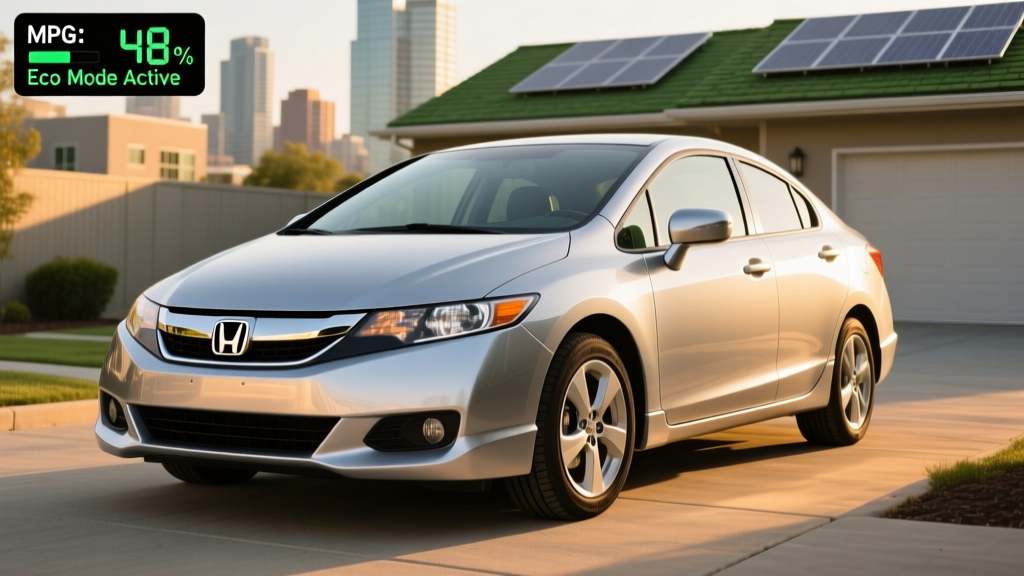
The 2012 Honda Civic Hybrid is a conventional hybrid (HEV) — not a plug-in — that Honda equipped with its Integrated Motor Assist (IMA) system to squeeze maximum efficiency out of a compact sedan. Rated at 44 MPG combined by the EPA, it was one of the most fuel-efficient non-plug-in cars you could buy in its model year. More than a decade later, it remains a popular used-hybrid option for buyers who want proven fuel savings without plug-in infrastructure or EV range concerns.
But buying a 14-year-old hybrid in 2026 comes with specific questions: Has the IMA battery degraded? What does replacement cost? And how does it stack up against modern hybrids and EVs? This guide covers everything with exact numbers.
| Spec | 2012 Honda Civic Hybrid |
|---|---|
| Powertrain Type | Conventional Hybrid (HEV) — IMA system |
| Engine | 1.5L i-VTEC inline-4 + electric motor |
| Combined Horsepower | 110 hp (90 hp engine + 20 hp motor assist) |
| Combined Torque | 127 lb-ft |
| Transmission | CVT (continuously variable) |
| EPA MPG (City / Hwy / Combined) | 44 / 44 / 44 |
| Hybrid Battery | 0.5 kWh NiMH (nickel-metal hydride) |
| Plug-In Required? | No — charges via regenerative braking & engine |
| Original MSRP | ~$24,200 (base Hybrid trim) |
| Used Price Range (2026) | $5,000–$9,500 depending on mileage/condition |
| Original Battery Warranty | 8 years / 80,000 miles (10 yr/100k in CARB states) |
HEV vs PHEV: What the 2012 Civic Hybrid Actually Is
A common point of confusion among used-car shoppers is whether the Civic Hybrid needs to be plugged in. It does not. Here's the distinction:
| Feature | Conventional Hybrid (HEV) | Plug-In Hybrid (PHEV) |
|---|---|---|
| Plug-in charging? | No | Yes |
| Electric-only range | None (motor assists engine only) | 20–50 miles typical |
| Battery size | 0.5–1.5 kWh | 8–20+ kWh |
| Federal tax credit (§30D)? | No | Up to $7,500 if eligible (new only) |
| Example | 2012 Honda Civic Hybrid | 2026 Toyota RAV4 Prime |
The 2012 Civic Hybrid uses Honda's IMA system, where a small electric motor sandwiched between the engine and transmission provides torque assist during acceleration and captures energy during braking. The 0.5 kWh NiMH battery is recharged entirely by the engine and regenerative braking — there is no charging port. You fuel it like any conventional car and never think about plugging in.
Fuel Economy: EPA Ratings and Real-World MPG
The EPA rates the 2012 Honda Civic Hybrid at 44 MPG city, 44 MPG highway, and 44 MPG combined. This was a standout figure for 2012 and remains competitive even against many 2026 compact hybrids. According to fueleconomy.gov, the annual fuel cost estimate is roughly $1,150 at current average gas prices — a meaningful savings over a conventional Civic of that era (rated around 29–32 MPG combined).
| Driving Scenario | EPA Rating | Real-World Expectation |
|---|---|---|
| City | 44 MPG | 42–48 MPG (hybrids often beat EPA in stop-and-go) |
| Highway | 44 MPG | 38–43 MPG (less regen benefit at sustained speed) |
| Combined | 44 MPG | 40–45 MPG typical mixed driving |
| Cold weather (below 32°F) | — | 36–40 MPG (engine runs more for cabin heat) |
Real-world note: Honda's IMA system is relatively mild compared to Toyota's Hybrid Synergy Drive. The electric motor's contribution is modest, so real-world gains over a gas Civic are meaningful but not dramatic. Many owners report 40–45 MPG in mixed driving, with city-heavy routes occasionally pushing past the EPA estimate thanks to regenerative braking. Highway-only road trips at 75+ MPH tend to drop to the high 30s.
One ownership reality for a 2012 model in 2026: if the IMA battery has degraded significantly, you may see MPG drop into the mid-to-high 30s. The system relies on the battery for assist; a weakened battery means the 1.5L engine does more work alone.
Powertrain and Driving Experience
The 2012 Civic Hybrid pairs a 1.5-liter i-VTEC four-cylinder engine (90 hp) with a 20-hp electric motor integrated into the flywheel, for a combined system output of 110 horsepower and 127 lb-ft of torque. Power reaches the front wheels through a continuously variable transmission (CVT).
This is not a performance-oriented setup. The 0-60 mph time sits around 10.5 seconds, which was average for fuel-sipping compacts in 2012 but feels leisurely by 2026 standards when even a base Toyota Corolla Hybrid delivers similar MPG with more refinement. The IMA system can shut off the engine at stops and during light-load cruising (cylinder deactivation), but the transitions aren't as seamless as modern hybrid systems.
The driving experience is what you'd expect from a compact economy car of its era: competent, light steering, firm ride quality, and noticeable road noise above 65 MPH. The hybrid-specific instrumentation includes a charge/assist gauge and an ECON mode button that softens throttle response and adjusts climate control to prioritize efficiency.
Hybrid Battery Health, Warranty, and Replacement Cost
Original IMA Battery Warranty: 8 years / 80,000 miles federally; 10 years / 100,000 miles in California Air Resources Board (CARB) states (CA, NY, CT, MA, ME, MD, NJ, OR, RI, VT, WA, and others adopting CARB standards).
Status in 2026: All original factory battery warranties have expired for 2012 models. Any battery replacement is an owner expense unless covered by an extended warranty or a goodwill program.
The IMA battery in the 2012 Civic Hybrid is a 0.5 kWh nickel-metal hydride (NiMH) pack — small by any standard, and far simpler than the lithium-ion packs in modern PHEVs and EVs. NiMH chemistry is durable and tolerant of heat, but it does degrade over time and with high cycle counts.
Typical lifespan: Honda IMA batteries in this generation commonly last 100,000–150,000 miles before showing meaningful degradation. Some units fail earlier (80,000–90,000 miles), while others soldier past 180,000 miles. Degradation manifests as reduced MPG, more frequent engine running, and eventually an IMA warning light on the dash.
Replacement cost breakdown:
| Option | Estimated Cost (Parts + Labor) | Notes |
|---|---|---|
| New OEM Honda IMA battery | $2,000–$3,000 | Dealer-installed; may be difficult to source for 2012 models in 2026 |
| Refurbished/remanufactured IMA pack | $1,000–$1,800 | Common aftermarket option; quality varies by supplier |
| Individual cell replacement (DIY/specialist) | $300–$700 | Requires technical skill; replaces only degraded cells within the pack |
| Used IMA battery from salvage | $400–$900 | Unpredictable remaining life; cheapest option but highest risk |
Is the 2012 Civic Hybrid reliable overall? The non-hybrid components — engine, transmission, suspension — are generally robust Honda engineering. The CVT from this generation has a mixed reputation but tends to hold up with regular fluid changes. The IMA system itself is the primary reliability variable. If the battery has already been replaced (and you have documentation), that's actually a positive sign for a used purchase. If it hasn't, budget for a potential replacement within your ownership window.
Pricing in 2026 and Tax Credit Eligibility
As a 14-year-old used vehicle, the 2012 Honda Civic Hybrid trades in the $5,000–$9,500 range depending on mileage, condition, and whether the IMA battery has been serviced. Low-mileage examples (under 80,000 miles) with documented battery replacement command the top of that range.
Federal tax credit: The 2012 Civic Hybrid does not qualify for any current federal tax credit. The IRS §30D credit applies to new plug-in vehicles (PHEVs and BEVs) meeting battery-sourcing, MSRP, and buyer-income requirements. Conventional hybrids like this Civic have never been eligible for §30D, and the used-EV credit (§25E, up to $4,000) applies only to used plug-in vehicles — not conventional HEVs. No state incentives for conventional hybrids are broadly available in 2026, though a few states offer minor registration fee discounts. Check your state's DMV or energy office for specifics.
2012 Civic Hybrid vs Modern Alternatives
If you're cross-shopping a used 2012 Civic Hybrid against other options in 2026, here's how the landscape compares:
Pros — 2012 Civic Hybrid
- Low purchase price ($5K–$9.5K) for a fuel-efficient sedan
- No plug-in required — fuel it like any gas car
- 44 MPG combined still competitive with many new hybrids
- Simple NiMH battery — easier/cheaper to replace than modern lithium packs
- Low insurance costs for a compact of its age
Cons — 2012 Civic Hybrid
- IMA battery likely at or past end of life; replacement is a $1,000–$3,000 gamble
- No electric-only driving — it's always burning fuel
- Modest 110 hp feels underpowered by modern standards
- Dated infotainment, safety tech, and interior materials
- No federal or state tax incentives available
- CVT refinement and longevity concerns
Compared to a 2026 Toyota Corolla Hybrid (~$23,500 new, 52 MPG combined): The new Corolla Hybrid delivers 8 more MPG, a modern interior, Toyota Safety Sense 3.0, and a full factory warranty — but at roughly three times the price. If your budget is strictly under $10,000, the 2012 Civic Hybrid makes sense; if you can stretch, a newer hybrid offers dramatically better value per dollar over a 5-year hold.
Compared to a used 2018–2021 Toyota Prius ($14,000–$20,000): The Prius offers 52–56 MPG, a more proven hybrid system with better battery longevity, and more modern safety features. The price premium is justified if you plan to keep the car beyond 2–3 years.
Compared to a full EV (e.g., used 2020 Nissan Leaf, ~$12,000–$15,000): An EV eliminates fuel costs entirely but requires home charging access. If you can install a Level 2 charger and your daily commute is under 100 miles, a used EV delivers lower operating costs than any hybrid. If you lack charging access or regularly drive 200+ miles, the Civic Hybrid's gas-and-go simplicity wins.
Who Should Buy the 2012 Civic Hybrid — and Who Shouldn't
Choose the 2012 Civic Hybrid if:
- Your budget is firmly under $10,000 and you need maximum MPG
- You lack access to plug-in charging (apartment, street parking)
- Your commute is mixed city/highway under 50 miles daily
- You're comfortable budgeting $1,000–$2,500 for a potential IMA battery replacement
- You want a simple, no-plug fuel-efficient daily driver
Look elsewhere if:
- You can stretch your budget to $15,000+ for a newer, more reliable hybrid
- You have home charging access — a used PHEV or BEV may save more long-term
- You prioritize modern safety features (AEB, lane-keeping, blind-spot monitoring)
- You plan to keep the car 5+ years and want predictable maintenance costs
- You want highway passing power or a refined driving experience
Frequently Asked Questions
How many MPG does the 2012 Honda Civic Hybrid get?
The EPA rates it at 44 MPG city, 44 MPG highway, and 44 MPG combined. In real-world mixed driving, expect 40–45 MPG. City-heavy routes can push toward 48 MPG thanks to regenerative braking, while sustained highway driving at 75+ MPH may drop to the high 30s. Cold weather and a degraded IMA battery will reduce these figures.
Does the 2012 Civic Hybrid need to be plugged in?
No. It is a conventional hybrid (HEV), not a plug-in hybrid (PHEV). The small NiMH battery charges through regenerative braking and the gasoline engine. There is no charging port — you simply fill it with gasoline like any other car.
How far can the 2012 Civic Hybrid drive on electric power alone?
It cannot drive on electric power alone. Honda's IMA system in this generation provides motor assist to the gasoline engine but does not enable pure electric-only propulsion. The engine can shut off at stops and during very light-load coasting, but the car always requires the engine for forward motion.
Is the 2012 Civic Hybrid reliable, and what does battery replacement cost?
Overall mechanical reliability is good — the 1.5L engine and Honda build quality hold up well. The main variable is the IMA battery, which typically lasts 100,000–150,000 miles. Replacement costs range from $300–$700 for a DIY cell swap to $2,000–$3,000 for a new OEM pack at a dealer. Refurbished packs ($1,000–$1,800) are the most common choice for a vehicle of this age and value.
Does the 2012 Honda Civic Hybrid qualify for any tax credit?
No. The 2012 Civic Hybrid is a conventional HEV and does not qualify for the federal §30D new-vehicle credit or the §25E used-EV credit. These credits are reserved for plug-in vehicles (PHEVs and BEVs). Some states may offer minor registration incentives, but no broadly available tax credit applies to this model. Consult IRS.gov for current credit rules.
Hybrid vs PHEV vs EV — which is right for me?
A conventional hybrid (HEV) like the 2012 Civic Hybrid is best if you want fuel savings with zero lifestyle change — no plugs, no range planning, just better MPG. A plug-in hybrid (PHEV) adds 20–50 miles of electric-only range for daily commutes and requires home or work charging to realize its benefit; it's ideal if you have charging access but also take longer road trips. A full EV (BEV) offers the lowest operating cost and zero tailpipe emissions but requires reliable charging access and acceptance of 200–350 miles of range. For a budget buyer without charging access in 2026, the HEV remains the simplest path to fuel savings.
What should I check before buying a used 2012 Civic Hybrid?
Prioritize these items: (1) IMA battery health — ask for a diagnostic readout or check for IMA warning lights; (2) documentation of any battery replacement; (3) CVT fluid change history; (4) timing chain condition (the 1.5L uses a chain, not a belt, but listen for rattle on cold start); (5) overall maintenance records. A pre-purchase inspection by a Honda-savvy mechanic is strongly recommended for a vehicle of this age.