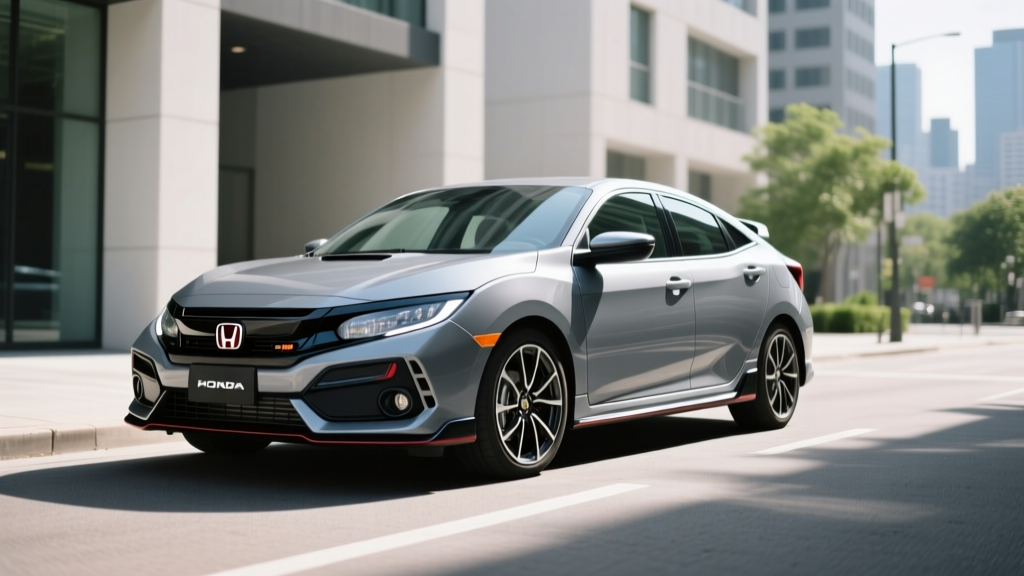
The Honda Civic Hatchback Hybrid Sport Touring occupies a specific niche: maximum fuel efficiency without the plug-in lifestyle. For 2025–2026, Honda pairs its two-motor hybrid system with the practicality of a hatchback and the top-tier Sport Touring equipment. If you want hatchback cargo room, 50 MPG, and zero charging hassle, this is one of the strongest contenders in the compact hybrid segment.
But how does it stack up against plug-in hybrids and full EVs? And does the Sport Touring trim justify its premium? We break down the exact EPA numbers, real-world fuel economy expectations, powertrain specs, warranty coverage, and total cost of ownership to help you decide.
Honda Civic Hatchback Hybrid Sport Touring: Key Specs at a Glance
| Specification | Detail |
|---|---|
| Powertrain | 2.0L 4-cyl Atkinson-cycle + 2-motor hybrid system |
| Combined Horsepower | 200 hp (197 lb-ft torque) |
| EPA Fuel Economy (City / Hwy / Combined) | 50 / 45 / 49 MPG |
| Fuel Tank Capacity | 10.6 gallons |
| Total Driving Range | ~519 miles (EPA est.) |
| Drivetrain | Front-wheel drive |
| 0–60 mph | ~6.9 seconds (est.) |
| Cargo Volume (rear seats up / folded) | 24.5 / 60.8 cu ft |
| Hybrid Battery Warranty | 8 years / 100,000 miles (10/150k in CARB states) |
| MSRP (Sport Touring Hybrid) | ~$32,550 (2025 model year) |
| Federal Tax Credit (§30D) | Not eligible (HEV, not PHEV or BEV) |
Source: fueleconomy.gov, Honda Newsroom
Fuel Economy: EPA Numbers vs. Real-World MPG
The EPA rates the Civic Hatchback Hybrid at 50 city / 45 highway / 49 combined MPG for the Sport Touring trim (the lighter Sport trim edges up to 50/47/50). These are outstanding numbers for a 200-hp hatchback, but real-world results depend heavily on your driving mix.
| Driving Scenario | Expected MPG | Notes |
|---|---|---|
| City / stop-and-go | 50–55 MPG | Hybrids excel here; regenerative braking recaptures energy |
| Mixed suburban | 47–51 MPG | Close to EPA combined |
| Highway (70+ mph) | 40–44 MPG | Aerodynamic drag reduces hybrid advantage at speed |
| Cold weather (below 30°F) | 42–47 MPG | Engine runs more for cabin heat; battery less efficient |
| Mountainous terrain | 38–45 MPG | Regen helps on descents, but climbs demand sustained engine power |
The Civic Hybrid's two-motor system lets the electric motor handle most low-speed driving, with the 2.0L engine acting primarily as a generator. Only at highway cruising does the engine mechanically connect to the wheels via a lock-up clutch. This is why city MPG actually exceeds highway MPG — the opposite of a conventional gas car.
Powertrain Deep Dive: How Honda's Two-Motor Hybrid Works
The Civic Hybrid uses Honda's fourth-generation two-motor hybrid system, which is fundamentally different from Toyota's planetary-gear approach. Here's how it operates across three modes:
- EV Drive: Battery powers the propulsion motor; engine is off. Used at low speeds and light acceleration.
- Hybrid Drive: Engine spins the generator motor, which sends electricity to the propulsion motor. The engine never directly turns the wheels.
- Engine Drive: At steady highway speeds, a lock-up clutch connects the engine directly to the wheels for maximum efficiency.
The result is 200 combined horsepower — 66 hp more than the non-hybrid Civic's 2.0L engine and 20 hp more than the 1.5T turbo. The electric motor delivers instant torque from a stop, making the Civic Hybrid feel quicker than its 6.9-second 0–60 time suggests in everyday driving.
The hybrid battery pack is a lithium-ion unit mounted under the rear seats. Honda does not publish the exact kWh capacity (it's small — roughly 1.0 kWh usable — because it's designed for frequent shallow cycles, not electric-only range).
Hybrid vs. PHEV vs. EV: Which Powertrain Fits Your Life?
The Civic Hatchback Hybrid is a conventional hybrid (HEV). It does not plug in, has no meaningful electric-only range, and refuels exclusively at gas stations. This is by design. Here's how it compares to the alternatives:
| Factor | HEV (Civic Hybrid) | PHEV (e.g., Toyota Prius Prime) | BEV (e.g., Chevy Equinox EV) |
|---|---|---|---|
| Plug-in required? | No | Yes (for EV range) | Yes |
| Electric-only range | ~1 mile at low speed | 35–45 miles | 250–315 miles |
| Total range | ~519 miles | ~400–440 miles | 250–315 miles |
| Fuel cost per mile | ~$0.07 (gas) | ~$0.04 (electric) / $0.07 (gas) | ~$0.04 (electric) |
| Home charging needed? | No | Recommended (Level 2) | Essential |
| Federal tax credit | None | Up to $7,500 (§30D, if eligible) | Up to $7,500 (§30D, if eligible) |
| Upfront price premium vs. gas | ~$1,500–$2,500 | ~$4,000–$7,000 | ~$8,000–$15,000 |
| Maintenance complexity | Low (similar to gas) | Moderate (two systems) | Low (fewer moving parts) |
Choose the Civic Hybrid if: You want maximum MPG with zero lifestyle change. No charging, no range planning, no electrical work. You drive 12,000–15,000 miles/year and want fuel costs around $1,000–$1,200 annually.
Choose a PHEV if: You have home charging and a short commute (under 40 miles). You'll drive mostly on electricity but want gas backup for road trips. The federal tax credit can offset the higher purchase price.
Choose a BEV if: You have reliable home charging, drive under 250 miles/day, and want the lowest per-mile fuel cost plus zero tailpipe emissions. You're willing to plan around charging on road trips.
Sport Touring Trim: What You Get for ~$32,550
The Sport Touring Hybrid sits at the top of the Civic Hatchback lineup. For the ~$32,550 MSRP, Honda includes:
- 10.2-inch digital instrument cluster
- 9-inch touchscreen with wireless Apple CarPlay and Android Auto
- 12-speaker Bose premium audio
- Wireless phone charging
- Heated front seats and heated steering wheel
- Honda Sensing suite (adaptive cruise, lane-keeping, collision mitigation)
- Blind-spot information with cross-traffic monitor
- Low-speed braking control and traffic sign recognition
- 18-inch alloy wheels (gloss black)
- Leather-trimmed seats
- Dual-zone automatic climate control
The Sport Touring commands roughly $3,300 over the Sport Hybrid trim. The key upgrades are the Bose audio, leather, heated steering wheel, and blind-spot monitoring. For most buyers, the Sport Touring is worth it — the Sport trim's cloth seats and smaller speaker count are the most noticeable downgrades.
Battery Warranty, Lifespan, and Replacement Cost
Hybrid battery degradation is a top concern for buyers, but real-world data is reassuring. Honda's lithium-ion hybrid packs are designed for shallow charge/discharge cycles (typically staying between 40–80% state of charge), which dramatically extends cell life. Failures within the warranty period are uncommon, and out-of-warranty failures before 150,000+ miles are rare.
If replacement is eventually needed, expect these approximate costs:
| Replacement Option | Estimated Cost | Notes |
|---|---|---|
| New OEM battery (Honda dealer) | $2,500–$4,000 | Full replacement, labor included |
| Refurbished / reconditioned battery | $1,500–$2,500 | Replaced cells, shorter warranty |
| Individual cell/module replacement | $500–$1,500 | Only failed modules replaced; requires specialist |
For context, Toyota Prius hybrid batteries routinely last 200,000+ miles with minimal degradation. Honda's system operates under similar principles. The risk of a costly battery replacement during typical ownership (5–8 years, 60,000–100,000 miles) is very low.
Tax Credits and Incentives: What Applies to the Civic Hybrid?
The Civic Hatchback Hybrid is a conventional hybrid (HEV), not a plug-in hybrid or battery electric vehicle. Under current IRS §30D rules, conventional hybrids do not qualify for the federal Clean Vehicle Credit (up to $7,500 for new EVs and PHEVs).
There is also no federal used-vehicle credit (§25E) for conventional hybrids.
However, some states and local utilities offer incentives for hybrids:
- State rebates: A few states offer modest rebates ($500–$1,500) for hybrid purchases, though most incentive programs have shifted toward PHEVs and BEVs.
- HOV lane access: Some states (e.g., California's Clean Air Vehicle decal program) have historically included hybrids, though eligibility changes frequently and often prioritizes zero-emission vehicles.
- Insurance discounts: Some insurers offer 5–10% discounts for hybrid vehicles.
Check your state's energy office or Alternative Fuels Data Center for current local incentives.
Driving Impressions and Practicality
The Civic Hatchback Hybrid Sport Touring drives like a well-sorted compact car that happens to be efficient. The electric motor's instant torque makes it feel responsive from stoplights, and the transition between EV, hybrid, and engine modes is nearly imperceptible. The regenerative braking is progressive — you can modulate it with paddle shifters, but it doesn't offer true one-pedal driving like a BEV.
Ride quality is firm but compliant. The 18-inch wheels on the Sport Touring transmit more road texture than smaller wheels, but the trade-off is sharper cornering. Road noise is well-controlled, though the engine note under hard acceleration has a droning quality typical of Atkinson-cycle engines.
The hatchback body adds genuine utility: 24.5 cubic feet behind the rear seats and 60.8 cubic feet with them folded. That's enough for a week's groceries, two carry-on suitcases, or a bicycle with the front wheel removed. The sedan hybrid offers only 14.8 cubic feet of trunk space by comparison.
Pros and Cons
- 49 MPG combined EPA — outstanding for a 200-hp car
- No plug-in charging required — zero lifestyle change
- Hatchback cargo room (24.5 cu ft) adds real utility
- Sport Touring trim is well-equipped (Bose, leather, Honda Sensing)
- Strong hybrid battery warranty (8yr/100k mi, 10yr/150k in CARB states)
- Quick off the line thanks to electric motor torque
- No federal tax credit (HEV, not PHEV/BEV)
- FWD only — no AWD option (unlike Toyota Prius)
- Highway MPG drops to ~42–44 in real-world 75-mph driving
- Engine drone under hard acceleration
- Sport Touring at ~$32,550 pushes into entry-luxury territory
- No spare tire (tire repair kit only)
Frequently Asked Questions
How many MPG does the Honda Civic Hatchback Hybrid Sport Touring get?
The EPA rates it at 50 city / 45 highway / 49 combined MPG. In real-world driving, expect 48–53 MPG in city-heavy commuting and 42–46 MPG on highway-heavy trips. Cold weather can reduce these figures by 5–10%.
Does the Civic Hybrid need to be plugged in?
No. The Civic Hybrid is a conventional hybrid (HEV). It charges its battery through regenerative braking and the gasoline engine. You never plug it in — you just fill it with gas like any other car.
Does the Civic Hatchback Hybrid qualify for any tax credit?
It does not qualify for the federal §30D Clean Vehicle Credit, which is limited to plug-in hybrids and battery electric vehicles. Some states may offer small hybrid incentives — check your state's energy office or the Alternative Fuels Data Center.
How reliable is the Civic Hybrid and what does battery replacement cost?
Honda's hybrid system has a strong reliability record. The hybrid battery is covered for 8 years/100,000 miles (10 years/150,000 in CARB states). Out-of-warranty replacement costs $2,500–$4,000 for a new OEM battery, but failures before 150,000+ miles are rare based on historical Honda hybrid data.
How does the Civic Hybrid compare to the Toyota Prius?
The Prius (57 city / 56 hwy / 57 combined on LE trim) beats the Civic Hybrid on fuel economy, and offers AWD on some trims. The Civic Hybrid counters with 200 hp (vs. 194 hp for the Prius), a more premium Sport Touring interior, and arguably better driving dynamics. Both are excellent choices — the Prius wins on pure MPG, the Civic on refinement and power.
Is the Sport Touring trim worth the price premium?
If you value leather seats, Bose audio, a heated steering wheel, and blind-spot monitoring, yes. The ~$3,300 premium over the Sport Hybrid is reasonable for the equipment added. If you're budget-conscious, the Sport Hybrid at ~$29,250 still includes Honda Sensing and the same hybrid powertrain.