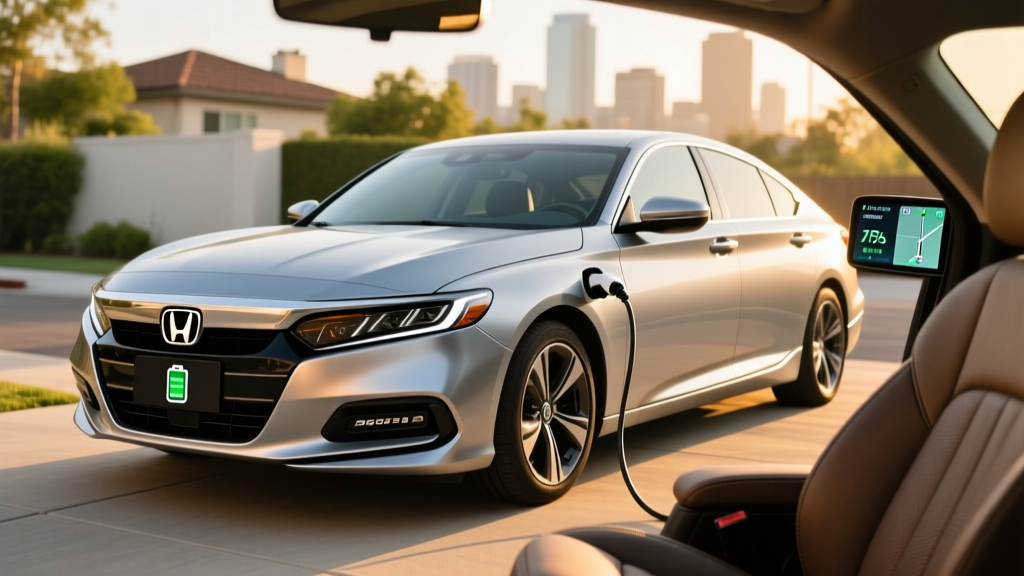
The 2025 Honda Accord Touring Hybrid sits at the top of Honda's midsize sedan lineup, pairing a 2.0-liter Atkinson-cycle four-cylinder with a two-motor hybrid system for 204 combined horsepower and an EPA-estimated 44 MPG combined. Unlike Honda's CR-V and Clarity, the Accord Hybrid is a conventional hybrid (HEV) — not a plug-in — meaning it requires no charging infrastructure and recovers energy solely through regenerative braking and the gasoline engine.
This review covers the Touring trim specifically, the most equipped and most expensive Accord Hybrid variant. We'll examine whether its premium features justify the price premium, how its real-world fuel economy compares to the EPA sticker, and where it fits for buyers cross-shopping conventional hybrids, plug-in hybrids, and full battery-electric vehicles.
2025 Honda Accord Touring Hybrid: Core Specifications
| Specification | 2025 Accord Hybrid Touring |
|---|---|
| Powertrain | 2.0L DOHC Atkinson-cycle I-4 + two-motor hybrid system |
| Combined Horsepower | 204 hp |
| Combined Torque | 247 lb-ft (electric motor) |
| Transmission | e-CVT (no fixed gears) |
| Drivetrain | Front-wheel drive |
| EPA Fuel Economy (City / Highway / Combined) | 46 / 41 / 44 MPG |
| Fuel Tank Capacity | 12.8 gallons |
| Total Driving Range | ~563 miles (EPA est.) |
| 0–60 mph | ~7.0 seconds (est.) |
| Hybrid Battery Type | Lithium-ion |
| Cargo Volume | 16.7 cu ft |
| Curb Weight | ~3,477 lbs |
| MSRP (Touring trim) | $40,390 (incl. destination) |
| Hybrid Battery Warranty | 8 years / 100,000 miles (10 yr / 150,000 mi in CARB states) |
Fuel Economy: EPA Estimates vs. Real-World MPG
The EPA rates the 2025 Accord Hybrid Touring at 46 MPG city, 41 MPG highway, and 44 MPG combined. These figures align with the Sport, EX-L, and Sport-L Hybrid trims — Honda uses the same fourth-generation two-motor hybrid powertrain across all Accord Hybrid variants, so fuel economy does not vary by trim level.
| Driving Condition | EPA Estimate | Real-World Expectation |
|---|---|---|
| City | 46 MPG | 45–50 MPG (hybrids often exceed EPA in stop-and-go) |
| Highway (70–80 mph) | 41 MPG | 37–41 MPG (aerodynamic drag reduces hybrid advantage) |
| Combined | 44 MPG | 41–46 MPG depending on driving mix |
| Cold Weather (below 35°F) | — | 36–40 MPG (engine runs more for cabin heat, battery less efficient) |
The Accord Hybrid's two-motor system excels in city driving, where the electric motor handles most low-speed propulsion and the gasoline engine acts primarily as a generator. This is why city MPG exceeds highway MPG — the opposite of a conventional gas car. On the highway, the engine can mechanically couple to the wheels via a lockup clutch for efficient cruising, but sustained high-speed driving reduces the hybrid system's regenerative advantage.
In real-world testing by owners and automotive publications, the Accord Hybrid consistently meets or slightly exceeds its EPA combined estimate in mixed suburban and city driving. Highway-heavy commutes at speeds above 75 mph tend to pull the average down to the high 30s. Cold weather further reduces efficiency because the gasoline engine must run more frequently to provide cabin heat (the Accord Hybrid uses engine waste heat rather than a dedicated electric heater for the cabin).
How the Two-Motor Hybrid Powertrain Works
Honda's fourth-generation hybrid system uses two electric motors paired with the 2.0-liter engine. One motor primarily functions as a generator (converting engine output to electricity), while the second, larger motor drives the wheels. In most driving scenarios below ~45 mph, the Accord Hybrid operates as a series hybrid — the engine generates electricity, and the drive motor propels the car. This delivers smooth, electric-like acceleration from a stop with 247 lb-ft of torque available immediately.
At highway cruising speeds, a lockup clutch engages to mechanically connect the engine to the front wheels, bypassing the electrical conversion step for greater efficiency. The system seamlessly transitions between EV Drive (battery only), Hybrid Drive (engine generates electricity for the motor), and Engine Drive (direct mechanical coupling) without driver input.
The result is a powertrain that feels more like an EV around town than a traditional hybrid with a rubber-band CVT sensation. Acceleration is linear and responsive, though the 204-hp combined output means passing maneuvers at highway speed require planning — this is not a performance sedan.
HEV vs. PHEV vs. EV: Where the Accord Hybrid Fits
Buyers cross-shopping the Accord Hybrid often wonder whether a plug-in hybrid (PHEV) or a full battery-electric vehicle (BEV) would serve them better. Here's how the three categories differ and who each one suits:
| Factor | HEV (Accord Hybrid) | PHEV (e.g., Toyota Prius Prime) | BEV (e.g., Tesla Model 3, Hyundai Ioniq 6) |
|---|---|---|---|
| Plug-in Charging Required? | No | Yes (for EV range benefit) | Yes (sole energy source) |
| Electric-Only Range | ~1 mile (low-speed only) | 25–45 miles typical | 250–360+ miles |
| Fuel / Energy Cost | Gas only (~$0.10–0.14/mi) | Electric for short trips + gas for longer | Electric only (~$0.04–0.08/mi at home) |
| Home Charging Needed? | No | Recommended (Level 2) | Essential (Level 2) |
| Upfront Price (Comparable) | $40,390 | $35,000–$42,000 | $40,000–$55,000 |
| Federal Tax Credit (§30D) | Not eligible | Up to $7,500 (varies by model/sourcing) | Up to $7,500 (varies by model/sourcing) |
| Maintenance | Oil changes, standard ICE upkeep | Oil changes + less brake wear | Minimal (no oil, fewer fluids, regen saves brakes) |
Choose a PHEV if: You can charge at home, most daily trips are under 30 miles, you still want a gas engine for road trips, and you want to reduce (not eliminate) gasoline consumption.
Choose a BEV if: You have reliable home Level 2 charging, want the lowest per-mile energy cost, want to eliminate tailpipe emissions and oil changes, and your typical road trips fall within DC fast-charging corridor coverage.
Pricing, Trims, and Tax Credit Eligibility
The 2025 Honda Accord Hybrid is offered in four trims. The Touring is the top-tier model:
| Trim | MSRP (incl. destination) | Key Features |
|---|---|---|
| Sport Hybrid | $34,390 | 19-inch wheels, sport styling, heated front seats |
| EX-L Hybrid | $36,040 | Leather seats, power moonroof, wireless CarPlay/Android Auto |
| Sport-L Hybrid | $36,690 | Sport styling + leather, heated rear seats |
| Touring Hybrid | $40,390 | Adaptive dampers, Bose 12-speaker audio, heated/ventilated front seats, heated rear seats, heated steering wheel, wireless phone charger, low-speed braking control |
Federal tax credit: The Accord Hybrid is a conventional HEV and does not qualify for the IRS §30D Clean Vehicle Credit. That credit applies only to plug-in electric vehicles (PHEVs and BEVs) meeting battery sourcing, MSRP, and buyer income requirements. There is no federal incentive for conventional hybrids. Some states may offer minor registration fee discounts or HOV lane access for hybrids, but these vary by jurisdiction — check your state's DMV or energy office for current programs.
For buyers whose primary motivation is fuel cost savings rather than tax incentives, the Accord Hybrid's 44 MPG combined still delivers significant savings over a comparable turbo-gas Accord (rated at 29 MPG combined with the 1.5T engine). At $3.40/gallon and 15,000 miles/year, the Hybrid saves roughly $1,100–$1,300 annually in fuel versus the gas model — recouping any trim premium within a few years.
Battery Longevity, Warranty, and Replacement Cost
Honda's fourth-generation hybrid system uses a relatively small lithium-ion battery (approximately 1.1 kWh usable capacity) that operates within a narrow state-of-charge window — typically between 20% and 80% SoC. This shallow cycling strategy significantly reduces degradation stress compared to the deep discharge cycles a full EV battery undergoes. Based on long-term data from Honda's hybrid fleet (including the Insight and previous Accord Hybrid generations), hybrid battery failure before 150,000 miles is uncommon.
Battery replacement cost: If the hybrid battery does require replacement outside of warranty, expect to pay between $2,000 and $4,000 for a new OEM battery pack including labor at a Honda dealership. Third-party reconditioned or refurbished packs are available for approximately $1,000–$2,000. For context, this is far less than a full EV battery replacement ($8,000–$20,000+) because the Accord Hybrid's battery is small and serves a supplemental role rather than being the vehicle's sole energy source.
The 12-volt auxiliary battery (a separate, conventional lead-accent or AGM battery that powers electronics and starts the system) typically needs replacement every 3–5 years at a cost of $150–$300, same as any modern vehicle.
Touring Trim Features and Technology
The Touring trim justifies its ~$4,000 premium over the Sport-L Hybrid with several meaningful upgrades:
- Adaptive Dampers: Electronically controlled suspension that adjusts firmness in real time. This is the only Accord trim with adaptive damping, and it noticeably improves ride quality on rough pavement while tightening body control on winding roads.
- Bose Premium Audio: 12-speaker system with center channel and subwoofer — a substantial upgrade over the 8-speaker system in lower trims.
- Heated and Ventilated Front Seats + Heated Rear Seats: Full climate comfort for all outboard passengers.
- Heated Steering Wheel: Particularly valuable in cold climates where it reduces the need for cabin heating (saving a small amount of fuel).
- Wireless Phone Charging: Qi-compatible pad in the center console.
- Low-Speed Braking Control: Automatic braking at low speeds to prevent parking-lot collisions.
- Honda Sensing Suite: Standard across all trims — includes adaptive cruise control with low-speed follow, lane-keeping assist, road departure mitigation, traffic sign recognition, and collision mitigation braking. This is a Level 1–2 driver-assist system; the driver must remain fully engaged at all times.
The Touring also includes a 12.3-inch infotainment touchscreen (the largest available in the Accord), Google built-in navigation, and a 10.2-inch digital instrument cluster. Wireless Apple CarPlay and Android Auto are standard.
Reliability, Safety Ratings, and Ownership Costs
Honda's hybrid powertrain has a strong reliability track record across the Accord, CR-V, and former Insight models. The e-CVT design eliminates the traditional transmission's wear components (clutch packs, torque converters, gear sets), and the two-motor system has fewer moving parts than a conventional automatic. The 2.0-liter Atkinson-cycle engine runs under less stress than a turbocharged engine, contributing to longevity.
The 2025 Accord earned a TOP SAFETY PICK+ rating from the IIHS (testing applies to the Accord platform), with Good ratings across all crashworthiness tests. The NHTSA has awarded the Accord a 5-star overall safety rating.
Estimated 5-year ownership costs (based on 15,000 miles/year, $3.40/gallon, national average insurance):
| Cost Category | Accord Hybrid Touring (5 yr) |
|---|---|
| Fuel (44 MPG combined) | ~$5,800 |
| Insurance (national avg.) | ~$7,500–$9,000 |
| Maintenance (oil, tires, brakes, fluids) | ~$2,500–$3,200 |
| Depreciation (est.) | ~$14,000–$17,000 |
| Estimated 5-Year Total | ~$30,000–$35,000 |
For comparison, a gasoline-only midsize sedan rated at 29 MPG combined would cost roughly $2,900 more in fuel over five years under the same assumptions. The Accord Hybrid's maintenance costs are comparable to any modern Honda — expect oil changes every 7,500–10,000 miles, tire rotations, and cabin air filter replacements. Brake pad life is often extended to 60,000+ miles thanks to regenerative braking handling much of the deceleration.
Pros and Cons: 2025 Honda Accord Touring Hybrid
- 44 MPG combined real-world achievable; often exceeds EPA in city driving
- Smooth, EV-like acceleration from the two-motor system
- No charging infrastructure required — fuel at any gas station
- 563-mile total range eliminates range anxiety entirely
- Top Safety Pick+ / 5-star NHTSA ratings
- Adaptive dampers on Touring improve ride and handling
- Spacious rear seat and 16.7 cu ft trunk (hybrid battery does not compromise cargo)
- Strong resale value and Honda reliability reputation
- No federal tax credit (HEV ineligible for §30D)
- Touring trim at $40,390 approaches luxury-sedan territory
- Highway MPG drops to 37–39 at sustained 80 mph speeds
- No all-wheel-drive option (FWD only)
- Cabin noise under hard acceleration (engine drone from Atkinson-cycle four)
- Infotainment lacks physical volume/tuning knobs
- Cold-weather fuel economy drops noticeably (no heat pump; uses engine waste heat)
Frequently Asked Questions
How many MPG does the 2025 Honda Accord Touring Hybrid get?
The EPA rates it at 46 city / 41 highway / 44 combined MPG. In real-world mixed driving, owners typically report 41–46 MPG, with city-heavy routes often exceeding the EPA city estimate. Highway driving at 80+ mph and cold weather will reduce these numbers.
Does the Accord Hybrid need to be plugged in?
No. The Accord Hybrid is a conventional hybrid (HEV), not a plug-in hybrid (PHEV). It charges its small lithium-ion battery through regenerative braking and the gasoline engine. You fuel it like any other car at a gas station.
How long will the hybrid battery last, and what does replacement cost?
Honda warranties the hybrid battery for 8 years/100,000 miles (10 years/150,000 miles in CARB states). Based on historical data, these batteries commonly last 150,000–200,000+ miles. Out-of-warranty replacement costs $2,000–$4,000 for an OEM pack.
Does the 2025 Accord Hybrid qualify for any tax credit?
No. The federal §30D Clean Vehicle Credit applies only to plug-in vehicles (PHEVs and BEVs). As a conventional hybrid, the Accord Hybrid is not eligible. Some states may offer minor incentives — check your state's energy office or DMV for current programs. See IRS.gov for federal credit rules.
Is the Accord Hybrid better than a full EV?
It depends on your situation. If you lack home charging access, frequently drive 400+ miles between stops, or live in an area with sparse DC fast-charging infrastructure, the Accord Hybrid offers greater flexibility with no charging planning. If you have home charging, drive mostly under 250 miles daily, and want the lowest per-mile energy cost, a BEV like the Tesla Model 3 or Hyundai Ioniq 6 will save more over time. The Accord Hybrid is the pragmatic choice for drivers who want excellent fuel economy without changing their fueling habits.
Is the Touring trim worth the premium over the Sport-L Hybrid?
If you value adaptive suspension, premium audio, ventilated seats, and heated rear seats, the ~$3,700 premium is reasonable — these features would cost more as packages on competitors. If you're primarily buying for fuel economy and daily practicality, the Sport-L or EX-L Hybrid delivers the same powertrain and MPG for less.
Sources: fueleconomy.gov (EPA estimates), Honda Accord specifications, IIHS safety ratings.