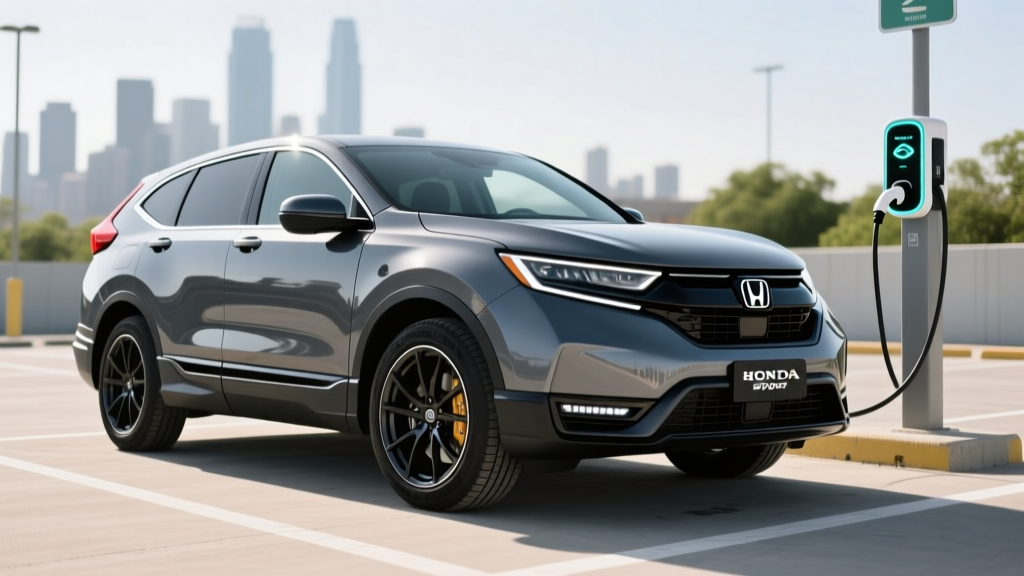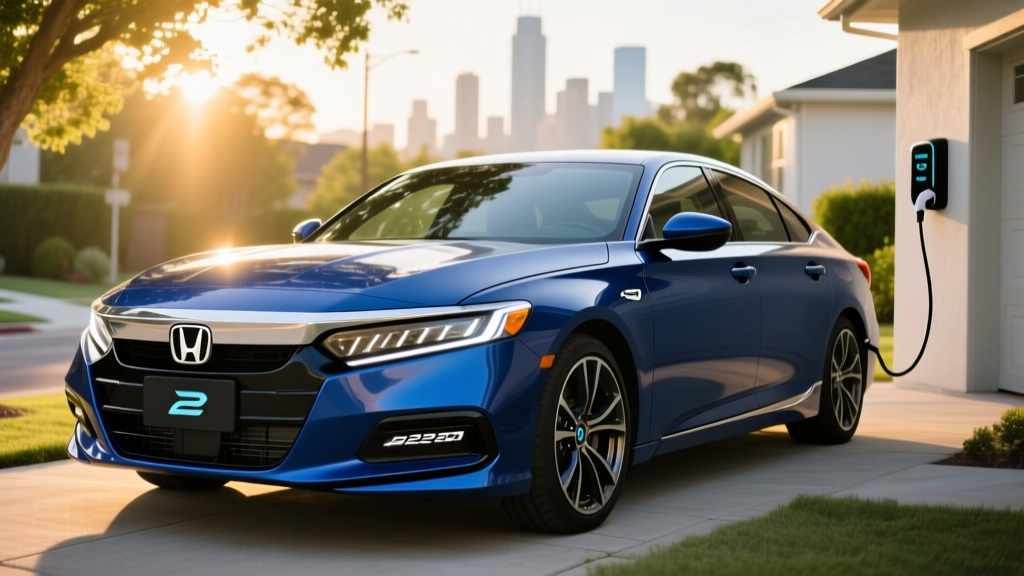
The midsize sedan segment hasn't surrendered to SUVs without a fight, and the 2025 Honda Accord Sport Hybrid is one of its strongest holdouts. Slotting between the Accord's base turbocharged four-cylinder and a full battery-electric vehicle, this conventional hybrid (HEV) targets buyers who want serious fuel economy without changing how they refuel. No plugs, no charging apps, no range anxiety—just a gas tank and a remarkably efficient two-motor powertrain.
For the 2025 model year, Honda continues its hybrid-only strategy for the Accord's upper trims while keeping the Sport Hybrid as the value-oriented entry point into the hybrid lineup. It pairs a 2.0-liter Atkinson-cycle four-cylinder with Honda's fourth-generation two-motor hybrid system, delivering strong city efficiency and a refined driving experience that outperforms its EPA sticker in stop-and-go traffic.
2025 Honda Accord Sport Hybrid MPG: EPA and Real-World Numbers
Fuel economy is the primary reason buyers choose the Accord Hybrid over the turbocharged 1.5T models. Here's what the EPA says—and what you'll likely see on the road.
| Metric | EPA Estimate | Real-World Expectation |
|---|---|---|
| City MPG | 51 MPG | 48–54 MPG (hybrids thrive in stop-and-go) |
| Highway MPG | 44 MPG | 39–44 MPG (sustained speeds reduce regen benefit) |
| Combined MPG | 48 MPG | 43–49 MPG (depends on city/highway mix) |
According to fueleconomy.gov, the 2025 Accord Hybrid achieves 51 city / 44 highway / 48 combined MPG. These figures apply across the hybrid trims, including the Sport Hybrid.
Compared to the non-hybrid Accord 1.5T (which returns approximately 29 city / 37 highway / 32 combined), the Sport Hybrid's advantage is substantial—roughly 50% more city fuel economy and a meaningful improvement on the highway.
Powertrain and Performance Specs
The Accord Sport Hybrid uses Honda's e-CVT two-motor hybrid system, which is fundamentally different from a traditional belt-driven CVT. There's no physical belt or pulley—instead, a drive motor propels the wheels while a second motor functions as a generator, with the gasoline engine primarily acting as a generator at lower speeds and engaging directly at highway cruising.
| Specification | 2025 Accord Sport Hybrid |
|---|---|
| Engine | 2.0L Atkinson-cycle inline-4 |
| Combined System Horsepower | 204 HP |
| Combined System Torque | 247 lb-ft (electric motor) |
| Transmission | e-CVT (two-motor hybrid system) |
| Drivetrain | Front-wheel drive |
| 0–60 mph | ~7.2 seconds |
| Hybrid Battery | ~1.1 kWh lithium-ion (not plug-in) |
| Fuel Tank Capacity | 12.8 gallons |
| Total Driving Range | ~614 miles (EPA combined) |
The 204 combined horsepower and 247 lb-ft of electric motor torque give the Sport Hybrid responsive acceleration from a stop—electric torque fills in the low-end gap that smaller turbocharged engines sometimes exhibit. The 0–60 time of roughly 7.2 seconds is adequate for merging and passing, though it won't feel sporty in the way a turbocharged performance sedan does.
Pricing, Trims, and Tax Credit Eligibility
The 2025 Accord Sport Hybrid is positioned as the most affordable hybrid trim in the Accord lineup, sitting below the EX-L Hybrid, Sport-L Hybrid, and Touring Hybrid.
| Trim | MSRP (incl. destination) |
|---|---|
| Accord Sport Hybrid | ~$34,490 |
| Accord EX-L Hybrid | ~$36,490 |
| Accord Sport-L Hybrid | ~$37,090 |
| Accord Touring Hybrid | ~$40,390 |
Pricing based on Honda's published MSRP for the 2025 model year. Dealer markups or discounts may apply.
Federal and State Tax Credit Status
Because the Accord Sport Hybrid is a conventional HEV—not a plug-in vehicle—it does not qualify for the federal §30D Clean Vehicle Credit (up to $7,500 for new EVs and PHEVs). The IRS restricts this credit to battery-electric vehicles and plug-in hybrids meeting battery capacity, critical-mineral sourcing, and buyer income requirements, as detailed on irs.gov.
However, some states and local utilities offer rebates or incentives for conventional hybrids. These vary by jurisdiction and change frequently, so check your state energy office or utility provider for current programs. A few states have historically offered modest hybrid incentives ($500–$1,500), though many have shifted their incentive budgets exclusively toward plug-in vehicles.
Battery Warranty, Reliability, and Replacement Cost
Hybrid battery longevity remains a top concern for buyers, even though two decades of real-world data have largely put this anxiety to rest. Honda backs the Accord Hybrid's lithium-ion battery pack with robust warranty coverage.
• Hybrid Battery: 8 years / 100,000 miles (10 years / 150,000 miles in CARB states including CA, NY, MA, and others)
• Powertrain Warranty: 5 years / 60,000 miles
• Basic Vehicle Warranty: 3 years / 36,000 miles
Honda's hybrid system has demonstrated strong long-term reliability. The Accord Hybrid's two-motor design places less stress on individual components than earlier single-motor hybrid systems, and the battery pack is relatively small (~1.1 kWh), meaning lower replacement cost if needed out of warranty.
Battery replacement cost: If the hybrid battery requires replacement after warranty expiration, expect to pay between $2,000 and $4,000 for a new OEM battery pack installed at a Honda dealer. Independent hybrid specialists may offer refurbished packs for $1,500–$2,500. For context, Toyota Prius batteries—which are more common in the replacement market—run $2,000–$3,500. The Accord Hybrid's smaller battery keeps costs below those of larger PHEV packs, which can exceed $6,000–$10,000.
Real-world data from high-mileage Accord Hybrid owners suggests battery degradation is minimal. Unlike full EVs where battery capacity directly determines range, the Accord Hybrid's small battery acts as a buffer—the gas engine compensates if capacity drops, so you'll notice a slight MPG decrease rather than a dramatic range loss. Most hybrid batteries last well beyond 150,000 miles with proper maintenance.
Driving Experience and Everyday Practicality
The Accord Sport Hybrid distinguishes itself from the turbocharged 1.5T Accord models in several ways beyond fuel economy:
Refinement: The hybrid system operates almost silently at low speeds, with the electric motor providing initial acceleration before the 2.0L engine starts as a generator. At highway speeds, the engine can lock directly to the wheels via a clutch, eliminating the "rubber-band" feeling some CVTs produce.
Regenerative braking: Steering-wheel-mounted paddle shifters let you adjust regen intensity across multiple levels, allowing mild one-pedal-like driving in city traffic without the aggressive deceleration of a full EV's one-pedal mode.
Cargo and interior: The hybrid battery is packaged beneath the rear seats, preserving the Accord's full 16.7 cubic feet of trunk space—identical to the gas-only models. Rear seat room remains class-leading at 40.8 inches of legroom.
Safety: The 2025 Accord carries Honda Sensing as standard equipment, including adaptive cruise control, lane-keeping assist, automatic emergency braking, and traffic sign recognition. The Accord has historically earned top marks from both the IIHS and NHTSA.
Accord Sport Hybrid vs. PHEV vs. Full EV: Which Fits You?
The Accord Sport Hybrid occupies a specific niche. Here's how it compares to the alternatives for a buyer cross-shopping electrified midsize transportation:
| Factor | Accord Sport Hybrid (HEV) | PHEV (e.g., Prius Prime) | Full EV (e.g., Hyundai Ioniq 6) |
|---|---|---|---|
| EPA Combined MPG / MPGe | 48 MPG | ~52 MPG + 44 mi electric | ~140 MPGe |
| Needs Plug-In Charging? | No | Optional (best with home charging) | Yes — required |
| Total Range | ~614 miles | ~440 miles total | ~300–360 miles |
| Home Charging Needed? | No | Strongly recommended | Essential |
| Federal Tax Credit | Not eligible | Up to $7,500 (if eligible) | Up to $7,500 (if eligible) |
| Base MSRP (approx.) | ~$34,490 | ~$33,445 (Prius Prime) | ~$37,500 (Ioniq 6) |
| Best For | No home charging access; road-trip heavy | Short commutes + home charger | Home charger + daily driving under 300 mi |
Choose the Accord Sport Hybrid if: You lack access to home or workplace charging, drive a mix of city and highway miles, take frequent road trips where charging infrastructure is uncertain, or want maximum simplicity with no behavioral change.
Choose a PHEV if: You can install a Level 2 charger at home, your daily commute is under 40 miles (covering most trips on electric), and you still want a gas engine for longer road trips.
Choose a full EV if: You have reliable home charging, your daily driving stays well under 300 miles, you want the lowest per-mile fuel cost, and you're ready to plan around DC fast charging on road trips.
Pros and Cons at a Glance
- 48 MPG combined — excellent for a midsize sedan
- No plug-in charging required; refuel at any gas station
- 614-mile total range eliminates range anxiety
- Responsive electric torque from a stop (247 lb-ft)
- Full trunk space preserved (16.7 cu ft)
- Strong hybrid battery warranty (8–10 yr / 100–150k mi)
- Honda Sensing safety suite standard
- No federal tax credit eligibility (HEV, not PHEV/EV)
- Highway MPG drops to ~40–43 in real-world driving
- No electric-only driving mode for zero-emission short trips
- e-CVT lacks the engagement of a geared transmission
- FWD only — no AWD option unlike some hybrid competitors
- Sport Hybrid trim lacks some premium features of EX-L/Touring
Frequently Asked Questions
How many MPG does the 2025 Honda Accord Sport Hybrid get?
The EPA rates the 2025 Accord Sport Hybrid at 51 city / 44 highway / 48 combined MPG. In real-world city driving with frequent stops, many owners report exceeding the 51 MPG city estimate thanks to regenerative braking. Highway-heavy driving typically yields 40–43 MPG.
Is the Accord Sport Hybrid a plug-in hybrid?
No. The Accord Sport Hybrid is a conventional hybrid (HEV). It cannot be plugged in and has no electric-only driving range. The small ~1.1 kWh battery charges through regenerative braking and the gasoline engine. If you want plug-in capability from Honda, you'd need to look at the Clarity PHEV (discontinued) or consider competitors like the Toyota Prius Prime.
Does the 2025 Accord Hybrid qualify for any tax credit?
The Accord Sport Hybrid does not qualify for the federal §30D Clean Vehicle Credit because it is not a plug-in vehicle. Some state or utility-level incentives may apply to conventional hybrids, but these vary by location and are increasingly rare as incentive programs shift toward plug-in vehicles. Check your state energy office for current programs.
How long will the Accord Hybrid battery last, and what does replacement cost?
Honda warranties the hybrid battery for 8 years / 100,000 miles (10 years / 150,000 miles in CARB states). Real-world data suggests most Accord Hybrid batteries last well beyond 150,000 miles. Out-of-warranty replacement costs $2,000–$4,000 at a dealer, or $1,500–$2,500 for a refurbished pack from an independent specialist.
How does the Accord Hybrid compare to the Toyota Camry Hybrid?
The Toyota Camry Hybrid (redesigned for 2025 with a fifth-generation hybrid system) achieves an EPA-estimated 51 city / 49 highway / 50 combined MPG in its front-wheel-drive LE trim—slightly better highway numbers than the Accord Hybrid. The Camry Hybrid also offers available AWD. However, the Accord Hybrid provides more rear-seat legroom (40.8 vs. 38.0 inches) and a larger trunk (16.7 vs. 15.1 cu ft). Both are excellent choices; the Accord favors space, the Camry favors peak efficiency.
Is the Accord Sport Hybrid worth the premium over the gas-only Accord?
The Sport Hybrid carries roughly a $2,500–$3,000 premium over the equivalent gas-only Accord 1.5T Sport. At 48 MPG combined versus 32 MPG combined, and assuming $3.50/gallon gas and 15,000 miles per year, the hybrid saves approximately $900–$1,000 annually in fuel costs. That means the hybrid premium pays for itself in roughly 3 years—after which the fuel savings are pure benefit, making the hybrid the clear financial choice for most buyers who plan to keep the car beyond 3–4 years.