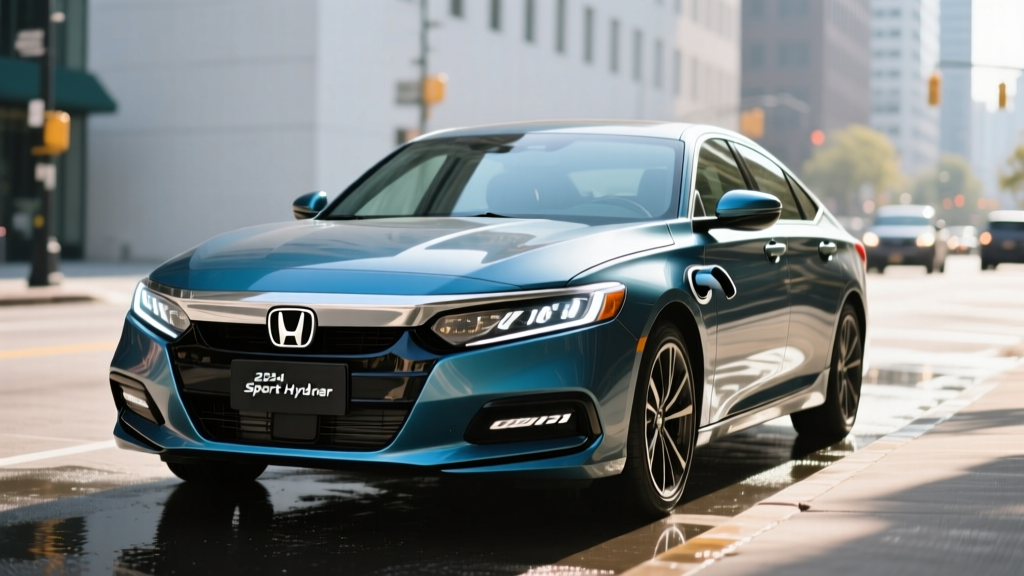
Quick Verdict: The Accord Sport Hybrid Is a Commuter's Efficiency Benchmark
The 2024 Honda Accord Sport Hybrid pairs a 2.0-liter Atkinson-cycle four-cylinder with Honda's fourth-generation two-motor hybrid system to deliver 204 combined horsepower and an EPA-estimated 46 MPG city / 47 MPG highway / 48 MPG combined. Starting at $30,340 (including destination), the Sport trim adds black exterior accents, 19-inch alloy wheels, and a leather-wrapped steering wheel over the base LX Hybrid. For buyers who want midsize-sedan comfort without plug-in complexity, this conventional hybrid (HEV) eliminates charging logistics entirely while keeping fuel costs below $1,400 per year at current gas prices.
But how does it stack up against the Accord's plug-in rivals, and should you consider a full EV instead? This guide breaks down every spec that matters.
HEV vs PHEV vs EV: Where the Accord Sport Hybrid Fits
Before examining the Accord Sport Hybrid's numbers, it's critical to understand what it is — and what it is not. The Accord Sport is a conventional hybrid (HEV), not a plug-in hybrid (PHEV). It has no charging port, no electric-only driving mode, and no external battery charging capability. Its small lithium-ion battery pack recharges exclusively through regenerative braking and the gasoline engine.
| Feature | Conventional Hybrid (HEV) | Plug-In Hybrid (PHEV) | Battery Electric (BEV) |
|---|---|---|---|
| Plug-in charging required? | No | Yes (optional but recommended) | Yes (mandatory) |
| Electric-only range | None (EV assist only) | Typically 20–45 miles | 200–400+ miles |
| Battery size | ~1–2 kWh | ~10–25 kWh | ~60–120 kWh |
| Federal tax credit (§30D) | Not eligible | Up to $7,500 (if eligible) | Up to $7,500 (if eligible) |
| Fueling | Gas station only | Gas + electric outlet/charger | Electric charger only |
Honda discontinued the Accord Plug-In Hybrid after the 2015 model year. The current 11th-generation Accord (2023–present) is offered exclusively as a conventional hybrid on four of its six trims (Sport, EX-L, Sport-L, Touring) and as a 1.5L turbo gasoline model on the base LX and SE trims. If you want plug-in capability in a Honda sedan, you would need to look at a different manufacturer — Honda's current US PHEV lineup is limited to the Clarity PHEV (discontinued after 2021).
Fuel Economy: EPA Ratings vs Real-World MPG
| Trim | City MPG | Highway MPG | Combined MPG | Annual Fuel Cost* |
|---|---|---|---|---|
| Sport (19" wheels) | 46 | 41 | 44 | ~$1,350 |
| EX-L / Sport-L (17" wheels) | 51 | 44 | 48 | ~$1,250 |
| Touring (19" wheels) | 46 | 41 | 44 | ~$1,350 |
*Based on 15,000 miles/year at $3.50/gallon regular unleaded, per fueleconomy.gov. Actual costs vary with driving habits and local fuel prices.
Real-World MPG: What Owners Actually Report
Honda's two-motor hybrid system excels in stop-and-go city driving, where the electric motor handles low-speed propulsion and the engine acts primarily as a generator. In real-world mixed driving, Accord Hybrid owners commonly report 44–50 MPG combined, with city-heavy commuters occasionally exceeding the EPA city estimate. Highway-only driving at 75+ MPH typically drops to 38–42 MPG due to increased aerodynamic drag and reduced regenerative braking opportunity.
Key factors that affect your real-world MPG:
- Wheel size matters: The Sport trim's 19-inch wheels reduce EPA combined MPG from 48 to 44 compared to 17-inch-equipped trims — a ~8% efficiency penalty for aesthetics.
- Cold weather: Expect a 5–10% MPG drop in sub-40°F conditions as the engine runs more frequently for cabin heat and battery conditioning.
- Driving mode: ECON mode softens throttle response and optimizes climate control for efficiency; SPORT mode holds the engine at higher RPM for responsiveness at the cost of ~2–3 MPG.
Powertrain and Performance Specs
| Engine | 2.0L DOHC Atkinson-cycle inline-4 |
| Engine horsepower | 146 hp @ 6,100 rpm |
| Engine torque | 134 lb-ft @ 4,500 rpm |
| Electric motors | Two-motor hybrid system (drive + generator) |
| Drive motor output | 184 hp / 247 lb-ft torque |
| Combined system output | 204 hp / 247 lb-ft |
| Transmission | Electronic continuously variable (e-CVT) |
| Drivetrain | Front-wheel drive |
| 0–60 mph | ~7.0 seconds (tested) |
| Battery type | Lithium-ion (approx. 1.1 kWh, HEV) |
| Fuel tank capacity | 14.8 gallons |
| Total driving range | ~650 miles (EPA combined) |
| Required fuel | Regular unleaded (87 octane) |
The Accord Sport Hybrid's two-motor system operates in three modes without driver input: EV Drive (battery powers the drive motor at low speeds for short distances, typically under 1 mile), Hybrid Drive (engine generates electricity for the drive motor), and Engine Drive (a lock-up clutch connects the engine directly to the front wheels at steady highway cruising speeds for maximum efficiency). This architecture feels more like an EV in city driving than a traditional parallel hybrid, with smooth, linear torque delivery from a stop.
The 204 combined horsepower is competitive with the Toyota Camry Hybrid (225 hp with AWD) and Hyundai Sonata Hybrid (192 hp). The 0–60 MPH time of approximately 7.0 seconds is adequate for highway merging but not sporty by turbocharged standards — Honda prioritizes efficiency over acceleration here.
Pricing, Trims, and Tax Credit Eligibility
| Trim | MSRP (incl. destination) | Key Features |
|---|---|---|
| Sport | $30,340 | 19" wheels, black accents, heated front seats, wireless Apple CarPlay/Android Auto |
| EX-L | $32,890 | Leather seats, power moonroof, wireless phone charger, 17" wheels (higher MPG) |
| Sport-L | $34,785 | Sport styling + leather seats, heated rear seats, 19" wheels |
| Touring | $38,890 | Full LED headlights, Bose 12-speaker audio, ventilated front seats, navigation, 19" wheels |
Federal Tax Credit: Does the Accord Hybrid Qualify?
No. The 2024 Honda Accord Sport Hybrid is a conventional HEV, not a plug-in vehicle. It does not qualify for the IRS §30D Clean Vehicle Credit (up to $7,500 for new EVs and PHEVs). Only vehicles with a battery capacity of at least 7 kWh and plug-in charging capability are eligible under current IRS rules.
However, some states offer separate hybrid or high-efficiency vehicle rebates. Check your state's energy office or department of environmental quality for local programs. Additionally, the Accord Hybrid's lower fuel consumption translates to roughly $600–$800 per year in fuel savings versus the turbocharged gas Accord (rated at 29 city / 37 highway / 32 combined MPG), which offsets the hybrid's modest price premium within 3–4 years of ownership.
Battery Warranty, Reliability, and Replacement Costs
Honda covers the Accord Hybrid's lithium-ion battery pack with a 8-year / 100,000-mile warranty (extended to 10 years / 150,000 miles in California Air Resources Board states, including CA, CO, CT, ME, MD, MA, NJ, NY, OR, RI, VT, and WA). This warranty covers defects and capacity loss below a functional threshold — typically defined as the battery's inability to hold sufficient charge for normal hybrid operation.
| Hybrid battery | 8 yr / 100,000 mi (10 yr / 150,000 mi in CARB states) |
| Hybrid system components | 8 yr / 100,000 mi |
| Powertrain (engine, transmission) | 5 yr / 60,000 mi |
| Bumper-to-bumper | 3 yr / 36,000 mi |
Real-world reliability data: Honda's two-motor hybrid system has proven durable across multiple generations. The Accord Hybrid's battery pack is relatively small (~1.1 kWh) and operates within a conservative state-of-charge window — Honda's battery management system avoids deep discharges and full charges, which are the primary drivers of lithium-ion degradation. Based on historical data from 10th-generation Accord Hybrids (2018–2022), widespread battery failures have not been reported within normal ownership periods. The IIHS rates the 2024 Accord as a Top Safety Pick+ across all trims.
Battery replacement cost: If the hybrid battery fails outside of warranty, expect a replacement cost of $2,000–$4,000 (parts and labor) at a Honda dealership. Independent hybrid specialists may offer refurbished packs for $1,500–$2,500. Given the conservative battery management and small pack size, most Accord Hybrids will never require a battery replacement during typical ownership.
Who Should Buy the Accord Sport Hybrid — And Who Shouldn't
Choose the Accord Sport Hybrid if:
- You drive 15,000+ miles per year and want to minimize fuel costs without changing your refueling habits
- You lack access to home or workplace charging (no garage, apartment living, street parking)
- You regularly take long road trips where charging infrastructure is sparse or unreliable
- You want a proven, low-risk ownership experience with strong resale value
- You prefer a traditional sedan with a spacious trunk (16.7 cu ft) and comfortable rear seat
Consider a PHEV instead if:
- You have reliable home Level 2 charging and a commute under 30 miles round-trip
- You want to drive on electricity most days while retaining a gas engine for road trips
- You want to qualify for the $7,500 federal tax credit (requires eligible PHEV with 7+ kWh battery)
Consider a full EV (BEV) instead if:
- You have home charging and rarely drive more than 250 miles in a single day
- You want zero tailpipe emissions and the lowest per-mile energy cost (~$0.04/mile on electricity vs ~$0.08/mile on gas for the Accord Hybrid)
- You want to qualify for federal and state EV incentives and avoid gas station visits entirely
Pros
- 44–48 MPG combined depending on trim and wheel size
- Smooth, EV-like acceleration feel in city driving
- No charging required — fill up at any gas station
- Spacious interior with 16.7 cu ft trunk (no battery intrusion)
- Top Safety Pick+ rating from IIHS
- Honda Sensing ADAS suite standard on all trims
- Strong reliability track record for Honda's hybrid system
Cons
- No federal tax credit eligibility (HEV, not PHEV)
- 19-inch wheels on Sport trim reduce MPG by ~4 combined
- 0–60 in ~7.0 seconds — adequate, not quick
- Engine drone under hard acceleration (e-CVT characteristic)
- No all-wheel-drive option (available on Toyota Camry Hybrid)
- Infotainment lacks physical volume knob on Sport trim
Ownership Costs: 5-Year Total Cost of Ownership
| Category | Accord Sport Hybrid | Accord Sport (1.5T Gas) | Toyota Camry SE Hybrid |
|---|---|---|---|
| Purchase price (MSRP) | $30,340 | $28,990 | $30,145 |
| Fuel (75k mi) | ~$6,750 | ~$9,400 | ~$6,400 |
| Insurance (avg) | ~$7,500 | ~$7,200 | ~$7,400 |
| Maintenance | ~$2,500 | ~$3,000 | ~$2,400 |
| Depreciation (est.) | ~$12,000 | ~$13,500 | ~$11,800 |
| 5-Year Total (est.) | ~$59,090 | ~$62,090 | ~$58,145 |
Estimates based on national averages. Fuel costs at $3.50/gal regular. Insurance varies significantly by driver profile, location, and coverage. Depreciation estimates based on historical Honda/Toyota midsize sedan retention rates. Source: fueleconomy.gov and industry data.
The Accord Sport Hybrid saves approximately $3,000 over five years compared to the gas-only Accord Sport, primarily through fuel savings and slightly better depreciation. The Camry Hybrid edges out the Accord on total cost due to marginally higher MPG (52 combined on LE trim) and Toyota's resale-value advantage, though the Accord offers a more refined interior and stronger safety-tech suite.
Frequently Asked Questions
How many MPG does the 2024 Honda Accord Sport Hybrid get?
The Accord Sport Hybrid (with 19-inch wheels) is EPA-rated at 46 city / 41 highway / 44 combined MPG. Trims with 17-inch wheels (EX-L, Sport-L) achieve 51 city / 44 highway / 48 combined. Real-world owners typically report 44–50 MPG in mixed driving, with city-heavy commutes sometimes exceeding EPA estimates thanks to the hybrid system's regenerative braking efficiency.
Does the Honda Accord Hybrid need to be plugged in?
No. The Accord Sport Hybrid is a conventional hybrid (HEV), not a plug-in hybrid. It has no charging port and requires no external charging. The small lithium-ion battery recharges through regenerative braking and the gasoline engine. You refuel exclusively at gas stations with regular 87-octane unleaded.
Is the 2024 Accord Hybrid reliable?
Honda's fourth-generation two-motor hybrid system has a strong reliability record. The hybrid battery is covered by an 8-year/100,000-mile warranty (10 years/150,000 miles in CARB states). The small ~1.1 kWh battery operates within a conservative charge window managed by Honda's battery management system, minimizing degradation risk. No widespread battery failure patterns have been reported for 10th- or 11th-generation Accord Hybrids.
What does it cost to replace the Accord Hybrid battery?
Out-of-warranty hybrid battery replacement costs approximately $2,000–$4,000 at a Honda dealer, or $1,500–$2,500 through an independent hybrid specialist using a refurbished pack. However, given the conservative battery management and small pack size, most Accord Hybrids will not require a battery replacement during a typical 10–15 year ownership cycle.
Does the Accord Hybrid qualify for any tax credit?
The 2024 Accord Sport Hybrid does not qualify for the federal IRS §30D Clean Vehicle Credit, which applies only to plug-in vehicles (PHEVs and BEVs) with battery packs of at least 7 kWh. Some states may offer separate incentives for high-efficiency vehicles — check your state's energy office. The fuel savings alone ($600–$800/year vs. the gas Accord) offset the hybrid's price premium within 3–4 years.
How does the Accord Hybrid compare to the Toyota Camry Hybrid?
The Camry Hybrid (52/49/52 MPG on LE trim) edges out the Accord on fuel economy and starts at a similar price. However, the Accord Hybrid offers a more refined interior, larger trunk (16.7 vs 15.1 cu ft), and Honda's comprehensive Honda Sensing ADAS suite as standard. The Camry Hybrid offers available AWD; the Accord does not. Both are excellent choices — prioritize the Accord for interior quality and the Camry for maximum MPG and AWD availability.
Can the Accord Hybrid drive on electric power alone?
Technically yes, but only for very short distances (under 1 mile) at low speeds (under 25 MPH). The hybrid system uses EV Drive mode during initial acceleration and low-speed crawling, but the small battery depletes quickly and the engine engages to generate electricity. This is not comparable to a PHEV's 20–40 mile electric-only range — think of it as EV-assisted driving rather than true electric mode.