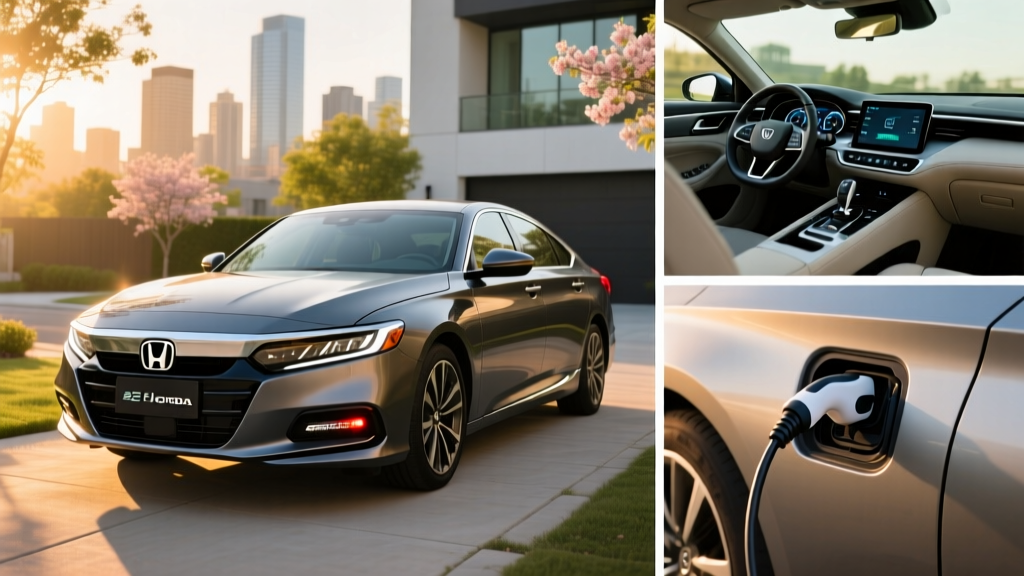
The 2025 Honda Accord Hybrid Touring sits at the top of Honda's midsize sedan lineup, pairing a proven two-motor hybrid system with the brand's most feature-rich trim. For buyers weighing a hybrid against a plug-in hybrid or full EV, the Accord Hybrid offers a compelling no-plug-required proposition: 44 MPG combined with zero lifestyle change. Here's everything you need to know about specs, real-world efficiency, battery longevity, and whether the Touring trim justifies its premium.
HEV vs PHEV: Where the Accord Hybrid Fits
Before diving into specs, it's critical to understand what the Accord Hybrid is—and isn't. This is a conventional hybrid (HEV), not a plug-in hybrid (PHEV). You never plug it in. The 1.3 kWh lithium-ion battery recharges exclusively through regenerative braking and the gasoline engine. There is no electric-only driving range to speak of—the electric motors assist the engine and enable brief low-speed EV mode, but the gas engine remains the primary energy source.
| Attribute | HEV (Accord Hybrid) | PHEV (e.g., Toyota Prius Prime) | BEV (e.g., Tesla Model 3) |
|---|---|---|---|
| Plug-in required? | No | Yes (optional but recommended) | Yes (mandatory) |
| Electric-only range | ~1 mi at low speed | 35–44 mi typical | 250–360 mi typical |
| Battery size | 1.3 kWh | 13–18 kWh | 60–82 kWh |
| Fueling | Gas only | Gas + electric | Electric only |
| Federal tax credit | None | Up to $7,500 (varies) | Up to $7,500 (varies) |
| Home charging needed? | No | Recommended | Essential |
If you lack access to home or workplace charging, the Accord Hybrid is the right electrified choice. If you can plug in nightly and want electric-only commuting, a PHEV or BEV may serve you better.
Fuel Economy: EPA Ratings and Real-World MPG
The 2025 Accord Hybrid (all trims including Touring) carries EPA ratings of 51 MPG city / 44 MPG highway / 48 MPG combined, according to fueleconomy.gov. These are class-leading figures for a midsize sedan, though it's worth noting the Touring's larger 19-inch wheels and heavier equipment load can shave 1–2 MPG compared to lighter Hybrid trims.
| Driving Cycle | EPA MPG | Real-World Expectation |
|---|---|---|
| City | 51 MPG | 48–55 MPG (hybrids often exceed EPA in stop-and-go) |
| Highway | 44 MPG | 40–46 MPG (sustained 75+ MPH reduces regen benefit) |
| Combined | 48 MPG | 44–50 MPG (depends on commute mix) |
Real-world insight: Honda's two-motor hybrid system excels in city driving, where regenerative braking recaptures energy at every stop. Owners consistently report beating the EPA city estimate in urban traffic. Highway driving is the weaker scenario—sustained high speeds rely more on the gasoline engine with less regen benefit. In cold weather (below 30°F), expect a 5–8% efficiency drop due to reduced battery efficiency and increased engine runtime for cabin heat.
Total Range: With a 12.8-gallon fuel tank and 48 MPG combined, the Accord Hybrid delivers approximately 614 miles of total range—enough for most drivers to visit the gas station once every two to three weeks.
Powertrain: 204 Horsepower from a Two-Motor System
The Accord Hybrid uses Honda's fourth-generation two-motor hybrid system, pairing a 2.0-liter Atkinson-cycle four-cylinder engine with two electric motors. The combined system output is 204 horsepower and 247 lb-ft of torque. Unlike some hybrid systems that use a traditional transmission, Honda's e-CVT uses the electric motors as the primary drive force, with the gas engine acting mostly as a generator at lower speeds and engaging directly only at highway cruising.
| Engine | 2.0L Atkinson-cycle 4-cylinder |
| Electric Motors | Two-motor system (drive + generator) |
| Combined Horsepower | 204 HP |
| Combined Torque | 247 lb-ft |
| Transmission | e-CVT (no traditional gears) |
| Drivetrain | Front-wheel drive |
| 0–60 MPH | ~7.2 seconds |
| Battery Capacity | 1.3 kWh lithium-ion |
| Fuel Tank | 12.8 gallons |
| Curb Weight (Touring) | ~3,532 lbs |
| EPA MPG (Combined) | 48 MPG |
| Base MSRP (Touring) | $39,490 (incl. destination) |
The driving experience is smooth and linear—electric motor torque fills in immediately from a stop, and the engine only audibly revs under hard acceleration. The Touring trim adds adaptive dampers, which subtly firm up the ride in Sport mode, though this is a comfort-oriented sedan, not a sport sedan.
Touring Trim: What You Get for $39,490
The Touring is the most expensive Accord Hybrid trim, and it shows in the feature list. Standard equipment includes:
- 12.3-inch touchscreen with wireless Apple CarPlay and Android Auto
- 12-speaker Bose premium audio system
- Wireless phone charging
- Heated and ventilated front seats, heated rear seats
- Heated steering wheel
- Head-up display
- Google built-in (navigation, voice assistant)
- Honda Sensing suite (adaptive cruise, lane-keeping, collision mitigation)
- Low-speed braking control and traffic jam assist
- 19-inch alloy wheels
At $39,490 including destination charges, the Touring commands roughly a $4,000 premium over the well-equipped Sport-L Hybrid. That premium buys genuine luxury features, but budget-conscious buyers should know the Sport-L delivers the same powertrain and MPG for less.
Tax Credit Eligibility: What Hybrid Buyers Need to Know
Federal Tax Credit Status: NOT ELIGIBLE
The 2025 Honda Accord Hybrid does not qualify for the IRS §30D Clean Vehicle Credit. Under current IRS rules, only plug-in electric vehicles (BEVs and PHEVs) with sufficient battery capacity (≥7 kWh for PHEVs, ≥16 kWh for some calculations) are eligible. Conventional hybrids like the Accord Hybrid have a 1.3 kWh battery and no plug-in capability, placing them outside the credit's scope.
Some states offer their own hybrid incentives, though these are increasingly rare as state programs shift toward plug-in vehicles. Check your state's energy or DMV website for current programs.
Battery Warranty, Lifespan, and Replacement Cost
Battery longevity is the top concern for hybrid buyers, and Honda's coverage is strong. The Accord Hybrid's lithium-ion battery pack is covered under Honda's hybrid system warranty:
| Hybrid Battery Warranty | 8 years / 100,000 miles (10 years / 150,000 miles in CARB states*) |
| Hybrid System Components | 8 years / 100,000 miles |
| Powertrain Warranty | 5 years / 60,000 miles |
| Bumper-to-Bumper | 3 years / 36,000 miles |
*CARB states include California, Colorado, Connecticut, Delaware, Maine, Maryland, Massachusetts, New Jersey, New York, Oregon, Pennsylvania, Rhode Island, Vermont, Virginia, and Washington.
Real-world lifespan: Honda's hybrid battery packs routinely last 150,000–200,000+ miles before significant degradation. The 1.3 kWh battery is small and operates in a narrow state-of-charge window (roughly 40–80%), which minimizes stress on the cells. Out-of-warranty replacement runs $2,500–$4,000 including labor, though third-party refurbished options are becoming available for $1,500–$2,500.
Honda's hybrid system has proven highly reliable. The IIHS awarded the 2025 Accord its Top Safety Pick+ designation, and the hybrid powertrain carries a strong track record from the previous-generation model.
Who Should Choose the Accord Hybrid Touring?
Strengths
- Class-leading 48 MPG combined—beats Toyota Camry Hybrid
- No plug-in required; zero lifestyle adjustment
- 614-mile total range between fill-ups
- Smooth, linear electric-motor-driven acceleration
- Touring trim rivals entry-level luxury sedans in features
- Proven hybrid reliability with 8–10 year battery warranty
- Spacious interior with 16.7 cu-ft trunk (no battery intrusion)
Limitations
- No federal tax credit eligibility
- Not a PHEV—no meaningful electric-only range
- Touring trim at ~$39.5K approaches luxury sedan territory
- FWD only; no AWD option (unlike Toyota Camry Hybrid)
- Highway MPG drops at sustained 75+ MPH speeds
- CVT-like engine drone under hard acceleration
Decision Framework: Accord Hybrid vs PHEV vs Full EV
Choose the Accord Hybrid if:
- You lack reliable access to home or workplace charging
- You want maximum MPG with zero plug-in behavior change
- Your annual mileage is high (15K+ miles) and fuel cost matters
- You want a proven, low-risk hybrid with strong resale value
Choose a PHEV (e.g., Toyota Prius Prime, Hyundai Tucson PHEV) if:
- You can charge at home nightly (Level 1 or Level 2)
- Your daily commute is under 40 miles (cover it on electric only)
- You want to qualify for the federal tax credit (up to $7,500, subject to income and sourcing rules)
- You want electric commuting but gas flexibility for road trips
Choose a full EV (e.g., Tesla Model 3, Hyundai Ioniq 6) if:
- You have reliable home Level 2 charging
- You want zero tailpipe emissions and minimal maintenance
- Your daily driving is under 250 miles and you road-trip infrequently
- You want the lowest per-mile fuel cost (electricity vs gasoline)
Frequently Asked Questions
How many MPG does the 2025 Honda Accord Hybrid Touring get?
The EPA rates the Accord Hybrid at 51 MPG city, 44 MPG highway, and 48 MPG combined. The Touring trim's 19-inch wheels may reduce real-world figures by 1–2 MPG. City drivers often exceed the EPA estimate thanks to strong regenerative braking.
Does the Accord Hybrid need to be plugged in?
No. The Accord Hybrid is a conventional HEV. The battery charges through regenerative braking and the gasoline engine. You fuel it exclusively at gas stations—no plug, no charger, no electric bill impact.
How far can the Accord Hybrid drive on electric only?
Effectively zero miles in practical terms. The EV mode can propel the car at very low speeds (under 25 MPH) for roughly one mile on a fully charged battery, but the engine engages quickly. This is not a plug-in hybrid with electric commuting capability.
Is the Accord Hybrid battery reliable and what does replacement cost?
Honda's hybrid batteries are among the most reliable in the industry, routinely lasting 150,000–200,000+ miles. Coverage is 8 years/100,000 miles (10 years/150,000 miles in CARB states). Out-of-warranty replacement costs $2,500–$4,000 new, or $1,500–$2,500 refurbished.
Does the 2025 Accord Hybrid qualify for any tax credit?
No federal tax credit. The IRS §30D Clean Vehicle Credit applies only to plug-in vehicles (BEVs and PHEVs). The Accord Hybrid's 1.3 kWh battery and lack of plug-in capability disqualify it. Some states may offer minor hybrid incentives—check your state energy office.
How does the Accord Hybrid compare to the Toyota Camry Hybrid?
The Accord Hybrid edges out the Camry Hybrid on combined MPG (48 vs 52 for the Camry LE, though the Camry XSE with larger wheels drops to 44). The Accord offers more rear legroom and cargo space. The Camry Hybrid offers available AWD, which the Accord does not. Both are excellent; choose Accord for space and driving refinement, Camry for AWD and slightly higher MPG on base trims.
What is the total cost of ownership vs a gas-only Accord?
At 48 MPG combined and $3.50/gallon gas, the Accord Hybrid costs roughly $1,020 per year in fuel for 14,000 miles. A comparable gas-only Accord at 30 MPG combined costs about $1,633/year—a savings of ~$613 annually. Over five years, the hybrid saves roughly $3,065 in fuel, easily offsetting any trim premium.