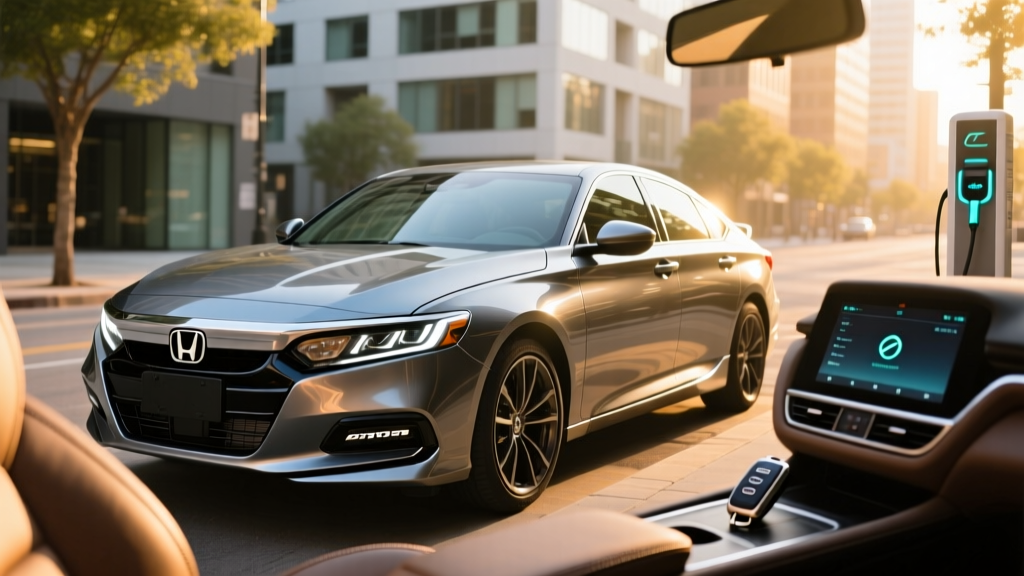
The midsize sedan segment hasn't surrendered to SUVs without a fight, and the Honda Accord Hybrid Sport-L is a key reason why. Sitting in the upper-middle of the Accord Hybrid lineup, the Sport-L trim pairs the efficiency of Honda's fourth-generation two-motor hybrid system with sport-tuned suspension and aesthetic upgrades that distinguish it from the more sedate EX-L. For 2026, Honda has refined the powertrain calibration and expanded standard safety features, making the Sport-L one of the most compelling arguments for a conventional hybrid over a plug-in hybrid or full EV — particularly for buyers without reliable home charging access.
This review covers the 2026 Accord Hybrid Sport-L with exact EPA figures, real-world fuel economy observations, powertrain specs, ownership costs, and battery longevity data. If you're cross-shopping against the Toyota Camry Hybrid, Hyundai Sonata Hybrid, or considering stepping up to a PHEV or BEV, we break down where this car fits.
What Is the Honda Accord Hybrid Sport-L?
The Accord Hybrid Sport-L is a conventional hybrid electric vehicle (HEV), not a plug-in hybrid (PHEV). That distinction matters: it generates its own electricity through regenerative braking and its gasoline engine — you never plug it in. There is no electric-only driving range to manage, no charging cable to deploy, and no range anxiety about finding a public charger. You simply fill it with regular unleaded and drive.
HEV vs PHEV vs BEV — Where the Accord Hybrid Sport-L Fits
| Vehicle Type | Plug In? | Electric-Only Range | Federal Tax Credit | Best For |
|---|---|---|---|---|
| HEV (this car) | No | None (EV mode limited to ~1 mi at low speed) | None | No home charging; high-mileage commuters |
| PHEV (e.g., Toyota Prius Prime) | Yes | 25–45 mi typical | Up to $7,500 if eligible | Home charging + short daily commutes |
| BEV (e.g., Tesla Model 3) | Yes | 250–360 mi | Up to $7,500 if eligible | Home charging; low-cost fueling; no gas engine |
The Accord Hybrid is not offered as a PHEV in the US market. Honda previously sold the Clarity Plug-In Hybrid (discontinued after 2021), but the current Accord lineup is strictly HEV for the hybrid variants. If electric-only commuting is a priority, you'll need to look at competitors like the Prius Prime or consider a full EV.
Fuel Economy: EPA Ratings and Real-World MPG
The 2026 Accord Hybrid Sport-L carries the same EPA ratings as other Accord Hybrid trims equipped with the 19-inch wheels (the Sport-L and Sport Touring). Because larger wheels carry a slight efficiency penalty versus the 17-inch wheels on the EX-L, the numbers differ by 1–2 MPG.
| Driving Cycle | EPA Rating | Real-World Observation |
|---|---|---|
| City | 51 MPG | 50–55 MPG (hybrids excel in stop-and-go) |
| Highway | 44 MPG | 39–43 MPG (aerodynamic drag dominates) |
| Combined | 48 MPG | 44–48 MPG (mixed driving) |
According to fueleconomy.gov, the 2026 Accord Hybrid Sport-L is rated at 51 city / 44 highway / 48 combined MPG. These are strong numbers for a 3,400-pound midsize sedan, and they translate to roughly 600 miles of total range on a single 12.4-gallon tank.
Compared to the gas-only Accord (which does not exist for 2026 — Honda made all Accords hybrid-only starting with the 2023 redesign), the hybrid system delivers roughly 15–20 MPG more in combined driving versus the last generation of turbocharged gas Accords.
Powertrain: How the Two-Motor Hybrid System Works
The Accord Hybrid Sport-L uses Honda's fourth-generation two-motor hybrid system, a series-parallel architecture that operates differently from traditional planetary-gear hybrids like Toyota's system.
| Specification | Value |
|---|---|
| Engine | 2.0L Atkinson-cycle inline-4, direct injection |
| Engine Output | 146 hp @ 6,100 rpm / 134 lb-ft torque |
| Drive Motor | AC permanent-magnet synchronous, 181 hp / 247 lb-ft |
| Combined System Output | 192 hp (limited by generator/engine output) |
| Transmission | Direct-drive (no traditional gears); engine clutch for highway cruise |
| Hybrid Battery | ~1.0 kWh lithium-ion (nominal), located under rear seats |
| 0–60 mph | ~7.1 seconds |
| Drivetrain | Front-wheel drive |
| Fuel Tank | 12.4 gallons (regular 87 octane) |
| Curb Weight | ~3,477 lbs |
In normal driving below ~45 mph, the Accord Hybrid operates primarily as a series hybrid: the gasoline engine spins a generator that feeds electricity to the drive motor, which turns the wheels. The engine does not mechanically connect to the wheels. Above highway speeds, a lock-up clutch engages, linking the engine directly to the front axle for more efficient high-speed cruising. Under hard acceleration, both the engine and battery feed the drive motor simultaneously.
The Sport-L trim adds a sport-tuned suspension with firmer damping, paddle shifters that adjust regenerative braking intensity across four levels, and a Sport drive mode that sharpens throttle response. These don't change the powertrain output but do alter the driving character meaningfully versus the comfort-oriented EX-L.
Pricing, Trims, and Tax Credit Eligibility
The 2026 Honda Accord Hybrid Sport-L starts at an MSRP of approximately $34,295, including the destination charge. This positions it roughly $1,200 above the EX-L Hybrid and about $3,500 below the range-topping Sport Touring Hybrid.
| Accord Hybrid Trim | 2026 MSRP (incl. destination) | Key Additions Over Lower Trim |
|---|---|---|
| Sport | $32,595 | 19" wheels, black accents, sport suspension |
| Sport-L | $34,295 | Leather-trimmed seats, heated rear seats, wireless charging |
| Sport Touring | $37,795 | Bose audio, ventilated front seats, low-speed braking control, Wi-Fi hotspot |
Does the Accord Hybrid Qualify for a Federal Tax Credit?
No. The Honda Accord Hybrid Sport-L is a conventional hybrid (HEV) and does not qualify for the IRS §30D New Clean Vehicle Credit. That credit — worth up to $7,500 — is reserved for plug-in electric vehicles (PHEVs and BEVs) that meet battery sourcing, critical mineral, MSRP cap, and buyer income requirements. Conventional hybrids that cannot be plugged in have not qualified for the federal EV credit since the Energy Policy Act of 2005 credits expired for most manufacturers over a decade ago.
Some states offer modest rebates or HOV lane access for hybrids, but these vary widely by jurisdiction. Check your state's department of energy or environmental agency for current programs. No federal incentive applies to this vehicle.
Battery Warranty, Lifespan, and Replacement Costs
The hybrid battery in the Accord Sport-L is a compact lithium-ion pack (approximately 1.0 kWh nominal capacity) located beneath the rear seats. Unlike a full EV battery, it undergoes shallow charge-discharge cycles — typically operating between roughly 20% and 80% state of charge — which significantly reduces degradation stress.
- Coverage: 8 years / 100,000 miles (10 years / 150,000 miles in CARB states including CA, NY, MA, WA, OR, CO, and others)
- What's covered: Defects and capacity loss below a functional threshold (Honda specifies the battery must maintain sufficient capacity to power the hybrid system)
- Hybrid system components: Also covered under the 8yr/100k powertrain warranty — includes the drive motor, generator, power control unit, and related electronics
How Long Will the Battery Last?
Based on data from Honda's previous-generation hybrid systems and broader industry patterns, the Accord Hybrid's battery pack is designed to last the lifetime of the vehicle under normal use — typically 150,000 to 200,000+ miles. The shallow cycling strategy, active thermal management, and conservative state-of-charge window all contribute to longevity. Failures within the warranty period are uncommon; failures beyond 150,000 miles are possible but not epidemic.
Battery Replacement Cost
If the hybrid battery does require replacement out of warranty, expect a cost in the range of $2,000 to $3,500 for the battery pack itself, plus labor. This is dramatically lower than EV battery replacements ($10,000–$20,000+) because the hybrid pack is small and modular. Third-party refurbished battery options are also emerging for older Honda hybrids, potentially reducing costs further.
Ownership Costs: Fuel, Insurance, and Maintenance
One of the strongest arguments for the Accord Hybrid Sport-L over a comparable gasoline sedan is fuel cost savings. At 48 MPG combined and an average US gas price of ~$3.30/gallon (as of early 2026), the Accord Hybrid costs roughly $0.069 per mile in fuel. A comparable 30 MPG gas sedan would cost about $0.11 per mile — a difference of approximately $615 per year at 15,000 miles driven annually.
| Cost Factor | Accord Hybrid Sport-L | Comparable Gas Sedan (~30 MPG) |
|---|---|---|
| Annual fuel cost (15,000 mi) | ~$1,031 | ~$1,650 |
| Oil changes per year | 1–2 (same interval) | 2–3 |
| Brake pad replacement interval | 80,000+ mi (regen braking reduces wear) | 40,000–60,000 mi |
| Estimated annual insurance | $1,500–$1,900 | $1,300–$1,700 |
Regenerative braking significantly extends brake pad life — many hybrid owners report original brake pads lasting past 80,000 miles. Maintenance intervals for the engine are the same as a conventional Honda four-cylinder, and there is no transmission fluid to change (the direct-drive system uses a simple clutch rather than a multi-gear automatic).
Insurance premiums for the Accord Hybrid are modestly higher than for a gas equivalent, reflecting the vehicle's higher replacement cost and repair complexity after collisions. However, the Accord consistently earns top safety ratings from IIHS, which helps moderate premiums.
Driving Impressions and Practical Considerations
The Sport-L's 192 combined horsepower is adequate rather than thrilling — the 0–60 time of approximately 7.1 seconds places it in the middle of the midsize sedan pack. Where the hybrid system shines is in low-speed responsiveness: the electric drive motor delivers 247 lb-ft of torque instantly from a standstill, making the Accord Hybrid feel quicker in city driving than its 0–60 time suggests.
The Sport-L's sport-tuned suspension firms up the ride noticeably versus the EX-L. Bumps and expansion joints are more perceptible, but body roll is well-controlled and the steering feels precise. The 19-inch wheels look excellent but do contribute to slightly more road noise — a common trade-off in sport trims.
Interior space is generous: 105.7 cubic feet of passenger volume and 16.7 cubic feet of trunk space (identical to gas-era Accords, since the hybrid battery is packaged under the rear seats rather than in the trunk). Rear legroom remains a class-leading 40.8 inches.
Technology and Driver Assistance
The Sport-L includes Honda's 10.2-inch touchscreen with wireless Apple CarPlay and Android Auto, a 12-speaker Bose audio system (shared with the Sport Touring), and the full Honda Sensing suite: adaptive cruise control with low-speed follow, lane-keeping assist, traffic sign recognition, and collision mitigation braking. This is an SAE Level 1 driver-assistance system — it supports the driver but does not enable hands-off or eyes-off operation. You remain fully responsible for steering and awareness at all times.
Who Should Buy the Accord Hybrid Sport-L?
Choose the Accord Hybrid Sport-L If:
- You don't have access to home or workplace charging (apartment, street parking, no garage outlet)
- Your commute is long or unpredictable — you need 600+ miles of range without planning stops
- You drive 15,000+ miles per year and want to minimize fuel costs without behavioral change
- You prefer a proven, low-complexity powertrain with strong resale value
- You value a sport-tuned ride and premium features without paying luxury-brand prices
Look at a PHEV or BEV Instead If:
- You have reliable Level 2 home charging and a short daily commute (PHEV gives you electric-only weekday driving)
- You want to qualify for the $7,500 federal tax credit (only PHEVs and BEVs qualify under current IRS §30D rules)
- You want zero tailpipe emissions during daily driving
- You want to eliminate gasoline purchases entirely (BEV)
Pros
- 48 MPG combined EPA — class-leading for a midsize sedan with 19-inch wheels
- No plug, no charging hassle — fill up at any gas station in 3 minutes
- 600+ mile total range per tank
- Generous interior space with full 16.7 cu-ft trunk
- 8yr/100k hybrid battery warranty (10yr/150k in CARB states)
- Instant electric torque for responsive city driving
Cons
- No federal tax credit eligibility
- Highway MPG drops to low 40s at sustained 75+ mph
- 19-inch wheels and sport suspension mean a firmer ride
- No AWD option (competitors like Camry Hybrid offer it)
- ~7.1 sec 0–60 is adequate, not quick
- Not available as a plug-in hybrid for electric-only commuting
Frequently Asked Questions
How many MPG does the Honda Accord Hybrid Sport-L get?
The 2026 Accord Hybrid Sport-L is EPA-rated at 51 MPG city, 44 MPG highway, and 48 MPG combined. Real-world results vary: expect 50–55 MPG in city driving, 39–43 MPG on sustained highway trips, and 44–48 MPG in mixed use. Cold weather and short trips reduce efficiency by 5–10%.
Does the Accord Hybrid need to be plugged in?
No. The Accord Hybrid is a conventional hybrid (HEV). It charges its small battery through regenerative braking and the gasoline engine. You never plug it in — just fill it with regular 87-octane gasoline.
Is the Accord Hybrid available as a plug-in hybrid (PHEV)?
No. Honda does not offer the current-generation Accord as a PHEV in the United States. If you want plug-in hybrid capability in a Honda, the brand currently does not offer a PHEV sedan in the US market. Competitors like the Toyota Prius Prime and the discontinued Hyundai Sonata PHEV are alternatives.
Is the Accord Hybrid reliable?
Honda's hybrid system has proven highly reliable across multiple generations. The two-motor architecture has fewer moving parts than a conventional automatic transmission (no torque converter, no multi-gear planetary set), and the battery is conservatively managed. The hybrid components are covered by an 8-year/100,000-mile warranty (10 years/150,000 miles in CARB states). Honda's NHTSA safety records for the Accord platform are strong.
What does it cost to replace the Accord Hybrid battery?
Out-of-warranty replacement of the hybrid battery pack typically costs $2,000–$3,500 including labor. This is far less than an EV battery replacement. Most Accord Hybrid batteries last 150,000+ miles, and many will outlast the vehicle. The 8-year/100,000-mile warranty covers premature failures.
Does the Accord Hybrid qualify for any tax credits?
The Accord Hybrid does not qualify for the federal §30D New Clean Vehicle Credit, which is limited to plug-in vehicles (PHEVs and BEVs). Some states may offer small hybrid rebates or incentives, but these vary by location and change frequently. Check with your state's energy or environmental agency for current programs.
How does the Accord Hybrid compare to the Toyota Camry Hybrid?
The 2026 Camry Hybrid (LE trim with 16" wheels) achieves 53 MPG combined versus the Accord Sport-L's 48 MPG (due to the Sport-L's larger 19" wheels). However, the Accord offers more rear legroom (40.8" vs ~38"), a larger trunk, and a more engaging driving experience. The Camry Hybrid offers AWD; the Accord does not. Both are excellent choices — the decision often comes down to styling preference and whether AWD matters in your climate.