Quick Verdict: The Accord Hybrid Sport Balances Efficiency and Punch
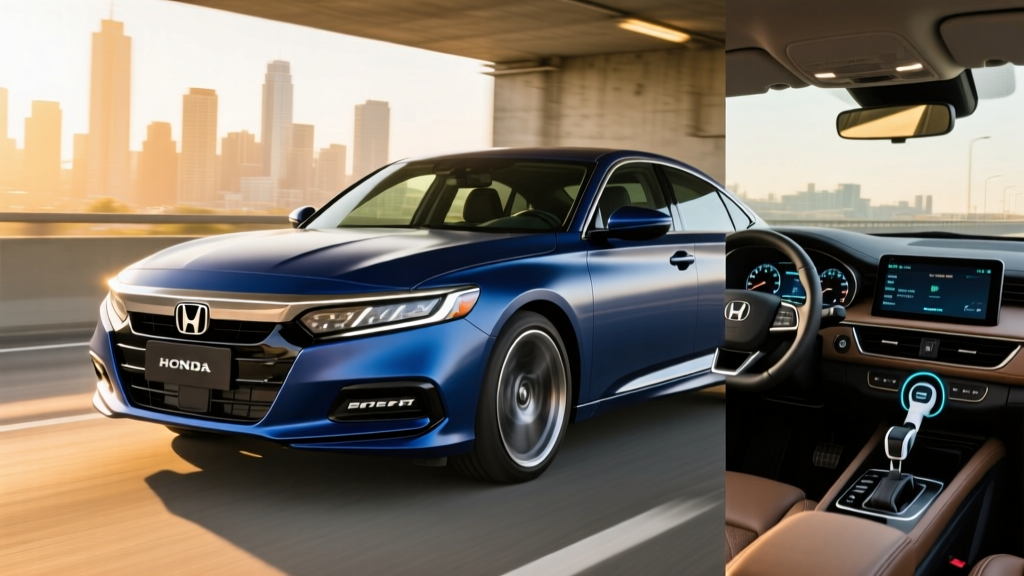
The Honda Accord Hybrid Sport occupies a specific niche in the midsize sedan market: it delivers genuinely quick acceleration for a hybrid while returning fuel economy numbers that make gas-only competitors look wasteful. If you've been searching for the Honda Accord Hybrid Sport 0-60 time, the answer is approximately 6.5 seconds — a figure that puts it ahead of most turbocharged gas sedans in its class and makes it one of the quicker hybrid sedans available without stepping into luxury pricing.
This isn't a plug-in hybrid. The Accord Hybrid is a conventional HEV (hybrid electric vehicle), meaning it generates all its electricity onboard through regenerative braking and its gasoline engine. You never plug it in, and there's no electric-only driving range to manage. That simplicity is both its greatest advantage and its limitation — depending on what you need from your daily commute.
A conventional hybrid (HEV) like the Accord Hybrid uses a small battery (typically 1.0–1.5 kWh) charged entirely by the engine and regen braking. It cannot plug in and has no electric-only range. A plug-in hybrid (PHEV) like the Toyota Prius Prime has a larger battery (13+ kWh), plugs into a wall outlet, and can drive 30–45 miles on electricity alone before the gas engine takes over. The Accord Hybrid is strictly HEV.
Honda Accord Hybrid Sport: Powertrain and 0-60 Performance
The Accord Hybrid powertrain pairs a 2.0-liter Atkinson-cycle four-cylinder engine with two electric motors integrated into Honda's e-CVT (electronic continuously variable transmission). The combined system output is 204 horsepower and 247 lb-ft of torque. Unlike a traditional CVT that uses belts and pulleys, Honda's system uses the electric motors as the primary drive force, with the gas engine either generating electricity or, at highway cruising speeds, connecting directly to the wheels via a lock-up clutch.
| Specification | Value |
|---|---|
| Combined Horsepower | 204 hp |
| Combined Torque | 247 lb-ft |
| Engine | 2.0L Atkinson-cycle I-4 |
| Electric Motors | Two (one drive, one generator) |
| Transmission | e-CVT (direct drive) |
| 0-60 mph | ~6.5 seconds |
| Drivetrain | Front-wheel drive |
| Hybrid Battery | ~1.0 kWh lithium-ion |
| Curb Weight | ~3,477 lbs |
| Base MSRP (Sport trim) | ~$33,655 (incl. destination) |
The 0-60 mph time of roughly 6.5 seconds matters in context. The non-hybrid Accord 1.5T (turbocharged gas model) runs 0-60 in about 7.2 seconds. The Accord Hybrid Sport actually feels quicker off the line than the gas model because electric motors deliver peak torque instantly from zero RPM — there's no turbo lag and no waiting for the CVT to find its ratio. In real-world driving, that instant torque makes merging and passing feel effortless, even though the peak horsepower number is modest.
The Sport trim specifically adds paddle shifters that simulate stepped gear ratios (Honda calls them "deceleration paddles" that also adjust regen braking intensity), sport-tuned suspension damping, and 19-inch alloy wheels. The larger wheels add a small weight penalty and marginally reduce efficiency compared to lower trims, but the performance character is noticeably sharper.
Fuel Economy: EPA Ratings and Real-World MPG
According to fueleconomy.gov, the Honda Accord Hybrid earns the following EPA estimates:
| Cycle | MPG |
|---|---|
| City | 51 MPG |
| Highway | 44 MPG |
| Combined | 48 MPG |
Note: The Sport and Sport-L trims, equipped with 19-inch wheels, carry a slight EPA penalty — typically rated at 46 MPG combined (50 city / 41 highway) due to increased rolling resistance and unsprung weight. The figures above reflect the EX-L and Sport-L trims most commonly cross-shopped.
Honda's hybrid system excels in city driving, where the electric motor handles most low-speed propulsion and regenerative braking recaptures energy at every stop. Many owners report exceeding the EPA city estimate in stop-and-go traffic — 52–55 MPG is common in warm weather on urban routes. Highway efficiency is the reverse: sustained 75+ mph driving relies more heavily on the gas engine, and real-world highway MPG often settles between 40–43 MPG. In cold weather (below 35°F), expect a 5–10% reduction across the board as the engine runs more frequently to provide cabin heat.
With a 12.8-gallon fuel tank, the Accord Hybrid's total range sits between 550 and 650 miles depending on your driving mix. That's a genuine road-trip advantage over most EVs and eliminates any range consideration for long-distance travel.
Hybrid Battery Warranty, Lifespan, and Replacement Cost
The Accord Hybrid's battery is small (~1.0 kWh usable) and operates within a narrow state-of-charge window — typically between 40% and 80%. Honda's battery management system never allows a full charge or full depletion, which dramatically reduces stress on the cells. This conservative strategy is why hybrid batteries routinely last 150,000–200,000+ miles before needing replacement.
If replacement becomes necessary out of warranty, expect to pay between $2,000 and $4,000 for a new OEM hybrid battery pack, with labor adding roughly $300–$600. Refurbished or aftermarket packs are available for $1,000–$2,000. This is a fraction of full EV battery replacement costs (which can exceed $10,000–$20,000) because the hybrid battery is far smaller.
Honda's hybrid system has proven highly reliable across multiple generations. The two-motor e-CVT design has fewer wear components than a conventional automatic transmission — no torque converter, no clutch packs, no planetary gearsets. The most common hybrid-system maintenance item is the inverter cooling system fluid, typically serviced at 60,000-mile intervals.
Pricing, Trims, and Tax Credit Eligibility
The 2025–2026 Honda Accord Hybrid is available in four trims:
- Sport: ~$33,655 — 19-inch wheels, paddle shifters, sport suspension, heated front seats
- Sport-L: ~$35,255 — adds leather-trimmed seats, wireless phone charger
- EX-L: ~$36,655 — 17-inch wheels (better MPG), leather, power moonroof
- Touring: ~$39,655 — navigation, premium audio, ventilated front seats, heated rear seats, wireless CarPlay/Android Auto
The Honda Accord Hybrid is a conventional hybrid (HEV), not a plug-in hybrid or battery electric vehicle. Under current IRS §30D rules, only plug-in electric vehicles (BEVs and PHEVs with at least 7 kWh of battery capacity) qualify for the federal clean vehicle credit of up to $7,500. The Accord Hybrid does not qualify for any federal EV tax credit. Some states may offer modest hybrid incentives — check your state energy office for local programs.
While the lack of a federal tax credit is a disadvantage on paper, the Accord Hybrid's lower base price and strong fuel economy often result in a lower total cost of ownership than similarly equipped gas sedans over five years — particularly for drivers covering 15,000+ miles annually in city-heavy commuting.
Hybrid vs PHEV vs Full EV: Which Should You Choose?
| Factor | HEV (Accord Hybrid) | PHEV (e.g., Prius Prime) | BEV (e.g., Tesla Model 3) |
|---|---|---|---|
| Plug in required? | No | Yes (optional but recommended) | Yes (mandatory) |
| Electric-only range | None | 30–45 miles | 250–360 miles |
| Federal tax credit | No | Up to $7,500* | Up to $7,500* |
| Home charging needed | No | Recommended (Level 1 OK) | Yes (Level 2 ideal) |
| Road trip convenience | Gas station (5 min) | Gas station (5 min) | DC fast charge (20–40 min) |
| Best for | No home charging access, high mileage, simplicity | Short daily commute + occasional road trips | Home charging available, daily driving under 250 mi |
* Federal tax credit eligibility depends on MSRP caps, buyer income limits, battery sourcing requirements, and point-of-sale transfer rules. Verify current eligibility at irs.gov.
The Accord Hybrid Sport makes the most sense if you lack reliable access to home or workplace charging but still want to reduce fuel costs significantly. It's also ideal for drivers who regularly take long road trips and don't want to plan around charging stops. If you can charge at home and your daily commute is under 40 miles, a PHEV gives you electric-only daily driving with gas-engine backup — potentially saving more on fuel while still qualifying for a federal tax credit.
Pros and Cons of the Accord Hybrid Sport
- 0-60 in ~6.5 sec — quick for the class
- 46–48 MPG combined real-world
- No plug-in charging required
- Instant electric torque, smooth acceleration
- 550+ mile total range per tank
- Strong reliability history, low hybrid maintenance
- Spacious cabin (16.7 cu ft trunk, no battery intrusion)
- Honda Sensing safety suite standard
- No federal tax credit eligibility
- No electric-only driving mode
- Sport trim's 19-inch wheels reduce MPG slightly
- Engine drone under hard acceleration (e-CVT characteristic)
- No AWD option (competitors like Camry Hybrid offer it)
- Higher base price than gas-only Accord
- Regenerative braking feel takes adjustment
Frequently Asked Questions
How fast is the Honda Accord Hybrid Sport from 0 to 60 mph?
The Honda Accord Hybrid Sport reaches 0-60 mph in approximately 6.5 seconds. This is quicker than the non-hybrid Accord 1.5T (~7.2 seconds) thanks to instant electric motor torque. The quarter-mile time is approximately 14.9 seconds at 95 mph.
How many MPG does the Accord Hybrid Sport get in real driving?
Real-world fuel economy varies by driving conditions. City driving typically yields 48–55 MPG (hybrids excel in stop-and-go traffic). Highway cruising at 70–75 mph typically returns 40–43 MPG. Combined mixed driving averages 44–48 MPG. Cold weather and short trips reduce efficiency by 5–10%.
Does the Honda Accord Hybrid need to be plugged in?
No. The Accord Hybrid is a conventional hybrid (HEV). Its battery charges entirely through regenerative braking and the gasoline engine. There is no plug, no charging cable, and no electric-only range. You fuel it exclusively at gas stations.
Is the Accord Hybrid battery expensive to replace?
Out-of-warranty hybrid battery replacement typically costs $2,000–$4,000 for the OEM pack plus $300–$600 in labor. However, Honda's hybrid batteries commonly last 150,000–200,000+ miles, and the factory warranty covers 8 years/100,000 miles (10 years/150,000 miles in CARB states). Most owners never need a replacement.
Does the Accord Hybrid qualify for any tax credit?
No. Under current IRS §30D rules, the federal clean vehicle credit applies only to plug-in electric vehicles (BEVs and PHEVs) with battery capacity of at least 7 kWh. The Accord Hybrid's ~1.0 kWh battery does not qualify. Some states offer separate hybrid incentives — check your state's energy or environmental agency website.
Should I buy the Accord Hybrid Sport or a full EV?
Choose the Accord Hybrid Sport if you lack home charging access, regularly drive more than 300 miles in a day, live in an area with sparse public charging infrastructure, or want zero lifestyle change from your current gas car. Choose a full EV if you can install a Level 2 home charger, your daily driving is under 250 miles, you want to qualify for the $7,500 federal tax credit, and you want to eliminate gasoline costs entirely. A PHEV splits the difference if your commute is under 40 miles but you still take road trips.
How does the Accord Hybrid compare to the Toyota Camry Hybrid?
The Camry Hybrid (with available AWD) earns slightly higher EPA ratings — up to 52 MPG combined on LE trims — but its 0-60 time is approximately 7.2 seconds, nearly a full second behind the Accord Hybrid Sport. The Accord also offers a larger trunk and more rear-seat legroom. If maximum fuel economy matters most, the Camry edges ahead. If you want quicker acceleration and a more engaging drive, the Accord Hybrid Sport wins.