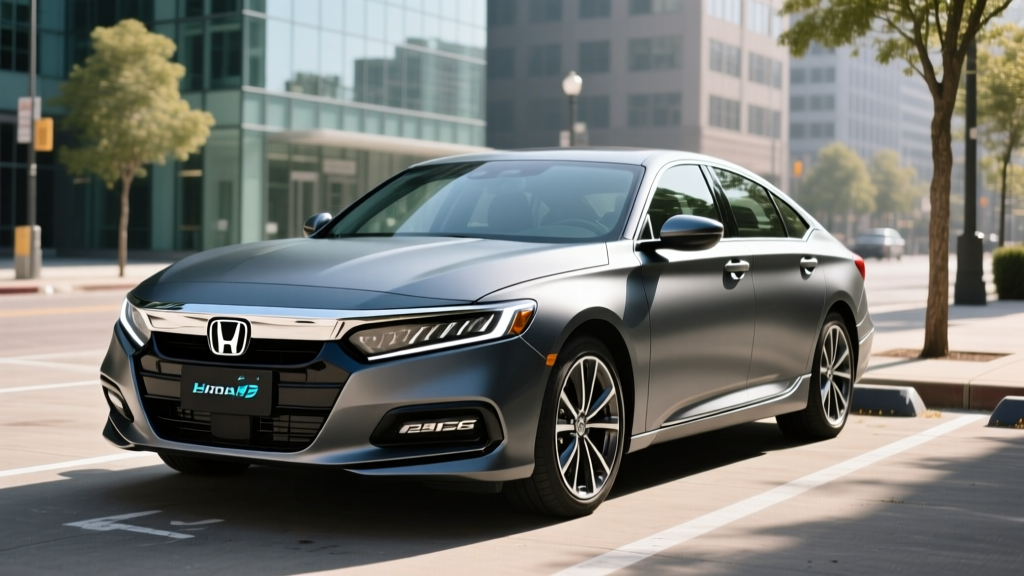
The midsize sedan segment has thinned considerably, but the Honda Accord Hybrid remains one of the most compelling arguments for electrified daily driving without plugging in. For buyers researching Honda Accord Hybrid reliability, the numbers tell a reassuring story: a proven two-motor powertrain, a 10-year/150,000-mile hybrid battery warranty, and EPA fuel economy that real-world drivers frequently exceed in city conditions. This guide covers the 2026 Accord Hybrid's efficiency, long-term durability data, battery replacement economics, and how it stacks up against plug-in hybrids and full EVs.
HEV vs PHEV: Where the Accord Hybrid Fits
Before diving into reliability, it's essential to clarify what the Accord Hybrid actually is — because confusion between conventional hybrids and plug-in hybrids leads to mismatched expectations.
| Feature | Honda Accord Hybrid (HEV) | Plug-In Hybrid (e.g., Toyota Prius Prime) | Full EV (e.g., Tesla Model 3) |
|---|---|---|---|
| Plugs in to charge? | No — self-charging via regen & engine | Yes — Level 1/Level 2 | Yes — Level 1/2/DC fast |
| Electric-only range | ~1-2 mi at low speed | 25-44 mi typical | 250-360 mi (EPA) |
| Total range | ~550+ mi (12.8-gal tank) | ~400-600 mi combined | 250-360 mi |
| Battery size | 1.06 kWh (lithium-ion) | 13.6-18.1 kWh | 60-82 kWh |
| Federal tax credit (§30D) | Not eligible | Up to $7,500 (if criteria met) | Up to $7,500 (if criteria met) |
| Home charging install needed | No | Recommended (Level 2) | Recommended (Level 2) |
The Accord Hybrid is a conventional hybrid (HEV). It generates electricity through regenerative braking and its gasoline engine — you never plug it in. This is a major advantage for apartment dwellers, street parkers, or anyone without reliable home charging access. The trade-off is that it cannot drive meaningful distances on electric power alone and does not qualify for the federal §30D EV tax credit.
EPA Fuel Economy and Real-World MPG
The 2026 Honda Accord Hybrid uses the same fourth-generation two-motor hybrid system that debuted with the 11th-generation Accord. Honda rates it identically across Sport, Sport-L, EX-L, and Sport Touring trims:
| Trim | City MPG | Highway MPG | Combined MPG | Fuel Tank | Total Range |
|---|---|---|---|---|---|
| Sport / Sport-L | 51 | 44 | 48 | 12.8 gal | ~614 mi |
| EX-L | 51 | 44 | 48 | 12.8 gal | ~614 mi |
| Sport Touring | 51 | 44 | 48 | 12.8 gal | ~614 mi |
Source: EPA Fuel Economy Guide
Real-World MPG: What Owners Actually Report
Hybrids typically exceed their EPA city rating in stop-and-go traffic because regenerative braking recaptures energy that a gas car wastes as heat. Many Accord Hybrid owners report 52-55 MPG in urban commuting. Highway driving is a different story: at sustained 75-80 mph speeds, the gasoline engine does most of the work, and real-world highway fuel economy drops to 38-42 MPG. Cold weather (below 35°F) reduces MPG by roughly 5-10% due to increased engine runtime for cabin heating and reduced battery efficiency.
Bottom line: If most of your driving is city or suburban, expect to beat the 48 MPG combined sticker. If you're a highway commuter doing 70+ mph, plan for low-to-mid 40s.
Powertrain Specs: How the Accord Hybrid Makes 204 HP
The Accord Hybrid pairs a 2.0-liter Atkinson-cycle four-cylinder engine with Honda's two-motor hybrid system. Unlike a traditional parallel hybrid (think older Toyota Camry Hybrid), Honda's system operates primarily as a series hybrid at low and moderate speeds — the gas engine acts as a generator, and the electric traction motor drives the wheels. Only at highway cruising speeds does a lockup clutch engage to connect the engine directly to the wheels.
| Specification | 2026 Honda Accord Hybrid |
|---|---|
| Engine | 2.0L DOHC Atkinson-cycle 4-cylinder |
| Engine output | 146 hp / 134 lb-ft torque |
| Electric traction motor | 181 hp / 247 lb-ft torque |
| Combined system output | 204 hp / 247 lb-ft torque |
| Hybrid battery | 1.06 kWh lithium-ion (72 cells) |
| Transmission | Single-speed direct drive (e-CVT behavior) |
| Drivetrain | Front-wheel drive |
| 0-60 mph | ~7.1 seconds |
| Curb weight | ~3,477 lbs (Sport Touring) |
The 247 lb-ft of electric torque is available from zero RPM, which gives the Accord Hybrid a responsive, EV-like feel off the line and in urban passing situations. It's not a performance sedan, but it never feels sluggish — a common complaint with older hybrid sedans.
Honda Accord Hybrid Reliability: What the Data Shows
Honda's two-motor hybrid system has been in production since 2014 (first in the Accord Hybrid, then expanded to the CR-V Hybrid, Civic Hybrid, and others). That gives us over a decade of field data to evaluate.
Powertrain Track Record
The fourth-generation hybrid system in the current Accord (2023-2026) is an evolution of a proven architecture, not an all-new design. Key reliability advantages:
- No traditional transmission: The Accord Hybrid uses a direct-drive system with a single lockup clutch. There are no planetary gearsets, belt-driven CVTs, or multi-speed automatics to fail — eliminating one of the most expensive repair categories in conventional cars.
- Engine longevity: The 2.0L Atkinson-cycle engine runs under lighter load than a conventional engine because the electric motor handles peak acceleration demands. Atkinson-cycle engines also keep intake valves open longer, reducing pumping losses and thermal stress.
- Regenerative braking reduces wear: The electric motor handles most deceleration, meaning brake pads and rotors last significantly longer — 80,000-100,000+ miles is common before the first brake job.
- Proven electronics: Honda's power control unit (PCU) and motor-generator assemblies have been refined over multiple generations with low failure rates reported across the Honda hybrid fleet.
Industry Reliability Ratings
The Honda Accord consistently earns above-average reliability scores. IIHS has named the Accord a Top Safety Pick+, and Consumer Reports has historically rated the Accord Hybrid at or above average for predicted reliability. The hybrid system itself rarely appears in major recall campaigns — Honda's hybrid-related recalls have typically involved software updates rather than hardware failures.
Hybrid Battery Warranty & Lifespan
Federal mandate: All hybrid and EV batteries sold in the US carry a minimum warranty of 8 years/100,000 miles (10 years/150,000 miles in CARB states including California, New York, Massachusetts, and others).
Honda's coverage: The Accord Hybrid battery is warrantied for 10 years/150,000 miles nationwide against defects and excessive capacity loss. Honda defines excessive loss as falling below approximately 70% of original capacity.
Expected lifespan: Based on field data from Honda and Toyota hybrid fleets, lithium-ion hybrid batteries typically last 150,000-200,000+ miles before significant degradation. Because the Accord Hybrid's battery is small (1.06 kWh) and operates in a narrow state-of-charge window (roughly 40-60% SoC), it experiences far less stress than a full EV battery that cycles through deep charge/discharge ranges daily.
Hybrid Battery Replacement Cost: The Number Buyers Want
Even with strong reliability data, the "what if the battery dies?" question dominates hybrid purchase research. Here are the actual numbers:
| Scenario | Estimated Cost | Notes |
|---|---|---|
| Full OEM battery replacement (dealer) | $3,000 - $4,500 | Includes battery pack + labor; varies by region |
| Refurbished/remanufactured battery | $1,500 - $2,500 | Third-party suppliers; may have shorter warranty |
| Individual cell/module replacement | $500 - $1,500 | Only if specific cells fail; requires specialist shop |
| Warranty-covered replacement | $0 | If within 10 yr/150k mi and capacity below threshold |
Context matters here. A $3,000-$4,500 battery replacement at 180,000 miles on a car that saved you thousands in fuel costs over its life is a manageable expense — not a financial catastrophe. For comparison, a transmission replacement on a conventional sedan at similar mileage runs $3,500-$5,500. The hybrid battery is not a ticking time bomb; it's a wear item with a predictable lifespan and a strong warranty backstop.
2026 Pricing, Trims, and Tax Credit Eligibility
| Trim | MSRP (2026) | Key Features |
|---|---|---|
| Sport | ~$34,995 | 19" wheels, heated front seats, wireless CarPlay/Android Auto, Honda Sensing suite |
| Sport-L | ~$36,495 | Leather-trimmed seats, wireless phone charger, heated rear seats |
| EX-L | ~$37,495 | Leather, power passenger seat, low-speed braking control, parking sensors |
| Sport Touring | ~$40,395 | Bose 12-speaker audio, heated steering wheel, navigation, front ventilated seats |
Federal tax credit: The Accord Hybrid does not qualify for the IRS §30D Clean Vehicle Credit. That credit applies only to plug-in electric vehicles (BEVs and PHEVs) with sufficient battery capacity. As a conventional HEV, the Accord Hybrid is ineligible regardless of buyer income or MSRP.
State incentives: A small number of states offer rebates or HOV lane access for conventional hybrids, but these programs have largely shifted focus to PHEVs and BEVs. Check your state's energy office or DMV for current programs — they vary by jurisdiction and change frequently.
Total cost of ownership advantage: Even without a tax credit, the Accord Hybrid's fuel savings are substantial. At 48 MPG combined versus a comparable gas-only midsize sedan at 30 MPG combined, driving 15,000 miles/year at $3.50/gallon:
- Accord Hybrid: ~$1,094/year in fuel
- Gas sedan (30 MPG): ~$1,750/year in fuel
- Annual savings: ~$656/year, or ~$3,280 over 5 years
Accord Hybrid vs PHEV vs Full EV: Which Should You Choose?
The Decision Framework
Choose the Accord Hybrid (HEV) if:
- You cannot install a home charger (apartment, street parking, condo restrictions)
- You want zero behavior change — no plugging in, no route planning around chargers
- You drive 12,000-20,000 miles/year in mixed city/highway conditions
- You want strong fuel economy (48 MPG) without the higher upfront cost of a PHEV or EV
- You plan to keep the car 8-12 years and value Honda's reliability reputation
Choose a PHEV (e.g., Toyota Prius Prime, Hyundai Tucson PHEV) if:
- You can charge at home (Level 2 preferred) and have a short commute (under 35 miles)
- You want to drive mostly on electricity daily but need gas-engine flexibility for road trips
- You qualify for the §30D federal tax credit (income and sourcing rules apply — see IRS guidelines)
- You want to reduce fuel consumption to near-zero on weekdays
Choose a full EV (e.g., Tesla Model 3, Hyundai Ioniq 6) if:
- You have reliable home Level 2 charging
- Your daily driving is under 200 miles and you can plan road-trip charging stops
- You want zero tailpipe emissions and minimal maintenance (no oil changes, no engine)
- You want the maximum federal tax credit benefit and lowest per-mile energy cost
Pros and Cons at a Glance
Pros
- 51 city MPG — among the best of any non-plug-in midsize sedan
- No plug-in charging required — works for any living situation
- 204 hp with 247 lb-ft electric torque feels responsive, not sluggish
- 10-year/150,000-mile hybrid battery warranty (nationwide)
- Proven powertrain architecture with 10+ years of field data
- Spacious interior with 16.7 cu ft trunk (no battery intrusion)
- Honda Sensing ADAS suite standard on all trims
- Low brake wear from regenerative braking
Cons
- No federal tax credit eligibility (HEV, not PHEV/BEV)
- Highway MPG drops to low 40s at sustained 75+ mph
- Not available with AWD (unlike the Toyota Camry Hybrid)
- Engine drone under hard acceleration (typical of Atkinson-cycle + e-CVT)
- No spare tire — tire repair kit only
- Infotainment can feel slow compared to rivals
Frequently Asked Questions
How many MPG does the Honda Accord Hybrid actually get?
The EPA rates it at 51 city / 44 highway / 48 combined MPG. In real-world city driving with frequent stops, many owners report 52-55 MPG thanks to regenerative braking. Highway-only driving at 75+ mph yields 38-42 MPG. Cold weather reduces fuel economy by roughly 5-10%.
Is the Honda Accord Hybrid reliable long-term?
Yes. Honda's two-motor hybrid system has been in production since 2014 with low failure rates. The system eliminates the traditional transmission (a common failure point), runs the engine under lighter loads, and uses regenerative braking to extend brake life. The hybrid battery is warrantied for 10 years/150,000 miles and typically lasts 150,000-200,000+ miles based on fleet data.
What does it cost to replace the Accord Hybrid battery?
A full OEM replacement at a Honda dealer runs approximately $3,000-$4,500 including labor. Refurbished batteries are available for $1,500-$2,500. Individual cell repairs can cost $500-$1,500 at specialist shops. However, most batteries last well beyond the warranty period, and the 10-year/150,000-mile warranty covers premature failures at no cost.
Does the Accord Hybrid qualify for any tax credits?
No. The IRS §30D Clean Vehicle Credit applies only to plug-in vehicles (BEVs and PHEVs). The Accord Hybrid is a conventional HEV that charges its small battery via the engine and regenerative braking — it has no plug and is not eligible for the federal credit. Some states may offer minor hybrid incentives; check your state's energy office for current programs.
Do I need to plug in the Honda Accord Hybrid?
No. The Accord Hybrid is a conventional hybrid (HEV), not a plug-in hybrid (PHEV). It charges its 1.06 kWh battery through regenerative braking and the gasoline engine. You fuel it exclusively at gas stations and drive it exactly like a conventional car — just with significantly better fuel economy.
How does the Accord Hybrid compare to the Toyota Camry Hybrid?
The Camry Hybrid (51 city/49 highway/50 combined for FWD) edges out the Accord on highway MPG and offers AWD as an option. The Accord Hybrid counters with more rear-seat legroom, a larger trunk (16.7 vs 15.1 cu ft), a more engaging driving feel with 247 lb-ft of electric torque, and a more premium interior on upper trims. Both have excellent reliability records and similar battery warranty terms. Choose the Camry for maximum highway MPG and AWD availability; choose the Accord for space, refinement, and driving dynamics.
Can the Accord Hybrid drive on electric power only?
Only for very short distances (roughly 1-2 miles) at low speeds (under 25 mph) with a light throttle input. The 1.06 kWh battery is far too small for meaningful electric-only driving. If you want substantial EV range, you need a PHEV (25-44 miles electric) or a full BEV (250-360 miles).