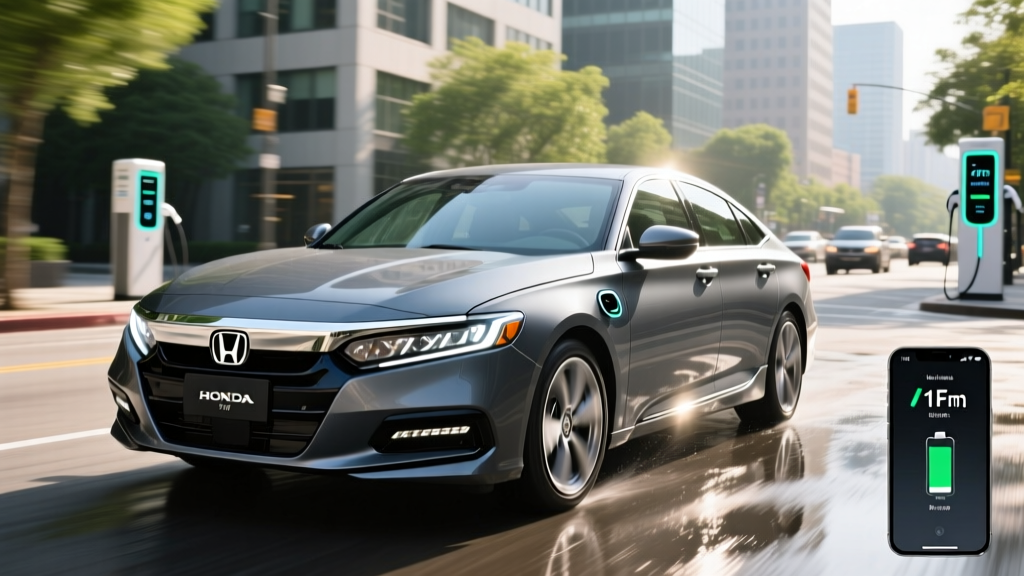
The Honda Accord Hybrid has long been the benchmark midsize sedan for drivers who want electric-like efficiency without plugging in. For 2026, Honda continues its two-motor hybrid system across the Accord lineup, pairing a 2.0-liter Atkinson-cycle engine with a dual-motor setup that prioritizes electric drive in city conditions. The result is a sedan that routinely exceeds its EPA rating in stop-and-go traffic while remaining a comfortable highway cruiser.
This guide covers everything a buyer needs: exact EPA figures, real-world MPG observations, powertrain details, battery longevity data, pricing by trim, and how the Accord Hybrid stacks up against plug-in hybrids and full battery-electric vehicles.
2026 Honda Accord Hybrid Fuel Economy: EPA and Real-World MPG
The 2026 Honda Accord Hybrid carries an EPA rating of 51 MPG city / 44 MPG highway / 48 MPG combined for the Sport and EX-L trims, according to fueleconomy.gov. The Sport-L and Touring trims, which add weight from larger wheels and additional equipment, dip slightly to 46 MPG combined.
| Trim | City MPG | Highway MPG | Combined MPG |
|---|---|---|---|
| Sport | 51 | 44 | 48 |
| EX-L | 51 | 44 | 48 |
| Sport-L | 48 | 42 | 46 |
| Touring | 48 | 42 | 46 |
Hybrid vs Plug-In Hybrid: What the Accord Is (and Isn't)
The Honda Accord Hybrid is a conventional hybrid electric vehicle (HEV). It has no plug, no external charging port, and no meaningful electric-only range. Its small lithium-ion battery (approximately 1.1 kWh usable) recharges exclusively through regenerative braking and the gasoline engine.
This is fundamentally different from a plug-in hybrid (PHEV) like the Toyota Prius Prime or the discontinued Honda Clarity Plug-In Hybrid, which carry larger batteries (13–18 kWh), offer 25–44 miles of electric-only driving, and require regular plug-in charging to realize their efficiency advantage.
| Feature | HEV (Accord Hybrid) | PHEV (e.g., Prius Prime) | BEV (e.g., Tesla Model 3) |
|---|---|---|---|
| Plug-in required? | No | Yes (for EV range) | Yes (always) |
| Electric-only range | ~1 mi at low speed | 25–44 mi | 250–360 mi |
| Total range | ~600 mi | ~550 mi combined | 250–360 mi |
| Home charging needed? | No | Recommended | Essential |
| Federal tax credit | Not eligible (§30D) | Up to $7,500* | Up to $7,500* |
| Best for | No home charging access | Short commutes + road trips | Home charging + daily driving |
*§30D credit eligibility depends on MSRP caps, buyer income limits, and battery-component/critical-mineral sourcing rules. See IRS.gov for current-year requirements.
Powertrain Specs: Engine, Motors, and Combined Output
The 2026 Accord Hybrid uses Honda's fourth-generation two-motor hybrid system. Here are the key specifications:
| Specification | Value |
|---|---|
| Engine | 2.0L DOHC Atkinson-cycle 4-cylinder |
| Engine horsepower | 146 hp @ 6,100 rpm |
| Drive motor output | 181 hp / 247 lb-ft torque |
| Combined system output | 204 hp |
| Transmission | Electronic continuously variable (e-CVT) |
| Drivetrain | Front-wheel drive |
| 0–60 MPH | ~7.5 seconds (est.) |
| Hybrid battery | Lithium-ion, ~1.1 kWh usable |
| Fuel tank | 12.8 gallons |
| Total range (est.) | ~614 miles (48 MPG × 12.8 gal) |
The system operates in three modes: EV Drive (battery powers the drive motor alone, limited to low speeds and short distances), Hybrid Drive (engine generates electricity to feed the drive motor, with excess charging the battery), and Engine Drive (a lock-up clutch connects the engine directly to the front wheels at steady highway speeds for maximum efficiency). Most city driving happens in Hybrid Drive mode, which is why the Accord Hybrid's city MPG exceeds its highway figure — the opposite of a conventional gas car.
Pricing and Trim Breakdown
The 2026 Accord Hybrid is available in four trims. Pricing below reflects MSRP before destination charges:
| Trim | MSRP (est.) | Key Additions |
|---|---|---|
| Sport | ~$34,595 | 19" wheels, sport styling, heated front seats, wireless CarPlay/Android Auto |
| EX-L | ~$36,495 | Leather seats, power passenger seat, wireless phone charger, low-speed braking control |
| Sport-L | ~$37,095 | Sport styling with leather, heated rear seats |
| Touring | ~$40,395 | Adaptive dampers, Bose 12-speaker audio, heated/ventilated front seats, heated steering wheel, Google built-in |
Battery Longevity, Warranty, and Replacement Costs
Hybrid battery lifespan is a top concern for buyers considering a used or new Accord Hybrid. Honda covers the hybrid battery with a 10-year / 150,000-mile warranty in states that follow California Air Resources Board (CARB) emissions standards, and 8 years / 100,000 miles in other states. This warranty guarantees the battery will retain sufficient capacity to function as designed — not a specific percentage, but coverage against failure and excessive degradation.
• CARB states (CA, NY, MA, WA, OR, CO, and others): 10 years / 150,000 miles
• Non-CARB states: 8 years / 100,000 miles
• Conventional powertrain warranty: 5 years / 60,000 miles
• Hybrid system components (inverter, motor): covered under 8-year / 100,000-mile hybrid system warranty nationwide
In practice, Honda's hybrid batteries have proven durable. The Accord Hybrid's ~1.1 kWh battery operates in a narrow state-of-charge window (roughly 20–80%) managed by the vehicle's battery management system, which avoids the deep cycles that accelerate degradation. Based on long-term owner data and fleet experience with previous-generation Accord Hybrids, battery replacement before 150,000 miles is uncommon.
If replacement is needed out of warranty, a new OEM hybrid battery from Honda typically costs between $2,000 and $4,000 including labor. Third-party refurbished batteries are available for $1,000–$2,000. This is dramatically less than a full EV traction battery replacement because the Accord Hybrid's battery is small.
Reliability, Safety, and Ownership Costs
Honda's hybrid powertrain has accumulated years of real-world data across the Accord, CR-V, and Civic lineups. The two-motor system has fewer moving parts than a conventional automatic transmission — there are no gear shifts, no torque converter, and no traditional friction brakes doing all the work (regenerative braking handles most deceleration, extending pad life to 80,000+ miles in many cases).
The 2026 Accord carries strong safety credentials. The previous-generation Accord earned the IIHS Top Safety Pick+ rating, and Honda Sensing — the brand's suite of driver-assistance features including adaptive cruise control, lane-keeping assist, and collision mitigation braking — is standard on every trim. Note that Honda Sensing is an SAE Level 2 driver-assistance system: it supports steering and speed control but requires continuous driver attention and hands-on-wheel engagement.
Ownership economics favor the Accord Hybrid strongly versus its gas-only competitors. At 48 MPG combined and $3.25/gallon regular unleaded, annual fuel cost for 12,000 miles is approximately $812. A comparable gas-only midsize sedan at 30 MPG combined would cost roughly $1,300/year — a savings of nearly $500 annually, or $2,500 over five years, with the hybrid.
Who Should Choose the Accord Hybrid vs a PHEV or Full EV?
Choose the Accord Hybrid if:
- You lack access to home or workplace charging
- You want maximum range without range anxiety (~614 mi)
- Your budget is $34,000–$40,000 and you don't qualify for EV tax credits
- You regularly take long road trips through areas with sparse charging infrastructure
- You want proven reliability with minimal behavioral change from a gas car
Consider a PHEV or BEV instead if:
- You have reliable Level 2 home charging and a short daily commute (PHEV or BEV)
- You qualify for the $7,500 federal §30D credit, effectively lowering a BEV's price
- You want electric-only driving for zero tailpipe emissions on daily trips
- You want one-pedal driving and instant torque (BEV experience)
- You drive less than 40 miles daily and can charge nightly (PHEV covers most trips on electricity)
Frequently Asked Questions
How many MPG does the Honda Accord Hybrid actually get?
The EPA rates the Sport and EX-L trims at 51 city / 44 highway / 48 combined MPG. Real-world testing shows city and suburban drivers regularly achieve 48–54 MPG, while sustained highway driving at 75+ MPH yields 40–43 MPG. Cold weather reduces efficiency by roughly 10–15%.
Does the Honda Accord Hybrid need to be plugged in?
No. The Accord Hybrid is a conventional HEV. Its battery recharges through regenerative braking and the gasoline engine. There is no charging port and no plug-in capability. You fuel it like any other car at a gas station.
How far can the Accord Hybrid go on electric power alone?
Less than one mile, at very low speeds (under 25 MPH). The battery is too small (~1.1 kWh) for meaningful EV-only driving. This is by design — the system uses electric assist to boost efficiency, not to replace the engine for extended distances. If electric-only commuting is your goal, look at a PHEV with 25–44 miles of EV range or a full BEV.
Does the Accord Hybrid qualify for a federal tax credit?
No. The federal §30D New Clean Vehicle Credit requires a plug-in electric vehicle with a battery capacity of at least 7 kWh. The Accord Hybrid's ~1.1 kWh battery does not meet this threshold. The credit applies to qualifying PHEVs and BEVs only. Check IRS.gov for current rules.
Is the Honda Accord Hybrid reliable, and what does a battery replacement cost?
Honda's hybrid system has a strong reliability track record over multiple generations. The hybrid battery is warrantied for 8–10 years / 100,000–150,000 miles depending on your state. Out-of-warranty replacement runs $2,000–$4,000 for an OEM battery, which is rare before 150,000 miles given the narrow state-of-charge operating window Honda uses.
How does the Accord Hybrid compare to the Toyota Camry Hybrid?
Both are strong choices. The 2026 Camry Hybrid (now exclusively hybrid) offers a comparable 51/44/48 MPG rating with standard AWD availability. The Accord Hybrid edges ahead in interior space, trunk volume (~16.7 cu ft vs ~15.1 cu ft), and rear-seat legroom. The Camry Hybrid starts slightly lower in price. Test-drive both — the Accord favors a quieter, more refined ride while the Camry Hybrid leans slightly sportier in its SE/XSE trims.