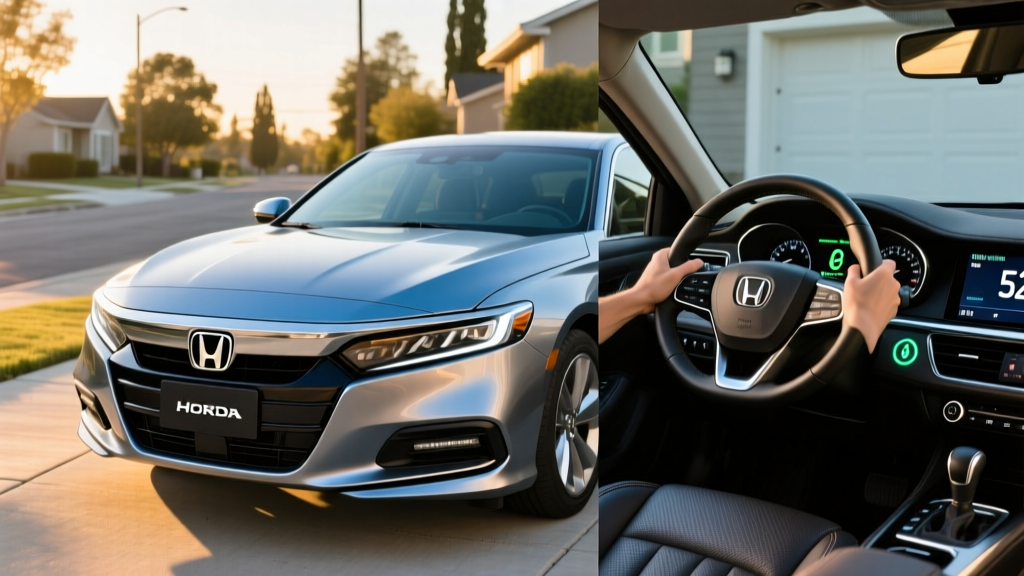
The midsize sedan segment has largely ceded ground to crossovers, but the Honda Accord Hybrid remains a compelling argument for electrified efficiency without the plug. For 2026, Honda continues its two-motor hybrid system across most Accord trims, delivering EPA-estimated fuel economy that rivals compact cars while offering midsize interior space and a refined ride. If you're researching Honda Accord Hybrid fuel economy to decide whether it's worth the premium over a gas-only competitor—or whether you should jump to a full EV—this guide breaks down every number that matters.
2026 Honda Accord Hybrid: EPA Fuel Economy Breakdown
The 2026 Honda Accord Hybrid uses Honda's fourth-generation two-motor hybrid system, pairing a 2.0-liter Atkinson-cycle inline-four with two electric motors. The result is EPA-estimated fuel economy that places it among the most efficient midsize sedans available.
| Trim | City MPG | Highway MPG | Combined MPG | Annual Fuel Cost* |
|---|---|---|---|---|
| Sport Hybrid | 51 | 44 | 48 | ~$1,150 |
| Sport-L Hybrid | 51 | 44 | 48 | ~$1,150 |
| EX-L Hybrid | 51 | 44 | 48 | ~$1,150 |
| Sport Touring Hybrid | 50 | 43 | 47 | ~$1,175 |
*Based on 15,000 miles/year, 55% city driving, and $3.50/gallon regular unleaded. Source: fueleconomy.gov
The city-biased MPG split (51 city vs. 44 highway) is characteristic of series-dominant hybrid systems. At low speeds, the Accord Hybrid operates primarily as a series hybrid—the gas engine generates electricity while the drive motor propels the car. This is far more efficient than a conventional gas engine idling and accelerating in stop-and-go traffic. On the highway, the engine can mechanically clutch to the drivetrain at cruising speeds, but aerodynamic drag and higher sustained RPMs reduce the efficiency advantage.
Real-World MPG: What Owners Actually Report
EPA estimates are a standardized benchmark, but real-world Honda Accord Hybrid fuel economy often differs based on driving style, climate, and terrain. Here's what to expect:
- City / suburban commuting: 48–54 MPG (hybrids often exceed EPA city estimates in gentle, low-speed driving)
- Mixed driving (50/50 city-highway): 44–48 MPG
- Predominantly highway (75+ mph): 39–43 MPG (aerodynamic drag and sustained engine operation reduce the hybrid advantage)
- Cold weather (below 35°F): 40–44 MPG combined (engine runs more frequently for cabin heat and battery warm-up)
Owner-reported data on platforms like Fuelly consistently shows the Accord Hybrid averaging 44–49 MPG across mixed driving cycles over tens of thousands of miles. Drivers who maximize regenerative braking through the steering-wheel paddle selectors (which adjust regen intensity across four levels) tend to see the highest returns. The Accord Hybrid does not offer true one-pedal driving like a full EV, but aggressive regen settings can significantly reduce brake wear and recapture energy in stop-and-go conditions.
Hybrid vs. Plug-In Hybrid vs. Full EV: Where the Accord Fits
A common point of confusion is whether the Accord Hybrid is a plug-in. It is not. The 2026 Accord Hybrid is a conventional hybrid electric vehicle (HEV)—it generates all its electricity onboard through the gas engine and regenerative braking. There is no plug, no electric-only range to manage, and no charging infrastructure required.
| Attribute | HEV (Accord Hybrid) | PHEV (e.g., Toyota Prius Prime) | BEV (e.g., Tesla Model 3) |
|---|---|---|---|
| Plugs in? | No | Yes | Yes |
| Electric-only range | N/A (EV assist only) | 25–44 miles | 250–360+ miles |
| Total range | ~560 miles (12.8-gal tank) | ~500–600 miles (EV + gas) | 250–360+ miles |
| Home charging needed? | No | Recommended (Level 2) | Essential (Level 2) |
| Federal tax credit (§30D) | Not eligible | Up to $7,500 (if eligible) | Up to $7,500 (if eligible) |
| Maintenance complexity | Low (no plug systems) | Moderate (dual systems) | Low (no engine) |
Honda discontinued the Accord Plug-In Hybrid after the 2015 model year and has not reintroduced a PHEV variant for 2026. If you want plug-in capability in a Honda, you'd need to look at the CR-V Hybrid (which is also an HEV, not a PHEV as of 2026) or consider competitors like the Toyota Prius Prime or Hyundai Tucson PHEV. For buyers committed to Honda's sedan platform, the Accord Hybrid is the only electrified option.
Powertrain Specs: What Moves the Accord Hybrid
| Engine | 2.0L Atkinson-cycle DOHC inline-4 |
| Engine power | 146 hp @ 6,100 rpm / 134 lb-ft torque |
| Drive motor | AC permanent-magnet synchronous, 181 hp / 247 lb-ft |
| Combined system output | 204 hp / 247 lb-ft torque |
| Transmission | e-CVT (single-speed direct drive + engine clutch) |
| Drivetrain | Front-wheel drive |
| Hybrid battery | ~1.1 kWh lithium-ion (NMC chemistry) |
| 0–60 mph | ~7.0 seconds |
| Fuel tank | 12.8 gallons (regular unleaded) |
| Total driving range | ~560 miles (EPA combined) |
| Curb weight | ~3,475–3,575 lbs (varies by trim) |
Honda's hybrid system is noteworthy for how it manages power flow. Below ~45 mph, the gas engine acts as a generator (series-hybrid mode), feeding electricity to the drive motor. At highway speeds, a lockup clutch mechanically connects the engine to the wheels (parallel-hybrid mode) for more efficient cruising. The system seamlessly transitions between these modes—most drivers never notice the switch. The 247 lb-ft of electric motor torque is available from 0 rpm, giving the Accord Hybrid responsive off-the-line acceleration that belies its 204 hp combined rating.
Battery Warranty, Lifespan, and Replacement Cost
- Federal emissions/hybrid battery warranty: 8 years / 80,000 miles (minimum, required by EPA for emissions components)
- CARB-state warranty: 10 years / 150,000 miles (applies in California and states adopting CARB standards: CO, CT, ME, MD, MA, NJ, NY, OR, RI, VT, WA)
- Capacity threshold: Honda covers defects and abnormal degradation; no published minimum capacity retention percentage (unlike EV batteries which typically warrant 70%)
The Accord Hybrid's ~1.1 kWh battery pack is small by EV standards, and its shallow charge-discharge cycles (the system keeps the battery in a narrow state-of-charge window, typically 40–80%) significantly reduce degradation stress. Real-world data from previous-generation Accord Hybrids shows the hybrid battery lasting well beyond the warranty period—many owners report 150,000–200,000+ miles on the original pack.
If replacement is needed outside warranty, expect the following:
- OEM battery pack: $2,500–$4,000 (parts + labor at a Honda dealer)
- Refurbished/aftermarket pack: $1,500–$2,500
- Individual cell/module replacement: $500–$1,500 (available through some independent hybrid specialists)
For context, the hybrid battery replacement cost is substantially lower than a full EV battery replacement ($8,000–$20,000+), because the pack is far smaller. The Accord Hybrid's engine-driven architecture also means that even a degraded battery won't strand you—the car will continue to operate, just with reduced electric assist and slightly lower fuel economy.
Pricing and Tax Credit Eligibility
| Trim | MSRP | Federal Tax Credit (§30D) | Effective Price |
|---|---|---|---|
| Sport Hybrid | $33,655 | Not eligible | $33,655 |
| Sport-L Hybrid | $35,350 | Not eligible | $35,350 |
| EX-L Hybrid | $36,705 | Not eligible | $36,705 |
| Sport Touring Hybrid | $40,050 | Not eligible | $40,050 |
Why no tax credit? The federal §30D Clean Vehicle Credit applies only to plug-in electric vehicles (PHEVs and BEVs) with a battery capacity of at least 7 kWh and the ability to charge from an external source. Conventional hybrids like the Accord Hybrid, which generate electricity onboard and have a small ~1.1 kWh pack, do not qualify. This is consistent across all non-plug-in hybrids from every manufacturer. For current §30D rules and eligible vehicles, consult the IRS Clean Vehicle Credits page.
Some states and utilities offer rebates or incentives for conventional hybrids, but these vary widely by jurisdiction and change frequently. Check your state energy office or local utility for current programs.
Reliability and Ownership Costs
The Accord Hybrid benefits from Honda's strong reliability reputation and the inherent simplicity of its hybrid system. The e-CVT has no traditional gears, belts, or clutches to wear (beyond the engine lockup clutch, which engages only at highway speeds). Regenerative braking reduces wear on the friction brake pads—many owners report original brake pads lasting 80,000–100,000 miles.
Estimated 5-year ownership costs compared to a gas-only midsize sedan (25 MPG combined) and a full EV (120 MPGe):
| Cost Category | Accord Hybrid (48 MPG) | Gas Sedan (25 MPG) | EV (120 MPGe) |
|---|---|---|---|
| Fuel / electricity | $5,750 | $11,000 | $3,200 |
| Maintenance | $2,800 | $3,500 | $1,800 |
| Insurance (avg) | $7,500 | $7,000 | $8,200 |
| Depreciation (est.) | $14,000 | $13,500 | $16,000 |
| Total (approx.) | $30,050 | $35,000 | $29,200 |
Estimates based on national averages. Actual costs vary by region, driving habits, insurance profile, and electricity/gas prices. The EV column assumes home Level 2 charging at $0.14/kWh.
The Accord Hybrid's strongest financial argument is fuel savings without behavioral change. You never need to plan charging stops, install a home charger, or adjust your driving routine. You simply fill up with gas less often.
Who Should Choose the Accord Hybrid (and Who Shouldn't)
- You want 45+ MPG without plugging in or changing your fueling routine
- You lack access to home or workplace charging (apartment, street parking, no garage outlet)
- You regularly drive long distances where EV charging infrastructure is sparse
- You want a proven, low-maintenance powertrain with strong resale value
- Your daily commute is 20–60 miles of mixed city/highway driving
- You have reliable home Level 2 charging and a short commute (a PHEV could cover your daily miles on electricity alone)
- You want to eliminate gasoline entirely and reduce tailpipe emissions to zero
- You want to take advantage of the $7,500 federal tax credit (only available on qualifying PHEVs and BEVs under current IRS §30D rules)
- You prioritize instant electric torque and a silent powertrain over total range flexibility
Frequently Asked Questions
How many MPG does the 2026 Honda Accord Hybrid get?
The EPA rates most Accord Hybrid trims at 51 city / 44 highway / 48 combined MPG. The Sport Touring trim, with larger 19-inch wheels, drops slightly to 50/43/47 MPG. In real-world mixed driving, most owners report 44–49 MPG.
Does the Honda Accord Hybrid need to be plugged in?
No. The Accord Hybrid is a conventional hybrid (HEV), not a plug-in hybrid (PHEV). It charges its small battery through regenerative braking and the onboard gas engine. You fuel it exclusively at gas stations.
Is the Honda Accord Hybrid reliable?
Honda's two-motor hybrid system has been in production since 2014 (across multiple models) and has a strong reliability track record. The e-CVT design eliminates traditional transmission wear points. The hybrid battery is warrantied for 8 years/80,000 miles (10 years/150,000 in CARB states), and real-world data shows packs commonly lasting 150,000+ miles.
What does it cost to replace the Accord Hybrid battery?
An OEM replacement hybrid battery pack costs approximately $2,500–$4,000 installed at a Honda dealer. Refurbished packs and individual module replacements are available for $500–$2,500 through independent hybrid specialists. Given the battery's typical 150,000+ mile lifespan, most owners never face this cost.
Does the Honda Accord Hybrid qualify for a federal tax credit?
No. The federal §30D Clean Vehicle Credit applies only to plug-in electric vehicles (PHEVs and BEVs). Conventional hybrids like the Accord Hybrid are not eligible. Some state or utility incentives may apply—check your local programs.
How does the Accord Hybrid compare to the Toyota Camry Hybrid?
The 2026 Toyota Camry Hybrid is rated at 51 city / 49 highway / 50 combined MPG (LE trim), giving it a slight highway and combined advantage. The Accord Hybrid counters with more rear-seat legroom (40.8 vs. 38.0 inches), a larger trunk (16.7 vs. 15.1 cu ft), and a more engaging driving feel. Both are strong choices; the Camry wins on pure MPG, while the Accord wins on space and refinement.
Sources: fueleconomy.gov, Honda Accord Hybrid official page, IRS Clean Vehicle Credits.