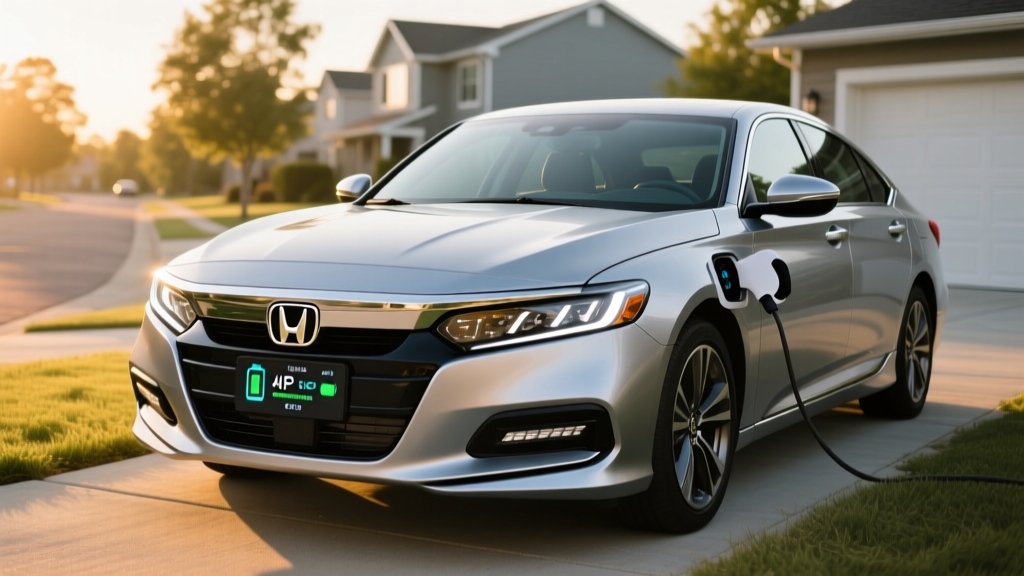
The 2019 Honda Accord Hybrid remains one of the most compelling midsize sedans on the used market in 2026. With its EPA-rated 48 MPG combined, refined two-motor hybrid system, and spacious cabin, it offers buyers a proven path to lower fuel costs without the range anxiety or charging infrastructure concerns of a full battery-electric vehicle (BEV). But as a conventional hybrid (HEV) — not a plug-in hybrid (PHEV) — it operates under different rules than the electrified vehicles dominating today's headlines. This guide breaks down exactly what you're getting, what it costs to own, and whether the 2019 Accord Hybrid is still the right call seven years after its debut.
2019 Honda Accord Hybrid: Powertrain and Performance Specs
Honda's hybrid system in the 2019 Accord is fundamentally different from Toyota's planetary-gear approach. Instead of blending engine and motor through a traditional transmission, Honda uses a two-motor setup where the gasoline engine primarily acts as a generator, powering an electric drive motor that actually turns the wheels. A lock-up clutch engages only at steady highway speeds, connecting the 2.0-liter Atkinson-cycle engine directly to the drivetrain for efficiency.
| Specification | Value |
|---|---|
| Powertrain Type | Conventional Hybrid (HEV) — no plug-in |
| Gas Engine | 2.0L Atkinson-cycle inline-4 |
| Engine Power | 143 hp / 129 lb-ft torque |
| Drive Motor Power | 181 hp / 232 lb-ft torque |
| Combined System Output | 212 hp |
| Transmission | Electronic CVT (e-CVT, no fixed gears) |
| Drivetrain | Front-wheel drive |
| 0–60 mph | ~6.7 seconds (Car and Driver tested) |
| Hybrid Battery | 1.3 kWh lithium-ion (non-plug-in) |
| Cargo Volume | 16.7 cu ft (trunk — battery under rear seats) |
| Seating | 5 passengers |
The result is smooth, linear acceleration that feels more like an EV than a traditional hybrid. The 212 combined horsepower provides confident merging and passing, and the electric motor's instant 232 lb-ft of torque gives the Accord Hybrid a responsiveness that many four-cylinder gas competitors lack. Honda's e-CVT avoids the rubber-band drone common to older CVTs because, for most driving, there is no belt-and-pulley CVT at all — just electric motor drive.
EPA Fuel Economy and Real-World MPG
Fuel economy is the Accord Hybrid's headline act. According to fueleconomy.gov, the 2019 Accord Hybrid earns identical ratings across all trims (Hybrid, Hybrid EX, Hybrid EX-L, Hybrid Touring):
| Driving Cycle | EPA MPG |
|---|---|
| City | 48 MPG |
| Highway | 47 MPG |
| Combined | 48 MPG |
The Accord Hybrid is one of the rare vehicles that can exceed its EPA rating in city driving, where regenerative braking and low-speed electric-only operation maximize efficiency. Owners reporting on Fuelly and similar platforms commonly log 46–52 MPG in mixed suburban/city driving. However, sustained highway driving at 75+ mph typically yields 42–45 MPG due to aerodynamic drag and the engine's direct-drive lock-up operating outside its most efficient range. In cold weather (below 32°F), expect a 5–10% reduction as the engine runs more frequently for cabin heat and battery warming. Annual fuel cost at 12,000 miles/year and $3.50/gallon averages roughly $875 — compared to ~$1,500 for a comparable 30 MPG gas sedan.
HEV vs. PHEV vs. EV: Where Does the Accord Hybrid Fit?
The 2019 Accord Hybrid is a conventional hybrid electric vehicle (HEV). This is a critical distinction in today's electrified-vehicle landscape. Here's how it compares to the other powertrain types you'll encounter:
| Feature | HEV (Accord Hybrid) | PHEV (e.g., Toyota RAV4 Prime) | BEV (e.g., Tesla Model 3) |
|---|---|---|---|
| Plug-in Charging | No — self-charging via engine + regen | Yes — 25–42 mi electric range | Yes — 250–350+ mi range |
| Electric-Only Driving | ~1–2 miles at low speed | 25–42 miles at full speed | Full range, all speeds |
| Battery Size | ~1.3 kWh | ~13–18 kWh | ~50–82 kWh |
| Fuel Backup | Yes — seamless | Yes — seamless | No — electric only |
| Home Charging Needed | No | Recommended (Level 2) | Essential (Level 2) |
| Federal Tax Credit (§30D) | Not eligible | Up to $7,500 (if eligible) | Up to $7,500 (if eligible) |
| Best For | No charging access; high-mileage commuters | Short commutes + home charging | Home charging + mostly under 300 mi/day |
The Accord Hybrid's advantage is simplicity: you never plug it in, never think about charging, and never worry about range. You just fill up at any gas station and drive. Its 14.8-gallon fuel tank gives a theoretical range of over 700 miles per fill-up — far more than any current BEV. For buyers who lack access to home or workplace charging, or who regularly take road trips exceeding 300 miles, the HEV format eliminates every objection to electrification.
However, if you have a garage or driveway where you can install a Level 2 charger, and your daily commute is under 35 miles, a PHEV like the 2019 Honda Clarity Plug-In Hybrid (47 miles electric-only range) or a newer model might deliver near-zero gasoline use on weekdays while retaining a gas engine for longer trips. And if you've already committed to home charging and rarely drive more than 250 miles in a day, a BEV offers lower per-mile energy costs and reduced maintenance.
2019 Accord Hybrid Battery: Warranty, Lifespan, and Replacement Cost
Hybrid battery longevity is the number-one concern among used-hybrid buyers, and it deserves a thorough answer. The 2019 Accord Hybrid uses a compact 1.3 kWh lithium-ion battery pack mounted beneath the rear seats. Because it's a conventional HEV, the battery operates within a narrow state-of-charge window (roughly 20–80% SoC), which significantly reduces stress and extends cell life compared to a BEV that routinely cycles across a wider range.
- Standard coverage: 8 years / 80,000 miles (whichever comes first)
- CARB-state coverage: 10 years / 150,000 miles in states that follow California Air Resources Board emissions rules (CA, CO, CT, DE, ME, MD, MA, MN, NJ, NM, NY, OR, PA, RI, VT, WA, and others adopting CARB standards)
- What's covered: Battery capacity loss below a defined threshold, cell/module failure, hybrid system control components
- Warranty is transferable to subsequent owners — a 2019 model purchased in 2026 may still have remaining factory hybrid warranty coverage
In practice, Honda's hybrid batteries have proven durable. High-mileage reports from taxi fleets and rideshare drivers using Honda and Toyota hybrid systems routinely show 150,000–200,000+ miles without battery replacement. The Accord Hybrid's lithium-ion pack is more energy-dense and longer-lasting than the older nickel-metal-hydride packs in early-2000s hybrids.
If replacement is eventually needed, expect the following costs in 2026:
- New OEM battery pack: $2,000–$3,500 (parts) plus $500–$800 labor
- Refurbished/remanufactured pack: $1,200–$2,000 installed
- Individual cell/module replacement (if only one segment has failed): $300–$800 at a specialist hybrid shop
For context, a conventional automatic transmission replacement on a gas car typically costs $3,000–$5,000 — and the hybrid system replaces the traditional transmission entirely.
Pricing and Tax Credit Eligibility in 2026
The 2019 Honda Accord Hybrid was offered in four trims when new, with MSRPs ranging from $26,240 (base Hybrid) to $35,620 (Touring). In the 2026 used market, pricing varies significantly based on mileage, condition, and region:
| Trim | Original MSRP | 2026 Used Range (60K–90K mi) |
|---|---|---|
| Hybrid (base) | $26,240 | $16,000–$19,000 |
| Hybrid EX | $29,470 | $18,500–$22,000 |
| Hybrid EX-L | $32,070 | $20,000–$24,000 |
| Hybrid Touring | $35,620 | $22,000–$26,500 |
Federal tax credit status: The 2019 Accord Hybrid is a conventional HEV and does not qualify for the IRS §30D Clean Vehicle Credit. That credit is reserved for plug-in vehicles (PHEVs and BEVs) meeting battery-sourcing, MSRP cap, and buyer income requirements. There is no federal tax incentive for purchasing a used conventional hybrid.
State incentives: A handful of states offer rebates or HOV lane access for hybrid vehicles, but these programs are increasingly focused on plug-in vehicles. Check your state's energy office or department of environmental quality for current offerings — most hybrid-specific incentives have phased out.
Despite the lack of tax credits, the Accord Hybrid's strong resale value, low fuel costs, and Honda reliability make its total cost of ownership competitive with — and often lower than — a comparably priced used gas sedan or even a used BEV with higher insurance premiums.
Reliability, Safety, and Ownership Costs
The 2019 Accord Hybrid benefits from Honda's strong reliability reputation and the inherent simplicity of its hybrid drivetrain. There is no traditional automatic transmission to fail, no starter motor, no alternator, and the regenerative braking system significantly reduces wear on the friction brake pads (many owners report 80,000+ miles on original brake pads).
Safety ratings: The 2019 Accord (including Hybrid trims) earned top marks from both major U.S. testing agencies:
- IIHS: Top Safety Pick+ (with optional front crash prevention and specific headlights)
- NHTSA: 5-Star Overall Safety Rating
All trims include Honda Sensing as standard: adaptive cruise control, lane-keeping assist, forward collision warning with automatic emergency braking, and road departure mitigation. Note that Honda Sensing is an SAE Level 2 driver-assistance system — the driver must remain fully engaged and attentive at all times. It is not autonomous driving.
Insurance costs: Expect $1,200–$1,800 annually for a 2019 Accord Hybrid depending on your profile — typically comparable to or slightly below the gas Accord 2.0T, and notably below most BEVs which carry higher collision-repair premiums.
Maintenance: Oil changes (0W-20 synthetic, ~$40–$60 every 7,500–10,000 miles), cabin air filter, and tire rotations constitute the bulk of scheduled maintenance. The hybrid system adds no routine maintenance items — there is no hybrid-specific fluid change or service interval.
Who Should Buy the 2019 Honda Accord Hybrid?
✓ Choose the Accord Hybrid If:
- You lack access to home or workplace EV charging
- You drive 15,000+ miles/year and want maximum fuel savings without lifestyle changes
- You want a spacious, comfortable midsize sedan with strong safety ratings
- You prefer proven, depreciated reliability over cutting-edge EV tech
- Your budget is $16,000–$26,000 for a used vehicle
- You take regular road trips exceeding 300 miles
✗ Look Elsewhere If:
- You have home charging and want zero-emission daily driving (consider a BEV or PHEV)
- You need AWD (the Accord Hybrid is FWD only — consider the Toyota Camry Hybrid AWD)
- You want eligibility for the $7,500 federal tax credit (requires a plug-in vehicle)
- You want the latest infotainment (2019's 8-inch screen and Honda interface feel dated in 2026)
- You need SUV cargo space or ground clearance
For the right buyer — a high-mileage commuter without charging access — the 2019 Accord Hybrid delivers exceptional value. It costs roughly half what a comparable new BEV costs, never requires plugging in, and will reliably deliver 45+ MPG for years. It's not glamorous, but it's arguably the most rational sedan purchase in the used market.
Frequently Asked Questions
How many MPG does the 2019 Honda Accord Hybrid actually get?
The EPA rates it at 48 city / 47 highway / 48 combined. In real-world mixed driving, most owners report 46–52 MPG. Sustained high-speed highway driving (75+ mph) typically returns 42–45 MPG. Cold weather reduces economy by roughly 5–10%.
Does the 2019 Accord Hybrid need to be plugged in?
No. The Accord Hybrid is a conventional HEV. It charges its small battery through regenerative braking and the gasoline engine. You never plug it in — just fill the gas tank as you would any other car.
How far can the 2019 Accord Hybrid drive on electric power alone?
Only about 1–2 miles at very low speeds (under 25 mph) in ideal conditions. The 1.3 kWh battery is far too small for meaningful electric-only range. If electric-only commuting is your goal, you need a PHEV (like the discontinued Honda Clarity Plug-In Hybrid, rated for 47 electric miles) or a BEV.
Is the hybrid battery reliable, and what does replacement cost?
Honda's hybrid batteries have proven highly reliable, with many exceeding 150,000–200,000 miles. The factory warranty covers 8 years/80,000 miles (10 years/150,000 miles in CARB states). A 2019 model may still carry remaining warranty coverage. Replacement costs range from $1,200 (refurbished) to $3,500+ (new OEM), though most owners never need one.
Does the 2019 Honda Accord Hybrid qualify for any tax credit?
No. The federal §30D Clean Vehicle Credit applies only to plug-in electric vehicles (PHEVs and BEVs) meeting specific battery-sourcing, MSRP, and buyer-income criteria. The Accord Hybrid, as a conventional HEV, does not qualify for federal or most state EV incentives.
How does the Accord Hybrid compare to the Toyota Camry Hybrid?
The 2019 Camry Hybrid LE earns a slightly higher 52 MPG combined (EPA), but the Accord Hybrid offers more rear-seat legroom (40.8 vs. 38.0 inches), a larger trunk (16.7 vs. 15.1 cu ft), and a more refined driving experience with stronger acceleration (212 hp vs. 208 hp). The Camry Hybrid offers available AWD; the Accord does not. Both are excellent choices — the Accord wins on space and refinement, the Camry on peak MPG and AWD availability.
What is the total range on a full tank?
With its 14.8-gallon fuel tank and 48 MPG combined rating, the theoretical maximum range is approximately 710 miles. Real-world range of 600–680 miles between fill-ups is common in mixed driving.