Quick Verdict: The Accord Hybrid Is the Midsize Sedan Benchmark
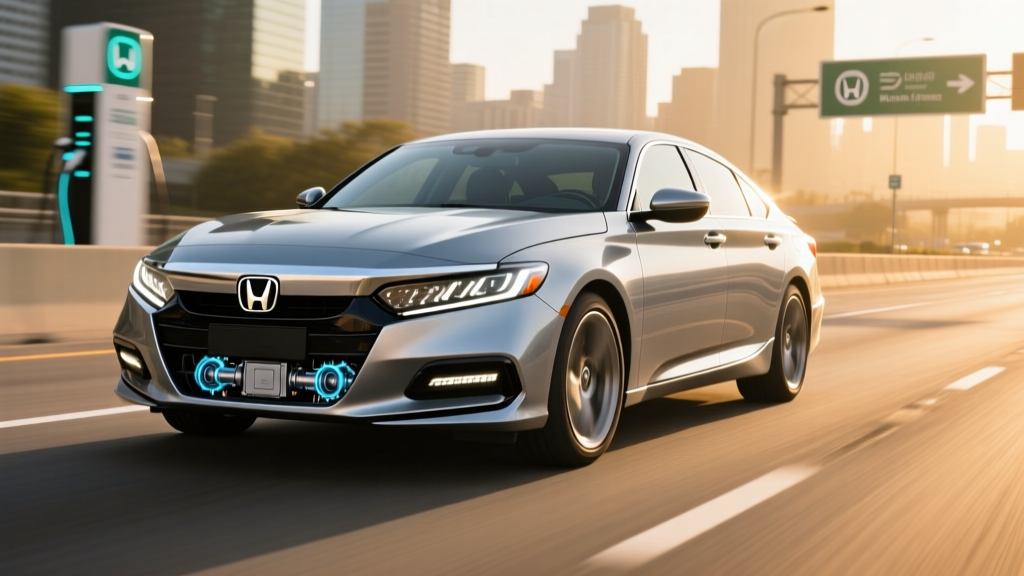
If you've searched for the 0-60 Honda Accord Hybrid time and landed here, you're likely weighing whether Honda's two-motor hybrid system delivers enough punch alongside its headline fuel economy. The short answer: the 2026 Accord Hybrid hits 60 mph in approximately 6.5 seconds, returns an EPA-estimated 48 MPG combined, and does so without requiring a plug, a charging app, or any change to your daily routine.
Now in its second year on the 11th-generation platform, the Accord Hybrid continues to use Honda's fourth-generation two-motor hybrid system. It's a conventional hybrid (HEV) — not a plug-in — meaning it generates and recovers all its own electricity. You fuel it like any gasoline car and never think about charging.
| Spec | Value |
|---|---|
| 0-60 mph | ~6.5 seconds |
| Combined Horsepower | 204 hp |
| Combined Torque | 247 lb-ft (motor) |
| Engine | 2.0L 4-cyl Atkinson + 2 electric motors |
| EPA MPG (City / Hwy / Combined) | 51 / 44 / 48 |
| Fuel Tank | 12.4 gallons |
| Total Range | ~595 miles |
| Hybrid Battery | Lithium-ion, ~1.1 kWh (not plug-in) |
| Drivetrain | FWD, e-CVT |
| Base MSRP (Sport Hybrid) | $34,995 |
| Hybrid Battery Warranty | 8 years / 100,000 miles (10 yr/150k in CARB states) |
Powertrain Deep Dive: Where the 0-60 Time Comes From
The Accord Hybrid's acceleration story is really a tale of two power sources working in tandem — and sometimes independently. Honda's two-motor hybrid system uses a 2.0-liter Atkinson-cycle four-cylinder engine paired with a propulsion motor and a separate generator motor. In most city and suburban driving below ~45 mph, the gasoline engine acts solely as a generator, feeding electricity to the propulsion motor that actually turns the wheels. This gives the Accord Hybrid the smooth, linear torque delivery of an EV in daily driving.
The propulsion motor produces 181 hp and 247 lb-ft of torque on its own. Combined system output (when the engine mechanically clutches in at highway speeds) is rated at 204 hp. That 247 lb-ft of electric torque is available essentially from zero RPM, which is why the Accord Hybrid feels considerably quicker off the line than its horsepower figure alone might suggest.
The 0-60 mph time of approximately 6.5 seconds places the Accord Hybrid ahead of the Toyota Camry Hybrid (7.1 seconds) and competitive with the Hyundai Sonata Hybrid (6.8 seconds). In real-world driving, the instant electric torque makes merging and passing feel responsive, even if the car isn't chasing sports-sedan numbers. Above 70 mph, the engine takes on a more direct role and acceleration tapers — a characteristic of the e-CVT power-split design rather than a traditional geared transmission.
Fuel Economy: EPA Numbers vs. Real-World MPG
| Trim | City MPG | Highway MPG | Combined MPG |
|---|---|---|---|
| Sport Hybrid | 51 | 44 | 48 |
| Sport-L Hybrid | 51 | 44 | 48 |
| EX-L Hybrid | 51 | 44 | 48 |
| Touring Hybrid | 50 | 43 | 47 |
The Sport, Sport-L, and EX-L trims share identical EPA ratings of 51 city / 44 highway / 48 combined MPG. The Touring trim drops by 1 MPG across the board due to its heavier wheel package and additional equipment. Source: fueleconomy.gov.
Here's where real-world experience matters. Honda's hybrid system, like Toyota's, tends to exceed its EPA city rating in stop-and-go traffic because regenerative braking recovers energy that a gas car wastes as heat. Owners who do heavy city driving regularly report 52-55 MPG in warm weather. Highway driving is the opposite story: sustained 75-80 mph cruising pushes the engine into a higher-load role and real-world highway numbers often land in the 40-43 MPG range.
Cold weather also matters. In sub-40°F conditions, expect a 5-10% reduction in fuel economy as the engine runs more frequently to maintain cabin heat and battery temperature. A combined winter figure of 42-45 MPG is typical for mixed driving in northern climates.
HEV vs. PHEV vs. EV: Which Powertrain Fits Your Life?
| Factor | HEV (Accord Hybrid) | PHEV (e.g., Prius Prime) | BEV (e.g., Tesla Model 3) |
|---|---|---|---|
| Plug-in charging required? | No | Yes (optional but recommended) | Yes (mandatory) |
| Electric-only range | None (EV assist only) | 25-44 miles typical | 250-360+ miles |
| Total range | ~595 miles | 400-600+ miles | 250-360+ miles |
| Fuel cost per mile (avg) | ~$0.07 | ~$0.04-0.07 | ~$0.03-0.05 |
| Home charging install needed? | No | Recommended (Level 2) | Yes (Level 2) |
| Federal tax credit (§30D) | Not eligible | Up to $7,500 (if eligible) | Up to $7,500 (if eligible) |
| Upfront price premium over gas | ~$1,500 | ~$4,000-6,000 | ~$5,000-15,000 |
| Maintenance complexity | Low (no plug, small battery) | Moderate (larger battery + ICE) | Low (no ICE, fewer fluids) |
The Accord Hybrid is a conventional hybrid (HEV). It has no plug, no electric-only driving mode, and no range-anxiety math to solve. The ~1.1 kWh lithium-ion battery is charged exclusively through regenerative braking and the onboard engine-generator. If you cannot install a home charger, live in an apartment, or simply want zero lifestyle change from a gas car, the HEV Accord is the right fit.
A plug-in hybrid (PHEV) like the Toyota Prius Prime offers 44 miles of electric-only range and qualifies for a federal tax credit — but requires home Level 2 charging to realize those benefits, and carries a higher purchase price. If you have a short commute and garage charging access, a PHEV can operate as a daily EV with a gas engine backup.
A battery-electric vehicle (BEV) eliminates gasoline entirely, delivers the lowest per-mile fuel cost, and provides the strongest acceleration — but demands reliable home or workplace charging, longer road-trip stops for DC fast charging, and a higher upfront investment. The Accord Hybrid occupies the pragmatic middle: EV-like efficiency in the city, gas-car convenience everywhere else.
Pricing, Trims, and Tax Credit Eligibility
The 2026 Honda Accord Hybrid is offered in four trims:
- Sport Hybrid — $34,995 MSRP
- Sport-L Hybrid — $36,995 MSRP
- EX-L Hybrid — $38,495 MSRP
- Touring Hybrid — $41,895 MSRP
Destination charges add approximately $1,195. All trims include Honda Sensing (adaptive cruise, lane-keeping, collision mitigation), wireless Apple CarPlay/Android Auto on upper trims, and a 12.3-inch touchscreen.
The Honda Accord Hybrid is a conventional hybrid (HEV) and does not qualify for the IRS §30D Clean Vehicle Credit, which applies only to plug-in electric vehicles (BEVs and PHEVs) meeting battery sourcing, MSRP cap, and buyer income requirements. There is currently no federal tax credit for conventional hybrids. Some states may offer rebates or HOV-lane access for hybrids — check your state's energy office for current programs. Source: IRS.gov.
For buyers comparing total cost against a gas-only midsize sedan, the Accord Hybrid's ~$1,500 premium over a comparable turbo-gas Accord (which was discontinued for 2025, making hybrid the standard Accord powertrain) pays for itself in fuel savings within roughly 2-3 years at 15,000 miles/year and $3.20/gallon gasoline, based on the gap between 48 MPG combined and a typical 30 MPG gas competitor.
Battery Longevity, Warranty, and Replacement Costs
Hybrid battery anxiety is the most common concern we hear from first-time hybrid buyers. Here's what the data shows for the Accord Hybrid's lithium-ion pack:
- Battery size: ~1.1 kWh (small by design — it buffers energy, not stores range)
- Chemistry: Lithium-ion (NMC-type cells)
- Warranty: 8 years / 100,000 miles nationwide; 10 years / 150,000 miles in California Air Resources Board (CARB) states including CA, NY, MA, NJ, CT, RI, VT, ME, MD, OR, WA, CO, and others adopting CARB standards
- Warranty trigger: Battery capacity falls below a defined threshold (typically ~60-70% of original capacity, per Honda's warranty terms)
In practice, Honda's hybrid battery systems have demonstrated strong longevity. The fourth-generation two-motor system uses conservative charge-discharge windows — the battery never fully charges or fully depletes, which dramatically reduces cell stress. Taxi fleets and high-mileage owners of previous-generation Accord and Civic Hybrids have reported original batteries lasting 150,000-200,000+ miles with gradual, manageable degradation rather than sudden failure.
If a replacement is needed out of warranty, a new OEM hybrid battery pack for the Accord Hybrid currently costs approximately $2,500-$4,000 including labor at a Honda dealer. Third-party remanufactured packs are available for $1,500-$2,500. This is a fraction of the $10,000-$20,000+ cost associated with large BEV traction batteries — a reflection of the Accord Hybrid's much smaller pack size.
Who Should Buy the Accord Hybrid — and Who Should Look Elsewhere
- Best-in-class 51 city MPG with instant electric torque
- 0-60 in ~6.5s — quickest in its hybrid-sedan segment
- No plug, no charging infrastructure dependency
- ~595-mile total range — fewer fill-ups than any gas sedan
- Honda Sensing ADAS standard on every trim
- Spacious rear seat and 16.7 cu-ft trunk (no battery intrusion)
- Strong resale value and proven hybrid reliability
- No federal tax credit (HEV, not PHEV/BEV)
- Highway MPG drops to low 40s at sustained 75+ mph
- e-CVT drone under hard acceleration (no simulated gears)
- FWD only — no AWD option unlike Camry Hybrid
- Touring trim pushes $43K out-the-door
- Cold-weather MPG penalty of 5-10%
- Choose the Accord Hybrid if: You want maximum city fuel economy without plugging in, you commute in stop-and-go traffic, you need a spacious rear seat, and you want a proven, low-maintenance hybrid system.
- Choose a PHEV (e.g., Prius Prime) if: You have home charging, a short commute under 40 miles, and want to drive mostly electric on weekdays while keeping gas flexibility for road trips — plus a potential $7,500 federal credit.
- Choose a BEV (e.g., Tesla Model 3, Hyundai Ioniq 6) if: You have reliable home Level 2 charging, want zero gasoline, prioritize the lowest per-mile fuel cost, and are comfortable with DC fast-charging on road trips.
- Choose the Toyota Camry Hybrid instead if: You need all-wheel drive (available on Camry Hybrid, not Accord) or prioritize a slightly lower starting price, accepting a slower 0-60 time and marginally lower MPG.
Frequently Asked Questions
How fast is the Honda Accord Hybrid 0-60?
The 2026 Honda Accord Hybrid accelerates from 0 to 60 mph in approximately 6.5 seconds. This is enabled by the electric propulsion motor's 247 lb-ft of torque, which is available from near-zero RPM. It's the quickest acceleration in the midsize hybrid sedan segment, beating the Toyota Camry Hybrid (7.1s) and Hyundai Sonata Hybrid (6.8s).
How many MPG does the Honda Accord Hybrid get in real driving?
The EPA rates the Accord Hybrid at 51 city / 44 highway / 48 combined MPG. In real-world city driving with frequent stops, many owners achieve 52-55 MPG thanks to aggressive regenerative braking. Highway cruising at 75-80 mph typically yields 40-43 MPG. Cold weather (below 40°F) reduces combined economy by roughly 5-10%, landing around 42-45 MPG in winter conditions.
Is the Honda Accord Hybrid a plug-in?
No. The Accord Hybrid is a conventional hybrid (HEV). It cannot be plugged in and has no electric-only driving range. Its small lithium-ion battery is charged exclusively through regenerative braking and the onboard engine-generator. You simply fill it with gasoline like any other car.
Does the Honda Accord Hybrid qualify for a tax credit?
No. The federal §30D Clean Vehicle Credit applies only to plug-in vehicles (BEVs and PHEVs) that meet battery sourcing, MSRP, and buyer income requirements. The Accord Hybrid, as a conventional HEV, does not qualify. Some states may offer separate hybrid incentives — check your local energy office.
How long does the Accord Hybrid battery last and what does replacement cost?
Honda warranties the hybrid battery for 8 years/100,000 miles (10 years/150,000 miles in CARB states). Real-world data from previous-generation Honda hybrids suggests these batteries commonly last 150,000-200,000+ miles with gradual degradation. Out-of-warranty replacement costs approximately $2,500-$4,000 at a Honda dealer, or $1,500-$2,500 with a remanufactured pack.
Is the Accord Hybrid reliable compared to gas-only cars?
Honda's fourth-generation two-motor hybrid system has fewer mechanical wear components than a traditional gas powertrain — no multi-speed transmission, no starter motor, no alternator. Regenerative braking also reduces brake pad wear significantly (many hybrid owners report 80,000+ miles on original pads). Honda's hybrid systems have earned strong reliability ratings from Consumer Reports and J.D. Power across multiple model years.
Does the Accord Hybrid have all-wheel drive?
No. The 2026 Accord Hybrid is front-wheel drive only across all trims. If AWD is a priority, the Toyota Camry Hybrid offers an available electronic AWD system with a rear-mounted motor, though it comes with a slight fuel economy trade-off and a slower 0-60 time.