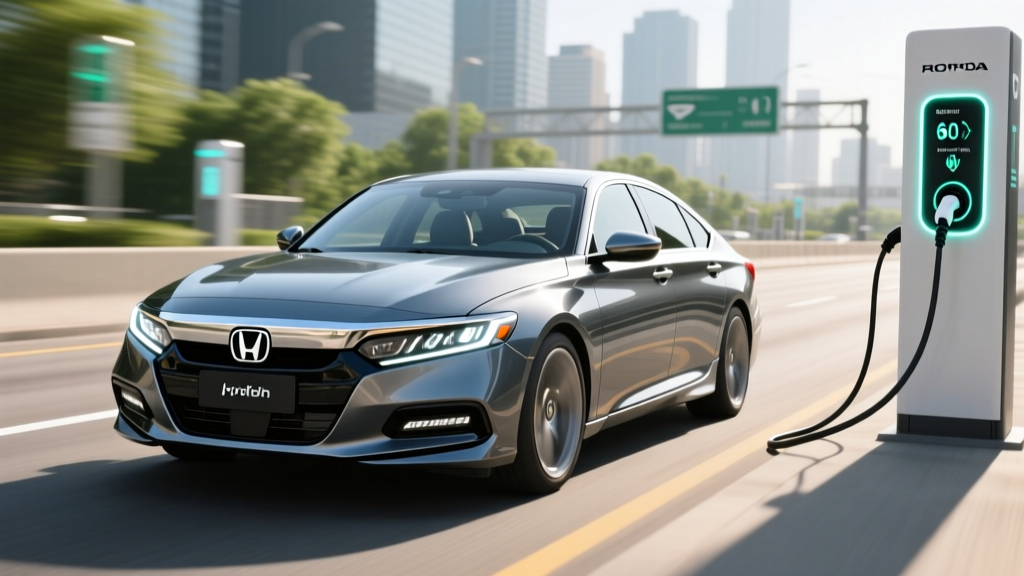
The Honda Accord Hybrid occupies a specific niche: a midsize sedan that prioritizes fuel economy without sacrificing the passing power drivers need for highway merging and overtaking. For buyers researching the Honda Accord Hybrid 0-60 time alongside efficiency figures, the current-generation model delivers a blend of acceleration and MPG that few competitors can match in the sedan segment.
This guide covers the Accord Hybrid's powertrain specs, real-world acceleration and fuel economy, battery longevity, and how it stacks up against plug-in hybrids and full EVs for different driving lifestyles.
Honda Accord Hybrid Powertrain: Engine, Motors, and Horsepower
The current Accord Hybrid uses Honda's fourth-generation two-motor hybrid system. A 2.0-liter Atkinson-cycle four-cylinder engine pairs with two electric motors — one functioning primarily as a generator, the other as the drive motor. The system operates mostly in series-hybrid mode at lower speeds (the engine generates electricity for the drive motor) and switches to direct engine drive via a lock-up clutch at sustained highway cruising speeds.
| Component | Specification |
|---|---|
| Engine | 2.0L Atkinson-cycle 4-cylinder |
| Engine Output | 146 hp / 134 lb-ft torque |
| Drive Motor Output | 181 hp / 247 lb-ft torque |
| Combined System Output | 204 hp / 247 lb-ft torque |
| Transmission | e-CVT (single-speed direct drive + lock-up clutch) |
| Drivetrain | Front-wheel drive |
| Hybrid Battery | ~1.06 kWh lithium-ion (HEV, not plug-in) |
The 247 lb-ft of torque from the electric drive motor is available from near zero RPM, which gives the Accord Hybrid its responsive off-the-line feel. This is the key to understanding its acceleration — peak torque delivery doesn't require waiting for engine revs to build or a transmission to downshift.
Honda Accord Hybrid 0-60 MPH Time and Acceleration Performance
Independent testing puts the Honda Accord Hybrid 0-60 mph time at approximately 7.5 seconds. That figure places it squarely in competitive territory against the Toyota Camry Hybrid (roughly 7.2 seconds for the AWD variant) and well ahead of most non-turbocharged gas-only midsize sedans.
At higher speeds, the acceleration curve flattens somewhat — the 204 combined horsepower is adequate rather than thrilling above 70 mph. The quarter-mile time lands around 15.8 seconds at roughly 90 mph. For context, the turbocharged gas Accord (252 hp in prior model years) hits 60 in about 5.5 seconds, but sacrifices 10+ MPG to get there.
Fuel Economy: EPA MPG Ratings and Real-World Efficiency
Fuel economy is where the Accord Hybrid earns its keep. Here is the EPA-rated breakdown by trim, sourced from fueleconomy.gov:
| Trim | City MPG | Highway MPG | Combined MPG |
|---|---|---|---|
| Sport / Sport-L / EX-L Hybrid | 51 | 44 | 48 |
The city-biased MPG split (51 city vs 44 highway) is characteristic of conventional hybrids. The electric motor handles low-speed driving where gasoline engines are least efficient — stop-and-go traffic, idling, and low-speed acceleration. At highway speeds, the engine takes over via the lock-up clutch, operating at its most efficient RPM, but aerodynamic drag and the lack of regenerative braking opportunities reduce the advantage.
Conventional Hybrid (HEV): The Accord Hybrid is an HEV. It generates all its electricity internally through regenerative braking and the gasoline engine. You never plug it in. The small ~1 kWh battery assists acceleration and enables brief low-speed electric-only driving (typically under 1 mile at very low speeds).
Plug-In Hybrid (PHEV): A PHEV like the Toyota Prius Prime or Hyundai Tucson PHEV has a much larger battery (13-18 kWh) that you charge via a plug, giving 25-44 miles of electric-only range before the gas engine engages. PHEVs qualify for federal tax credits; conventional HEVs like the Accord Hybrid do not.
Real-World MPG: What Owners Actually See
Conventional hybrids frequently exceed their EPA city ratings in real-world driving because regenerative braking recovers more energy in heavy traffic than the EPA test cycle simulates. Accord Hybrid owners commonly report:
- City driving: 48–55 MPG (often exceeding the 51 EPA rating in congested traffic)
- Highway cruising (70-75 mph): 40–44 MPG
- Mixed driving: 44–50 MPG combined
- Cold weather penalty: Expect a 5–10% reduction in winter months as the engine runs more frequently to provide cabin heat and maintain battery temperature
Over a 15,000-mile year at $3.50/gallon, the 48 MPG combined rating translates to roughly $1,094 in annual fuel cost — compared to about $1,837 for a 29 MPG combined gas-only midsize sedan. That's approximately $743 in yearly fuel savings.
Accord Hybrid vs Plug-In Hybrid vs Full EV: Which Fits Your Life?
The Accord Hybrid is a conventional HEV — it cannot plug in, has no meaningful electric-only range, and does not qualify for the federal §30D EV tax credit. So who should choose it over a PHEV or a battery-electric vehicle (BEV)?
| Factor | Accord Hybrid (HEV) | PHEV (e.g., Prius Prime) | Full EV (e.g., Tesla Model 3) |
|---|---|---|---|
| Plug-in Required? | No | Yes (for EV range benefit) | Yes |
| Electric-Only Range | ~0.5 mi at low speed | 25–44 miles | 250–360 miles |
| Total Range | ~570 miles | ~400–600 miles combined | 250–360 miles |
| Home Charging Needed? | No | Recommended (Level 1 or 2) | Yes (Level 2 strongly recommended) |
| Federal Tax Credit | None | Up to $7,500 (§30D) | Up to $7,500 (§30D) |
| Best For | No home charging access; long commutes; apartment dwellers | Short commutes + occasional road trips; home charging available | Home charging available; daily driving under 250 mi; lowest operating cost |
| Fuel Cost (annual, 15k mi) | ~$1,094 | ~$400–$800 (depends on EV% of driving) | ~$500–$700 (electricity) |
Choose the Accord Hybrid if: You lack access to home or workplace charging, drive long distances regularly, want maximum range without planning charging stops, or live in an apartment without plug-in capability.
Choose a PHEV if: Your daily commute is under 40 miles round-trip, you have access to a standard 120V outlet or Level 2 charger at home, and you want to drive mostly on electricity while keeping a gas engine for road trips.
Choose a full BEV if: You can install a Level 2 home charger, your daily driving is under 250 miles, you want the lowest per-mile energy cost, and you're ready to plan occasional road-trip DC fast-charging stops.
Pricing, Trims, and Tax Credit Eligibility
The Honda Accord Hybrid is available across multiple trims. Pricing for the current model year (MSRP, before destination):
- Sport Hybrid: ~$33,995
- Sport-L Hybrid: ~$35,995
- EX-L Hybrid: ~$38,995
Destination charges add approximately $1,150. Honda has structured the Accord lineup so that hybrid powertrains are available on the most popular trims, not locked behind a premium tier.
Does the Accord Hybrid Qualify for a Federal Tax Credit?
No. The Honda Accord Hybrid is a conventional hybrid (HEV), not a plug-in vehicle. The federal §30D Clean Vehicle Credit applies exclusively to battery-electric vehicles (BEVs) and plug-in hybrids (PHEVs) that meet specific battery capacity, critical-mineral sourcing, MSRP, and buyer income requirements as outlined on IRS.gov. Conventional hybrids like the Accord Hybrid have not qualified for any federal purchase incentive since the original Energy Improvement Act credits expired years ago.
Some states offer modest rebates or HOV-lane access for hybrids, but these vary widely by jurisdiction. Check your state's energy or environmental agency website for current programs.
Battery Warranty, Reliability, and Replacement Cost
Hybrid battery longevity is consistently the top concern among prospective hybrid buyers. Honda addresses this with robust warranty coverage:
• Hybrid battery: 8 years / 100,000 miles (10 years / 150,000 miles in CARB states including California, New York, Massachusetts, and others that follow California emissions standards)
• Hybrid system components (inverter, electric motors): 8 years / 100,000 miles
• Conventional powertrain warranty: 5 years / 60,000 miles
• Bumper-to-bumper: 3 years / 36,000 miles
Real-World Hybrid Battery Lifespan
Honda's hybrid systems have demonstrated strong long-term reliability. The Accord Hybrid's lithium-ion battery pack is relatively small (~1.06 kWh) and is managed conservatively — the system never fully charges or fully depletes it, keeping the battery in its optimal state-of-charge window (roughly 20-80% SoC). This buffer strategy significantly extends cycle life.
Based on long-term data from Honda hybrid owners and fleet use:
- Most Accord Hybrid batteries last well beyond 150,000 miles without significant degradation
- Failures within the warranty period are uncommon but covered with no out-of-pocket cost
- Out-of-warranty hybrid battery replacement cost: approximately $2,500–$4,000 (parts and labor) depending on whether you use a new OEM unit, a refurbished unit, or an independent hybrid specialist
For comparison, a full BEV battery replacement can cost $10,000–$20,000+, making the Accord Hybrid's smaller battery a much lower financial risk over the vehicle's lifetime. The Accord Hybrid also earned strong reliability ratings from industry trackers and holds a strong resale value, per IIHS safety data showing Top Safety Pick+ recognition for the current generation.
Driving Experience: Ride, Tech, and Daily Usability
The Accord Hybrid shares the same chassis, interior, and technology suite as the gas-only Accord. The hybrid system adds approximately 200 pounds over the gasoline model, but this weight is low in the chassis (the battery sits under the rear seats) and doesn't noticeably affect handling.
Key specs:
- Cargo volume: 16.7 cu ft (identical to gas Accord — the hybrid battery does not intrude on trunk space)
- Infotainment: 12.3-inch touchscreen (upper trims) with wireless Apple CarPlay and Android Auto
- Honda Sensing suite: Adaptive cruise control, lane-keeping assist, automatic emergency braking, traffic sign recognition (SAE Level 1 driver-assist — you must remain fully engaged)
- Seating: 5 passengers, available heated/ventilated front seats, heated rear seats on EX-L
The regenerative braking feel is well-calibrated. Unlike some hybrids that have a grabby or inconsistent brake pedal transition between regenerative and friction braking, the Accord Hybrid's pedal feel is linear and predictable. Paddle shifters on the steering wheel allow you to select from three levels of regen deceleration, though true one-pedal driving (coming to a complete stop via regen alone) is not supported.
Pros and Cons at a Glance
Pros
- 48 MPG combined (51 city) — among the best in the midsize sedan class
- 7.5-second 0-60 with instant electric torque feel
- No plug-in charging required — zero lifestyle change from a gas car
- Full 16.7 cu ft trunk (no battery intrusion)
- Strong reliability record and 8-10 year hybrid battery warranty
- Competitive pricing starting around $34K
Cons
- No federal tax credit (HEV, not PHEV or BEV)
- No all-wheel-drive option (Camry Hybrid offers AWD)
- Highway MPG (44) trails city MPG (51) — less ideal for predominantly highway commuters
- Not a true one-pedal driving experience
- Engine drone under hard acceleration (e-CVT characteristic)
Frequently Asked Questions
How many MPG does the Honda Accord Hybrid get?
The EPA rates the Accord Hybrid at 51 city / 44 highway / 48 combined MPG. Real-world owners frequently report 48–55 MPG in city driving and 40–44 MPG on the highway. Cold weather and sustained high-speed driving (80+ mph) reduce efficiency by 5–15%.
What is the Honda Accord Hybrid 0-60 time?
Independent testing records the Accord Hybrid 0-60 mph time at approximately 7.5 seconds. The electric drive motor's 247 lb-ft of instant torque makes it feel responsive in everyday driving, particularly in city acceleration and highway passing situations.
Do I need to plug in the Honda Accord Hybrid?
No. The Accord Hybrid is a conventional hybrid (HEV). It charges its own small battery through regenerative braking and the gasoline engine. There is no plug, no charging cable, and no electric-only range to manage. You simply fuel it with gasoline like a conventional car.
How far can the Accord Hybrid drive on electric only?
Effectively less than one mile, and only at very low speeds (under 25 mph). The hybrid system uses its small ~1 kWh battery for acceleration assist and brief low-speed coasting — not for meaningful electric-only driving. If you want 25+ miles of electric-only range, you need a plug-in hybrid (PHEV) or a full EV.
Does the Honda Accord Hybrid qualify for any tax credit?
The Accord Hybrid does not qualify for the federal §30D Clean Vehicle Credit, which is limited to plug-in vehicles (BEVs and PHEVs) meeting specific battery-sourcing and MSRP requirements. Some states may offer small hybrid incentives — check your local jurisdiction. The Accord Hybrid's advantage is its lower sticker price compared to PHEVs and BEVs, which can offset the lack of a tax credit.
How long will the Accord Hybrid battery last and what does replacement cost?
Honda warranties the hybrid battery for 8 years/100,000 miles (10 years/150,000 miles in CARB states). Real-world data shows most Honda hybrid batteries last 150,000+ miles without significant issues. Out-of-warranty replacement costs approximately $2,500–$4,000 for parts and labor — far less than a full EV battery replacement.
Is the Accord Hybrid better than the Toyota Camry Hybrid?
Both are strong choices. The Accord Hybrid leads in city MPG (51 vs 51 for Camry LE Hybrid) and interior space, while the Camry Hybrid offers available AWD (the Accord does not) and a slightly quicker 0-60 in its AWD variant. The decision typically comes down to brand preference, dealership experience, and whether AWD is a priority for your climate.