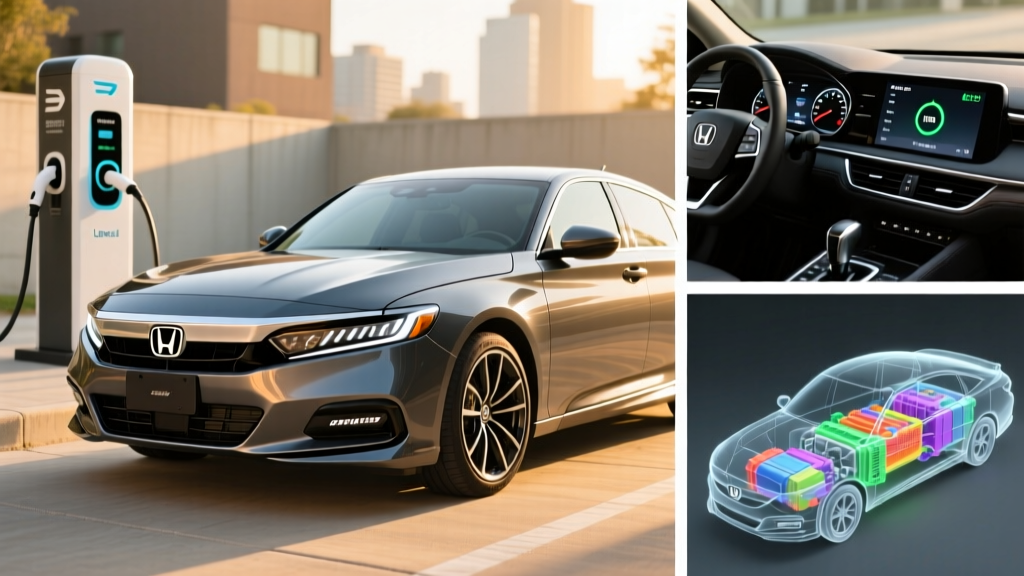
The 2024 Honda Accord Hybrid Sport sits in a sweet spot for buyers who want electric-like city efficiency without plugging in. Honda's two-motor hybrid system delivers 48 MPG combined in a midsize sedan that still looks sharp and drives well. But how does the real-world fuel economy stack up, what does ownership actually cost, and should you consider a plug-in hybrid or full EV instead? This guide breaks down every spec that matters.
Honda Accord Hybrid Sport at a Glance
| Specification | 2024 Accord Hybrid Sport |
|---|---|
| Powertrain Type | Conventional Hybrid (HEV) — no plug required |
| Engine | 2.0L 4-cylinder Atkinson-cycle + two electric motors |
| Combined Horsepower | 204 hp |
| Combined Torque | 247 lb-ft (electric motor) |
| EPA City / Highway / Combined | 51 / 44 / 48 MPG |
| Drivetrain | Front-wheel drive (FWD) |
| Transmission | e-CVT (direct-drive with fixed gear ratio) |
| 0–60 mph | ~7.0 seconds |
| Fuel Tank | 12.8 gallons |
| Total Range | ~614 miles |
| Starting MSRP | $38,490 (including destination) |
| Hybrid Battery Warranty | 8 years / 100,000 miles (10 yr/150k mi in CARB states) |
HEV vs PHEV vs EV: Where the Accord Hybrid Fits
Conventional Hybrid (HEV): The Accord Hybrid Sport is a standard HEV. It captures energy through regenerative braking and engine-driven generation to charge a small lithium-ion battery (~1.0 kWh usable). You never plug it in — just fill up with gas. The electric motors assist the engine and can drive the car solo at low speeds, dramatically improving city fuel economy.
Plug-in Hybrid (PHEV): A PHEV like the Toyota RAV4 Prime or Hyundai Tucson PHEV has a larger battery (15–20 kWh), an electric-only range of 25–42 miles, and a charge port for Level 2 home charging. Honda does not offer the Accord as a PHEV in the US market. If you want plug-in capability in a Honda sedan, you'd need to look at other brands.
Battery Electric Vehicle (BEV): A full EV like the Tesla Model 3 or Hyundai Ioniq 6 eliminates gas entirely, offering 250–360 miles of EPA range and lower per-mile energy costs — but requires reliable home or public charging access.
The Accord Hybrid Sport makes sense if you want maximum fuel efficiency with zero lifestyle changes: no charging setup, no range planning, no cold-weather range loss concerns beyond typical engine efficiency drops.
Fuel Economy: EPA Numbers vs Real-World MPG
| Driving Scenario | Expected MPG |
|---|---|
| EPA City | 51 MPG |
| EPA Highway | 44 MPG |
| EPA Combined | 48 MPG |
| Real-World City (mixed stop-and-go) | 47–53 MPG |
| Real-World Highway (70–75 mph) | 40–44 MPG |
| Real-World Combined (owner-reported average) | 44–49 MPG |
| Cold Weather (below 30°F, short trips) | 38–43 MPG |
Honda's fourth-generation two-motor hybrid system excels in city driving, where the electric motors handle most low-speed propulsion and the engine acts primarily as a generator. On fueleconomy.gov, the Accord Hybrid's 51 MPG city rating reflects this electric-dominant behavior.
Highway efficiency drops because the system switches to direct engine drive at sustained speeds — the engine is efficient, but you lose the electric motor's assistance advantage. In real-world testing at 75 mph on flat interstate, expect 40–43 MPG. Cold weather further reduces efficiency as the engine runs more frequently for cabin heat and battery conditioning.
Compared to the gas-only Accord 1.5T (30 MPG combined), the hybrid saves roughly 200 gallons of fuel per year at 15,000 miles driven — approximately $600–$750 annually at $3.25/gallon.
Powertrain Deep Dive: Honda's Two-Motor Hybrid System
The 2024 Accord Hybrid uses Honda's e:HEV two-motor system, which operates in three distinct modes:
- EV Drive: The propulsion motor powers the wheels using battery energy alone. Active at low speeds and light loads — typically 0–30 mph in gentle acceleration. The engine remains off.
- Hybrid Drive: The engine runs but does not drive the wheels directly. Instead, it spins the generator motor to produce electricity that feeds the propulsion motor in real time. This is the dominant mode in city and suburban driving.
- Engine Drive: At highway cruising speeds, a lock-up clutch connects the engine directly to the wheels through a single fixed gear ratio. This eliminates conversion losses and is the most efficient mode for sustained high-speed travel.
The 2.0-liter Atkinson-cycle engine produces 146 hp on its own, but the propulsion motor generates 184 hp and 247 lb-ft of torque. System net output is 204 hp. The result is smooth, linear acceleration that feels more like an EV than a traditional hybrid, with no rubber-band CVT sensation.
Regenerative braking is adjustable via steering-wheel paddles, offering four levels of deceleration. The strongest setting provides meaningful one-pedal-style driving in traffic, though it won't bring the car to a complete stop like a full EV's regen system.
Hybrid Battery Warranty and Long-Term Reliability
Battery Warranty: Honda covers the Accord Hybrid's lithium-ion battery pack for 8 years or 100,000 miles (whichever comes first) in all 50 states. In California Air Resources Board (CARB) states — including CA, NY, MA, WA, OR, and others — coverage extends to 10 years or 150,000 miles.
Battery Replacement Cost: If the hybrid battery fails out of warranty, a replacement from Honda typically costs $2,000–$4,000 including labor. Third-party refurbished units run $1,200–$2,500. This is significantly less than full EV battery replacements ($8,000–$20,000) because the Accord Hybrid's battery pack is small (~1.0 kWh).
Longevity Data: Honda's hybrid systems have demonstrated strong durability. Taxi fleet data and high-mileage owner reports routinely show Accord and Civic Hybrid batteries lasting 150,000–200,000+ miles before significant degradation. The battery management system keeps the pack in a conservative state-of-charge window (roughly 20–80%), minimizing stress on the cells.
Beyond the battery, the Accord Hybrid benefits from having fewer wear components than a conventional gas car. There's no traditional automatic transmission (the e-CVT has no belts or clutches to wear), regenerative braking extends pad and rotor life significantly, and the engine operates less frequently and at steadier RPMs, reducing mechanical wear.
Honda's overall vehicle warranty covers 3 years/36,000 miles bumper-to-bumper and 5 years/60,000 miles powertrain. The official Honda Accord Hybrid page details all coverage terms.
Pricing, Trims, and Tax Credit Eligibility
The 2024 Honda Accord Hybrid is available in four trims, all sharing the same 204 hp powertrain:
| Trim | MSRP (incl. destination) | Key Additions |
|---|---|---|
| Sport Hybrid | $38,490 | 19" wheels, sport styling, heated front seats, wireless CarPlay/Android Auto |
| Sport-L Hybrid | $40,190 | Leather-trimmed seats, heated steering wheel, wireless charging pad |
| EX-L Hybrid | $41,090 | Leather, power passenger seat, low-speed braking control |
| Touring Hybrid | $43,890 | Navigation, Bose 12-speaker audio, heated rear seats, low-speed braking control |
Federal Tax Credit: Does the Accord Hybrid Qualify?
The 2024 Honda Accord Hybrid does not qualify for the federal §30D new clean vehicle tax credit (up to $7,500). Under current IRS rules, the §30D credit requires a minimum battery capacity of 7 kWh — the Accord Hybrid's ~1.0 kWh pack falls well below this threshold. This credit is designed for plug-in hybrids (PHEVs) and battery electric vehicles (BEVs) only.
Conventional hybrids like the Accord also do not qualify for the §25D used clean vehicle credit or most state-level EV rebates, which target plug-in vehicles. Some states and local utilities offer small incentives ($250–$500) for purchasing any hybrid, but these vary by jurisdiction — check your state energy office or utility provider for current programs.
Total Cost of Ownership: 5-Year Estimate
| Cost Category | Accord Hybrid Sport | Accord 1.5T Sport (Gas) |
|---|---|---|
| MSRP | $38,490 | $32,890 |
| Fuel (75,000 miles @ $3.25/gal) | $5,078 | $8,125 |
| Estimated Maintenance (5 yr) | $2,800 | $3,200 |
| Estimated Insurance (5 yr) | $8,500 | $8,200 |
| 5-Year Total (before depreciation) | $54,868 | $52,415 |
| Fuel Savings vs Gas Model | ~$3,047 over 5 years | |
The hybrid carries a ~$5,600 premium over the gas-only Accord Sport. Fuel savings of roughly $3,000 over five years recover about half that premium. The remaining cost gap narrows further with lower brake wear and potentially higher resale value. If you keep the car 8–10 years, the hybrid typically breaks even or saves money overall.
Who Should Choose the Accord Hybrid Sport?
Pros
- 48 MPG combined — among the best in the midsize sedan class
- Smooth, EV-like acceleration feel with no plug-in requirement
- No range anxiety or charging infrastructure dependency
- Strong battery warranty (8–10 years depending on state)
- Competitive 204 hp output; not sluggish like older hybrids
- Honda Sensing safety suite standard on all trims
- Spacious interior with 16.7 cu ft trunk (no battery intrusion)
Cons
- No PHEV variant available — cannot drive on electric-only for extended distances
- No federal tax credit eligibility
- ~$5,600 premium over the gas-only Accord Sport
- Highway MPG (44) less impressive than city (51)
- FWD only — no AWD option unlike the Toyota Camry Hybrid
- Engine noise becomes noticeable under hard acceleration
Choose the Accord Hybrid Sport If:
- You drive 12,000–20,000+ miles per year and want to minimize fuel costs without plugging in
- You live in an apartment or lack reliable home charging access for a PHEV or EV
- You take frequent long road trips and don't want to plan around charging stations
- You want a midsize sedan with strong reliability data and low maintenance costs
- You do significant city and suburban driving where hybrid efficiency shines
Consider a PHEV or EV Instead If:
- You have home charging access and a commute under 30 miles — a PHEV like the Toyota Prius Prime (44 miles electric-only) could eliminate daily gas use entirely
- You want to qualify for the $7,500 federal tax credit — a BEV like the Tesla Model 3 or Chevy Equinox EV may net out cheaper after incentives
- You want AWD — the Toyota Camry Hybrid offers electronic AWD with similar MPG
- You want zero tailpipe emissions — only a full BEV delivers that
Frequently Asked Questions
How many MPG does the 2024 Honda Accord Hybrid Sport get?
The EPA rates the Accord Hybrid at 51 MPG city, 44 MPG highway, and 48 MPG combined. Real-world owners typically report 44–49 MPG combined, with city driving often exceeding the EPA estimate and sustained highway driving falling slightly below it. Cold weather and aggressive driving can drop combined figures to 38–43 MPG.
Does the Accord Hybrid need to be plugged in?
No. The Accord Hybrid is a conventional hybrid (HEV), not a plug-in hybrid (PHEV). The battery charges itself through regenerative braking and the gasoline engine. You simply fill up at a gas station as you would with any conventional car.
How far can the Accord Hybrid drive on electric only?
Because the Accord Hybrid has a very small battery (~1.0 kWh), it can only travel roughly 1–2 miles on electric power alone, and only at low speeds (under 30 mph). This is not a meaningful electric-only range — the system uses electric assist to improve efficiency, not to replace gasoline driving. If you want 25–40+ miles of electric-only driving, you need a PHEV.
Is the Accord Hybrid reliable? What about battery replacement?
Honda's hybrid system has a strong reliability track record spanning two decades. The lithium-ion battery is covered by an 8-year/100,000-mile warranty (10 years/150,000 miles in CARB states). Out-of-warranty replacement costs $2,000–$4,000 — far less than EV battery replacement. High-mileage reports show these batteries routinely lasting 150,000–200,000+ miles.
Does the 2024 Honda Accord Hybrid qualify for any tax credit?
No. The Accord Hybrid does not qualify for the federal §30D clean vehicle tax credit because its battery capacity (~1.0 kWh) is below the 7 kWh minimum required. Only plug-in hybrids and full electric vehicles qualify. Some local utilities may offer small hybrid incentives — check with your provider.
How does the Accord Hybrid compare to the Toyota Camry Hybrid?
The Camry Hybrid offers similar combined MPG (52 MPG for the LE trim) and a lower starting price (~$30,000). The Camry also offers available AWD. However, the Accord Hybrid provides more interior space, a more premium feel in upper trims, and a more refined two-motor drive system that feels smoother in EV-dominant city driving. Both are excellent choices — the Camry wins on price and AWD availability, the Accord on space and driving refinement.
What is the total driving range of the Accord Hybrid?
With a 12.8-gallon fuel tank and 48 MPG combined, the Accord Hybrid delivers approximately 614 miles of total range. In real-world mixed driving, expect 550–600 miles between fill-ups. This exceeds most EVs and eliminates any range concerns for road trips.