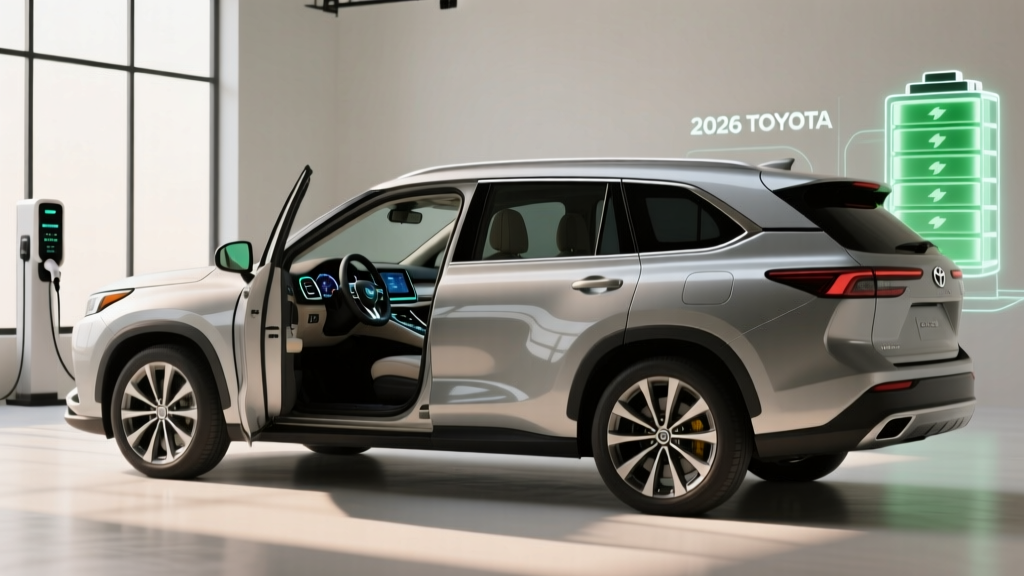
Quick Verdict: Is the 2026 Highlander Hybrid Worth the Premium?
The 2026 Toyota Highlander Hybrid remains one of the most practical three-row SUVs for families prioritizing fuel economy without plugging in. With an EPA-estimated 35 MPG combined, standard all-wheel drive, and Toyota's proven hybrid synergy drive system, it delivers real-world savings that justify its ~$4,000 premium over the gas-only Highlander. Current dealer incentives and low APR financing make 2026 Highlander Hybrid deals more accessible than ever — but understanding which trim offers the best value requires digging into the numbers.
| Spec | Value |
|---|---|
| EPA Combined MPG | 35 MPG |
| EPA City / Highway | 35 city / 35 highway |
| Powertrain | 2.5L 4-cyl + 2 electric motors (AWD) |
| Combined Horsepower | 243 hp |
| Battery Type | Nickel-metal hydride (NiMH) |
| Drivetrain | Electronic On-Demand AWD (standard) |
| Seating | 7 passengers (8 on LE trim) |
| Cargo Volume (behind 3rd row) | 16.1 cu ft |
| Starting MSRP (LE) | $40,970 |
| Hybrid Battery Warranty | 10 years / 150,000 miles |
HEV vs PHEV: Understanding What the Highlander Hybrid Actually Is
The Highlander Hybrid is a conventional hybrid (HEV), not a plug-in hybrid (PHEV). This distinction matters because it affects how you fuel it, what tax credits apply, and what to expect from daily driving.
| Feature | HEV (Highlander Hybrid) | PHEV (e.g., RAV4 Prime) |
|---|---|---|
| Plug-in charging | No — refuels with gas only | Yes — charges via Level 1/2 |
| Electric-only range | None (motor assists engine) | 25–42 miles typical |
| Battery size | ~1.6 kWh (small buffer) | 14–18 kWh usable |
| Federal tax credit | Not eligible (§30D requires plug-in) | Up to $7,500 if eligible |
| Fuel economy (gas only) | 35 MPG combined | 35–40 MPG combined after battery depletes |
| Best for | No home charging; simplicity | Short commutes + home charger |
The Highlander Hybrid's electric motors work alongside the 2.5-liter four-cylinder engine at all times — they assist during acceleration, capture energy during braking (regenerative braking), and enable brief low-speed electric-only movement. But you never plug it in. The battery recharges through the engine and regen system.
Fuel Economy: EPA Ratings vs Real-World MPG
| Trim | City MPG | Highway MPG | Combined MPG |
|---|---|---|---|
| LE | 35 | 35 | 35 |
| XLE | 35 | 34 | 35 |
| Limited | 35 | 34 | 35 |
| Platinum | 35 | 34 | 35 |
Toyota's hybrid system shines in city driving, where regenerative braking and electric-motor assist reduce engine load. According to fueleconomy.gov, the Highlander Hybrid achieves 35 MPG across all driving conditions — a significant advantage over the gas-only Highlander's 24 MPG combined.
Real-world expectations: Hybrid owners consistently report matching or slightly exceeding EPA city estimates thanks to stop-and-go regen capture. Highway driving at sustained 75+ MPH may yield 30–32 MPG as the engine works harder without regen benefit. Cold-weather operation (below freezing) typically drops fuel economy by 2–4 MPG as the engine runs longer to maintain cabin heat and battery temperature.
For comparison, filling the 17.1-gallon tank at $3.40/gallon costs ~$58 and delivers roughly 530–600 miles of real-world range — a meaningful advantage for road-trip-heavy families.
Powertrain Deep Dive: 243 HP with AWD Standard
The Highlander Hybrid pairs a 2.5-liter Atkinson-cycle four-cylinder engine (186 hp, 186 lb-ft) with two electric motor-generators — one driving the front axle and one powering the rear. Combined system output is 243 horsepower. The rear motor enables electronic on-demand all-wheel drive without a mechanical driveshaft, reducing weight and parasitic loss.
Acceleration to 60 MPH takes approximately 7.8 seconds — adequate for merging and passing but noticeably less punchy than the turbocharged gas Highlander (which delivers 265 hp). The hybrid's continuously variable transmission (eCVT) prioritizes smoothness and efficiency over sportiness. Under hard acceleration, engine drone is present but well-managed compared to earlier Toyota CVT implementations.
One practical advantage: the hybrid's smaller NiMH battery pack sits under the second-row seats, preserving cargo volume. Behind the third row, you get 16.1 cubic feet — identical to the gas model. Fold both rear rows flat and cargo capacity reaches 84.3 cubic feet.
Pricing, Trims, and Current 2026 Highlander Hybrid Deals
The 2026 Highlander Hybrid lineup spans four trims, all with standard AWD:
- LE: $40,970 MSRP — 8-passenger seating, 18" alloy wheels, Toyota Safety Sense 3.0, 8" touchscreen
- XLE: $44,570 MSRP — 7-passenger (captain's chairs), SofTex seats, heated front seats, power liftgate, wireless CarPlay/Android Auto
- Limited: $49,070 MSRP — leather-trimmed seats, 12.3" touchscreen, JBL 11-speaker audio, panoramic sunroof
- Platinum: $52,820 MSRP — head-up display, panoramic view monitor, ventilated front seats, heated steering wheel, 20" wheels
Current deal landscape (2026): Toyota typically offers $500–$1,500 in customer cash or 2.9%–4.9% APR financing on Highlander Hybrid trims through Toyota Financial Services. Loyalty incentives for current Toyota owners can stack an additional $500–$1,000. Lease deals on XLE trims have surfaced around $499/month for 36 months with $3,500 due at signing in competitive markets. Always verify current incentives on Toyota's official offers page or through local dealer quotes, as regional programs vary.
The hybrid premium over the gas-only Highlander runs approximately $3,600–$4,000 depending on trim. At 11 MPG combined improvement and 12,000 miles driven annually, fuel savings reach roughly $600–$800 per year at $3.40/gallon — meaning the hybrid pays back its premium in approximately 5–6 years for average drivers. High-mileage drivers (15,000+ miles/year) or those in expensive fuel markets (California, New York) see payback in 3–4 years.
Tax Credits: Does the Highlander Hybrid Qualify?
No. The Highlander Hybrid is a conventional HEV and does not qualify for the federal §30D Clean Vehicle Credit. Under current IRS rules, only plug-in electric vehicles (BEVs and PHEVs) with a battery capacity of at least 7 kWh and external charging capability are eligible for the up-to-$7,500 federal tax credit.
However, some states offer their own hybrid incentives:
- California: Certain air quality districts offer $500–$1,000 rebates for hybrid purchases
- Oregon: Previously offered hybrid rebates (check current program status)
- Utility programs: Some electric utilities offer $100–$300 incentives for hybrid owners (varies by provider)
If the federal tax credit is a priority in your purchase decision, you'd need to consider a PHEV like the Toyota RAV4 Prime or a full BEV. But for buyers without home charging access or those who want zero lifestyle change from their gas vehicle, the HEV's fuel savings stand on their own without government incentives.
Reliability, Battery Lifespan, and Warranty Coverage
Toyota Hybrid Battery Warranty
Coverage: 10 years or 150,000 miles (whichever comes first) for the hybrid battery pack and hybrid system components.
What's covered: Battery capacity loss below functional threshold, inverter, motor-generators, hybrid control module.
Real-world data: Toyota's hybrid battery packs in the Highlander and similar platforms routinely exceed 150,000 miles without significant degradation. NiMH chemistry is proven and less prone to the capacity-loss concerns associated with early lithium-ion packs.
Toyota's hybrid system has two decades of field-proven reliability since the original Prius. The Highlander Hybrid's NiMH battery is smaller, simpler, and less stressed than a full EV's lithium-ion pack — it never deep-cycles, never fast-charges, and operates in a narrow state-of-charge window managed by the hybrid control system.
Battery replacement cost: If the hybrid battery does fail outside warranty, replacement runs approximately $3,000–$4,500 including labor at a Toyota dealer. Third-party hybrid battery refurbishers offer reconditioned packs for $1,500–$2,500. However, field data from Consumer Reports and owner forums suggest that fewer than 5% of Toyota hybrid batteries require replacement within the first 10 years.
According to IIHS, the Highlander carries top safety ratings, and Toyota's Safety Sense 3.0 suite (pre-collision, lane-departure, adaptive cruise, road-sign assist) is standard across all trims — a meaningful value-add over competitors that gate these features behind premium packages.
Who Should Buy the Highlander Hybrid — And Who Shouldn't
Choose the Highlander Hybrid If:
- You want three rows and 35 MPG without plugging in
- You lack reliable home or workplace charging access
- You take frequent road trips and want 530+ mile range
- You prioritize long-term reliability and resale value
- You drive 12,000+ miles per year (faster payback)
Look Elsewhere If:
- You want electric-only daily commuting (consider RAV4 Prime PHEV)
- You need towing over 3,500 lbs (hybrid tows 3,500 lbs; gas tows 5,000)
- You prioritize acceleration and sporty driving dynamics
- You want the $7,500 federal tax credit (requires PHEV or BEV)
- You only carry passengers occasionally (two-row hybrid SUVs cost less)
Highlander Hybrid vs PHEV vs EV: Which Fits Your Life?
| Your Situation | Best Choice | Why |
|---|---|---|
| No home charger, need 3 rows | Highlander Hybrid (HEV) | 35 MPG, gas-and-go, no infrastructure needed |
| Home charger, short commute, road trips | RAV4 Prime or similar PHEV | 42 mi electric + gas backup, $7,500 credit eligible |
| Home charger, mostly local driving | Kia EV9 or similar 3-row BEV | Lowest operating cost, 300 mi range, $7,500 credit |
| Frequent towing, heavy loads | Gas-only Highlander or truck | Higher torque, 5,000 lb tow rating |
The Highlander Hybrid occupies a specific niche: three-row family hauling with minimal fuel cost and zero lifestyle compromise. It doesn't require you to install a Level 2 home charger, plan routes around DC fast chargers, or accept reduced towing capacity. For families in apartments, condos, or homes without dedicated garage circuits, the HEV path removes every barrier to electrified efficiency.
Frequently Asked Questions
How many MPG does the 2026 Highlander Hybrid actually get?
The EPA rates it at 35 MPG combined (35 city / 34–35 highway depending on trim). In real-world driving, owners report 33–38 MPG depending on conditions — city driving often exceeds the EPA estimate thanks to regen braking, while sustained highway speeds above 75 MPH may drop to 30–32 MPG.
Does the Highlander Hybrid need to be plugged in?
No. It's a conventional hybrid (HEV), meaning the battery recharges through the gasoline engine and regenerative braking. You fuel it exactly like a gas car — at any gas station.
Is the hybrid battery reliable, and what does replacement cost?
Toyota's hybrid batteries carry a 10-year / 150,000-mile warranty and routinely last well beyond that. NiMH chemistry is proven and low-stress. Out-of-warranty replacement costs $3,000–$4,500 at a dealer or $1,500–$2,500 from third-party refurbishers, but actual failure rates are very low.
Does the Highlander Hybrid qualify for any federal tax credit?
No. The IRS §30D Clean Vehicle Credit applies only to plug-in vehicles (BEVs and PHEVs). The Highlander Hybrid is a conventional HEV and does not qualify. Some state or utility incentives may apply — check your local programs.
How much can the Highlander Hybrid tow?
The Highlander Hybrid has a 3,500-pound tow rating across all trims — 1,500 pounds less than the gas-only Highlander (5,000 lbs). If you tow a larger trailer or boat regularly, the gas model or a body-on-frame SUV may be more appropriate.
What's the best Highlander Hybrid trim for value?
The XLE ($44,570) offers the strongest balance: captain's chairs, heated seats, wireless connectivity, and a power liftgate without the premium of the Limited or Platinum. Most Highlander Hybrid deals and incentives target the XLE and Limited trims.
How does the Highlander Hybrid compare to the Kia Sorento Hybrid?
The Sorento Hybrid starts lower (~$38,000) and delivers 37 MPG combined, but offers less cargo volume and a smaller third row. The Highlander Hybrid is larger, has a stronger AWD system, and benefits from Toyota's resale-value advantage. Both are strong choices — the Sorento wins on price, the Highlander on space and long-term value.