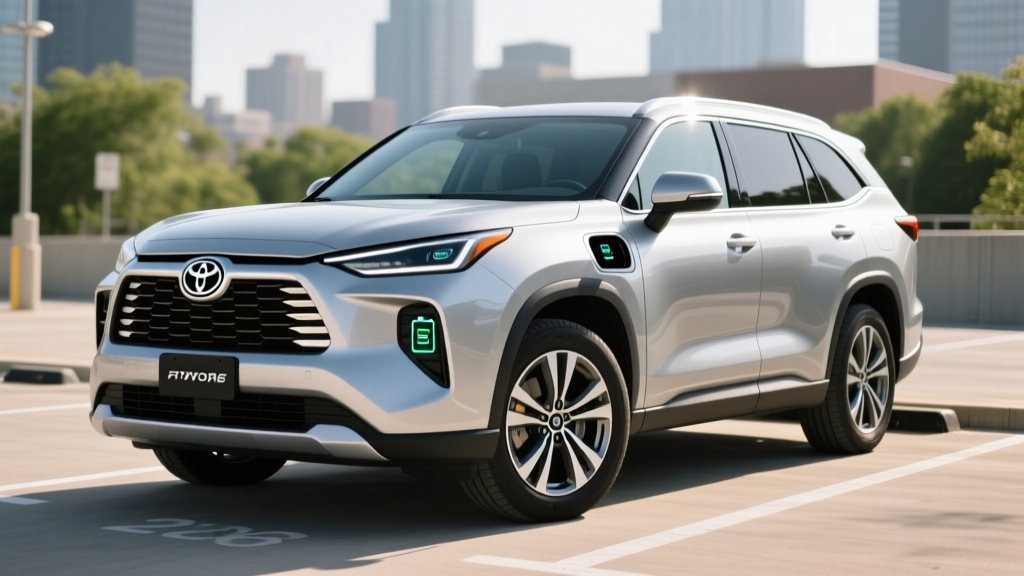
If you need three-row family hauling with genuine cargo space but aren't ready to commit to a full battery-electric vehicle, the 2026 Toyota Grand Highlander Hybrid Max sits in a compelling middle ground. It pairs a turbocharged engine with electric motors for 362 horsepower while delivering 27 MPG combined — no plug, no range anxiety, no behavioral change required. But does the Hybrid Max powertrain justify its premium over the standard Grand Highlander Hybrid, and how does it stack up against plug-in rivals?
This guide breaks down everything you need to know: real-world fuel economy, powertrain specs, battery longevity, warranty coverage, pricing by trim, and whether this conventional hybrid (HEV) or a plug-in hybrid (PHEV) or full EV is the right move for your household.
Grand Highlander Hybrid Max: HEV vs PHEV — What's the Difference?
The Toyota Grand Highlander is offered with two distinct hybrid powertrains, and the naming can confuse shoppers. Here's the critical distinction:
Conventional Hybrid (HEV) — Grand Highlander Hybrid & Hybrid Max
- No plug required. The battery recharges through regenerative braking and the gasoline engine.
- No electric-only range of any meaningful distance (less than 1 mile at very low speeds).
- No federal tax credit under IRS §30D — conventional hybrids do not qualify.
- Always ready — you fuel it like a normal car and the hybrid system optimizes efficiency automatically.
Plug-In Hybrid (PHEV) — Not Currently Offered
- Would require a plug and offer 20-40 miles of electric-only driving.
- Would qualify for up to $7,500 in federal tax credits (subject to income, MSRP, and battery sourcing rules).
- Toyota does not currently offer a Grand Highlander PHEV variant in the US market.
Both the standard Hybrid and the Hybrid Max are conventional hybrids. The "Max" designation refers to the upgraded, more powerful powertrain — not a plug-in system. If you want electric-only commuting capability, you'll need to look at competitors like the Jeep Grand Cherokee 4xe or consider a full EV like the Kia EV9.
Fuel Economy: EPA Ratings and Real-World MPG
The Hybrid Max powertrain uses a 2.4-liter turbocharged four-cylinder engine paired with front and rear electric motors through Toyota's Hybrid MAX system. Here's how the fuel economy breaks down according to EPA estimates on fueleconomy.gov:
| Drivetrain | City MPG | Highway MPG | Combined MPG |
|---|---|---|---|
| Hybrid Max AWD | 26 | 27 | 27 |
| Standard Hybrid AWD (comparison) | 34 | 34 | 34 |
| Standard Hybrid FWD (comparison) | 36 | 36 | 36 |
Real-world expectations: The Hybrid Max's city and highway MPG are remarkably close — unusual for a combustion-heavy vehicle. In practice, expect to achieve 25-28 MPG in mixed driving. Highway cruising at 75+ mph with a full load of passengers and cargo may pull figures down to 24-25 MPG. In stop-and-go city traffic, the hybrid system's regenerative braking can push figures slightly above the EPA city estimate to 28-29 MPG. This is a key advantage of conventional hybrids: they often exceed their EPA city rating because electric motors handle low-speed propulsion where gasoline engines are least efficient.
For context, the standard (non-Max) Grand Highlander Hybrid achieves 34-36 MPG combined — a 7-9 MPG advantage. That gap translates to roughly $300-$400 more per year in fuel costs for the Hybrid Max at 15,000 miles annually and $3.50/gallon regular unleaded.
Powertrain Specs: Horsepower, Torque, and Acceleration
The Hybrid Max exists for buyers who find the standard hybrid's acceleration adequate but want more passing confidence, especially when loaded with passengers and cargo or merging onto fast-moving highways.
| Engine | 2.4L turbocharged 4-cylinder |
| Engine Output | 271 hp / 317 lb-ft torque |
| Front Electric Motor | 83 hp / 184 lb-ft |
| Rear Electric Motor | 54 hp / 89 lb-ft |
| Combined System Output | 362 hp / 400 lb-ft torque |
| Transmission | 6-speed automatic (not CVT) |
| Drivetrain | Electronic AWD (eAWD) standard |
| 0-60 mph | 6.3 seconds (manufacturer est.) |
| Towing Capacity | 5,000 lbs |
| Fuel Type | Regular unleaded (87 octane) |
The 6-speed automatic transmission is a deliberate choice for the Hybrid Max — it provides more natural, stepped shifting compared to the CVT in the standard Hybrid, and handles the turbo engine's torque band better. The eAWD system uses the rear electric motor for rear-wheel torque distribution, providing traction without a mechanical driveshaft.
Compared to the standard Grand Highlander Hybrid's 245 combined horsepower, the Hybrid Max's 362 hp is a substantial 48% increase. The 0-60 time drops from approximately 7.8 seconds to 6.3 seconds — meaningful when merging or overtaking.
Hybrid Battery: Size, Warranty, and Replacement Cost
A common concern among hybrid shoppers is battery longevity. Unlike full EVs with massive 70-100 kWh packs, the Grand Highlander Hybrid Max uses a compact lithium-ion hybrid battery designed for frequent shallow charge-discharge cycles rather than deep cycling.
Hybrid Battery Warranty — Toyota Coverage
- Hybrid Battery Warranty: 10 years / 150,000 miles (whichever comes first)
- Hybrid System Components: 8 years / 100,000 miles
- Powertrain Warranty: 5 years / 60,000 miles
- Basic Bumper-to-Bumper: 3 years / 36,000 miles
Toyota's hybrid battery warranty has been extended to 10 years/150,000 miles for all model years 2020 and newer, regardless of state (previously, CARB states received longer coverage). This is among the best in the industry.
Battery size: The Hybrid Max uses a 1.87 kWh (nominal) lithium-ion hybrid battery pack. This is not a traction battery meant for miles of electric driving — it's a power-assist buffer that captures regenerative energy and deploys it for acceleration boosts and low-speed electric assist. The battery never fully charges or fully depletes; the system maintains a middle state-of-charge window to maximize longevity.
Real-world lifespan data: Toyota's hybrid battery track record is strong. Data from fleet operators and long-term Prius owners suggests hybrid batteries commonly last 150,000-200,000+ miles before significant degradation. The smaller, shallow-cycle design avoids the deep discharge stress that degrades EV batteries faster.
Replacement cost: If the hybrid battery does fail outside warranty, a replacement from Toyota typically costs between $3,000 and $5,000 including labor for the Hybrid Max system. Third-party reconditioned batteries are available for $1,500-$2,500. Individual module replacement (rather than the full pack) can reduce costs further, as hybrid batteries are composed of multiple modules that can be serviced individually.
Pricing, Trims, and Tax Credit Eligibility
The Hybrid Max powertrain is available on Limited and Platinum trims of the Grand Highlander, carrying a premium over the standard Hybrid.
| Trim | MSRP (est.) | Key Features |
|---|---|---|
| Limited AWD (Hybrid Max) | $55,500 | Leather, panoramic roof, 12.3" display, JBL audio |
| Platinum AWD (Hybrid Max) | $60,000 | Head-up display, 360° camera, premium leather, 20" wheels |
For comparison, the standard Hybrid starts around $45,000 on the XLE trim, making the Hybrid Max a roughly $10,000+ step up when comparing similar equipment levels.
Federal Tax Credit: Does the Grand Highlander Hybrid Max Qualify?
No. The Grand Highlander Hybrid Max is a conventional hybrid (HEV), not a plug-in hybrid (PHEV) or battery-electric vehicle (BEV). Under current IRS §30D rules, only plug-in electric vehicles with a minimum battery capacity of 7 kWh qualify for the federal clean vehicle credit. Conventional hybrids are excluded entirely.
There is no federal tax credit for purchasing a conventional hybrid in 2026. Some states may offer minor incentives or HOV lane access for hybrids, but these vary by jurisdiction. Check your state's energy office or DMV for local programs.
Total Cost of Ownership Context
Without a tax credit, the Hybrid Max must justify its premium through driving experience and capability rather than financial incentives. Over 5 years at 15,000 miles annually:
- Fuel cost (Hybrid Max, 27 MPG): ~$9,700 at $3.50/gallon
- Fuel cost (Standard Hybrid, 34 MPG): ~$7,700 at $3.50/gallon
- Fuel cost (Gas-only V6 competitor, 21 MPG): ~$12,500 at $3.50/gallon
The Hybrid Max saves roughly $2,800 in fuel over a comparable gas-only three-row SUV across 5 years, but costs approximately $2,000 more in fuel than the standard Hybrid over the same period.
Who Should Choose the Hybrid Max vs. Alternatives?
Pros
- 362 hp provides confident acceleration for a 4,700-lb three-row SUV
- No plug-in requirement — fuel and go
- 5,000-lb towing capacity exceeds most hybrid competitors
- 10-year/150,000-mile hybrid battery warranty
- Genuine third-row space fits adults (unlike many midsize competitors)
- Regular 87-octane fuel keeps per-gallon costs low
Cons
- 27 MPG combined trails the standard Hybrid by 7-9 MPG
- No federal tax credit eligibility
- $55,500+ starting price is steep for the segment
- Hybrid Max limited to Limited and Platinum trims only
- No electric-only driving mode for silent neighborhood operation
- Higher annual fuel cost vs. standard Hybrid (~$400/year more)
Choose the Hybrid Max If:
- You need towing capacity (5,000 lbs) that the standard Hybrid's 3,500-lb rating can't match
- You frequently drive loaded with passengers and cargo on highways and want passing power reserve
- You want the driving refinement of a turbo engine with a conventional automatic transmission
- You have no home charging access and don't want to rely on public infrastructure
Choose the Standard Grand Highlander Hybrid Instead If:
- Maximum fuel efficiency (34-36 MPG) is your top priority
- You do mostly city and suburban driving where the efficiency gap is most noticeable
- You want a lower entry price (XLE Hybrid from ~$45,000)
- Towing needs are light (under 3,500 lbs)
Choose a PHEV or Full EV Instead If:
- You want electric-only commuting and have home charging access
- Federal tax credit eligibility ($7,500) is important to your purchase math
- You want to minimize or eliminate gasoline use entirely
- Consider the Kia EV9 (300-mile range BEV, three rows) or wait for a potential Toyota PHEV three-row offering
Reliability and Long-Term Ownership
Toyota's hybrid systems have accumulated over 25 years of real-world data since the original Prius. The Hybrid Max system is newer (introduced on the Crown and Grand Highlander), but its core components — the electric motors, power control unit, and hybrid battery management — share architecture with proven Toyota hybrid systems.
According to NHTSA vehicle data, Toyota's hybrid-specific recall history is minimal. The most common hybrid-related service items are:
- Inverter coolant pump: Occasionally fails around 100,000+ miles; $300-$500 replacement
- Hybrid battery cooling fan: Can accumulate dust; periodic cleaning recommended
- 12V auxiliary battery: Like any vehicle, requires replacement every 4-6 years ($200-$350)
Toyota dealerships are widely distributed across the US, and hybrid system diagnostics are well-established in their service network — an advantage over newer EV-only brands with limited service infrastructure.
Frequently Asked Questions
How many MPG does the Grand Highlander Hybrid Max get?
The EPA rates the 2026 Grand Highlander Hybrid Max AWD at 26 city / 27 highway / 27 combined MPG. Real-world mixed driving typically yields 25-28 MPG, with city driving sometimes exceeding the EPA estimate thanks to regenerative braking.
Does the Grand Highlander Hybrid Max have an electric-only mode?
No. The Hybrid Max is a conventional hybrid (HEV), not a plug-in hybrid. It can operate on electric power alone only at very low speeds for very short distances (under 1 mile). It cannot be plugged in to charge. If you want meaningful electric-only range, you need a PHEV or full EV.
Is the hybrid battery reliable and what does replacement cost?
Toyota's hybrid batteries are among the most proven in the industry, commonly lasting 150,000-200,000+ miles. The battery is covered by a 10-year/150,000-mile warranty. Out-of-warranty replacement costs $3,000-$5,000 from Toyota, or $1,500-$2,500 for a reconditioned unit from third-party suppliers.
Does the Grand Highlander Hybrid Max qualify for a tax credit?
No. Under current IRS §30D rules, only plug-in electric vehicles (PHEVs and BEVs) qualify for the federal clean vehicle credit. Conventional hybrids like the Grand Highlander Hybrid Max are not eligible for any federal tax credit. Check your state's energy office for any local hybrid incentives.
What's the difference between the Hybrid Max and the standard Hybrid?
The standard Grand Highlander Hybrid uses a 2.5L naturally aspirated engine with a CVT, producing 245 combined hp and achieving 34-36 MPG. The Hybrid Max uses a 2.4L turbocharged engine with a 6-speed automatic, producing 362 combined hp and achieving 27 MPG. The Max trades fuel efficiency for significantly more power and a higher towing capacity (5,000 lbs vs. 3,500 lbs).
Can I tow with the Grand Highlander Hybrid Max?
Yes. The Hybrid Max is rated to tow up to 5,000 lbs when properly equipped — 1,500 lbs more than the standard Hybrid's 3,500-lb rating. This makes it suitable for small boat trailers, utility trailers, or lightweight campers.
Hybrid vs PHEV vs EV — which is right for my family?
Choose a conventional hybrid (HEV) like the Grand Highlander Hybrid Max if you want better fuel economy with zero behavior change — no plug, no charging, just fuel and drive. Choose a PHEV if you have home charging and a short commute (under 30 miles) and want electric-only daily driving with gas backup for road trips. Choose a full EV if you have reliable home charging, want to eliminate gasoline entirely, and your daily driving plus road trip patterns fit within 250-300 miles between charges (or you're comfortable with DC fast charging stops).