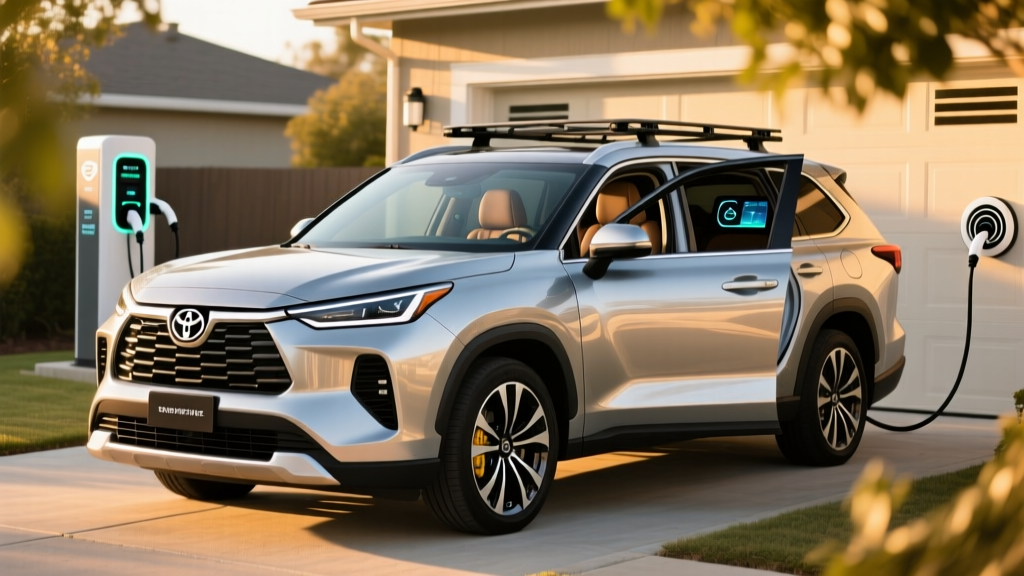
Three-row SUVs rarely deliver on the fuel-economy promises their window stickers make. The Toyota Grand Highlander Hybrid is the rare exception. In the mid-tier XLE trim — the volume seller for Toyota's largest hybrid utility vehicle — you get a powertrain that sips fuel in the city, a cabin that genuinely fits adults in the third row, and a price that undercuts most competitors in the segment by a significant margin.
This review focuses specifically on the Grand Highlander Hybrid XLE, the trim most buyers cross-shop against the Honda Pilot, Hyundai Palisade, and Kia Telluride. We break down the real-world MPG you can expect, the hybrid powertrain's strengths and limitations, battery longevity, and whether this HEV (conventional hybrid) is the right electrified choice for your family — or whether you should look at a PHEV or full EV instead.
Quick Verdict: Who the Grand Highlander Hybrid XLE Is For
Choose the Grand Highlander Hybrid XLE if:
- You need 3-row seating for 7-8 passengers but refuse to accept 20 MPG
- You don't have reliable home charging access for a PHEV or EV
- You want Toyota's proven hybrid reliability with a 10-year battery warranty
- City-heavy driving dominates your commute (hybrids shine here)
Look elsewhere if:
- You want any electric-only driving range (this is not a PHEV)
- You need towing above 3,500 lbs (the hybrid's CVT limits heavy loads)
- You want the Hybrid MAX powertrain's 362 hp (that's Limited and Platinum trims only)
HEV vs. PHEV: What the Grand Highlander Hybrid Actually Is
Let's clear up the most common confusion first. The Grand Highlander Hybrid is a conventional hybrid electric vehicle (HEV). It cannot be plugged in. There is no charging port, no electric-only driving mode beyond very low-speed parking-lot maneuvers, and no external battery charging. The gasoline engine and regenerative braking system charge the small hybrid battery automatically during driving.
| Feature | HEV (Grand Highlander Hybrid) | PHEV (e.g., Toyota RAV4 Prime) | BEV (e.g., Tesla Model X) |
|---|---|---|---|
| Plug-in charging | No | Yes | Yes |
| Electric-only range | ~0.5 mi at low speed | 30-42 mi typical | 250-400 mi |
| Battery size | ~1.6 kWh (NiMH) | 13-18 kWh (Li-ion) | 75-100+ kWh (Li-ion) |
| Federal tax credit | No | Up to $7,500 (if eligible) | Up to $7,500 (if eligible) |
| Gasoline engine | Yes (primary) | Yes (backup) | None |
Toyota does not currently offer a Grand Highlander PHEV variant. If plug-in capability is a dealbreaker in a 3-row Toyota, the closest option is the smaller Highlander PHEV (if available in your market) or stepping down to the RAV4 Prime, which sacrifices the third row entirely.
EPA Fuel Economy: City, Highway, and Combined MPG
The Grand Highlander Hybrid XLE with front-wheel drive (FWD) carries an EPA-estimated 36 MPG combined, broken down as 37 MPG city / 34 MPG highway. The all-wheel-drive (AWD) variant drops slightly to 35 MPG combined (36 city / 32 highway).
| Drivetrain | City MPG | Highway MPG | Combined MPG | Annual Fuel Cost* |
|---|---|---|---|---|
| FWD | 37 | 34 | 36 | ~$1,750 |
| AWD | 36 | 32 | 35 | ~$1,800 |
*Based on 15,000 mi/year, $3.50/gal regular unleaded. Actual costs vary by region and driving style.
Real-World MPG: What Owners Actually Report
Toyota's hybrid systems are notorious for matching or exceeding EPA city estimates in real-world stop-and-go driving, where regenerative braking recaptures the most energy. Expect 36-40 MPG on city commutes with moderate traffic. Highway driving at 75-80 MPH is a different story: the 2.5-liter four-cylinder works harder at sustained speed, and real-world highway MPG typically falls to 30-32 MPG. In cold weather (below 30°F), expect a 5-10% reduction across the board as the engine runs more frequently to provide cabin heat.
Powertrain Specs: Horsepower, Engine, and Hybrid System
The Grand Highlander Hybrid XLE uses Toyota's fourth-generation hybrid system, pairing a naturally aspirated 2.5-liter inline-4 engine with two electric motors (FWD) or three electric motors (AWD, with a rear-axle motor for electronic on-demand AWD).
| Engine | 2.5L inline-4, Atkinson cycle |
| Engine horsepower | 186 hp @ 6,000 rpm |
| Combined system output | 245 hp |
| Transmission | eCVT (planetary gearset, not a belt CVT) |
| Drivetrain (standard) | FWD |
| Drivetrain (optional) | AWD (electronic, rear motor) |
| 0-60 MPH | ~7.9 seconds (FWD) |
| Towing capacity | 3,500 lbs (hybrid) |
| Hybrid battery type | Nickel-metal hydride (NiMH) |
| Hybrid battery capacity | ~1.6 kWh |
| Fuel tank | 17.1 gallons |
| Total driving range | ~580-615 miles (FWD) |
A note on the eCVT: Toyota's hybrid "CVT" is a planetary gearset, not the rubber-belt continuously variable transmissions found in some competitors. It's mechanically simple, proven over 25+ years of Prius production, and largely immune to the reliability concerns that plague belt-type CVTs. Acceleration is adequate for family hauling but won't thrill — the Hybrid MAX powertrain (362 hp, available on Limited and Platinum trims) addresses that, at the cost of 2-3 MPG combined.
Battery Warranty, Lifespan, and Replacement Cost
Toyota Hybrid Battery Warranty
- Coverage: 10 years / 150,000 miles (whichever comes first)
- What's covered: Hybrid battery pack, hybrid control module, inverter
- Applies to: All 50 states (California and CARB states may have additional emissions-related coverage)
- Transferable: Yes, to subsequent owners
Toyota's hybrid battery track record is among the best in the industry. The NiMH pack in the Grand Highlander Hybrid is a mature, conservatively engineered component — not the high-energy-density lithium-ion chemistry used in EVs. Real-world data from Prius and Highlander Hybrid fleets shows these batteries commonly lasting 150,000-200,000+ miles before significant degradation.
Battery replacement cost: If the hybrid battery does fail outside warranty, a new OEM replacement runs approximately $3,000-$4,500 including labor at a Toyota dealer. Independent hybrid specialists can often perform the same job for $2,000-$3,000. Refurbished/reconditioned packs are available for $1,500-$2,500. This is dramatically less than EV battery replacement ($10,000-$20,000+), which is one reason cost-conscious buyers lean toward HEVs.
Pricing, Trim Levels, and Tax Credit Eligibility
The 2026 Grand Highlander Hybrid XLE starts at approximately $45,170 MSRP (FWD), with AWD adding roughly $1,600. This positions the XLE about $4,000 above the base LE Hybrid and $6,000+ below the Limited Hybrid.
| Trim | FWD MSRP | AWD MSRP | Key Additions Over LE |
|---|---|---|---|
| LE | ~$41,170 | ~$42,770 | Base: 8-seat, Toyota Safety Sense 3.0 |
| XLE | ~$45,170 | ~$46,770 | SofTex seats, heated front seats, power liftgate, wireless CarPlay |
| Limited | ~$51,570 | ~$53,170 | Hybrid MAX available, leather, panoramic roof |
| Platinum | ~$55,070 | ~$56,670 | Head-up display, 360° camera, ventilated 2nd row |
Federal Tax Credit: Does the Grand Highlander Hybrid Qualify?
No. Under current IRS §30D rules, the federal clean vehicle credit (up to $7,500) applies only to plug-in electric vehicles — battery electric vehicles (BEVs) and plug-in hybrids (PHEVs) with a minimum battery capacity of 7 kWh. The Grand Highlander Hybrid is a conventional HEV with a ~1.6 kWh NiMH battery and no plug-in capability. It does not qualify for the federal EV tax credit.
Some states offer their own hybrid purchase incentives or HOV lane access for HEVs, but these vary widely by jurisdiction. Check your state's energy office or DMV for current programs. The fuel savings, however, are substantial on their own: at 36 MPG combined versus a gas-only 3-row SUV averaging 22 MPG, you'd save approximately $900-$1,100 per year in fuel costs at 15,000 miles driven annually.
Real-World Ownership: What the XLE Trim Gets You
The XLE is the sweet spot in the Grand Highlander Hybrid lineup. Here's what distinguishes it from the base LE:
- Seating: SofTex (synthetic leather) upholstery, heated front seats, available captain's chairs (7-passenger) or bench (8-passenger)
- Technology: 12.3-inch touchscreen, wireless Apple CarPlay and Android Auto, 7-inch digital driver display, 6 USB-C ports throughout the cabin
- Convenience: Power liftgate, smart key with push-button start, auto-dimming rearview mirror
- Safety: Toyota Safety Sense 3.0 (pre-collision with pedestrian detection, lane departure alert, full-speed dynamic radar cruise control, lane tracing assist, road sign assist, automatic high beams)
The 12.3-inch infotainment system is responsive and well-organized, though it lacks the sheer screen real estate of Hyundai/Kia's latest dual-panel setups. The third row genuinely accommodates adults on shorter trips — a key differentiator over the standard Highlander, which relegates the third row to children only.
Hybrid vs. PHEV vs. EV: Which 3-Row SUV Fits Your Life?
The electrified 3-row SUV market has expanded, but each powertrain type serves a different use case. Here's how to decide:
Choose the Grand Highlander Hybrid (HEV) if:
- You cannot charge at home (apartment, street parking, no garage)
- You regularly take long road trips and don't want to plan around charging stops
- You want the lowest purchase price in an electrified 3-row
- Your driving is city-heavy (where hybrids beat their EPA numbers)
Consider a PHEV 3-row (e.g., Volvo XC90 Recharge) if:
- You have Level 2 home charging and a short commute (<35 mi round trip)
- You want electric-only weekday driving with gas flexibility for road trips
- You qualify for the $7,500 federal tax credit (income and sourcing rules apply)
- You're willing to pay a $10,000-$15,000 premium over the Grand Highlander Hybrid
Consider a full EV 3-row (e.g., Kia EV9, Rivian R1S) if:
- You have reliable home Level 2 charging
- Your typical daily driving is under 250 miles and you're comfortable with DC fast charging on road trips
- You want zero tailpipe emissions and minimal maintenance
- You can absorb higher upfront cost ($55,000-$80,000+) for lower running costs
Pros, Cons, and Bottom Line
Pros
- 36 MPG combined in a genuine 3-row SUV — class-leading efficiency
- Proven Toyota hybrid powertrain with 10-year/150K battery warranty
- Adult-usable third row with 97 cu ft max cargo volume
- Lowest starting price in the electrified 3-row segment
- Toyota Safety Sense 3.0 standard across all trims
- No charging infrastructure required — just fill up with gas
Cons
- No electric-only driving range — this is not a PHEV
- No federal tax credit eligibility (HEV, not plug-in)
- Hybrid towing limited to 3,500 lbs (gas model tows 5,000 lbs)
- 245 hp feels merely adequate; Hybrid MAX (362 hp) costs $6,000+ more
- Highway MPG drops to ~30-32 in real-world 75+ MPH driving
- Infotainment lags behind Hyundai/Kia in responsiveness and features
Frequently Asked Questions
How many MPG does the Grand Highlander Hybrid XLE actually get?
The EPA rates it at 37 city / 34 highway / 36 combined (FWD). In real-world driving, city MPG often reaches 37-40 thanks to aggressive regenerative braking. Highway driving at 75+ MPH typically yields 30-32 MPG. Cold weather reduces both by roughly 5-10%.
Can I plug in the Grand Highlander Hybrid to charge?
No. The Grand Highlander Hybrid is a conventional HEV with no plug-in capability. The hybrid battery charges automatically through the gasoline engine and regenerative braking. There is no charging port on the vehicle.
How far can the Grand Highlander Hybrid drive on electric power alone?
Effectively zero miles at any meaningful speed. The hybrid system can propel the vehicle at very low speeds (parking lot crawling, under ~15 MPH) for brief distances, but the gasoline engine engages almost immediately for normal driving. If you want electric-only range, you need a PHEV or BEV.
Is the Grand Highlander Hybrid reliable? What about battery replacement cost?
Toyota's hybrid systems have an exceptional reliability record spanning 25+ years since the original Prius. The hybrid battery is covered by a 10-year/150,000-mile warranty. Out-of-warranty replacement costs approximately $3,000-$4,500 at a dealer, or $2,000-$3,000 at an independent hybrid specialist. Most Toyota hybrid batteries last 150,000-200,000+ miles.
Does the Grand Highlander Hybrid qualify for any tax credit?
It does not qualify for the federal §30D clean vehicle credit, which requires a plug-in vehicle with at least 7 kWh of battery capacity. Some states may offer separate hybrid incentives — check your state energy office. The fuel savings alone (~$900-$1,100/year vs. a gas 3-row SUV) provide meaningful long-term value.
How does the Grand Highlander Hybrid compare to the standard gas Grand Highlander?
The gas-only Grand Highlander (2.4L turbo, 265 hp) gets an EPA-estimated 24 MPG combined and tows up to 5,000 lbs. The Hybrid trades 500 lbs of towing capacity and 20 hp for 12 additional MPG combined. For most family buyers who don't tow frequently, the hybrid's fuel savings ($900+ annually) make it the smarter financial choice over a 5-7 year ownership period.
What's the difference between the Grand Highlander Hybrid and the Hybrid MAX?
The standard hybrid (XLE and below) uses a 245 hp system optimized for efficiency (36 MPG combined). The Hybrid MAX (available on Limited and Platinum trims only) pairs a turbocharged 2.4L engine with a more powerful electric system for 362 hp and a 6-speed automatic, but drops to 27 MPG combined. The MAX is significantly quicker (0-60 in ~6.3 seconds vs. ~7.9 seconds) but costs $6,000+ more and sacrifices 9 MPG.