Two Hybrid Flavors for Toyota's Biggest Three-Row SUV
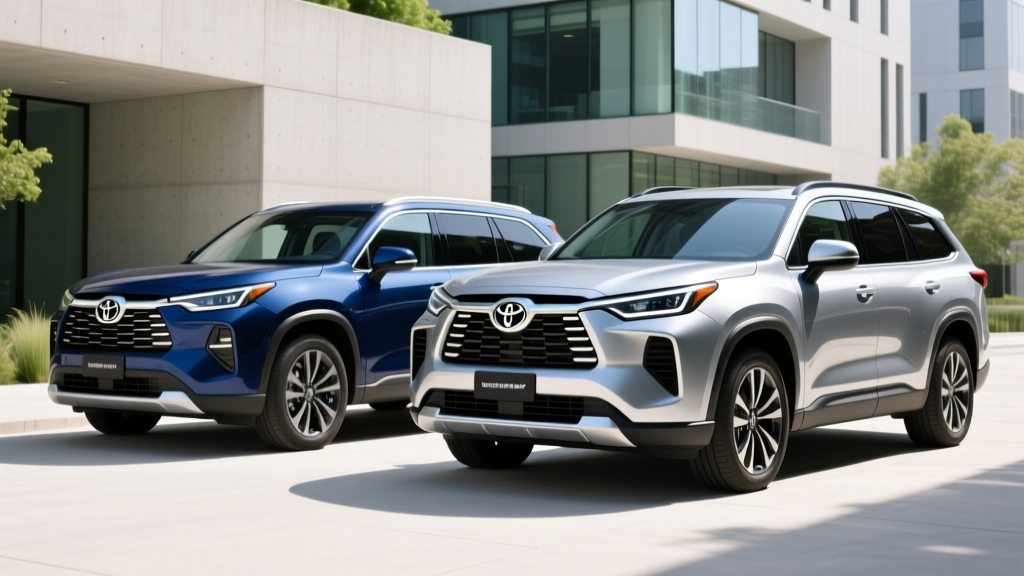
Toyota's Grand Highlander gives buyers a choice that's increasingly rare in the SUV segment: two completely different hybrid powertrains in the same body. The standard Grand Highlander Hybrid pairs a 2.5-liter four-cylinder with Toyota's fourth-generation hybrid system for maximum efficiency. The Hybrid Max swaps in a turbocharged 2.4-liter engine and a more powerful electric motor for a 49-percent horsepower bump — at the cost of roughly 9 MPG combined.
Neither is a plug-in hybrid. Both are conventional self-charging hybrids (HEVs) that refuel exclusively at the gas pump. The question isn't whether to plug in — it's whether you prioritize fuel economy or acceleration. Here's every number that matters.
Side-by-Side Spec Table: Hybrid vs Hybrid Max
| Specification | Grand Highlander Hybrid | Grand Highlander Hybrid Max |
|---|---|---|
| Powertrain | 2.5L 4-cyl + 2 electric motors (AWD-i) | 2.4L turbo 4-cyl + electric motor (Direct Shift 6AT) |
| Combined Horsepower | 245 hp | 362 hp |
| Combined Torque | 173 lb-ft (engine) + electric motor torque | 400 lb-ft (combined) |
| Transmission | eCVT | 6-speed automatic |
| Drivetrain | AWD-i (electronic rear motor) | Full-time AWD |
| EPA City MPG | 36 | 26 |
| EPA Highway MPG | 32 | 27 |
| EPA Combined MPG | 34 | 27 |
| 0-60 mph (est.) | ~7.8 sec | ~6.3 sec |
| Towing Capacity | 3,500 lbs | 5,000 lbs |
| Fuel Tank | 17.1 gal | 17.1 gal |
| Approx. Total Range | ~581 miles | ~462 miles |
| Starting MSRP (2026) | ~$46,905 (XLE) | ~$55,590 (Limited) |
Sources: fueleconomy.gov, Toyota.com. Verify exact trim pricing with your dealer; destination charges apply.
HEV vs PHEV vs EV: Where Do These Fit?
Important distinction: Both Grand Highlander hybrid variants are conventional hybrids (HEVs). They have small battery packs (~1.6 kWh usable) that recharge through regenerative braking and the gasoline engine. You never plug them in. Toyota does not currently offer a Grand Highlander Prime (plug-in hybrid), though the smaller Highlander has historically had a PHEV variant in some markets.
If you're cross-shopping, here's how the categories break down:
- HEV (this vehicle): No plug. 30+ MPG combined. Best for buyers without home charging access who want fuel savings with zero behavior change.
- PHEV (e.g., Hyundai Tucson PHEV, Toyota RAV4 Prime): Plug in for 30-42 miles electric-only, then operates as a hybrid. Best for short commutes with home charging.
- BEV (e.g., Kia EV9, Tesla Model X): Full electric, 250-330+ miles range. Best for buyers with reliable home Level 2 charging who want to eliminate gas entirely.
Real-World MPG: What Owners Actually Report
The EPA numbers tell a clear story, but hybrids behave differently depending on driving conditions — and the two Grand Highlander powertrains respond to real-world variables in opposite ways.
| Scenario | Hybrid (245 hp) | Hybrid Max (362 hp) |
|---|---|---|
| EPA Combined | 34 MPG | 27 MPG |
| City / Suburban (real-world) | 35-38 MPG | 24-27 MPG |
| Highway 70-80 mph (real-world) | 28-31 MPG | 25-28 MPG |
| Cold weather (<32°F, short trips) | 28-31 MPG | 22-25 MPG |
| Towing 3,000+ lbs | 18-22 MPG | 16-20 MPG |
Why the standard Hybrid often beats its EPA rating in the city: Toyota's series-parallel hybrid system runs the electric motor heavily at low speeds, where gasoline engines are least efficient. Stop-and-go traffic actually improves hybrid fuel economy because regenerative braking recaptures energy that a gas car wastes as heat. On the highway, the engine carries more of the load, so the efficiency advantage narrows.
Why the Hybrid Max lags: The turbocharged 2.4L engine and 6-speed automatic are optimized for torque delivery, not efficiency. The Hybrid Max uses a different hybrid architecture — the electric motor assists primarily during acceleration and low-speed maneuvering, but the gas engine is the dominant power source. Expect the Hybrid Max to behave more like a conventional turbocharged SUV that happens to have mild regenerative braking.
Powertrain Deep Dive: How They Actually Work
Standard Hybrid (245 hp, AWD-i)
Toyota's proven eCVT hybrid system uses a 2.5-liter Atkinson-cycle four-cylinder engine paired with two motor-generators. The front motor handles most propulsion duties; a smaller rear motor provides electronic all-wheel drive (AWD-i) by powering the rear wheels when slip is detected or during hard acceleration. There's no mechanical driveshaft to the rear — the rear axle is purely electric.
The eCVT isn't a traditional belt-and-pulley CVT. It's a planetary gearset that seamlessly blends engine and motor power without fixed gear ratios. The result is smooth, linear acceleration and exceptional low-speed efficiency — but also a characteristic engine drone under hard acceleration that some drivers find unrefined.
Hybrid Max (362 hp, Full-Time AWD)
The Hybrid Max uses Toyota's turbocharged 2.4-liter inline-four (shared with the Tacoma and Grand Highlander's non-hybrid turbo trim) combined with a more powerful electric motor integrated into a 6-speed automatic transmission. This system delivers 400 lb-ft of combined torque — enough to move the Grand Highlander's ~4,700-lb curb weight with genuine urgency.
Full-time AWD means a mechanical connection to all four wheels at all times, giving the Hybrid Max a more traditional SUV feel on wet roads and light off-road surfaces. The trade-off is parasitic drivetrain loss that contributes to the lower MPG.
Hybrid Battery Warranty & Replacement Cost
Both Grand Highlander hybrid variants carry Toyota's standard hybrid battery warranty: 10 years or 150,000 miles (whichever comes first) in all 50 states, per Toyota's current coverage terms. This applies to the hybrid traction battery pack.
Replacement cost if out of warranty: Based on comparable Toyota hybrid battery replacements (Highlander, Camry), expect $3,000-$5,000 for a new OEM hybrid battery pack, plus $500-$1,000 in labor. Third-party refurbished options can reduce this to $1,500-$2,500.
Longevity reality: Toyota's nickel-metal hydride and lithium-ion hybrid packs have demonstrated strong durability. Taxis and fleet vehicles using similar systems have exceeded 300,000 miles on original battery packs. Degradation in a conventional hybrid is less critical than in a full EV because the battery is small and the vehicle doesn't depend on it for primary range.
Source: Toyota Warranty Guide
Pricing, Trims & Tax Credit Eligibility
The Grand Highlander Hybrid starts at the XLE trim, while the Hybrid Max is reserved for the higher Limited and Platinum trims. This creates a significant price gap beyond just the powertrain difference.
| Trim | Powertrain | Approx. MSRP |
|---|---|---|
| XLE | Hybrid (245 hp) | $46,905 |
| Limited | Hybrid (245 hp) | $51,115 |
| Limited | Hybrid Max (362 hp) | $55,590 |
| Platinum | Hybrid Max (362 hp) | $59,390 |
Destination charge (~$1,490) not included. Verify with dealer.
Federal Tax Credit: Neither Qualifies
Under current IRS §30D rules, the $7,500 federal EV tax credit applies only to plug-in electric vehicles (BEVs and PHEVs) with sufficient battery capacity. Conventional hybrids like both Grand Highlander powertrains do not qualify for §30D. They also do not qualify for the §25D used EV credit or the commercial clean vehicle credit.
Some states offer hybrid-specific rebates or HOV lane access (notably California's Clean Air Vehicle decal program has historically included certain hybrids, though eligibility narrows over time). Check your state's energy office or DMV for current programs.
Source: IRS.gov — Clean Vehicle Credits
Who Should Choose Which?
Choose the Standard Hybrid (245 hp) if:
- Your priority is fuel cost savings — the 7 MPG combined advantage saves roughly $350-$500/year at 15,000 miles driven and $3.50/gal fuel
- You do mostly city and suburban driving where the hybrid system excels
- You want the lowest possible starting price ($46,905 vs $55,590)
- You don't need to tow more than 3,500 lbs
- Smooth, quiet, low-stress driving is your preference
Choose the Hybrid Max (362 hp) if:
- You regularly carry a full load of passengers and cargo up steep grades or at altitude
- You need the 5,000-lb towing capacity for a boat, camper, or trailer
- You want confident highway merging and passing power (6.3 sec 0-60 vs 7.8 sec)
- You prefer a traditional geared transmission feel over the eCVT's drone
- You value full-time mechanical AWD over electronic AWD-i
- You're already shopping the Limited or Platinum trim for features, making the powertrain upgrade less of a price jump
Ownership Costs Over 5 Years
| Cost Category | Hybrid (XLE) | Hybrid Max (Limited) |
|---|---|---|
| Fuel (75,000 mi @ $3.50/gal) | ~$7,720 | ~$9,720 |
| Insurance (avg.) | ~$9,500 | ~$10,800 |
| Maintenance (est.) | ~$2,800 | ~$3,200 |
| Depreciation (est.) | ~$18,000 | ~$22,000 |
| Total (approx.) | ~$38,020 | ~$45,720 |
The standard Hybrid's fuel savings compound to roughly $2,000 over five years, but the larger cost difference comes from the Hybrid Max's higher purchase price and steeper depreciation on a more expensive vehicle. For pure economic optimization, the standard Hybrid XLE wins decisively.
Pros & Cons at a Glance
Standard Hybrid Pros
- 34 MPG combined — best-in-class for a three-row SUV this size
- Lowest entry price in the Grand Highlander lineup
- Proven Toyota hybrid reliability with 10yr/150k battery warranty
- Quiet, smooth city driving with strong regenerative braking
- ~581 miles of total range per tank
Hybrid Max Pros
- 362 hp and 400 lb-ft — genuinely quick for a three-row SUV
- 5,000-lb towing capacity (1,500 lbs more than standard Hybrid)
- Full-time mechanical AWD for all-weather confidence
- 6-speed automatic avoids eCVT engine drone
- Available only on higher trims with premium features
Standard Hybrid Cons
- eCVT drone under hard acceleration
- Only 3,500-lb towing capacity
- 245 hp feels merely adequate when fully loaded
- Electronic AWD-i less robust than mechanical AWD
Hybrid Max Cons
- 27 MPG combined — 7 MPG worse than the standard Hybrid
- $8,685+ higher starting price (Limited trim required)
- Higher fuel, insurance, and depreciation costs
- Turbo engine adds complexity vs naturally aspirated 2.5L
- No federal tax credit to offset the premium
Frequently Asked Questions
How many MPG does the Grand Highlander Hybrid get?
The standard Grand Highlander Hybrid achieves an EPA-estimated 36 city / 32 highway / 34 combined MPG. The Hybrid Max drops to 26 city / 27 highway / 27 combined. In real-world suburban driving, the standard Hybrid often exceeds its EPA rating, returning 35-38 MPG. Highway driving at 75-80 mph typically yields 28-31 MPG for the standard Hybrid.
Does either Grand Highlander hybrid need to be plugged in?
No. Both are conventional self-charging hybrids (HEVs). The battery recharges through regenerative braking and the gasoline engine. You refuel only at the gas station. Toyota does not currently offer a Grand Highlander plug-in hybrid (PHEV) variant.
Is the Grand Highlander Hybrid reliable?
Toyota's hybrid systems are among the most proven in the industry, with over 25 years of production history dating to the 1997 Prius. The hybrid battery carries a 10-year/150,000-mile warranty. Independent reliability surveys (Consumer Reports, J.D. Power) consistently rate Toyota hybrids at or above average. The 2.5L Atkinson-cycle engine in the standard Hybrid is a low-stress design with minimal turbocharger or high-boost components that could fail.
What does it cost to replace the hybrid battery?
Out-of-warranty replacement for a Toyota hybrid battery pack in a vehicle of this size typically runs $3,000-$5,000 for an OEM unit plus $500-$1,000 labor. However, failure before 150,000 miles is uncommon based on historical Toyota hybrid data. The 10-year/150,000-mile warranty covers the vast majority of ownership periods.
Does the Grand Highlander Hybrid qualify for a tax credit?
No. The federal §30D clean vehicle credit ($7,500) applies only to plug-in vehicles (BEVs and PHEVs) meeting battery sourcing and MSRP requirements. Conventional hybrids do not qualify. Some states may offer minor hybrid incentives or HOV lane access — check your state's energy office for current programs.
Which is better for towing: Hybrid or Hybrid Max?
The Hybrid Max, definitively. Its 5,000-lb rating handles most boat, small camper, and utility trailer loads, while the standard Hybrid is limited to 3,500 lbs. The Max's 400 lb-ft of torque and full-time mechanical AWD also provide better control on grades and in crosswinds while towing.
How does the Grand Highlander Hybrid compare to a full EV like the Kia EV9?
The EV9 offers 279 miles of EPA range, zero tailpipe emissions, and lower per-mile fuel costs (roughly $0.04-$0.06/mile on home electricity vs $0.10-$0.13/mile on gas for the Grand Highlander Hybrid). But the EV9 requires home Level 2 charging infrastructure ($500-$2,000 installation), has longer refueling times on road trips (20-30 min DC fast charge vs 5 min at a gas pump), and starts at a higher price. If you have reliable home charging and drive under 250 miles daily, the EV9 is worth considering. If you take frequent long road trips or lack home charging, the Grand Highlander Hybrid is the lower-friction choice.