If you need three rows, serious cargo space, and a tow rating that handles a camper or boat trailer, the 2026 Toyota Grand Highlander Hybrid is one of the few midsize SUVs that threads all three needles without punishing you at the pump. But Toyota sells two very different hybrid powertrains under the same badge — and only one of them unlocks the headline tow capacity buyers are searching for.
This guide breaks down the Grand Highlander Hybrid's tow ratings by powertrain, real-world MPG, ownership costs, and whether the hybrid or the Hybrid MAX is the right call for your driveway.
Grand Highlander Hybrid Tow Capacity: By the Numbers
The 2026 Grand Highlander Hybrid comes in two distinct powertrain flavors, and tow capacity differs sharply between them:
| Powertrain | Combined HP | Drivetrain | Max Tow Capacity |
|---|---|---|---|
| Hybrid (standard) | 245 hp | AWD (eAWD) | 3,500 lbs |
| Hybrid MAX | 362 hp | AWD | 5,000 lbs |
The standard hybrid uses Toyota's familiar series-parallel system with a 2.5-liter inline-four and front/rear electric motors. It's the efficiency champion of the lineup, but its 3,500-lb rating limits you to light utility trailers, small boat rigs, or a pair of personal watercraft.
The Hybrid MAX swaps in a turbocharged 2.4-liter four-cylinder paired with a more powerful electric motor and a six-speed automatic (rather than the eCVT in the standard hybrid). That extra torque — 400 lb-ft combined — is what pushes the tow rating to 5,000 pounds, enough for most travel trailers in the 20-25 foot range, a loaded car-hauler, or a mid-size bass boat on a tandem-axle trailer.
Fuel Economy: EPA Ratings vs. Real-World MPG
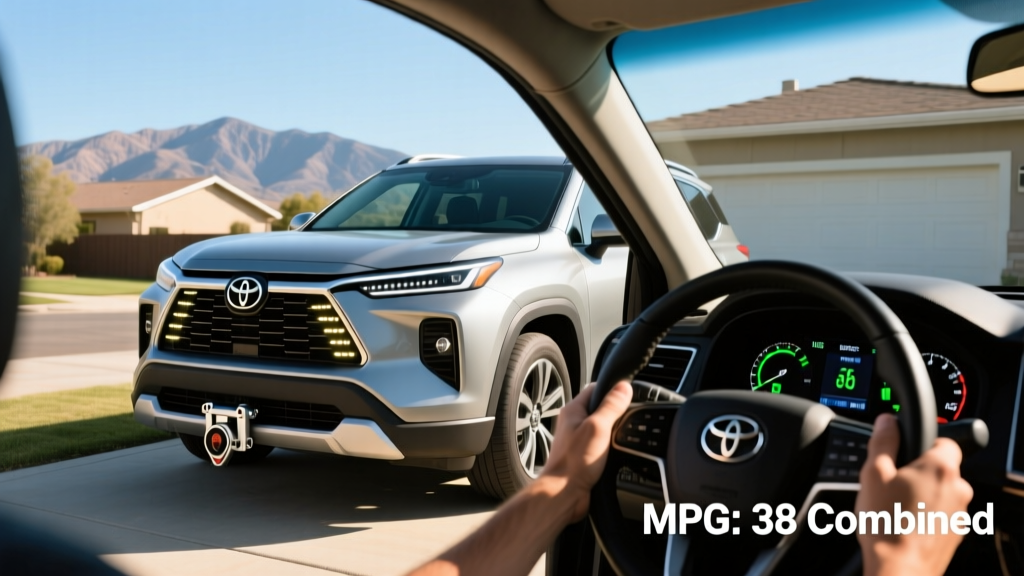
Here's where the Grand Highlander Hybrid earns its keep. The standard hybrid powertrain delivers exceptional efficiency for a vehicle this size — and in real-world city driving, you'll often beat the EPA sticker.
| Powertrain / Trim | City MPG | Highway MPG | Combined MPG |
|---|---|---|---|
| Hybrid (LE/SE/XLE — eAWD) | 36 | 32 | 34 |
| Hybrid MAX (Limited/Platinum) | 26 | 27 | 27 |
Source: fueleconomy.gov
Why City MPG Often Exceeds the Sticker
Like all Toyota hybrids, the Grand Highlander's eAWD system recovers energy during braking and low-speed driving, relying heavily on its electric motors below ~25 mph. In stop-and-go traffic or school-dropoff loops, owners regularly report 37–39 MPG in the standard hybrid. Highway driving is where efficiency dips — aerodynamic drag on a 4,700-lb three-row SUV works against you at 75 mph, and the four-cylinder engine carries more of the load.
The Hybrid MAX trades roughly 7 MPG combined for its 1,500-lb tow advantage and 117 extra horsepower. If your typical week includes towing or heavy cargo loads, the tradeoff is reasonable. If you're mostly commuting and hauling kids, the standard hybrid's 34 MPG combined saves roughly $600–$800/year in fuel versus the MAX, depending on local gas prices and annual mileage.
Powertrain Deep Dive: Standard Hybrid vs. Hybrid MAX
Toyota markets both as "hybrid," but the engineering is quite different. Neither is a plug-in hybrid (PHEV) — you never plug in either version. Both recharge their small traction batteries through regenerative braking and the gasoline engine.
| Specification | Standard Hybrid | Hybrid MAX |
|---|---|---|
| Engine | 2.5L inline-4 | 2.4L turbo inline-4 |
| Transmission | eCVT | 6-speed automatic |
| Combined Horsepower | 245 hp | 362 hp |
| Combined Torque | 173 lb-ft (engine) + electric | 400 lb-ft |
| 0–60 mph (est.) | ~7.8 sec | ~6.3 sec |
| Drivetrain | eAWD (rear electric motor) | AWD (mechanical + electric) |
| Tow Rating | 3,500 lbs | 5,000 lbs |
| Battery Type | NiMH (sealed) | NiMH (sealed) |
The standard hybrid's eCVT isn't a traditional continuously variable transmission with belts and pulleys — it's a planetary gearset that seamlessly blends engine and motor power. It's proven, durable, and nearly maintenance-free. The Hybrid MAX's six-speed automatic provides more direct acceleration feel and better towing control, especially on grades.
Pricing, Trims, and Tax Credit Eligibility
The 2026 Grand Highlander Hybrid starts in the low-$40,000 range and climbs past $55,000 at the top Hybrid MAX Platinum trim. Here's the approximate MSRP breakdown:
| Trim | Powertrain | Approx. MSRP | Tow Rating |
|---|---|---|---|
| LE | Standard Hybrid | $42,500 | 3,500 lbs |
| XLE | Standard Hybrid | $46,000 | 3,500 lbs |
| Limited | Hybrid MAX | $52,000 | 5,000 lbs |
| Platinum | Hybrid MAX | $56,500 | 5,000 lbs |
Pricing is approximate and excludes destination charges. Verify with your local Toyota dealer.
Federal Tax Credit: What You Need to Know
The Grand Highlander Hybrid (both standard and MAX) is a conventional hybrid (HEV), not a plug-in hybrid or battery electric vehicle. Under current IRS §30D rules, conventional HEVs do not qualify for the federal clean vehicle tax credit of up to $7,500. That credit is reserved for PHEVs and BEVs that meet battery sourcing, MSRP caps, and buyer income requirements.
However, some states offer their own incentives for efficient hybrids. Check with your state's energy or DMV office. Toyota's own Grand Highlander Hybrid page may list any current manufacturer incentives.
Battery Warranty, Lifespan, and Replacement Cost
This is one of the strongest hybrid battery warranties in the industry, and it reflects Toyota's two decades of hybrid reliability data. The sealed NiMH battery packs in the Grand Highlander are a mature, well-understood technology — far less prone to catastrophic failure than early-generation hybrid batteries.
How Long Do Toyota Hybrid Batteries Last?
Based on long-term data from the Highlander Hybrid, Camry Hybrid, and Prius lineages, Toyota's NiMH hybrid batteries typically last 150,000–200,000+ miles before significant capacity loss. Many first-generation Prius taxis exceeded 300,000 miles on original batteries. The Grand Highlander's larger battery and more robust cooling should perform similarly.
If replacement is needed out of warranty, expect to pay $3,000–$5,000 for a new OEM hybrid battery pack (installed). Refurbished packs run $1,500–$2,500. This is far less than a full EV battery replacement, and hybrid battery failures remain statistically rare within the warranty period.
Who Should Buy the Grand Highlander Hybrid?
Choose the Standard Hybrid If:
- Your towing needs stay under 3,500 lbs
- Fuel economy is your top priority (34 MPG combined)
- You drive mostly city/suburban routes
- You want the lowest purchase price and operating cost
Choose the Hybrid MAX If:
- You need to tow 3,500–5,000 lbs regularly
- You want stronger highway passing power (362 hp)
- You prefer a traditional automatic over an eCVT
- You're willing to trade ~7 MPG for tow capacity
Grand Highlander Hybrid vs. Full EV vs. Gas
vs. Gas-only Grand Highlander: The non-hybrid Grand Highlander (turbo 2.4L, 265 hp) returns about 24 MPG combined and tows 5,000 lbs. The standard hybrid beats it by 10 MPG combined and costs only marginally more. The gas model is hard to recommend unless you find a steep discount.
vs. a full EV three-row SUV (e.g., Kia EV9, Rivian R1S): EVs offer 0–60 performance and home charging convenience, but three-row EVs with 5,000+ lb tow ratings start at $55,000–$75,000+, and highway range while towing drops dramatically (expect 40–50% range loss). If you tow more than occasionally and lack reliable DC fast-charging along your route, the Grand Highlander Hybrid is the pragmatic choice today.
vs. PHEV alternatives: There's currently no PHEV version of the Grand Highlander. If you want plug-in capability with three rows, the Toyota RAV4 Prime (42 miles EV range, 302 hp, but only 5 seats) or the Mazda CX-90 PHEV (26 miles EV range, 3 rows) are the closest alternatives — though neither matches the Grand Highlander's cargo volume or Hybrid MAX tow rating.
Frequently Asked Questions
Can the Grand Highlander Hybrid tow a travel trailer?
Yes — the Hybrid MAX's 5,000-lb rating handles most travel trailers in the 18–25 foot range (dry weights typically 3,000–4,500 lbs). Always check your specific trailer's GVWR and use a weight-distributing hitch for trailers over 3,500 lbs. The standard hybrid's 3,500-lb limit is better suited to pop-up campers or teardrop trailers.
Does the Grand Highlander Hybrid need to be plugged in?
No. Both the standard hybrid and Hybrid MAX are conventional (self-charging) hybrids. The small traction battery recharges through regenerative braking and the gasoline engine. You fuel it like any other gas vehicle.
What is the real-world MPG when towing?
Expect 16–20 MPG combined when towing near the 5,000-lb maximum on flat terrain with the Hybrid MAX. Hilly or mountainous routes will push that lower. Without a trailer, the Hybrid MAX returns its EPA-rated 27 MPG combined in mixed driving.
Is the Grand Highlander Hybrid reliable?
Toyota's hybrid powertrains have an industry-leading reliability track record. The 2.5L hybrid system in the standard variant has been in production since 2017 across multiple models. The 2.4L turbo in the Hybrid MAX is newer but shares architecture with proven Toyota turbo engines. The 10-year/150,000-mile hybrid battery warranty provides strong long-term coverage.
Does the Grand Highlander Hybrid qualify for any tax credit?
No federal tax credit applies — the §30D clean vehicle credit requires a plug-in hybrid or battery electric vehicle with a minimum battery capacity. The Grand Highlander Hybrid is a conventional HEV and does not plug in. Check your state's incentive programs for possible local rebates on efficient vehicles.