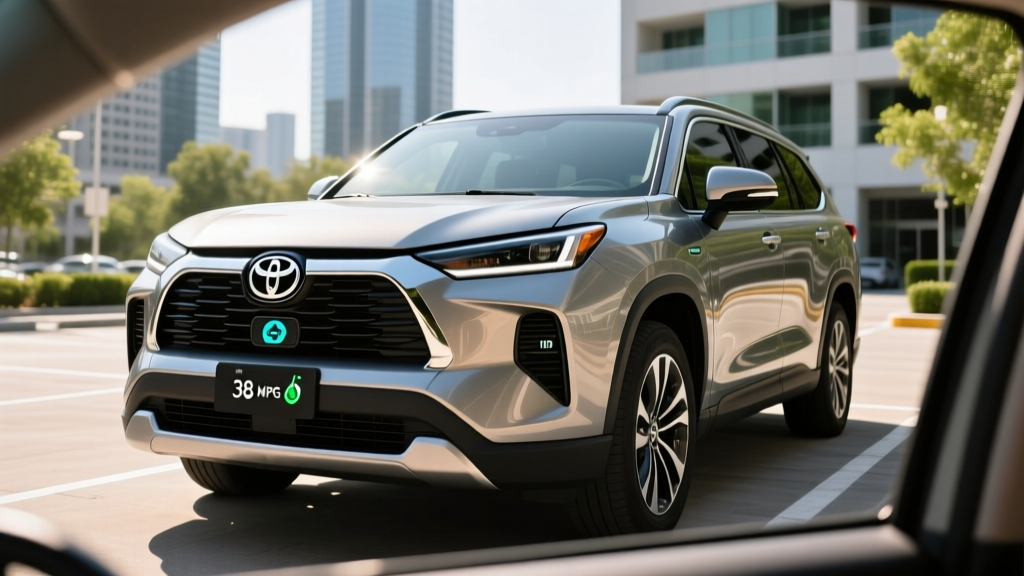
Three-row SUVs have historically been fuel-economy disasters. The Toyota Grand Highlander Hybrid upends that formula, delivering midsize-sedan efficiency in a package that seats seven or eight and offers over 97 cubic feet of cargo room behind the front row. For families weighing electrified options, the Grand Highlander Hybrid MPG story is one of the most compelling in the segment — but the numbers require some unpacking, especially since Toyota offers two distinct hybrid powertrains across the lineup.
This guide breaks down every Grand Highlander Hybrid configuration, its EPA-rated and real-world fuel economy, powertrain specs, battery longevity, pricing, and tax-credit eligibility. We'll also help you decide whether this conventional hybrid (HEV) is the right move versus a plug-in hybrid or a full battery-electric vehicle.
HEV vs PHEV: What Toyota Actually Offers
The Grand Highlander is available exclusively as a conventional hybrid electric vehicle (HEV). It does not plug in, has no electric-only driving range, and generates all its electricity through regenerative braking and its gasoline engine. This is a critical distinction: Toyota does not currently sell a Grand Highlander plug-in hybrid (PHEV) variant. If you need electric-only commuting in a Toyota SUV, you'd be looking at the smaller RAV4 Prime or the Highlander Hybrid — both different vehicles.
| Attribute | Grand Highlander Hybrid (HEV) | PHEV (e.g., RAV4 Prime) | Battery EV (e.g., Kia EV9) |
|---|---|---|---|
| Plugs in? | No | Yes (Level 1/2) | Yes (Level 2 + DC fast) |
| Electric-only range | 0 miles | 30-42 miles typical | 250-310 miles (full battery) |
| Gasoline required? | Yes | Yes (backup) | No |
| Federal tax credit (§30D) | Not eligible | Up to $7,500 (rules apply) | Up to $7,500 (rules apply) |
| Home charging install needed? | No | Recommended for PHEV | Essential |
The conventional hybrid approach means zero lifestyle change: you fuel up at any gas station, never think about charging, and still cut fuel consumption by roughly 40% compared to the gas-only Grand Highlander.
Grand Highlander Hybrid MPG: EPA Ratings by Powertrain
Toyota offers two hybrid systems in the Grand Highlander, and the MPG gap between them is significant. The standard hybrid pairs a 2.5-liter four-cylinder engine with front and rear electric motors. The Hybrid MAX uses a turbocharged 2.4-liter four-cylinder with a more powerful motor setup, trading some efficiency for substantially more performance.
| Powertrain | Drivetrain | EPA City | EPA Highway | EPA Combined | Combined HP |
|---|---|---|---|---|---|
| 2.5L Hybrid | FWD | 37 mpg | 34 mpg | 36 mpg | 245 hp |
| 2.5L Hybrid | AWD (eAWD) | 36 mpg | 32 mpg | 34 mpg | 245 hp |
| Hybrid MAX | AWD | 27 mpg | 28 mpg | 27 mpg | 362 hp |
Source: fueleconomy.gov — EPA estimates. Actual mileage will vary.
The 2.5L FWD hybrid at 36 mpg combined is the efficiency champion. That figure rivals many compact sedans and is remarkable for a 4,700-pound, three-row SUV. The Hybrid MAX's 27 mpg combined is less impressive on paper, but it's still a 30%+ improvement over the gas-only Grand Highlander's 20-21 mpg combined — and it delivers 362 horsepower with a 5,000-pound towing capacity.
Real-World MPG: What Owners Actually Report
EPA numbers tell part of the story, but Toyota's hybrid system has a well-documented tendency to match or even exceed EPA estimates in city driving, where regenerative braking and electric-motor assist do the heaviest lifting. Highway driving is where hybrids lose their advantage somewhat, since the gasoline engine runs continuously at sustained speeds.
Based on owner-reported data and independent testing, here's what to expect:
- 2.5L Hybrid (city/suburban): 35-40 mpg — stop-and-go traffic maximizes regen braking and electric-motor usage
- 2.5L Hybrid (highway, 70 mph): 30-33 mpg — aerodynamic drag dominates at speed
- 2.5L Hybrid (cold weather, short trips): 28-32 mpg — engine runs more to heat the cabin and warm up the catalytic converter
- Hybrid MAX (mixed driving): 24-27 mpg — performance-oriented tuning sacrifices some efficiency
The 2.5L hybrid's real-world combined driving typically lands between 32-36 mpg depending on your route mix and climate. Owners in warm climates with mostly suburban driving routinely report 37+ mpg. Northern-climate owners averaging short winter trips may see 28-30 mpg during the coldest months.
Powertrain and Battery Specifications
Understanding what's under the hood helps explain where the efficiency comes from — and what maintenance looks like long-term.
| Specification | 2.5L Hybrid | Hybrid MAX |
|---|---|---|
| Engine | 2.5L inline-4 Atkinson cycle | 2.4L turbo inline-4 |
| Combined system output | 245 hp | 362 hp / 400 lb-ft torque |
| Electric motors | Front + rear (eAWD) or front only (FWD) | Front + rear |
| Transmission | eCVT (planetary gearset) | 6-speed automatic |
| Hybrid battery type | Nickel-metal hydride (NiMH) | Nickel-metal hydride (NiMH) |
| Hybrid battery capacity | ~1.6 kWh (nominal) | ~1.6 kWh (nominal) |
| Towing capacity | 3,500 lbs | 5,000 lbs |
| 0-60 mph (est.) | ~7.8 seconds | ~6.3 seconds |
| Fuel tank | 17.1 gallons | 17.1 gallons |
| Total driving range (est.) | ~580-615 miles | ~460 miles |
The hybrid battery in the Grand Highlander is a small, self-charging unit — roughly 1.6 kWh nominal capacity. It's not designed to drive the vehicle on electricity alone for meaningful distances. Instead, it buffers energy from regenerative braking and provides short bursts of electric-motor assist during acceleration. The Atkinson-cycle engine in the 2.5L variant is specifically tuned for thermal efficiency over peak power, which is why it achieves such strong MPG despite moving a large vehicle.
Battery Warranty, Lifespan, and Replacement Cost
Toyota Hybrid Battery Warranty: 10 years or 150,000 miles (whichever comes first), covering repair or replacement if the hybrid battery falls below a defined capacity threshold. This applies to all 2020+ model-year Toyota hybrids, including the Grand Highlander.
Real-world longevity: Toyota's NiMH hybrid batteries have an extensive track record. Data from Prius and Camry Hybrid fleets shows most batteries lasting 150,000-200,000+ miles before significant degradation. Many first-generation Prius batteries (2001-2003) exceeded 200,000 miles on the original pack.
Replacement cost if out of warranty: A new OEM hybrid battery for a Toyota three-row hybrid typically runs $3,000-$5,000 installed. Refurbished or reconditioned packs are available for $1,500-$2,500. Individual module replacement (replacing only failed cells) can reduce costs to $500-$1,500 at a hybrid-specialist shop.
The 10-year/150,000-mile warranty is one of the strongest in the industry and should cover the vast majority of original owners through their entire ownership period. For context, the federal government mandates a minimum 8-year/100,000-mile warranty on hybrid and EV batteries, so Toyota exceeds the floor by a significant margin.
It's worth noting that hybrid battery failure rates are statistically low. Toyota's hybrid synergy drive system has been in production since 1997, and the NiMH chemistry used in the Grand Highlander is among the most proven and thermally stable battery technologies available. Unlike the large lithium-ion packs in full EVs, these small NiMH batteries experience far less thermal stress and cycling depth.
Pricing, Trims, and Tax-Credit Eligibility
The Grand Highlander Hybrid commands a premium over the gas-only model, but the fuel savings and strong resale value typically offset the upcharge within 3-5 years of average driving.
- Grand Highlander Hybrid LE (base): ~$45,120 MSRP (2026 model year, FWD)
- Grand Highlander Hybrid XLE: ~$48,500 MSRP
- Grand Highlander Hybrid Limited: ~$53,200 MSRP
- Grand Highlander Hybrid MAX (Platinum/ Limited): ~$54,000-$58,700 MSRP
Pricing reflects approximate 2026 MSRP including destination. Verify current pricing at Toyota.com.
Federal tax credit status: The Grand Highlander Hybrid (HEV) does not qualify for the IRS §30D Clean Vehicle Credit. That credit — up to $7,500 — applies only to plug-in electric vehicles (PHEVs and BEVs) with sufficient battery capacity and meeting battery-sourcing and critical-mineral requirements.
Other incentives that may apply:
- Some states offer rebates or HOV-lane access for hybrids — check your state's energy office
- Toyota Financial Services occasionally offers hybrid-specific lease or finance incentives
- Employer commuter-benefit programs may cover hybrid fuel costs in some cases
For current federal incentive rules, always verify at IRS.gov §30D.
While the lack of a federal tax credit stings compared to PHEV and EV competitors, the Grand Highlander Hybrid's lower starting price, zero charging infrastructure requirements, and strong fuel savings still make the total cost of ownership competitive — especially for buyers who can't charge at home.
Hybrid vs PHEV vs EV: Which Three-Row SUV Fits You?
Choose the Grand Highlander Hybrid if:
- You can't charge at home (apartment, street parking, no garage)
- You frequently take long road trips (500+ miles) and don't want to plan around charging stops
- You want a three-row SUV with minimal lifestyle change from your current gas vehicle
- Your annual mileage is moderate (10,000-15,000 miles) and fuel cost savings matter but aren't extreme
- You prioritize proven reliability and low maintenance complexity
Consider a PHEV (e.g., Chrysler Pacifica PHEV) if:
- You can install a Level 2 charger at home
- Your daily commute is under 30-40 miles (covers most PHEV electric-only range)
- You want to drive mostly on electricity for daily errands but keep gas flexibility for road trips
- You qualify for the §30D federal tax credit (income, MSRP, and sourcing rules apply)
Consider a full EV (e.g., Kia EV9, Tesla Model X) if:
- You have reliable home Level 2 charging
- Your daily driving is under 250 miles and you're comfortable planning DC fast-charge stops on road trips
- You want to eliminate gasoline entirely and minimize per-mile fuel cost (electricity at $0.13/kWh ≈ $0.04/mile vs. gas at $3.50/gal and 34 mpg ≈ $0.10/mile)
- You qualify for the full $7,500 federal tax credit and any state incentives
The Grand Highlander Hybrid occupies a specific and valuable niche: maximum efficiency with zero behavioral change. For the roughly 65% of American households that cannot reliably charge an EV at home, it may be the most practical electrified three-row SUV available.
Fuel Cost Savings: Grand Highlander Hybrid vs Gas vs EV
Let's put real numbers to the ownership equation. Assuming 15,000 miles per year, $3.50/gallon gasoline, and $0.13/kWh electricity:
| Vehicle | Efficiency | Annual Fuel Cost | 5-Year Fuel Cost | Federal Credit |
|---|---|---|---|---|
| Grand Highlander Gas (AWD) | 21 mpg combined | $2,500 | $12,500 | $0 |
| Grand Highlander Hybrid (AWD) | 34 mpg combined | $1,544 | $7,720 | $0 |
| Grand Highlander Hybrid MAX | 27 mpg combined | $1,944 | $9,720 | $0 |
| Kia EV9 (AWD, comparable) | 2.8 kWh/mile (≈ 110 MPGe) | $585 | $2,925 | Up to $7,500* |
*§30D credit eligibility depends on buyer income, vehicle MSRP, battery sourcing, and point-of-sale transfer rules. Verify at IRS.gov.
The hybrid saves roughly $4,780 in fuel over five years compared to the gas model. That essentially pays for the hybrid powertrain premium. The EV saves even more on fuel, but the higher purchase price, potential home-charging installation ($500-$2,000+), and insurance premiums narrow the gap.
Pros, Cons, and Verdict
Pros
- 36 mpg combined (FWD) is class-leading for a three-row SUV
- No charging infrastructure required — fuel anywhere
- 580+ mile total range means fewer fill-ups than any competitor
- 10-year / 150,000-mile hybrid battery warranty
- Strong Toyota resale value and reliability track record
- 97.5 cu ft cargo volume rivals vehicles a class larger
Cons
- No federal tax credit eligibility (§30D applies to PHEVs/BEVs only)
- Hybrid MAX trades significant MPG for performance (27 vs 34 mpg)
- CVT-like driving feel in the 2.5L hybrid won't satisfy enthusiast drivers
- AWD hybrid drops 2 mpg combined vs FWD
- Real-world highway MPG falls 3-5 mpg below EPA estimate
- No PHEV variant available for electric-only commuting
The Grand Highlander Hybrid's fuel economy is genuinely impressive for its size class, and the conventional hybrid system removes every barrier to adoption that EVs and PHEVs present. If your priority is a large, efficient family hauler with zero infrastructure hassle, this is currently the strongest option on the market.
Frequently Asked Questions
How many MPG does the Grand Highlander Hybrid get?
The EPA rates the 2.5L hybrid at 36 mpg combined (37 city / 34 highway) with front-wheel drive, and 34 mpg combined (36 city / 32 highway) with AWD. The Hybrid MAX is rated at 27 mpg combined. Real-world results typically fall within 2-4 mpg of EPA estimates depending on driving conditions.
Does the Grand Highlander Hybrid need to be plugged in?
No. The Grand Highlander Hybrid is a conventional hybrid (HEV), not a plug-in hybrid. It charges its small battery entirely through regenerative braking and the gasoline engine. You never plug it in — you simply fuel it at any gas station.
Is the Grand Highlander Hybrid reliable?
Toyota's hybrid system is among the most proven in the industry, with over 25 years of production history. The hybrid battery carries a 10-year/150,000-mile warranty. Independent reliability surveys consistently rank Toyota hybrids at or near the top of their segments. The eCVT transmission has no traditional clutch packs or bands to wear out, contributing to long-term durability.
What does a Grand Highlander Hybrid battery replacement cost?
If replacement is needed outside the 10-year/150,000-mile warranty window, expect $3,000-$5,000 for a new OEM battery installed at a dealership. Refurbished batteries run $1,500-$2,500, and individual cell-module replacement at a hybrid specialist can cost $500-$1,500. Most Toyota hybrid batteries last 150,000-200,000+ miles in practice.
Does the Grand Highlander Hybrid qualify for a tax credit?
No. The federal §30D Clean Vehicle Credit applies only to plug-in vehicles (PHEVs and BEVs). As a conventional hybrid, the Grand Highlander Hybrid does not qualify. Some states may offer minor incentives for hybrids — check your state's energy office for current programs.
How does the Grand Highlander Hybrid compare to a full EV for family use?
The hybrid offers 580+ miles of range, zero charging planning, and 34-36 mpg at a lower purchase price. A full EV like the Kia EV9 offers lower per-mile fuel cost (roughly $0.04/mile vs. $0.10/mile for the hybrid), qualifies for up to $7,500 in federal credits, and produces zero tailpipe emissions — but requires home charging access and road-trip charging planning. For families without home charging, the hybrid is the more practical choice.
What is the total driving range of the Grand Highlander Hybrid?
With a 17.1-gallon fuel tank and 34-36 mpg combined, the 2.5L hybrid delivers approximately 580-615 miles of total range per fill-up. The Hybrid MAX, at 27 mpg combined, provides roughly 460 miles. Both figures significantly exceed most three-row SUV competitors and most full EVs.