Quick Verdict: A Three-Row Hybrid That Actually Delivers
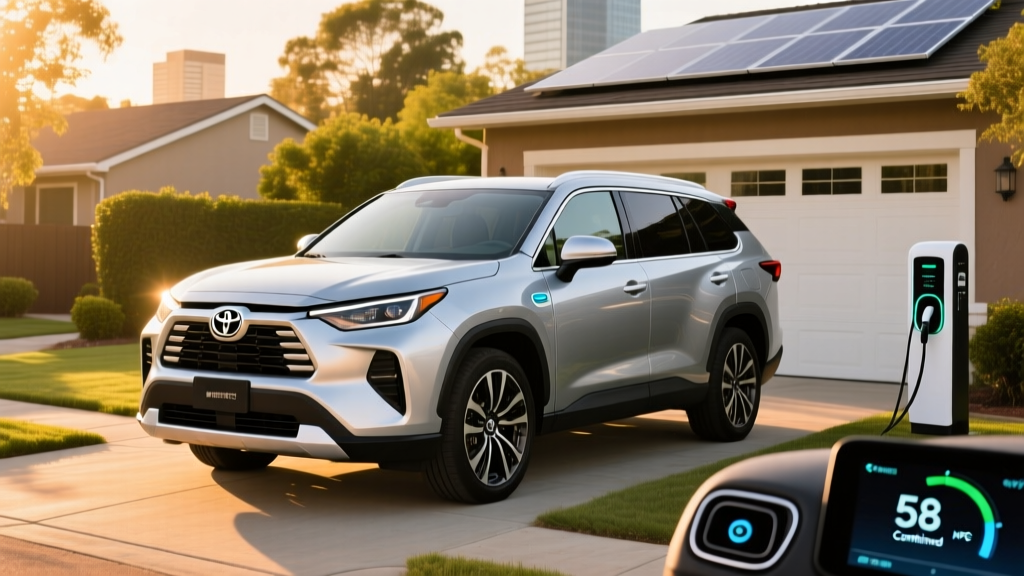
If you need three rows of seating but refuse to accept the fuel bills that usually come with them, the 2026 Toyota Grand Highlander Hybrid remains one of the most practical vehicles on the market. It's a conventional hybrid (HEV) — meaning no plug, no charging cord, no range anxiety — yet it returns EPA-rated efficiency that embarrasses many compact sedans. With up to 36 MPG combined and a starting MSRP around $45,000, it occupies a sweet spot between a gas-only SUV and a full battery-electric vehicle (BEV) for families who can't yet commit to plugging in.
This guide covers every Grand Highlander Hybrid powertrain option, real-world fuel economy expectations, battery longevity, pricing, and how it stacks up against plug-in hybrids and full EVs for family duty.
HEV vs. PHEV: What the Grand Highlander Hybrid Actually Is
Before we get into the numbers, a critical clarification: the Toyota Grand Highlander Hybrid is a conventional hybrid (HEV), not a plug-in hybrid (PHEV). This distinction matters because it shapes everything from your fueling routine to your tax-credit eligibility.
| Feature | HEV (Grand Highlander Hybrid) | PHEV (e.g., RAV4 Prime) | BEV (e.g., Tesla Model X) |
|---|---|---|---|
| Plug-in charging required? | No — regenerative braking + engine charges the battery | Yes — 120V or 240V outlet | Yes — 240V home or DC fast charger |
| Electric-only range | ~1 mile at low speed (not meaningful) | 30–42 miles typical | 250–350+ miles EPA |
| Total range | ~550–620 miles per tank | ~450–550 miles (electric + gas) | 250–350 miles per charge |
| Federal tax credit (§30D) | Not eligible | Up to $7,500 (if sourcing/income rules met) | Up to $7,500 (if sourcing/income rules met) |
| Home electrical upgrade needed? | No | Possibly (Level 2 recommended) | Yes (Level 2 strongly recommended) |
The Grand Highlander's hybrid system uses a small traction battery (approximately 1.6 kWh for the standard hybrid, ~1.4 kWh for Hybrid MAX) that charges itself through regenerative braking and the gasoline engine. You simply fill up at a gas station and drive. There is no plug, no cord, and no change to your fueling habits.
Fuel Economy: EPA Ratings and Real-World MPG
The 2026 Grand Highlander Hybrid comes in two distinct powertrain flavors, and their efficiency profiles are very different. Here's the full breakdown based on EPA data at fueleconomy.gov:
| Powertrain | City MPG | Highway MPG | Combined MPG | Drivetrain |
|---|---|---|---|---|
| 2.5L 4-cyl Hybrid (LE/XLE) | 36 | 32 | 34 | AWD (eAWD) |
| 2.5L 4-cyl Hybrid (FWD trims) | 37 | 34 | 36 | FWD |
| Hybrid MAX 2.4L Turbo (Limited/Platinum) | 27 | 28 | 27 | AWD |
Real-world MPG reality check: Toyota's 2.5L hybrid system is one of the most proven in the industry, and real-world results tend to track closely with EPA estimates — sometimes even exceeding them in city driving, where regenerative braking and electric-only low-speed operation shine. On mixed suburban routes, owners commonly report 34–38 MPG in the standard hybrid. However, sustained highway driving at 75+ MPH with a full load of passengers and cargo can drop the standard hybrid to 29–31 MPG. The Hybrid MAX, tuned for performance (362 hp), delivers a more consistent 25–28 MPG regardless of conditions, but it's clearly the efficiency trade-off for the power bump.
Powertrain Specs: Standard Hybrid vs. Hybrid MAX
Toyota offers two hybrid powertrains in the Grand Highlander, and choosing between them comes down to whether you prioritize fuel economy or acceleration.
| Specification | 2.5L Hybrid | Hybrid MAX 2.4T |
|---|---|---|
| Engine | 2.5L inline-4 + 2 electric motors (3 with eAWD) | 2.4L turbo inline-4 + electric motor |
| Combined horsepower | 245 hp | 362 hp |
| Combined torque | 173 lb-ft (engine) + electric torque | 400 lb-ft combined |
| 0–60 mph (est.) | ~7.8 seconds | ~5.8 seconds |
| Transmission | eCVT (planetary gearset) | 6-speed automatic |
| Drivetrain | FWD or eAWD | AWD (standard) |
| Towing capacity | 3,500 lbs | 5,000 lbs |
| EPA combined MPG | 34–36 | 27 |
The standard 2.5L hybrid uses Toyota's familiar eCVT — a planetary gearset that blends engine and electric motor power seamlessly. There are no gears to shift, and the result is smooth, if occasionally buzzy, acceleration under hard throttle. The rear axle on eAWD trims is driven by a separate electric motor (no mechanical driveshaft), providing traction without the weight and friction losses of a traditional AWD system.
The Hybrid MAX swaps the eCVT for a conventional 6-speed automatic and pairs a turbocharged 2.4L engine with a more powerful electric motor integrated between the engine and transmission. The result is genuine V6-rivaling thrust — 362 hp and 400 lb-ft of torque — making highway merging and mountain passes effortless. The trade-off is a 7–9 MPG penalty at the pump.
Pricing, Trims, and Tax Credit Eligibility
Here's where the Grand Highlander Hybrid's positioning becomes clear. It's priced above mainstream competitors but undercuts luxury three-row SUVs by a wide margin.
| Trim (2026 est.) | Powertrain | MSRP (approx.) |
|---|---|---|
| LE | 2.5L Hybrid | $45,120 |
| XLE | 2.5L Hybrid | $48,500 |
| Limited | 2.5L Hybrid or Hybrid MAX | $52,700 / $56,200 |
| Platinum | Hybrid MAX | $59,500 |
Federal tax credit: The Grand Highlander Hybrid does not qualify for the IRS §30D clean vehicle credit. Under current law, conventional hybrids (HEVs) are excluded — only plug-in hybrids (PHEVs) and battery-electric vehicles (BEVs) with sufficient battery capacity and qualifying battery sourcing are eligible. If the $7,500 federal credit is a deciding factor in your purchase, you would need to look at a PHEV like the Toyota RAV4 Prime (limited availability) or a BEV like the Kia EV9 or Tesla Model Y.
Some states offer separate incentives for hybrids, though these are increasingly rare as programs shift toward plug-in vehicles. Check your state's energy office or DMV for current rebate availability.
Battery Warranty, Reliability, and Replacement Cost
This is the question every hybrid buyer asks: what happens when the battery dies?
Reliability track record: Toyota's hybrid synergy drive system is now in its fourth generation and has accumulated billions of real-world miles across the Prius, Camry Hybrid, RAV4 Hybrid, and Highlander Hybrid lineups. The hybrid battery in the Grand Highlander uses a nickel-metal hydride (NiMH) pack in the standard 2.5L hybrid and a lithium-ion pack in the Hybrid MAX. NiMH packs from Toyota have demonstrated exceptional longevity — it's common for Prius and Highlander Hybrid batteries to exceed 150,000–200,000 miles before any meaningful capacity loss.
Replacement cost: If the hybrid battery does need replacement outside of warranty, expect to pay between $3,000 and $5,000 for a new OEM pack installed at a Toyota dealer. Refurbished or aftermarket packs can reduce this to $1,500–$2,500. Importantly, hybrid battery failure is statistically rare within the first decade of ownership, and Toyota's 10-year/150,000-mile warranty provides substantial coverage.
The hybrid system's other components — the inverter, electric motors, and eCVT — are similarly robust. The eCVT has no clutch packs, belts, or bands to wear out; it's essentially a set of planetary gears that Toyota rates for the life of the vehicle.
Grand Highlander Hybrid vs. PHEV vs. Full EV: Which Fits Your Family?
Choosing between a conventional hybrid, a plug-in hybrid, and a full electric vehicle depends on your driving patterns, home charging access, and budget. Here's a decision framework:
Choose the Grand Highlander Hybrid (HEV) if:
- You have no access to home or workplace charging (apartment, street parking, no garage outlet)
- You regularly take long road trips (400+ miles) and don't want to plan around charging stops
- You want three rows of seating with maximum cargo room
- You want the lowest-maintenance electrified option — no plug, no charging app, no electrical panel upgrade
Choose a PHEV (e.g., Chrysler Pacifica PHEV, Toyota Sienna — if available) if:
- You can charge at home (even a standard 120V outlet works for overnight top-ups)
- Your daily commute is under 30–40 miles round trip (you could run mostly on electricity)
- You want to reduce gas consumption significantly but still need gas-engine range for road trips
- You want to pursue the §30D federal tax credit (subject to income, MSRP, and sourcing rules)
Choose a full EV (e.g., Kia EV9, Tesla Model X) if:
- You have reliable Level 2 home charging (240V)
- Your daily driving is predictable and under 250 miles
- You want zero tailpipe emissions and the lowest per-mile "fuel" cost
- You can accept higher upfront cost and plan road trips around DC fast-charging infrastructure
The honest truth: for most three-row SUV buyers in 2026 who lack home charging, the Grand Highlander Hybrid is the lowest-friction path to meaningful fuel savings. You'll spend roughly $1,600–$1,800 per year on gas (at $3.40/gallon, 15,000 miles/year, 34 MPG combined) versus $2,400–$2,700 for a comparable gas-only three-row SUV getting 22–24 MPG combined. That's $600–$900 in annual savings with zero lifestyle changes.
Pros and Cons at a Glance
- Up to 36 MPG combined in a three-row, 8-passenger SUV
- 620-mile total range eliminates refueling stops on most road trips
- No plug required — zero charging infrastructure dependency
- 10-year/150,000-mile hybrid battery warranty
- Strong resale value (Toyota hybrid demand remains high)
- Hybrid MAX offers 362 hp and 5,000-lb towing for those who need it
- Not eligible for the $7,500 federal §30D tax credit
- Hybrid MAX drops to 27 MPG — only modestly better than some gas V6 SUVs
- Starting MSRP above $45,000 — premium over gas-only Grand Highlander
- Standard hybrid's eCVT can drone under hard acceleration
- No electric-only driving for school-dropoff or neighborhood errands
- Wait times at some dealers remain long due to high demand
Frequently Asked Questions
How many MPG does the Grand Highlander Hybrid get?
The standard 2.5L hybrid with FWD earns an EPA-estimated 37 city / 34 highway / 36 combined MPG. With eAWD, it drops slightly to 36/32/34. The performance-oriented Hybrid MAX is rated at 27 MPG combined. In real-world suburban driving, the standard hybrid commonly matches or exceeds its EPA city rating thanks to frequent regenerative braking opportunities.
Does the Grand Highlander Hybrid need to be plugged in?
No. The Grand Highlander Hybrid is a conventional (self-charging) hybrid. Its small battery recharges through regenerative braking and the gasoline engine. You fuel it exclusively at a gas station — no plug, no charger, no electrical work needed.
Is there a plug-in hybrid (PHEV) version of the Grand Highlander?
As of the 2026 model year, Toyota does not offer a Grand Highlander PHEV. If you want a Toyota plug-in hybrid with three rows, your options are limited — the Sienna minivan is a hybrid (HEV) only. For a true three-row PHEV, look at the Chrysler Pacifica Hybrid (32 miles electric-only, ~82 MPGe) or the Mitsubishi Outlander PHEV (smaller third row).
How long will the Grand Highlander Hybrid battery last?
Toyota covers the hybrid battery for 10 years or 150,000 miles. Based on long-term data from the Highlander Hybrid and Prius lineups, Toyota's hybrid batteries commonly last 150,000–200,000+ miles before significant degradation. Replacement cost, if needed outside warranty, runs $3,000–$5,000 for an OEM pack.
Does the Grand Highlander Hybrid qualify for any tax credit?
It does not qualify for the federal §30D clean vehicle credit, which is limited to plug-in hybrids and battery-electric vehicles. Some states may offer minor hybrid incentives, but these vary by jurisdiction and are increasingly uncommon. Consult the IRS clean vehicle credit page and your state energy office for current programs.
Grand Highlander Hybrid vs. regular Highlander Hybrid — which should I buy?
The Grand Highlander is roughly 6.5 inches longer than the standard Highlander, translating to a genuinely usable third row (adults can fit) and significantly more cargo space behind the third row. If you regularly carry passengers in the third row or need cargo room with all seats up, the Grand Highlander is the clear choice. If you only use the third row occasionally for small children, the standard Highlander Hybrid (35 MPG combined, lower MSRP) may suffice.
How does the Grand Highlander Hybrid compare to the Kia Sorento Hybrid?
The Kia Sorento Hybrid (37 MPG combined, ~$39,000 MSRP) is smaller, less expensive, and slightly more efficient, but its third row is tight even for children. The Grand Highlander offers meaningfully more interior volume and cargo capacity. If you need a genuine adult-capable third row, the Grand Highlander wins; if budget and compact dimensions matter more, the Sorento Hybrid is a strong alternative.
Sources: EPA fuel economy data via fueleconomy.gov, Toyota Motor Corporation specifications, IRS §30D clean vehicle credit guidelines. Pricing and specifications reflect 2026 model year estimates and are subject to change. Always verify current figures with your local Toyota dealer and the IRS before purchasing.