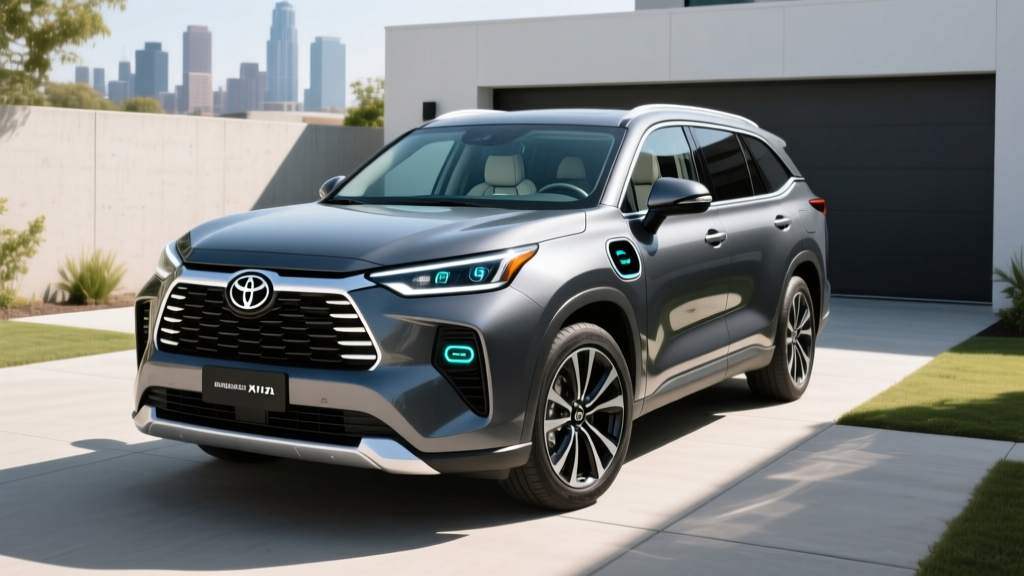
If three-row space and fuel efficiency are your top priorities, the 2026 Toyota Grand Highlander Hybrid demands a hard look. Toyota stretched the standard Highlander platform to unlock genuine adult-sized third-row legroom and meaningful cargo volume, then paired it with a proven hybrid powertrain that sips fuel at a rate that shames many compact sedans. But not all Grand Highlander Hybrid trims are created equal — the standard HEV and the punchier Hybrid MAX deliver vastly different efficiency and performance profiles.
We've analyzed EPA data, real-world owner reports, and Toyota's latest spec sheets to give you every number you need before visiting a dealer. No marketing fluff — just the MPG, horsepower, pricing, and ownership realities that matter.
HEV vs Hybrid MAX: Two Very Different Powertrains
Toyota offers the 2026 Grand Highlander Hybrid in two distinct configurations. Understanding the difference is essential before you pick a trim.
Standard Hybrid (HEV)
The volume seller. A 2.5-liter four-cylinder engine paired with Toyota's fourth-generation hybrid system and front and rear electric motors. Standard all-wheel drive (AWD) is available, and front-wheel drive (FWD) is the base configuration. This is a conventional self-charging hybrid — it requires no plug and no behavior change from a gas car. The battery recharges through regenerative braking and the gasoline engine.
Hybrid MAX
The performance-oriented variant. A 2.4-liter turbocharged four-cylinder teamed with a more powerful electric motor and a 6-speed automatic transmission (rather than the e-CVT in the standard HEV). AWD is standard. It sacrifices some fuel economy for significantly more horsepower and quicker acceleration. Also a conventional hybrid — no plug required.
Critical note: The Grand Highlander is not offered as a plug-in hybrid (PHEV). If you need electric-only driving range, you'll need to look at alternatives like the Chrysler Pacifica PHEV (32 miles electric-only) or step up to a full battery-electric vehicle like the Kia EV9.
Fuel Economy: EPA Ratings and Real-World MPG
The standard Grand Highlander Hybrid is the efficiency champion of the lineup. Here's the EPA-verified breakdown from fueleconomy.gov:
| Powertrain | Drivetrain | City MPG | Highway MPG | Combined MPG |
|---|---|---|---|---|
| 2.5L Hybrid (HEV) | FWD | 37 | 34 | 36 |
| 2.5L Hybrid (HEV) | AWD | 36 | 32 | 34 |
| 2.4T Hybrid MAX | AWD | 27 | 28 | 27 |
| Gas 2.4T (non-hybrid) | AWD | 21 | 27 | 24 |
Real-World MPG vs EPA Sticker
EPA Combined: 36 MPG (FWD Hybrid) / 34 MPG (AWD Hybrid) / 27 MPG (Hybrid MAX)
What to actually expect: Toyota's hybrid system excels in city and suburban driving, where frequent deceleration feeds energy back into the battery. Owners consistently report matching or slightly exceeding EPA city estimates — 37-39 MPG in mixed suburban commuting is common. Highway-only road trips at 75+ mph will drop the standard HEV to roughly 30-32 MPG. The Hybrid MAX, with its turbo engine and performance tuning, typically returns 25-27 MPG in mixed driving. In cold weather (below freezing), expect a 2-4 MPG dip across all trims as the engine runs more frequently to provide cabin heat.
For context, the gas-only Grand Highlander AWD returns 24 MPG combined. Choosing the standard hybrid saves roughly $600-$800 per year in fuel costs at 15,000 miles annually and $3.30/gallon regular unleaded, based on EPA fuel-cost estimates.
Powertrain Specs: Horsepower, Towing, and Acceleration
| Specification | 2.5L Hybrid (HEV) | Hybrid MAX |
|---|---|---|
| Engine | 2.5L 4-cyl + 2 electric motors | 2.4L turbo 4-cyl + electric motor |
| Combined Horsepower | 245 hp | 362 hp |
| Combined Torque | 173 lb-ft (engine) | 400 lb-ft |
| Transmission | e-CVT | 6-speed automatic |
| 0-60 mph (est.) | ~7.8 seconds | ~6.0 seconds |
| Max Towing Capacity | 3,500 lbs | 5,000 lbs |
| Drivetrain | FWD or AWD | AWD standard |
The standard HEV provides adequate acceleration for daily driving and highway merging, but it's not quick. The Hybrid MAX transforms the character of the vehicle — 362 hp in a three-row SUV means confident passing and a genuinely engaging drive. The towing gap matters too: if you're pulling a small boat or camper trailer, the Hybrid MAX's 5,000-lb rating gives you meaningful headroom the standard hybrid can't match.
Pricing by Trim and Tax Credit Eligibility
The 2026 Grand Highlander Hybrid starts in the low $45,000s and climbs past $58,000 for a loaded Hybrid MAX Platinum. Approximate MSRP by key trim:
- Hybrid LE (FWD): ~$45,120
- Hybrid XLE (AWD): ~$48,500
- Hybrid Limited (AWD): ~$52,800
- Hybrid MAX Limited (AWD): ~$54,900
- Hybrid MAX Platinum (AWD): ~$58,100
Federal Tax Credit Status
The Grand Highlander Hybrid does NOT qualify for the §30D federal EV tax credit. Under current IRS rules, only battery-electric vehicles (BEVs) and plug-in hybrids (PHEVs) with sufficient battery capacity and compliant critical-mineral/battery-sourcing chains are eligible for up to $7,500. Conventional hybrids like the Grand Highlander HEV and Hybrid MAX are excluded entirely. For the latest eligibility rules, consult IRS.gov §30D guidance.
Some states offer rebates for conventional hybrids — check your state energy office or department of environmental quality for local programs.
Reliability, Battery Warranty, and Long-Term Costs
Toyota's hybrid system is one of the most proven electrified powertrains on the road, with over two decades of real-world deployment since the original Prius. The Grand Highlander uses Toyota's latest hybrid architecture, which has fewer wear-prone components than a conventional automatic transmission (the e-CVT has no traditional belts, clutches, or torque converter).
Hybrid Battery Warranty
Coverage: 10 years / 150,000 miles (whichever comes first)
What's covered: The hybrid traction battery, battery control module, and associated hybrid-system components. Toyota warrants that the battery will retain sufficient capacity for normal operation throughout the warranty period.
Replacement cost (out of warranty): Based on current Toyota hybrid battery pricing, a replacement traction battery for the Grand Highlander is estimated at $3,000-$4,500 installed. However, Toyota hybrid batteries rarely require full replacement within the first 150,000 miles — individual cell or module repairs are often possible at lower cost.
Toyota's hybrid batteries are nickel-metal-hydride (NiMH) in the standard HEV, a chemistry known for exceptional longevity and thermal stability. The Hybrid MAX uses a lithium-ion pack for higher power density. Both chemistries benefit from Toyota's conservative state-of-charge management — the system never fully charges or fully depletes the battery, which dramatically extends cycle life.
For long-term reliability data, Consumer Reports and J.D. Power vehicle dependability studies consistently rank Toyota's hybrid systems among the most reliable in the industry.
Who Should Buy the Grand Highlander Hybrid?
Choose the Grand Highlander Hybrid If:
- You need genuine three-row seating for adults (the third row fits 6-foot passengers comfortably)
- You want 34-36 MPG without changing your fueling habits — no plug, no charging apps, no route planning
- Your daily commute is stop-and-go suburban or city driving, where hybrid efficiency peaks
- You plan to keep the vehicle 8-10 years and want a proven, low-risk powertrain
- You tow occasionally but don't need heavy-duty capacity (3,500-5,000 lbs)
Look Elsewhere If:
- You want electric-only driving for short commutes — consider a PHEV like the Toyota RAV4 Prime or a minivan PHEV
- You want the lowest possible fuel cost and have home charging access — a BEV like the Kia EV9 or Tesla Model X eliminates gasoline entirely
- You need maximum towing capacity (7,500+ lbs) — look at body-on-frame SUVs
- You prioritize sporty handling over efficiency — the Grand Highlander is tuned for comfort, not cornering
Grand Highlander Hybrid vs the Competition
The three-row hybrid SUV segment is competitive. Here's how the Grand Highlander stacks up against key rivals:
| Vehicle | Combined MPG | Third-Row Usability | Starting MSRP | Hybrid Type |
|---|---|---|---|---|
| Toyota Grand Highlander Hybrid (FWD) | 36 | Excellent | ~$45,120 | HEV |
| Toyota Highlander Hybrid (AWD) | 35 | Tight for adults | ~$42,320 | HEV |
| Kia Sorento Hybrid (FWD) | 37 | Small — kids only | ~$39,590 | HEV |
| Mazda CX-90 PHEV (AWD) | 25 (56 MPGe elec.) | Moderate | ~$51,500 | PHEV (26 mi elec.) |
| Honda Pilot (AWD, gas) | 22 | Good | ~$40,200 | Gas only |
The Grand Highlander Hybrid's advantage is the combination of best-in-class third-row space with mid-30s fuel economy. The Sorento Hybrid edges it on MPG but sacrifices third-row usability. The standard Highlander Hybrid is close on efficiency but can't match the Grand's interior volume.
Frequently Asked Questions
How many MPG does the 2026 Grand Highlander Hybrid get?
The FWD standard hybrid achieves 37 city / 34 highway / 36 combined MPG. The AWD version drops slightly to 36/32/34. The Hybrid MAX (AWD only) returns 27/28/27. In real-world suburban driving, many owners report matching or slightly exceeding the EPA city numbers thanks to Toyota's excellent regenerative braking system.
Does the Grand Highlander Hybrid need to be plugged in?
No. Both the standard Hybrid and Hybrid MAX are conventional self-charging hybrids. The battery recharges through regenerative braking and the gasoline engine. You fuel it exactly like a normal gas car — just with fewer fill-ups.
Is there a plug-in hybrid (PHEV) version of the Grand Highlander?
Not for 2026. Toyota has not announced a PHEV variant of the Grand Highlander. If electric-only commuting is a priority in a three-row package, the Mazda CX-90 PHEV (26 miles electric-only) or Chrysler Pacifica PHEV (32 miles) are the closest alternatives.
How long will the hybrid battery last?
Toyota warrants the hybrid battery for 10 years / 150,000 miles. Based on long-term data from millions of Toyota hybrids on the road, the traction battery typically lasts the life of the vehicle with normal use. Toyota's battery management system keeps the state of charge in a conservative window (roughly 40-80%), which prevents the deep-cycle stress that degrades batteries prematurely.
What does a hybrid battery replacement cost?
If replacement is needed outside the warranty period, expect $3,000-$4,500 for a new OEM battery, installed. However, independent hybrid specialists can often replace individual battery modules for $500-$1,500, restoring full function at a fraction of the cost. Full battery replacement in a Toyota hybrid is relatively rare before 200,000 miles.
Does the Grand Highlander Hybrid qualify for any tax credit?
It does not qualify for the federal §30D clean vehicle credit — that credit is limited to plug-in vehicles (BEVs and PHEVs). Some states offer separate incentives for hybrids, but these vary widely. Check with your state's department of revenue or energy office for current programs.
How does the Grand Highlander Hybrid perform in cold weather?
Hybrids lose some efficiency in cold weather — typically 2-4 MPG in sustained below-freezing temperatures. The gasoline engine runs more frequently to provide cabin heat, reducing the time the vehicle can operate in electric-only mode at low speeds. However, unlike battery-electric vehicles (which can lose 20-30% of range in extreme cold), the Grand Highlander Hybrid's efficiency loss is modest and its total range remains over 550 miles per tank.
What's the difference between the Hybrid LE and Hybrid MAX?
The standard Hybrid (245 hp, 36 MPG) prioritizes efficiency and value. The Hybrid MAX (362 hp, 27 MPG) prioritizes performance and towing. The MAX uses a turbocharged engine, a traditional 6-speed automatic, and standard AWD. If you regularly drive loaded or tow a trailer, the MAX's extra torque and 5,000-lb towing capacity justify the fuel-economy trade-off.