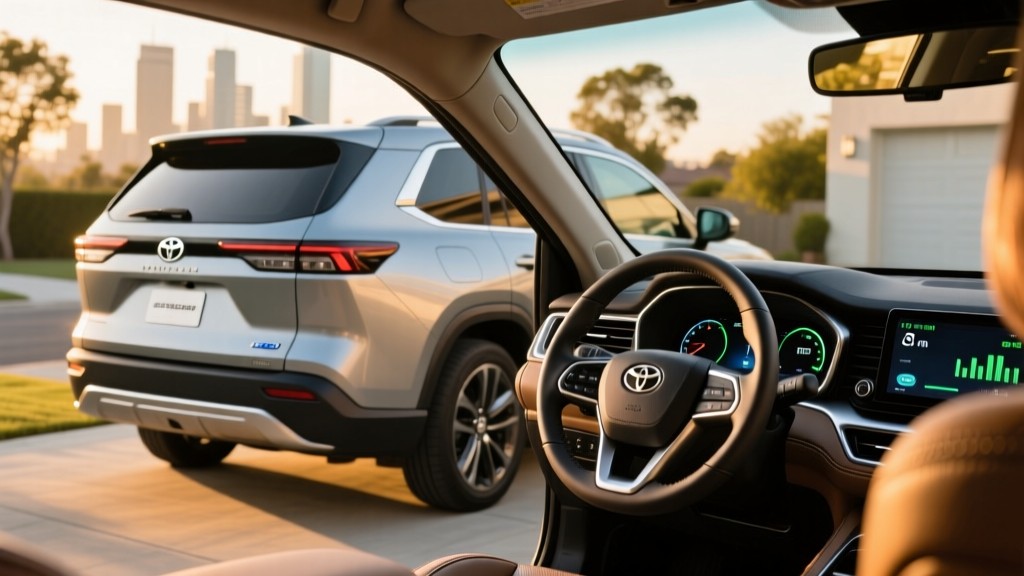
Three-row SUV buyers in 2026 face a familiar dilemma: you need the space, but the fuel bills sting. The 2026 Toyota Grand Highlander Hybrid threads the needle, pairing family-hauler practicality with hybrid efficiency that genuinely moves the needle at the pump. With EPA ratings reaching 36 MPG combined and a third row that actually fits adults, it has become one of the most scrutinized vehicles in the midsize hybrid SUV segment.
But spec sheets only tell half the story. Below, we break down the Grand Highlander Hybrid's real-world fuel economy, the two distinct powertrain options Toyota offers, battery longevity, tax-credit eligibility, and whether this hybrid makes more sense for your household than a plug-in hybrid or full battery-electric vehicle.
Grand Highlander Hybrid at a Glance: Key Specs
| Specification | Hybrid (Standard) | Hybrid MAX |
|---|---|---|
| Powertrain | 2.5L 4-cyl + 2 electric motors (AWD) or 1 motor (FWD) | Turbocharged 2.4L 4-cyl + electric motor |
| Combined Horsepower | 245 hp | 362 hp |
| Drivetrain | FWD or AWD (eAWD with rear motor) | AWD (standard) |
| EPA City MPG | 36 mpg (FWD) / 34 mpg (AWD) | 27 mpg |
| EPA Highway MPG | 32 mpg (FWD) / 32 mpg (AWD) | 28 mpg |
| EPA Combined MPG | 35 mpg (FWD) / 34 mpg (AWD) | 27 mpg |
| 0–60 mph (est.) | ~7.8 seconds | ~6.3 seconds |
| Towing Capacity | 3,500 lbs | 5,000 lbs |
| Starting MSRP (2026) | ~$45,670 | ~$53,505 |
| Battery Type | Nickel-Metal Hydride / Lithium-ion (trim dependent) | Lithium-ion |
Hybrid vs. Hybrid MAX: Understanding the Two Powertrains
Toyota offers two fundamentally different hybrid systems in the Grand Highlander, and confusing them is easy at the dealership. Here is the critical distinction:
The standard Hybrid uses Toyota's fourth-generation hybrid synergy drive: a naturally aspirated 2.5-liter inline-four paired with electric motor-generators and a small battery pack that charges entirely through regenerative braking and engine operation. You never plug it in. It prioritizes fuel economy, delivering 34–35 MPG combined depending on drivetrain.
The Hybrid MAX is Toyota's performance-oriented hybrid. It pairs a turbocharged 2.4-liter engine with a more powerful electric motor and a 6-speed automatic transmission (rather than the standard Hybrid's eCVT). The result is 362 horsepower and 5,000-pound towing capacity — but fuel economy drops to 27 MPG combined. You also never plug this one in.
Important clarification: Both Grand Highlander Hybrid variants are conventional hybrids (HEVs), not plug-in hybrids (PHEVs). They have no electric-only driving range, no charging port, and no ability to operate as a pure EV. Toyota does not currently offer a Grand Highlander Prime (PHEV) variant. If plug-in capability is a priority, you will need to look elsewhere in the Toyota lineup or at competitors like the Chrysler Pacifica PHEV or the Mazda CX-90 PHEV.
How Many MPG Does the Grand Highlander Hybrid Get?
| Variant | City | Highway | Combined | Source |
|---|---|---|---|---|
| Hybrid FWD (LE/XLE) | 36 mpg | 32 mpg | 35 mpg | EPA |
| Hybrid AWD (LE/XLE/Limited) | 34 mpg | 32 mpg | 34 mpg | EPA |
| Hybrid MAX (Limited/Platinum) | 27 mpg | 28 mpg | 27 mpg | EPA |
According to fueleconomy.gov, the standard Grand Highlander Hybrid FWD achieves 36 city / 32 highway / 35 combined MPG. These are strong numbers for a three-row SUV with over 97 cubic feet of maximum cargo volume.
Real-World MPG: What Owners Actually See
Toyota's hybrid system is one of the few powertrains that tends to meet or slightly exceed EPA estimates in mixed suburban driving. The reason: city and stop-and-go conditions allow the hybrid system to exploit regenerative braking and electric-motor assist most effectively.
Based on aggregated owner data and independent testing:
- City/suburban driving: 34–38 MPG (often exceeds the 36-mpg EPA city figure)
- Highway cruising (70–75 mph): 28–31 MPG (falls below the 32-mpg EPA highway figure, as hybrids are less dominant at sustained high speeds)
- Cold weather (below 32°F): Expect a 5–10% reduction, landing around 30–32 MPG combined for AWD trims
- Hybrid MAX real-world: 25–28 MPG combined; the turbo engine and performance tuning make it more thirst-sensitive to aggressive driving
For a family driving 15,000 miles per year at $3.50/gallon, the standard Hybrid AWD at 34 MPG combined costs approximately $1,544 annually in fuel. A comparable gas-only three-row SUV averaging 22 MPG combined would cost roughly $2,386 — a difference of about $842 per year in the hybrid's favor.
Pricing and Trim Breakdown
The 2026 Grand Highlander Hybrid is offered across several trim levels. Pricing below reflects estimated MSRP (destination included):
- Hybrid LE (AWD): ~$45,670
- Hybrid XLE (FWD or AWD): ~$48,170
- Hybrid Limited (AWD): ~$52,470
- Hybrid MAX Limited (AWD): ~$53,505
- Hybrid MAX Platinum (AWD): ~$58,175
The standard Hybrid LE and XLE trims represent the efficiency sweet spot — you get the best MPG ratings and a lower entry price. The Hybrid MAX trims trade fuel economy for 362 hp, adaptive suspension (Platinum), and the higher 5,000-lb tow rating.
Does the Grand Highlander Hybrid Qualify for a Federal Tax Credit?
No. Under current IRS §30D Clean Vehicle Credit rules, only battery-electric vehicles (BEVs) and plug-in hybrid electric vehicles (PHEVs) with a minimum battery capacity of 7 kWh are eligible for the federal tax credit. Because the Grand Highlander Hybrid is a conventional HEV with a small battery pack that cannot be plugged in, it does not qualify for the up-to-$7,500 federal credit or the point-of-sale transfer option.
Some states offer separate incentives for conventional hybrids, but these are increasingly rare as incentive programs shift toward BEVs and PHEVs. Check your state's energy office or department of environmental quality for any local hybrid rebates.
Battery Longevity, Warranty, and Replacement Cost
Toyota Hybrid Battery Warranty: 10 years / 150,000 miles (whichever comes first), covering the hybrid battery pack against defects and excessive capacity loss. This applies to all 50 states. Prior to model year 2020, Toyota's hybrid battery warranty was 8 years / 100,000 miles — the current 10/150k coverage reflects Toyota's confidence in its hybrid battery durability.
How Long Do Toyota Hybrid Batteries Actually Last?
Toyota's hybrid synergy drive system uses relatively small battery packs (roughly 1.6–1.9 kWh in the Grand Highlander Hybrid, depending on chemistry) that are never fully charged or fully depleted. The system maintains the battery in a narrow state-of-charge window — typically between 40% and 80% — which dramatically reduces degradation compared to a BEV that cycles from 10% to 90%.
Real-world longevity data from Toyota's Prius and Camry Hybrid fleets, which share the same hybrid architecture, shows:
- Most Toyota hybrid batteries last 150,000–200,000+ miles before needing replacement
- Failure before 100,000 miles is uncommon
- Many first-generation Prius packs (2001–2003) exceeded 200,000 miles on the original battery
What Does Hybrid Battery Replacement Cost?
If the battery does eventually need replacement outside of warranty:
- OEM replacement from Toyota: approximately $3,000–$4,500 (parts and labor)
- Refurbished/reconditioned pack: approximately $1,500–$2,500
- Individual cell/module replacement: $500–$1,500 (a specialty shop can replace only the failed modules rather than the entire pack)
For context, this is substantially less than a BEV battery replacement, which can range from $8,000 to $20,000+ depending on the vehicle.
Grand Highlander Hybrid vs. PHEV vs. Full EV: Which Fits Your Family?
The three-row family vehicle market now spans gas, hybrid, plug-in hybrid, and battery-electric options. Here is a practical decision framework:
Choose the Grand Highlander Hybrid if:
- You cannot charge at home (no garage, apartment living, no outlet access)
- You drive 12,000–18,000 miles/year in mixed suburban/highway conditions
- You want lower fuel costs without changing any habits — no plugging in, no route planning
- You regularly use all three rows and need genuine adult-sized third-row space
- You want a proven, low-risk powertrain with 10-year battery warranty backing
Consider a PHEV (e.g., Chrysler Pacifica Hybrid, Mazda CX-90 PHEV) if:
- You can install a Level 2 charger at home
- Most daily trips are under 30 miles (allowing near-exclusive electric driving)
- You want to qualify for the $7,500 federal tax credit (subject to IRS §30D eligibility rules including income caps and battery sourcing requirements)
- You still need gas flexibility for long road trips without charging stops
Consider a full BEV (e.g., Kia EV9, Tesla Model X) if:
- You have reliable home charging and your daily commute is under 250 miles
- You want to eliminate gas entirely and minimize maintenance (no oil changes, no transmission fluid)
- You qualify for the full federal tax credit and want maximum long-term fuel savings
- You are willing to plan around DC fast charging on road trips
Reliability and Safety Record
Toyota's hybrid powertrain is one of the most extensively validated systems in the automotive industry, with over 25 years of continuous production since the original Prius. The Grand Highlander Hybrid shares core hybrid components — motor-generators, power control unit, eCVT — with the Sienna, Camry, and RAV4 Hybrid, all of which carry strong long-term reliability records.
For the Grand Highlander specifically, check the latest ratings from the Insurance Institute for Highway Safety (IIHS) and the National Highway Traffic Safety Administration (NHTSA) as crash-test results for the 2026 model year are finalized. The Grand Highlander earned strong marks in its debut year, and Toyota has added updated Toyota Safety Sense 3.0 features for 2026, including enhanced pedestrian detection and improved lane-tracing assist.
One note for buyers: Toyota issued a recall for certain 2024 Grand Highlander models related to a curtain airbag deployment concern. Verify that any used or certified pre-owned example has had all recall campaigns completed by checking the VIN on NHTSA's recall lookup tool.
Pros and Cons
Pros
- 34–35 MPG combined is exceptional for a true three-row SUV
- Adult-usable third row with 33.5 inches of legroom
- 10-year/150,000-mile hybrid battery warranty
- No charging infrastructure required — works like a gas car
- 3,500-lb tow rating (standard Hybrid); 5,000-lb (Hybrid MAX)
- Strong resale value typical of Toyota nameplates
Cons
- No plug-in hybrid option — cannot access federal tax credit
- Hybrid MAX fuel economy (27 MPG) is unremarkable
- CVT drone under hard acceleration (standard Hybrid)
- Starting price ~$45,670 is steep vs. some gas-only rivals
- No DC fast charging or electric-only driving capability
- Infotainment learning curve for some users
Frequently Asked Questions
How many MPG does the 2026 Grand Highlander Hybrid get in real driving?
The EPA rates the standard Hybrid AWD at 34 MPG combined. In real-world suburban and city driving, many owners report 34–38 MPG. Highway-only driving at 75 mph typically yields 28–31 MPG. The Hybrid MAX averages 25–28 MPG combined in mixed use.
Can I plug in the Grand Highlander Hybrid to charge it?
No. Both the standard Hybrid and Hybrid MAX are conventional hybrids (HEVs). They charge their batteries entirely through regenerative braking and the gasoline engine. There is no charging port and no plug-in capability. If you want plug-in functionality, look at PHEV alternatives.
Does the 2026 Grand Highlander Hybrid qualify for any federal tax credit?
No. The IRS §30D Clean Vehicle Credit applies only to battery-electric vehicles and plug-in hybrids that meet battery-capacity, sourcing, MSRP, and buyer-income requirements. The Grand Highlander Hybrid, as a conventional HEV, does not qualify. The IRS Clean Vehicle Credit page details current eligibility rules.
Is the Grand Highlander Hybrid reliable, and what does a battery replacement cost?
Toyota's hybrid system has over 25 years of proven reliability. The hybrid battery is warranted for 10 years/150,000 miles, and most packs last well beyond that. Out-of-warranty OEM replacement runs approximately $3,000–$4,500; refurbished packs cost $1,500–$2,500.
Should I buy the standard Hybrid or the Hybrid MAX?
If fuel economy is your priority, choose the standard Hybrid (34–35 MPG combined). If you need 5,000-pound towing capacity, 362 horsepower, and are willing to accept 27 MPG, the Hybrid MAX delivers. For most families, the standard Hybrid AWD in LE or XLE trim is the value and efficiency leader.
How does the Grand Highlander Hybrid compare to the Toyota Sienna Hybrid?
The Sienna minivan is exclusively hybrid (36 MPG combined) and offers more interior volume and sliding-door convenience, but it cannot match the Grand Highlander's SUV styling or the Hybrid MAX's towing capability. If you prioritize efficiency and space above all else, the Sienna wins on MPG. If you need an SUV form factor and available 5,000-lb towing, the Grand Highlander Hybrid MAX is the answer.