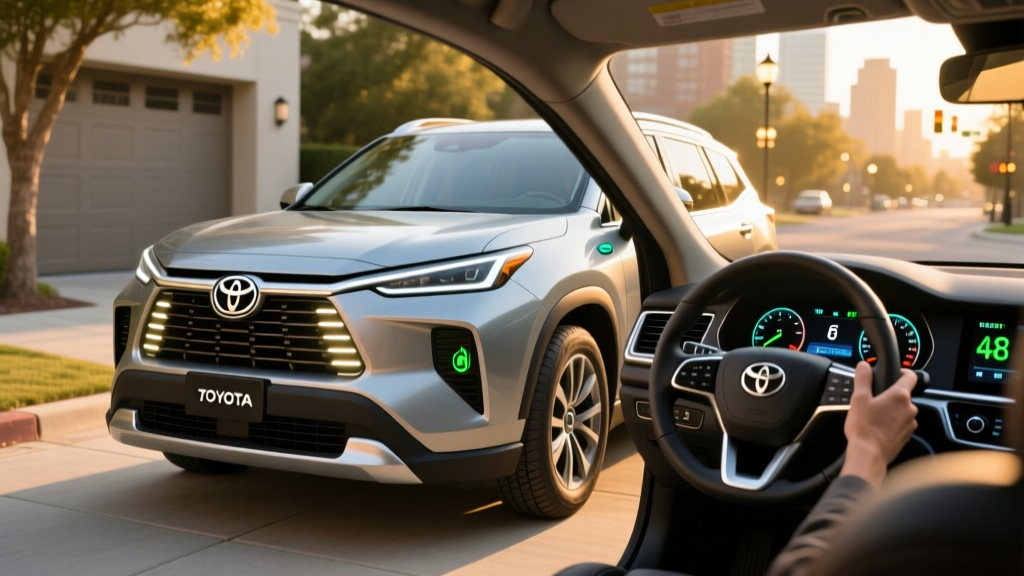
Three-row SUVs with genuine cargo space and hybrid efficiency are rare. The 2025 Toyota Grand Highlander Hybrid fills that gap with EPA ratings up to 36 MPG combined, seating for seven or eight, and the reliability reputation Toyota has built over two decades of hybrid production. But with two distinct hybrid powertrains — the standard Hybrid and the performance-oriented Hybrid MAX — choosing the right trim matters more than most buyers realize.
This guide breaks down the exact fuel economy, powertrain specs, pricing, and real-world ownership considerations for every 2025 Grand Highlander Hybrid configuration.
HEV vs. PHEV: What the Grand Highlander Hybrid Actually Is
Conventional Hybrid (HEV): The 2025 Grand Highlander Hybrid is a self-charging hybrid. It uses a gasoline engine paired with electric motors and a small battery pack that recharges through regenerative braking and engine operation. You never plug it in. You simply fuel it with gasoline and drive.
Plug-in Hybrid (PHEV): Toyota does not offer a Grand Highlander Hybrid Prime (PHEV) for the 2025 model year. If you need electric-only driving with plug-in capability, you'd look at the RAV4 Prime or Prius Prime instead — both smaller vehicles without three-row seating.
Full EV (BEV): The bZ4X is Toyota's current battery-electric SUV, but it seats five and offers significantly less cargo volume. For buyers needing three rows and zero gasoline, competitors like the Kia EV9 exist, though at a higher price point and with charging infrastructure considerations.
The Grand Highlander Hybrid sits firmly in the HEV camp: maximum simplicity, no charging infrastructure needed, and fuel economy gains of roughly 50% over the non-hybrid turbocharged Grand Highlander.
Fuel Economy: EPA Ratings and Real-World MPG
| Powertrain | City MPG | Highway MPG | Combined MPG | Drivetrain |
|---|---|---|---|---|
| Hybrid (2.5L 4-cyl) | 37 | 34 | 36 | AWD (standard) |
| Hybrid MAX (2.4L turbo) | 27 | 28 | 27 | AWD (standard) |
| Gas 2.4L Turbo (non-hybrid baseline) | 21 | 27 | 24 | AWD |
Source: EPA Fuel Economy
Real-World MPG Reality Check: Toyota hybrids historically perform at or slightly above EPA city estimates in stop-and-go driving because regenerative braking recovers energy that gas cars waste as heat. On the highway, expect the standard Hybrid to deliver 31–34 MPG at sustained 70–75 mph speeds. Cold weather (below freezing) typically drops hybrid fuel economy by 5–10% as the engine runs more frequently to provide cabin heat. In our experience, a mixed-driving annual average of 33–36 MPG is realistic for the standard Hybrid powertrain if you're not exclusively highway-commuting.
The Hybrid MAX trades efficiency for performance. Its 27 MPG combined is still an improvement over the non-hybrid turbo's 24 MPG, but buyers choosing Hybrid MAX are prioritizing acceleration and towing, not maximizing fuel savings.
Powertrain Specs: Standard Hybrid vs. Hybrid MAX
| Specification | Standard Hybrid | Hybrid MAX |
|---|---|---|
| Engine | 2.5L 4-cylinder | 2.4L turbocharged 4-cylinder |
| Combined Horsepower | 245 hp | 362 hp |
| Combined Torque | 173 lb-ft (engine) + electric motor torque | 400 lb-ft |
| Transmission | eCVT (electronically controlled) | 6-speed automatic |
| 0–60 mph (estimated) | ~7.8 seconds | ~6.3 seconds |
| Max Towing Capacity | 3,500 lbs | 5,000 lbs |
| Drivetrain | Electronic AWD | AWD with torque vectoring |
The standard Hybrid uses Toyota's proven planetary-gear eCVT system — the same architecture refined across the Camry, RAV4, and Highlander hybrids for years. It's smooth, quiet, and optimized for efficiency. The electric motors provide instant low-end torque for city acceleration, while the engine handles sustained highway cruising.
The Hybrid MAX pairs a turbocharged engine with a more powerful electric motor and a conventional 6-speed automatic. The result is a dramatically different driving character: confident highway passing, responsive throttle, and the 5,000-pound tow rating that makes it viable for boat or camper trailers. The trade-off is 9 MPG less combined efficiency and a higher purchase price.
Pricing by Trim and Tax Credit Eligibility
The 2025 Grand Highlander Hybrid lineup spans six trims. All prices below include Toyota's destination charge.
- Hybrid LE: $45,120
- Hybrid XLE: $47,560
- Hybrid Limited: $51,310
- Hybrid MAX Limited: $55,160
- Hybrid MAX Platinum: $59,460
Does the Grand Highlander Hybrid Qualify for Federal Tax Credits?
No. Under current IRS §30D rules, the federal clean vehicle credit of up to $7,500 applies only to plug-in electric vehicles (BEVs and PHEVs) that meet battery-sourcing, MSRP, and buyer-income requirements. Because the Grand Highlander Hybrid is a conventional HEV with no plug-in capability, it does not qualify for the federal EV tax credit.
Some states offer separate incentives for hybrid vehicles, though these are uncommon and typically much smaller than EV credits. Check your state's energy or environmental agency for current programs. Toyota's hybrid pricing already reflects the efficiency benefit — there is no purchase incentive needed to make the math work for most buyers.
Total Fuel Cost Savings vs. Gas Model
At 15,000 miles per year and $3.40/gallon regular unleaded:
- Gas Grand Highlander (24 MPG combined): ~$2,125/year in fuel
- Hybrid (36 MPG combined): ~$1,417/year in fuel
- Annual savings: ~$708
- 5-year savings: ~$3,540
The Hybrid LE carries roughly a $2,000–$3,000 premium over the equivalent gas LE trim, meaning the fuel savings pay back the price difference within 3–4 years for average drivers. Higher-mileage drivers recoup faster.
Battery Warranty, Lifespan, and Replacement Cost
Toyota Hybrid Battery Warranty: 10 years or 150,000 miles, whichever comes first. This applies to all 2025 Toyota hybrid models and covers defects and capacity loss that impairs vehicle operation.
Real-World Lifespan: Toyota's hybrid battery packs have an exceptional longevity track record. The nickel-metal hydride (NiMH) and lithium-ion packs used across Toyota's hybrid fleet routinely last 150,000–200,000+ miles without replacement. Failures before 100,000 miles are rare. Third-party fleet data from taxi and rideshare operations — where Toyota hybrids accumulate extreme mileage — consistently shows battery packs surviving well beyond the warranty period.
Replacement Cost: If a hybrid battery does require replacement outside warranty, expect $3,000–$5,000 for a new OEM pack, or $1,500–$2,500 for a refurbished unit from a reputable supplier. Independent hybrid specialists in most metro areas can perform the swap. However, given Toyota's track record, most original owners will never face this cost.
The hybrid system's other high-voltage components — the inverter, electric motors, and eCVT — are similarly durable. The eCVT has no belts, clutches, or friction bands to wear out; it uses a planetary gearset that is essentially maintenance-free. Toyota's hybrid powertrain warranty covers these components for 8 years/100,000 miles, and the hybrid battery for 10 years/150,000 miles.
Reliability and Safety Ratings
Toyota's hybrid systems are among the most proven electrified powertrains in production. The Grand Highlander Hybrid uses a mature architecture shared with the Highlander Hybrid and Sienna, both of which have accumulated years of reliability data.
For the 2025 model year, the Grand Highlander carries strong safety credentials:
- NHTSA overall rating: Check NHTSA.gov for the latest 5-star safety test results
- IIHS: Toyota Safety Sense 3.0 is standard on all trims, including automatic emergency braking, lane departure alert with steering assist, full-speed adaptive cruise control, and lane tracing assist
- Standard blind-spot monitoring with rear cross-traffic alert on all trims
One note for hybrid buyers: Toyota's hybrid system adds minimal mechanical complexity compared to a conventional gas powertrain. There are no additional fluids to change, no turbocharger plumbing to maintain (on the standard Hybrid), and regenerative braking significantly extends brake pad life — many Toyota hybrid owners report original brake pads lasting 80,000–100,000 miles.
Who Should Choose the Grand Highlander Hybrid?
Pros
- 36 MPG combined in a genuine 3-row SUV with adult-sized third-row seating
- No plug-in charging required — works with existing gas-station infrastructure
- 10-year/150,000-mile hybrid battery warranty
- Standard AWD across all Hybrid trims
- 3,500-lb tow rating (standard Hybrid); 5,000-lb with Hybrid MAX
- Toyota Safety Sense 3.0 standard on every trim
- Strong projected resale value based on Toyota hybrid demand
Cons
- No electric-only driving — the engine runs whenever the vehicle is moving under load
- Hybrid MAX efficiency (27 MPG) is only marginally better than the gas turbo
- No federal tax credit eligibility for HEVs
- Third-row cargo space behind the third row is modest (roughly 18 cu ft)
- Hybrid LE starts above $45,000 — higher entry point than some competitors
- eCVT drone under hard acceleration (standard Hybrid)
Choose the Standard Hybrid If:
You prioritize fuel economy, drive primarily in city and suburban conditions, and want the lowest possible cost of ownership. The 36 MPG combined rating and 3,500-lb tow rating cover most family SUV needs. The LE and XLE trims offer the best value proposition.
Choose the Hybrid MAX If:
You regularly tow above 3,500 pounds, want responsive highway acceleration, and are willing to accept 27 MPG for 362 horsepower. The Hybrid MAX Limited and Platinum trims compete with luxury three-row SUVs on performance while still returning better fuel economy than most V6 competitors.
Look at a Full EV (BEV) If:
You have reliable home charging (Level 2), drive fewer than 300 miles between charging opportunities, and want zero tailpipe emissions. The Kia EV9 or Tesla Model X offer three-row electric options, though at higher prices and with route-planning requirements for road trips.
Stick with Gas If:
Your annual mileage is very low (under 8,000 miles), you rarely drive in stop-and-go traffic where hybrids shine, or you need the absolute lowest purchase price and the gas Grand Highlander LE fits your budget.
Frequently Asked Questions
How many MPG does the 2025 Grand Highlander Hybrid get?
The standard Hybrid powertrain earns EPA ratings of 37 city / 34 highway / 36 combined MPG. The Hybrid MAX is rated at 27 city / 28 highway / 27 combined. Real-world results typically match or slightly exceed EPA city estimates in mixed driving.
Does the Grand Highlander Hybrid need to be plugged in?
No. The Grand Highlander Hybrid is a conventional hybrid (HEV), not a plug-in hybrid. The battery charges through regenerative braking and engine operation. You fuel it exclusively with gasoline.
Is there a Grand Highlander plug-in hybrid (PHEV)?
Not for the 2025 model year. Toyota does not offer a Grand Highlander Hybrid Prime with electric-only range. If you need a Toyota PHEV, the RAV4 Prime (42 miles electric-only) and Prius Prime (up to 44 miles) are available, but neither offers three-row seating.
How long will the hybrid battery last?
Toyota's hybrid batteries are covered for 10 years/150,000 miles. Based on long-term fleet data, most Toyota hybrid batteries last 150,000–200,000+ miles without replacement. Premature failures are uncommon.
What does a hybrid battery replacement cost?
Outside of warranty, expect $3,000–$5,000 for a new OEM replacement, or $1,500–$2,500 for a refurbished unit. Most original owners never need to replace the battery.
Does the Grand Highlander Hybrid qualify for any tax credit?
No federal tax credit applies to conventional hybrids under current IRS §30D rules, which cover only plug-in EVs and PHEVs. Some states may offer small hybrid incentives — check your state energy office for details.
Can the Grand Highlander Hybrid tow?
Yes. The standard Hybrid is rated for 3,500 pounds. The Hybrid MAX increases that to 5,000 pounds, making it suitable for small boat trailers, lightweight travel trailers, and utility trailers.
Is the eCVT transmission reliable?
Toyota's eCVT uses a planetary gearset with no belts, clutches, or friction components to wear. It is considered one of the most durable transmission designs in production and is covered under the 8-year/100,000-mile hybrid system warranty.