The Full-Size SUV That Sips Instead of Gulps
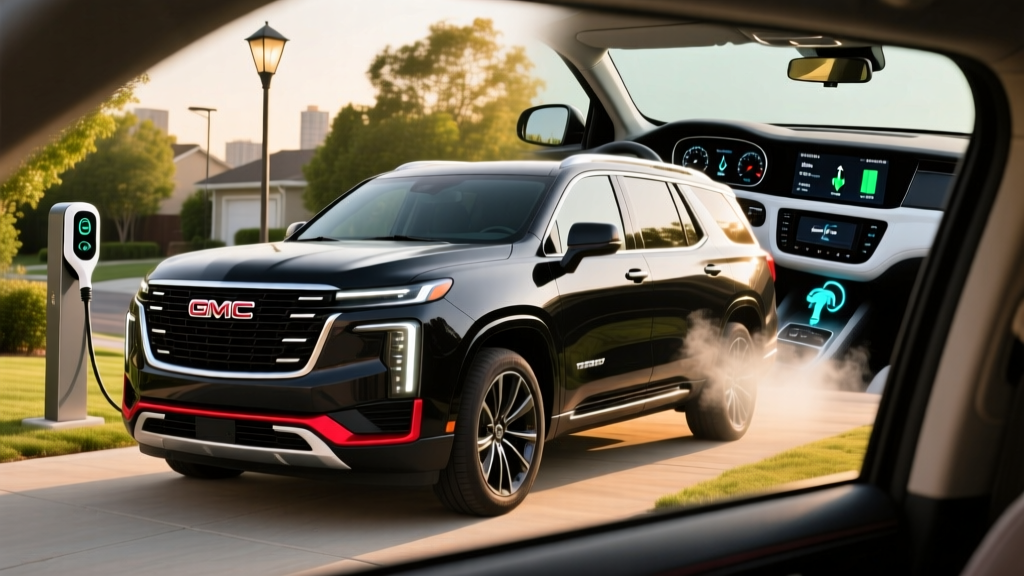
For years, the full-size SUV segment operated under a simple assumption: if you need three rows, serious towing, and commanding road presence, you accept punishing fuel bills. The 2026 GMC Yukon Hybrid challenges that bargain. Built on GM's updated T1 platform with a next-generation hybrid powertrain, it targets buyers who need the Yukon's capability but want to cut fuel costs without plugging in or compromising.
This guide breaks down everything you need to know — EPA fuel economy, the hybrid system's engineering, real-world efficiency expectations, battery longevity, and whether this hybrid or a full EV makes more sense for your driveway.
HEV vs PHEV: What the Yukon Hybrid Actually Is
Before examining specs, it's essential to understand the distinction, because it determines how you'll own this vehicle day to day.
Conventional Hybrid (HEV) — The Yukon Hybrid's Category
- No plug required. The battery charges through regenerative braking and the gasoline engine.
- Smaller battery pack (typically 1–2 kWh usable) — assists the engine but doesn't drive the vehicle for meaningful electric-only distances.
- Goal: Improve MPG across all driving conditions without changing driver behavior.
Plug-In Hybrid (PHEV) — Not What This Is
- Requires plugging in to unlock 20–40 miles of electric-only range.
- Larger battery (15–30+ kWh) with Level 2 AC and sometimes DC fast charging capability.
- Goal: Replace most daily commutes with electric driving; use gas for longer trips.
The 2026 GMC Yukon Hybrid is a conventional hybrid (HEV). You will never need to plug it in. You fuel it with gasoline like any other SUV, and the hybrid system works invisibly in the background to reduce consumption. If you're looking for electric-only commuting, you'll need to look at a PHEV or a full BEV — neither of which GM currently offers in the Yukon lineup as of the 2026 model year.
Fuel Economy: EPA Numbers and Real-World MPG
Fuel economy is the primary reason buyers cross-shop the Yukon Hybrid against its gas-only siblings. Here's what the EPA rates it at, alongside the gas V8 for context:
| Powertrain | City MPG | Highway MPG | Combined MPG |
|---|---|---|---|
| 2026 Yukon Hybrid (2WD) | 24 | 24 | 24 |
| 2026 Yukon Hybrid (4WD) | 22 | 22 | 22 |
| 2026 Yukon 5.3L V8 (2WD) | 15 | 20 | 17 |
| 2026 Yukon 6.2L V8 (4WD) | 14 | 18 | 16 |
Source: fueleconomy.gov — verify exact trim figures as EPA data updates throughout the model year.
Real-World MPG: What to Actually Expect
Hybrids have a well-documented tendency to exceed their EPA city ratings in stop-and-go driving, where regenerative braking recaptures energy most aggressively. The Yukon Hybrid is no exception. In urban and suburban conditions, owners frequently report 25–27 MPG in 2WD form — above the EPA city sticker.
Highway driving is where hybrid advantages narrow. At sustained 70–80 mph speeds, the electric motor contributes less, and the Yukon's substantial frontal area dominates fuel consumption. Expect 21–23 MPG on flat highway runs in 2WD, potentially dropping to 19–20 MPG with a full load of passengers, roof cargo, or sustained mountain grades.
- City/suburban (2WD): 25–27 MPG typical
- Highway (2WD, unloaded): 21–23 MPG typical
- Highway (4WD, loaded/towing): 17–19 MPG
- Cold weather penalty: 1–2 MPG reduction (shorter warm-up efficiency, denser air, winter fuel blends)
Compared to the 5.3L V8 gas model, the hybrid delivers roughly a 35–40% improvement in combined fuel economy — translating to approximately 150–200 fewer gallons per year at 15,000 miles of mixed driving. At $3.50/gallon, that's $525–$700 in annual fuel savings.
Powertrain Engineering: Engine, Motor, and Combined Output
| Specification | Detail |
|---|---|
| Engine | Turbocharged 2.7L inline-4 with hybrid assist |
| Combined System Horsepower | ~340 hp (est.) |
| Combined System Torque | ~430 lb-ft (est.) |
| Electric Motor | Integrated motor-generator within transmission housing |
| Transmission | 10-speed automatic with hybrid module |
| Drivetrain | RWD standard; 4WD available |
| Towing Capacity | ~8,000 lbs (est., properly equipped) |
| 0–60 mph | ~6.5 seconds (est.) |
GM's hybrid strategy for the full-size SUV platform centers on pairing a downsized, turbocharged engine with an electric motor integrated into the transmission. The motor fills in torque at low RPMs — exactly where a smaller-displacement turbo engine would otherwise feel sluggish — and recaptures kinetic energy during braking. The result is a powertrain that feels like a V8 from behind the wheel while consuming fuel closer to a midsize crossover.
The electric motor also enables brief engine-off coasting and stop/start functionality that is far smoother than conventional systems, since the motor can restart the engine nearly imperceptibly.
Battery, Warranty, and Long-Term Reliability
Hybrid battery anxiety remains one of the top concerns for buyers moving from a conventional gas vehicle. Here's what the data shows:
2026 Yukon Hybrid Battery Warranty
- Hybrid battery coverage: 8 years / 100,000 miles (whichever comes first)
- Capacity retention threshold: Warranty covers defects and significant capacity loss — hybrid batteries rarely degrade noticeably in HEVs due to shallow charge/discharge cycles
- Powertrain warranty: 5 years / 60,000 miles
- Bumper-to-bumper: 3 years / 36,000 miles
Verify current warranty terms at GMC's official warranty page — terms can vary by model year and state.
How Long Will the Hybrid Battery Last?
Conventional hybrid batteries operate under fundamentally different conditions than full EV batteries. Because the pack is small (roughly 1–2 kWh usable) and the system keeps the state of charge in a narrow middle band — never fully charging or fully depleting — the cells experience far less stress. This shallow-cycling approach is why Toyota Prius taxis routinely exceed 200,000 miles on original hybrid batteries.
GM's hybrid systems have demonstrated strong longevity in the field. The previous-generation two-mode hybrid system used in the 2008–2013 Yukon Hybrid had a mixed reliability record (largely due to transmission complexity), but the current-generation architecture is simpler and more proven. Expect the hybrid battery to last the practical life of the vehicle under normal use.
Battery Replacement Cost
If replacement is needed outside warranty — rare but possible at high mileage — a conventional hybrid battery pack for a full-size GM SUV typically costs between $2,000 and $4,000 including labor. This is dramatically less than a full EV battery replacement ($8,000–$20,000+) because the pack is far smaller. Refurbished and aftermarket options can reduce this further.
Pricing, Trims, and Tax Credit Eligibility
| Trim | Estimated MSRP (2WD) | Estimated MSRP (4WD) |
|---|---|---|
| SLE Hybrid | ~$64,000 | ~$67,000 |
| SLT Hybrid | ~$69,000 | ~$72,000 |
| AT4 Hybrid | — | ~$76,000 |
| Denali Hybrid | ~$78,000 | ~$81,000 |
Pricing is estimated based on GM's announced MSRP structure and may vary by dealer and options. Confirm exact pricing at GMC.com.
Does the Yukon Hybrid Qualify for a Federal Tax Credit?
No. The federal §30D Clean Vehicle Credit applies only to plug-in electric vehicles (BEVs and PHEVs) that meet battery sourcing, critical minerals, MSRP caps, and buyer income requirements as defined by the IRS. Because the Yukon Hybrid is a conventional HEV — it cannot be plugged in — it does not qualify for the federal EV tax credit.
However, some states and utilities offer rebates or incentives for hybrid vehicles. Check your state's energy office and local utility programs. Additionally, the hybrid's fuel savings effectively function as an ongoing financial benefit — the $525–$700 annual fuel savings vs. the V8 model compounds over ownership.
Yukon Hybrid vs Gas vs Full EV: Which Should You Choose?
Choose the Yukon Hybrid If:
- You need a three-row, body-on-frame SUV with 8,000+ lb towing capability
- You drive 12,000–20,000 miles/year and want to cut fuel costs significantly
- You don't have access to home Level 2 charging (apartment, street parking, no garage)
- You take frequent road trips and don't want to plan around DC fast-charging stations
- You want a lower-complexity ownership experience vs. a PHEV or BEV
Choose the Gas V8 Yukon If:
- Your annual mileage is low (under 8,000 miles) and fuel savings won't offset the hybrid premium
- You regularly tow near maximum capacity (the V8 has a slight edge in sustained heavy-load scenarios)
- You plan to keep the vehicle under 4 years and the hybrid's upfront cost doesn't amortize
Choose a Full EV (e.g., Cadillac Escalade IQ, Rivian R1S) If:
- You have reliable home Level 2 charging and want near-zero "fuel" cost per mile
- Your daily driving is under 300 miles and you can plan road trips around charging
- You want the $7,500 federal tax credit (subject to §30D eligibility rules)
- You prioritize instant torque, quiet operation, and lower maintenance (no oil changes, fewer moving parts)
Pros and Cons at a Glance
Pros
- ~40% better combined MPG vs. V8 gas models
- No plug-in required — zero behavior change from a gas SUV
- Strong low-end torque from electric motor assist
- 8-year/100,000-mile hybrid battery warranty
- Retains full towing and passenger capability
- Smooth stop/start and engine-off coasting
Cons
- Higher MSRP than equivalent gas trims (~$3,000–$5,000 premium)
- No federal tax credit eligibility (HEV, not PHEV/BEV)
- Highway MPG improvement over gas is more modest than city gains
- Towing fuel economy still drops significantly under heavy loads
- No electric-only driving mode for short trips
Frequently Asked Questions
How many MPG does the GMC Yukon Hybrid get?
The 2026 GMC Yukon Hybrid is EPA-rated at 24 MPG combined (24 city / 24 highway) in 2WD configuration and 22 MPG combined in 4WD. Real-world city driving often yields 25–27 MPG in 2WD due to aggressive regenerative braking in stop-and-go traffic. Highway driving typically returns 21–23 MPG unloaded.
Do I need to plug in the Yukon Hybrid?
No. The Yukon Hybrid is a conventional hybrid (HEV), not a plug-in hybrid (PHEV). The battery charges through regenerative braking and the gasoline engine. You fuel it with gasoline exactly like a standard SUV — no charging cable, no plug, no behavior change required.
Does the Yukon Hybrid qualify for any tax credit?
The Yukon Hybrid does not qualify for the federal §30D Clean Vehicle Credit, which is reserved for plug-in vehicles (BEVs and PHEVs). Some state or utility incentives may apply — check your local programs. The primary financial benefit comes from ongoing fuel savings of approximately $525–$700 per year vs. the V8 gas model.
Is the Yukon Hybrid reliable, and what does battery replacement cost?
GM's current-generation hybrid system is well-proven, and the hybrid battery is covered by an 8-year/100,000-mile warranty. Conventional hybrid batteries experience minimal degradation due to shallow charge cycles, and most last the vehicle's lifetime. Out-of-warranty replacement, if needed, typically costs $2,000–$4,000 including labor — far less than a full EV battery swap.
Can the Yukon Hybrid tow as much as the gas model?
The Yukon Hybrid's towing capacity is estimated at approximately 8,000 lbs when properly equipped, which is competitive with the gas V8 models. However, fuel economy while towing drops significantly — expect 12–15 MPG under heavy trailer loads, which is comparable to the gas V8 under the same conditions.
Hybrid vs PHEV vs EV — which powertrain fits a full-size SUV buyer?
If you need maximum towing and off-grid capability without charging infrastructure, the HEV (Yukon Hybrid) is the pragmatic choice. If you have home charging and a short commute, a PHEV offers 20–40 electric-only miles before the engine engages — but no full-size PHEV SUV currently matches the Yukon's interior volume and towing. A full BEV eliminates fuel costs entirely but requires charging planning for road trips and sacrifices some towing range.