Quick Verdict: A Mild-Hybrid Workhorse, Not a Plug-In
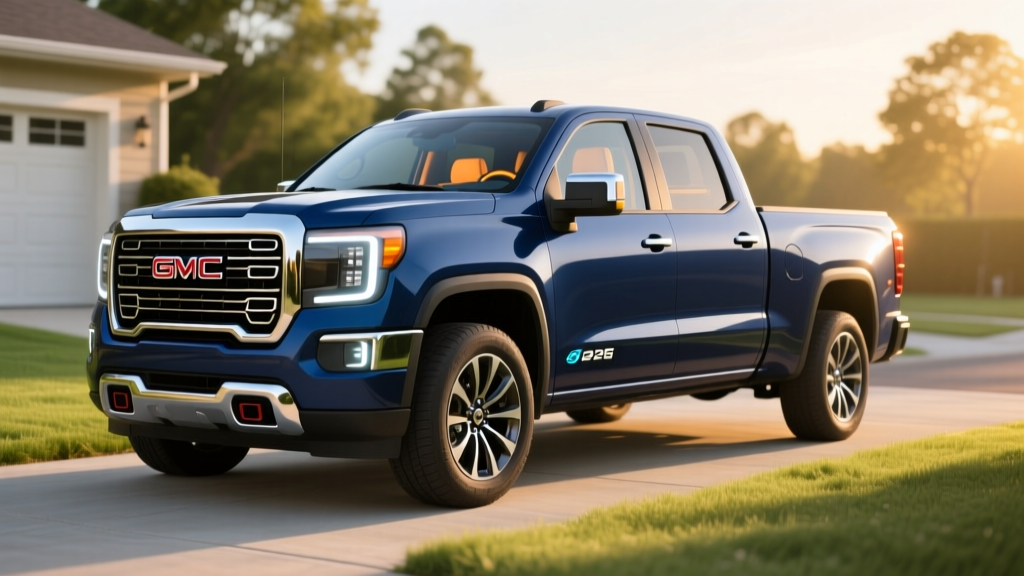
The 2026 GMC Sierra hybrid pickup truck uses General Motors' mild-hybrid system paired with the 3.0L Duramax LZ0 turbo-diesel inline-six. This is a conventional hybrid (HEV) — not a plug-in — meaning it recovers energy through regenerative braking and assists the engine under load, but you never plug it in. The result: modest fuel-economy gains over the standard diesel Sierra, improved stop-start smoothness, and a small torque fill at low RPMs.
If you're searching for a GMC Sierra PHEV with electric-only driving range, it doesn't exist in the 2026 model year. GM has not announced a plug-in hybrid Sierra. For full-electric pickup capability, the GMC Hummer EV Pickup remains the brand's battery-electric option, while the Sierra EV enters production for fleet and retail customers. This guide focuses on the mild-hybrid diesel Sierra that's available now.
HEV vs. PHEV — Where the Sierra Stands
Conventional Hybrid (HEV): Small battery (<2 kWh), charges via regen braking, no plug, modest MPG gains. This is the Sierra's system.
Plug-In Hybrid (PHEV): Larger battery (10–25+ kWh), plug-in charging, 20–50 miles electric-only range, qualifies for potential tax credits. Not available on any 2026 Sierra trim.
Full EV (BEV): Large traction battery (100+ kWh), zero tailpipe emissions, requires charging infrastructure. See the GMC Sierra EV or Hummer EV.
2026 GMC Sierra Hybrid Fuel Economy: EPA and Real-World MPG
The 2026 GMC Sierra 1500 with the 3.0L Duramax LZ0 turbo-diesel and mild-hybrid assist carries the following EPA-estimated fuel economy figures, depending on cab configuration and drivetrain:
| Configuration | City MPG | Highway MPG | Combined MPG |
|---|---|---|---|
| 2WD Crew Cab (Diesel HEV) | 24 | 29 | 26 |
| 4WD Crew Cab (Diesel HEV) | 22 | 27 | 24 |
| 2WD Crew Cab (6.2L V8 Gas — non-hybrid baseline) | 15 | 20 | 17 |
| 4WD Crew Cab (6.2L V8 Gas — non-hybrid baseline) | 14 | 19 | 16 |
Real-World MPG vs. EPA Sticker
Diesel mild-hybrids tend to match or slightly exceed EPA city estimates because regenerative braking recovers energy during stop-and-go driving where diesels are least efficient. On the highway, expect results close to the EPA figure at 65–70 mph. At sustained 80+ mph speeds or when towing, fuel economy drops sharply — expect 16–19 MPG combined when pulling a 5,000+ lb trailer. In cold weather (below 30°F), diesel efficiency drops 5–10% due to longer warm-up cycles and winter fuel blends.
Powertrain Specs: Diesel Meets Mild-Hybrid Assist
| Specification | 2026 Sierra 1500 Diesel HEV |
|---|---|
| Engine | 3.0L Duramax LZ0 Turbo-Diesel I6 |
| Hybrid System | Mild-hybrid (eAssist-style belt-integrated motor/generator) |
| Combined Horsepower | 305 hp @ 3,750 rpm (diesel) |
| Combined Torque | 495 lb-ft @ 1,500 rpm |
| Electric Motor Assist | ~15–20 hp / ~50 lb-ft torque fill (belt-driven) |
| Hybrid Battery | ~1.0–1.5 kWh lithium-ion (not plug-in capable) |
| Transmission | 10-speed automatic (Hydra-Matic 10L80) |
| Max Towing Capacity | Up to 9,300 lbs (config-dependent) |
| Max Payload | Up to 1,920 lbs |
| 0–60 mph | ~6.9 seconds (4WD Crew Cab) |
The mild-hybrid system's primary role isn't dramatic power addition. It smooths the auto stop-start function (a common diesel complaint), provides torque fill while the turbo spools up, and recovers kinetic energy during deceleration to recharge the small lithium-ion pack. You'll notice the biggest difference in city traffic where the engine cycles off more seamlessly than a non-hybrid diesel.
Pricing and Tax Credit Eligibility
The 2026 GMC Sierra 1500 diesel with mild-hybrid assist is available across multiple trims. The Duramax diesel engine option carries a premium over the standard gas V8:
| Trim Level | Approx. Starting MSRP (4WD Crew Cab) | Diesel HEV Availability |
|---|---|---|
| SLE | ~$56,500 | Optional |
| SLT | ~$59,800 | Optional |
| AT4 | ~$66,400 | Standard |
| Denali | ~$69,200 | Standard |
| Denali Ultimate | ~$78,500 | Standard |
Federal Tax Credit: Not Eligible
The 2026 GMC Sierra mild-hybrid does not qualify for the IRS §30D federal clean vehicle tax credit. That credit applies only to plug-in electric vehicles (BEVs and PHEVs) meeting battery-sourcing, MSRP, and buyer-income requirements. Conventional hybrids (HEVs) — including mild-hybrids — are excluded. Some states may offer small rebates for high-efficiency diesel vehicles, but these vary by jurisdiction and are not guaranteed. Check your state's energy office for current programs.
Battery Warranty, Reliability, and Replacement Costs
Hybrid Battery Warranty Coverage
Warranty: GM covers the hybrid battery and hybrid-system components for 8 years / 100,000 miles (whichever comes first) under the powertrain warranty. This is standard across the industry for hybrid components.
Diesel Powertrain: The 3.0L Duramax engine and 10-speed transmission carry a 5-year / 60,000-mile powertrain warranty.
Bumper-to-Bumper: 3 years / 36,000 miles.
Because the Sierra's mild-hybrid system uses a small (~1.0–1.5 kWh) lithium-ion battery rather than a large traction pack, degradation is far less of a concern than in a full EV or PHEV. The battery operates in a narrow state-of-charge window (roughly 30–70%), which significantly extends cycle life. Most mild-hybrid batteries outlast the vehicle's useful life without replacement.
Replacement cost if needed out of warranty: $1,500–$3,500 for the mild-hybrid battery module, including labor. This is dramatically less than a full EV battery replacement ($8,000–$20,000+) because the pack is tiny. The belt-integrated motor/generator unit, if it fails, runs $800–$1,500 to replace.
Reliability track record: The Duramax 3.0L I6 diesel (LZ0 generation) has proven robust in GM's full-size trucks since its 2019 introduction, with the updated LZ0 variant addressing earlier oil-pump concerns from the LM2 generation. The mild-hybrid components add minimal complexity — the belt-driven motor/generator replaces the traditional alternator and starter, both of which are wear items on any vehicle anyway. According to owner forums and long-term reviews, hybrid-system-specific failures are rare.
Hybrid vs. PHEV vs. Full EV Pickup: Which Fits You?
The decision between the Sierra's mild-hybrid diesel, a plug-in hybrid pickup (like the Ford F-150 PowerBoost full hybrid or the upcoming Ram 1500 Ramcharger EREV), and a full EV pickup (GMC Sierra EV, Ford F-150 Lightning, Rivian R1T) depends on your driving pattern, charging access, and towing needs.
Sierra Diesel HEV Pros
- Best-in-class highway range (~650+ miles on a 24-gallon tank)
- No charging infrastructure needed
- Strong towing capacity (9,300 lbs)
- Diesel torque for heavy loads
- Proven reliability, simple hybrid system
Sierra Diesel HEV Cons
- No electric-only driving capability
- No federal tax credit eligibility
- Diesel fuel costs more per gallon than gas in many regions
- DEF (diesel exhaust fluid) maintenance required
- Higher upfront cost vs. gas Sierra (~$2,500–$3,000 diesel premium)
Decision Framework: Which Powertrain Is Right for You?
Choose the Sierra Diesel HEV if: You tow regularly (5,000+ lbs), drive 20,000+ miles/year with significant highway miles, lack home charging access, or operate in rural areas with sparse EV charging infrastructure.
Choose a PHEV pickup if/when available if: You have home Level 2 charging, drive 30–50 miles daily (within electric range), rarely tow heavy loads, and want to eliminate most daily fuel use while keeping a gas engine for road trips.
Choose a full EV pickup (Sierra EV, F-150 Lightning) if: You have reliable home charging, your daily driving is under 250 miles, you want the lowest per-mile fuel cost (~$0.04–$0.08/mile vs. $0.18–$0.25/mile for diesel), and your towing needs stay under 7,500 lbs.
Annual Fuel Cost: Diesel Hybrid vs. Gas vs. EV
To put the Sierra diesel hybrid's efficiency in dollar terms, here's an estimated annual fuel cost comparison based on 15,000 miles/year (55% city / 45% highway) using national average fuel prices as of early 2026:
| Powertrain | Combined MPG / MPGe | Fuel Cost/Gallon or kWh | Est. Annual Fuel Cost |
|---|---|---|---|
| Sierra Diesel HEV (4WD) | 24 MPG | $3.85/gal (diesel) | ~$2,406 |
| Sierra 6.2L V8 Gas (4WD) | 16 MPG | $3.25/gal (gas) | ~$3,047 |
| Sierra 2.7L Turbo I4 Gas (4WD) | 19 MPG | $3.25/gal (gas) | ~$2,566 |
| GMC Sierra EV (est. 78 MPGe) | 78 MPGe | $0.14/kWh (home) | ~$585 |
The diesel hybrid saves roughly $640/year over the 6.2L V8 gas Sierra, which helps offset the diesel engine premium over approximately 4–5 years of ownership. The Sierra EV, charged at home, saves $1,800+/year but requires charging infrastructure and sacrifices some towing range.
Frequently Asked Questions
How many MPG does the GMC Sierra hybrid get?
The 2026 GMC Sierra 1500 diesel mild-hybrid achieves an EPA-estimated 24 city / 29 highway / 26 combined MPG in 2WD configuration, and 22 city / 27 highway / 24 combined MPG in 4WD. Real-world results vary: expect slightly better city MPG in stop-and-go traffic thanks to regenerative braking, and reduced efficiency when towing or driving at sustained high speeds.
Is there a plug-in hybrid GMC Sierra?
No. As of the 2026 model year, GMC does not offer a plug-in hybrid (PHEV) Sierra. The available hybrid system is a mild-hybrid (HEV) paired with the 3.0L Duramax diesel. It cannot be plugged in and provides no electric-only driving range. If you want a GM plug-in electric pickup, the GMC Sierra EV (battery-electric) is the brand's electrified truck option.
Does the GMC Sierra hybrid qualify for any tax credit?
No. The IRS §30D clean vehicle credit applies only to plug-in electric vehicles (BEVs and PHEVs) that meet battery sourcing, MSRP caps ($80,000 for trucks/SUVs), and buyer income limits. Conventional hybrids and mild-hybrids are excluded. Check your state's energy department for any local efficiency rebates, though these are uncommon for diesel vehicles.
Is the Sierra diesel hybrid reliable? What about battery replacement cost?
The mild-hybrid system adds minimal complexity — the belt-integrated motor/generator replaces the alternator and starter, both standard wear items. The small (~1.0–1.5 kWh) lithium-ion battery operates in a narrow charge window, which promotes longevity. GM covers hybrid components for 8 years/100,000 miles. Out-of-warranty battery replacement is estimated at $1,500–$3,500, far less than a full EV battery. The LZ0 Duramax engine has a strong reliability record since the 2023 refresh addressed earlier-generation concerns.
How far can the Sierra hybrid go on a full tank?
With a 24-gallon fuel tank and 24 MPG combined (4WD), expect approximately 576 miles of range under mixed driving. Highway-heavy driving at moderate speeds could push this past 650 miles. This is a key advantage over full EV pickups, which typically offer 270–390 miles of range and require 30–50 minutes to recharge on a DC fast charger.
Does the mild-hybrid system affect towing capacity?
No. The Sierra diesel mild-hybrid maintains the same towing ratings as the standard Duramax diesel — up to 9,300 lbs depending on configuration. The electric motor assist provides torque fill at low RPMs, which can actually improve low-speed trailer maneuvering responsiveness. However, fuel economy drops significantly under tow (expect 16–19 MPG combined with a 5,000+ lb trailer).
What maintenance does the diesel hybrid require that a gas truck doesn't?
Diesel-specific maintenance includes DEF (diesel exhaust fluid) refills every 5,000–7,500 miles (~$10–$15 per fill), fuel filter changes every 20,000–30,000 miles, and potentially higher oil-change costs due to the larger oil capacity. The mild-hybrid system itself requires no additional maintenance beyond standard service intervals.