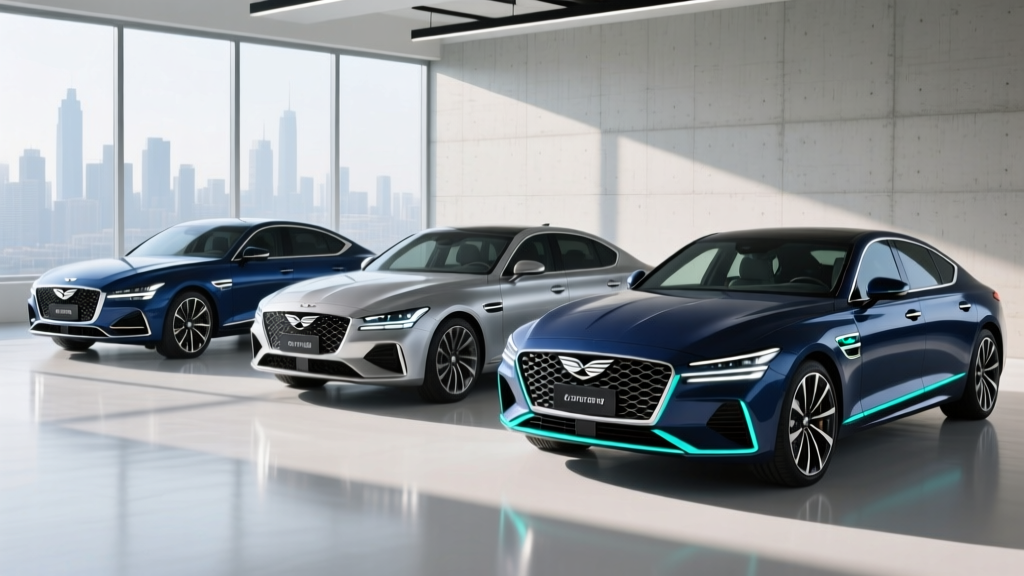
The 2026 Genesis Hybrid Lineup at a Glance
Genesis approaches electrification with two distinct strategies: conventional hybrids (HEVs) that recapture energy without ever needing a plug, and plug-in hybrids (PHEVs) that offer meaningful electric-only driving before the gas engine takes over. For 2026, the brand fields a mix of both across its sedan and SUV range, giving buyers real choices depending on commute patterns and charging access.
This guide breaks down every current Genesis hybrid and PHEV by the numbers that matter — EPA MPG, electric-only range, battery capacity, charging times, powertrain output, pricing, and federal tax credit eligibility under current IRS §30D rules.
| Model | Type | EPA Combined MPG / MPGe | Electric Range (PHEV) | Combined HP | Base MSRP |
|---|---|---|---|---|---|
| G80 2.5T Hybrid | HEV | 28 combined | N/A | 300 hp | $58,050 |
| GV70 2.5T Hybrid | HEV | 26 combined | N/A | 300 hp | $52,550 |
| GV80 2.5T Hybrid | HEV | 24 combined | N/A | 300 hp | $63,600 |
| GV60 (EV) | BEV | 95 MPGe combined | 264 mi (EPA) | 314 hp | $53,350 |
| GV70 Electrified | BEV | 89 MPGe combined | 236 mi (EPA) | 429 hp | $67,950 |
Note: Genesis does not currently offer a plug-in hybrid (PHEV) variant in the U.S. market for 2026. The brand's electrified lineup consists of conventional HEVs and full battery-electric vehicles (BEVs). This guide covers both, since many Genesis hybrid shoppers are also cross-shopping the EV models.
Genesis Conventional Hybrids: HEV MPG and Powertrain Details
The 2026 G80, GV70, and GV80 hybrids all share a similar architecture: a 2.5-liter turbocharged inline-four paired with an electric motor integrated into the transmission. Unlike a PHEV, these conventional hybrids (HEVs) cannot be plugged in. The small battery (approximately 1.5–2.0 kWh) charges exclusively through regenerative braking and engine power. You simply fuel up and drive — no charging infrastructure required.
G80 2.5T Hybrid
The G80 sedan hybrid delivers an EPA-estimated 28 MPG combined (26 city / 31 highway) according to fueleconomy.gov. In real-world city driving, conventional hybrids often exceed their EPA city ratings because stop-and-go traffic maximizes regenerative braking. Expect 29–32 MPG in urban commuting, with highway figures closer to the sticker at 65–70 mph. At 80 mph or in sustained mountain driving, plan for 24–26 MPG.
GV70 2.5T Hybrid
The compact luxury SUV hybrid rates at 26 MPG combined (24 city / 28 highway). The GV70's heavier curb weight and higher frontal area reduce efficiency versus the G80 sedan. Real-world mixed driving typically yields 25–28 MPG, with city-heavy commutes occasionally touching 29 MPG thanks to regen braking.
GV80 2.5T Hybrid
The three-row GV80 hybrid comes in at 24 MPG combined (22 city / 27 highway). This is the heaviest vehicle in the hybrid lineup, and the EPA numbers reflect that. Real-world owners report 22–26 MPG in mixed use. If you regularly load all three rows and haul cargo, expect figures at the lower end of that range.
| Model | EPA City | EPA Highway | EPA Combined | Real-World Expectation |
|---|---|---|---|---|
| G80 2.5T Hybrid | 26 MPG | 31 MPG | 28 MPG | 27–32 MPG (city-favorable) |
| GV70 2.5T Hybrid | 24 MPG | 28 MPG | 26 MPG | 25–28 MPG |
| GV80 2.5T Hybrid | 22 MPG | 27 MPG | 24 MPG | 22–26 MPG |
Genesis Electrified SUVs: The EV Alternative
Because Genesis does not sell a PHEV in the U.S. for 2026, buyers seeking electric-only driving must look at the brand's battery-electric models: the GV60 and the GV70 Electrified. These are full BEVs — no gas engine at all.
GV60
Built on Hyundai Motor Group's E-GMP platform, the GV60 Advanced AWD delivers an EPA-estimated 264 miles of range from its 77.4 kWh (usable) battery pack. The motor setup produces 314 hp in standard mode and up to 429 hp in Boost mode (0–60 mph in approximately 3.9 seconds). DC fast charging peaks at roughly 240 kW on an 800V-capable charger, enabling a 10–80% charge in about 18 minutes under ideal conditions. Level 2 charging at 10.9 kW adds roughly 30 miles of range per hour.
GV70 Electrified
The GV70 Electrified uses the same 77.4 kWh battery but carries a heavier body, resulting in an EPA-estimated 236 miles of range and 89 MPGe combined. Output is 429 hp with 516 lb-ft of torque, and 0–60 mph takes approximately 4.5 seconds. DC fast charging also peaks near 240 kW (10–80% in roughly 18 minutes on an 800V station).
HEV vs. PHEV vs. BEV: Which Genesis Fits Your Driving?
With no PHEV in the 2026 Genesis lineup, the real decision is between a conventional hybrid (no plug needed, moderate fuel savings) and a full battery-electric vehicle (maximum efficiency, but requires charging access).
Choose a Genesis HEV If:
- You lack reliable home or workplace charging
- You want 24–28 MPG without changing any habits
- You take frequent long road trips and don't want to plan around chargers
- You prefer a lower purchase price ($52K–$64K range)
Choose a Genesis BEV (GV60/GV70) If:
- You can install a Level 2 home charger (240V, ~$500–$1,500 install)
- Your daily commute is under 200 miles round-trip
- You want the lowest per-mile fuel cost (~$0.04–$0.06/mi on residential electricity)
- You value instant torque, quiet operation, and minimal maintenance
Pricing, Tax Credits, and Ownership Costs
Here's where the math gets specific — and where many buyers get confused.
Genesis HEVs: No Federal Tax Credit
Conventional hybrids (HEVs) like the G80, GV70, and GV80 hybrid do not qualify for the federal §30D clean vehicle tax credit. That credit is reserved for plug-in vehicles (PHEVs and BEVs) with a minimum battery capacity of 7 kWh. Since HEV batteries are typically under 2 kWh, they are ineligible. Some states offer modest hybrid rebates (check your state energy office), but there is no federal incentive.
Genesis BEVs: §30D Credit Eligibility Is Complex
The GV60 and GV70 Electrified may qualify for up to $7,500 under the IRS §30D credit, but eligibility depends on multiple factors that change regularly:
- MSRP cap: SUVs (GV70 Electrified) must be under $80,000; sedans/crossovers (GV60) under $55,000. Some GV60 trims exceed the cap.
- Buyer income cap: AGI must not exceed $150,000 (single), $225,000 (head of household), or $300,000 (joint filers).
- Battery sourcing: Critical minerals and battery components must meet phased-in percentage thresholds from U.S. or free-trade-agreement countries. These thresholds tighten annually.
- Point-of-sale transfer: As of 2024+, eligible buyers can transfer the credit to the dealer for an immediate price reduction at purchase rather than waiting to claim it on their tax return.
Always verify current eligibility on IRS.gov before purchasing, as battery sourcing compliance can shift mid-year.
Five-Year Fuel Cost Comparison
| Model | Fuel Type | Efficiency | Est. Cost/Gallon or kWh | 5-Year Fuel Cost |
|---|---|---|---|---|
| G80 Hybrid | Gasoline (premium) | 28 MPG | $4.20/gal | ~$11,250 |
| GV80 Hybrid | Gasoline (premium) | 24 MPG | $4.20/gal | ~$13,125 |
| GV60 (home charging) | Electricity | 2.8 kWh/mi | $0.16/kWh | ~$3,360 |
| GV60 (public DCFC mix) | Electricity | 2.8 kWh/mi | $0.35/kWh avg | ~$7,350 |
The fuel savings from going fully electric are substantial if you charge primarily at home. Relying heavily on public DC fast charging narrows the gap significantly.
Battery Warranty, Reliability, and Replacement Costs
Hybrid Battery Longevity
Conventional hybrid batteries (1.5–2.0 kWh) experience far fewer deep charge/discharge cycles than EV batteries, and they tend to last well beyond the warranty period. Toyota and Hyundai Motor Group (Genesis's parent) have extensive track records with hybrid packs lasting 150,000–200,000+ miles in real-world use. If replacement is eventually needed out of warranty, a Genesis HEV battery pack typically costs $2,000–$4,000 including labor — far less than an EV traction battery.
EV Battery Replacement
The 77.4 kWh packs in the GV60 and GV70 Electrified are significantly more expensive to replace: $15,000–$22,000+ if needed out of warranty. However, modern NMC (nickel-manganese-cobalt) packs with active thermal management are projected to retain 85–90% capacity at 100,000 miles under normal use. Most owners will never need a full replacement.
Reliability Context
Genesis as a brand has scored above average in J.D. Power dependability studies, and Hyundai Motor Group's E-GMP platform (underpinning the GV60) has proven robust since its 2022 debut. The hybrid powertrains in the G80/GV70/GV80 use a well-established architecture with no major failure patterns reported as of early 2026. Check NHTSA.gov for the latest safety recalls and technical service bulletins on any specific model.
Charging the Genesis Electrified Models
For the GV60 and GV70 Electrified, charging speed and access are the practical ownership questions.
| Charging Level | Power (kW) | Miles Added Per Hour | Full Charge Time | Connector |
|---|---|---|---|---|
| Level 1 (120V outlet) | ~1.4 kW | ~4 mi/hr | ~55 hours | J1772 / NACS |
| Level 2 (240V home) | 10.9 kW | ~30 mi/hr | ~7.5 hours | J1772 / NACS |
| DC Fast Charge | Up to 240 kW | ~150 mi in 18 min (10–80%) | 18 min (10–80%) | CCS / NACS (adapter) |
Genesis vehicles originally shipped with CCS connectors. As the industry shifts to NACS (Tesla's standard), Genesis has committed to adopting NACS on new vehicles and providing CCS-to-NACS adapters for existing owners to access Tesla Supercharger stations. Verify adapter availability and compatibility with your model year before relying on Supercharger access.
Pros and Cons: Genesis Hybrid and Electrified Lineup
Pros
- HEVs require zero charging infrastructure — fill up and go
- Industry-leading 10-year/100,000-mile battery and powertrain warranty
- GV60's 800V architecture enables class-leading 18-min DC fast charging
- Strong luxury build quality, materials, and ride refinement
- Hybrid models improve MPG 15–25% over gas-only equivalents
- Complimentary scheduled maintenance for 3 years / 36,000 miles
Cons
- No PHEV option — no middle ground between HEV and full EV
- HEV models do not qualify for any federal tax credit
- GV70 Electrified range (236 mi) trails rivals like the BMW iX and Mercedes EQE SUV
- HEV fuel savings are modest vs. gas models (~2–4 MPG improvement)
- Genesis dealer network is smaller than BMW, Mercedes, or Lexus
- CCS-to-NACS adapter transition still creating access uncertainty
Frequently Asked Questions
How many MPG does a Genesis hybrid get?
The 2026 G80 Hybrid achieves 28 MPG combined (26 city / 31 highway). The GV70 Hybrid rates at 26 MPG combined, and the GV80 Hybrid at 24 MPG combined. All require premium gasoline. Real-world city driving may exceed EPA estimates by 1–3 MPG thanks to regenerative braking, while sustained highway driving above 75 mph typically drops 2–4 MPG below the sticker.
Does Genesis make a plug-in hybrid (PHEV)?
Not for the 2026 U.S. market. Genesis currently offers conventional hybrids (HEVs) that never need plugging in, and full battery-electric vehicles (BEVs) like the GV60 and GV70 Electrified. There is no mid-range PHEV option with electric-only driving capability. If you want some electric-only range without committing to a full EV, you'd need to look at competitors like the BMW X5 xDrive50e or Volvo XC90 Recharge.
Do Genesis hybrids qualify for a tax credit?
No. Conventional hybrids (HEVs) are not eligible for the federal §30D Clean Vehicle Credit, which requires a minimum 7 kWh battery and plug-in capability. Genesis HEV batteries are under 2 kWh. The full-electric GV60 and GV70 Electrified may qualify for up to $7,500, subject to MSRP caps, buyer income limits, and battery sourcing requirements. Verify on IRS.gov before purchasing.
How long will the Genesis hybrid battery last?
Genesis covers the hybrid battery for 10 years or 100,000 miles. In practice, conventional hybrid batteries from Hyundai Motor Group routinely last 150,000–200,000+ miles because they undergo shallow charge/discharge cycles. Replacement cost if needed out of warranty is approximately $2,000–$4,000 for an HEV pack — far less than an EV battery replacement.
Is the Genesis GV60 a hybrid?
No. The GV60 is a fully battery-electric vehicle (BEV) with no gasoline engine. It uses a 77.4 kWh battery and dual electric motors producing 314–429 hp depending on trim and mode. EPA-estimated range is 264 miles for the Advanced AWD trim.
Should I buy a Genesis hybrid or a full EV?
Choose a Genesis HEV (G80, GV70, GV80 Hybrid) if you cannot charge at home, drive more than 300 miles regularly, or want a lower entry price without lifestyle changes. Choose a Genesis BEV (GV60, GV70 Electrified) if you have home Level 2 charging, commute under 200 miles daily, and want to minimize fuel costs (roughly $3,000–$4,000 saved over 5 years vs. the HEV models on residential electricity rates).