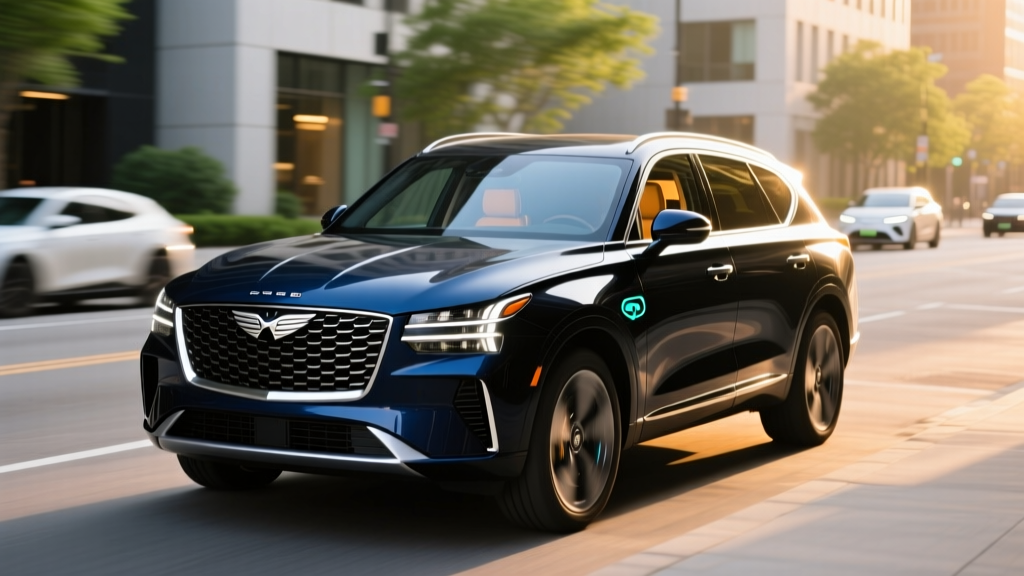
The Genesis GV80 has carved out a niche as a luxury midsize SUV that punches above its weight in interior refinement and technology. For 2026, the GV80 Hybrid variant aims to address one of the nameplate's few weak points: fuel economy. By pairing a turbocharged 2.5-liter four-cylinder with an electric motor integrated into the eight-speed automatic transmission, Genesis targets buyers who want the GV80's premium cabin without the thirst of the twin-turbo V6.
This guide breaks down the 2026 GV80 Hybrid's powertrain specs, real-world efficiency expectations, pricing, and whether it qualifies for any federal tax incentives. We'll also clarify exactly what this hybrid can — and cannot — do compared to a plug-in hybrid or full battery-electric vehicle.
2026 Genesis GV80 Hybrid: Powertrain and Key Specs
| Specification | 2026 GV80 Hybrid |
|---|---|
| Powertrain | 2.5L turbocharged I-4 + electric motor (HEV) |
| Combined Horsepower | ~304 hp |
| Combined Torque | ~348 lb-ft |
| Transmission | 8-speed automatic with integrated electric motor |
| Drivetrain | AWD (standard) |
| Battery Type | Lithium-ion (small capacity, self-charging HEV) |
| Plug-In Required? | No — charges via regenerative braking and engine |
| 0-60 mph (est.) | ~7.2 seconds |
| Towing Capacity | ~4,000 lbs (est.) |
The 2026 GV80 Hybrid uses a conventional hybrid (HEV) architecture. The electric motor sits between the engine and transmission, providing torque fill at low RPMs and enabling brief electric-only motoring at low speeds — such as in stop-and-go traffic or while coasting. Unlike a plug-in hybrid (PHEV), there is no large battery pack and no charging port. The system recharges itself through regenerative braking and engine-driven generation.
This is a critical distinction for buyers cross-shopping the GV80 Hybrid against vehicles like the BMW X5 xDrive50e (a PHEV) or the Genesis Electrified GV70 (a full BEV). The GV80 Hybrid never needs to be plugged in, but it also cannot travel meaningful distances on electricity alone.
HEV vs. PHEV vs. EV: Where Does the GV80 Hybrid Fit?
| Feature | GV80 Hybrid (HEV) | Typical Luxury PHEV (e.g., X5 xDrive50e) | Full EV (e.g., Electrified GV70) |
|---|---|---|---|
| Plug-In Required | No | Yes (optional for best efficiency) | Yes (mandatory) |
| Electric-Only Range | ~1 mile at low speed | 30-40 miles | 236-283 miles (EPA) |
| Home Charging Needed | No | Recommended (Level 2) | Essential (Level 2) |
| Combined MPG / MPGe | ~26 MPG combined | ~50 MPGe (electric) / ~20 MPG (gas) | ~77 MPGe |
| Federal Tax Credit (§30D) | Not eligible | Up to $7,500 (if eligible) | Up to $7,500 (if eligible) |
| Starting MSRP Range | ~$59,000-$67,000 | ~$67,000+ | ~$68,000+ |
The GV80 Hybrid occupies a specific lane: you want better fuel economy than the GV80's 2.5T or 3.5T V6 without changing your fueling habits. If you have reliable home charging and a commute under 35 miles, a PHEV like the X5 xDrive50e will deliver dramatically lower operating costs. If you're ready to go fully electric and have charging access, the Electrified GV70 or a comparable BEV will be cheaper to run. The GV80 Hybrid is for buyers who simply want to visit the gas station less often — not eliminate it.
Fuel Economy: EPA MPG and Real-World Expectations
| Driving Condition | EPA Estimate | Real-World Expectation |
|---|---|---|
| City | 25 MPG | 26-28 MPG (hybrids often exceed EPA in city) |
| Highway | 27 MPG | 24-26 MPG (hybrid advantage diminishes at sustained speed) |
| Combined | 26 MPG | 24-27 MPG depending on driving mix |
The conventional hybrid architecture shines in city driving. Regenerative braking recaptures energy at every stop, and the electric motor handles low-speed acceleration where the gasoline engine is least efficient. In mixed suburban driving with frequent stops, owners commonly report exceeding the EPA city estimate by 1-3 MPG.
Highway driving tells a different story. At sustained speeds above 65 mph, the GV80 Hybrid operates primarily on its gasoline engine — the electric motor provides minimal assistance. The aerodynamic drag of a midsize luxury SUV limits efficiency gains. Expect highway fuel economy to fall slightly below the EPA estimate, particularly at speeds above 75 mph or in cold weather when the engine runs longer to heat the cabin.
For comparison, the non-hybrid GV80 2.5T AWD achieves an EPA-estimated 21 city / 25 highway / 23 combined MPG according to fueleconomy.gov. The hybrid's ~3 MPG combined improvement translates to roughly 60-80 fewer gallons per year at 15,000 miles annually — a meaningful savings, but not transformative.
Driving Impressions and Powertrain Behavior
The hybrid system's most noticeable contribution isn't raw fuel savings — it's refinement. The electric motor's instant torque fills the gap before the turbo spools, giving the GV80 Hybrid a smoother, more responsive feel from a stop than the standard 2.5T. Acceleration is linear and confident, with the 304 combined horsepower making highway merging effortless.
The eight-speed automatic with its integrated motor is notably smooth. There's no rubber-band CVT drone, and transitions between electric assist and engine power are well-masked. Under light throttle, the system can shut off the engine during coasting and low-speed deceleration, contributing to that city-driving efficiency advantage.
Genesis's drive modes (Eco, Comfort, Sport) adjust the hybrid system's behavior. Eco mode maximizes regenerative braking and keeps the engine off longer at stops. Sport mode keeps the engine running for immediate response. The difference between modes is tangible — Eco can add 1-2 MPG in city driving at the cost of slightly lazier throttle response.
Pricing, Trims, and Tax Credit Eligibility
The 2026 Genesis GV80 Hybrid is expected to slot between the 2.5T and 3.5T V6 trims in pricing. Based on Genesis's current lineup structure:
- GV80 Hybrid Standard: ~$59,000 MSRP
- GV80 Hybrid Advanced: ~$63,000 MSRP
- GV80 Hybrid Prestige: ~$67,000 MSRP
Some states and local utilities offer rebates or reduced registration fees for hybrid vehicles, though these are far less common than EV incentives. Check your state's energy office or utility provider for current programs.
Reliability, Battery Warranty, and Long-Term Costs
Hybrid battery longevity is consistently a top concern for buyers. Genesis covers the GV80 Hybrid's battery and hybrid-specific components under its powertrain warranty:
- Hybrid Battery Warranty: 10 years / 100,000 miles (whichever comes first)
- Powertrain Warranty: 10 years / 100,000 miles
- New Vehicle Limited Warranty: 5 years / 60,000 miles
- Complimentary Maintenance: 3 years / 36,000 miles
The 10-year/100,000-mile hybrid battery warranty is among the best in the luxury segment and matches Hyundai's coverage (Genesis's parent company). For context, Toyota covers hybrid batteries for 10 years/150,000 miles, while BMW and Mercedes-Benz typically offer 8 years/80,000 miles on PHEV batteries.
In practice, modern hybrid batteries rarely require replacement within the warranty period. Toyota's hybrid systems — the benchmark for longevity — routinely surpass 200,000 miles with minimal capacity loss. The GV80 Hybrid's smaller battery (roughly 1-2 kWh, typical for a non-plug-in hybrid) undergoes less stress than a PHEV or BEV battery because it operates within a narrow state-of-charge window managed by the vehicle's computer.
If replacement is ever needed out of warranty, hybrid battery packs for vehicles in this class typically cost between $2,000 and $4,000 installed — substantially less than a BEV or PHEV battery replacement. The smaller capacity and simpler thermal management of an HEV battery keep costs manageable.
Who Should Choose the GV80 Hybrid?
Choose the GV80 Hybrid If:
- You want a luxury midsize SUV with better fuel economy but don't want to plug in
- Your driving is primarily city and suburban with frequent stops
- You value the GV80's interior quality and want the smoothest powertrain option
- You lack access to home or workplace charging
- You want a 10-year hybrid battery warranty for peace of mind
Look Elsewhere If:
- You have home charging and want 30+ miles of electric-only commuting (consider a PHEV)
- You want federal tax credit eligibility (HEVs don't qualify for §30D)
- Maximum fuel savings is the priority (a BEV costs roughly 50% less per mile to fuel)
- You regularly tow heavy loads (the V6 offers more reserve power)
- You want the fastest GV80 (the 3.5T Sport does 0-60 in ~5.1 seconds)
The GV80 Hybrid makes the most sense for luxury SUV buyers who are hybrid-curious but not EV-ready. If you live in an apartment without charging access, frequently take long road trips where charging infrastructure is sparse, or simply prefer the simplicity of gas-station refueling, the hybrid delivers a tangible efficiency upgrade without any lifestyle changes.
GV80 Hybrid vs. the Competition
The luxury hybrid midsize SUV segment is relatively thin. Most competitors have moved toward PHEV or full-electric offerings. Here's how the GV80 Hybrid stacks up:
- BMW X5 xDrive50e (PHEV): ~38 miles electric-only, ~50 MPGe on electricity, starts ~$67,000, may qualify for partial tax credit. More efficient if you can charge, but more expensive and requires a plug.
- Volvo XC90 Recharge (PHEV): ~33 miles electric-only, starts ~$72,000. Three-row seating. Requires charging for best efficiency.
- Toyota Grand Highlander Hybrid: ~35 MPG combined, starts ~$45,000. Far more efficient, but not in the luxury tier. A value alternative if premium branding isn't essential.
- Mercedes-Benz GLE 450e (PHEV): ~48 miles electric-only range, starts ~$65,000. Plug-in required for efficiency gains.
The GV80 Hybrid is one of the few remaining conventional (non-plug-in) hybrid options in the luxury midsize segment. That's either its greatest strength or its limitation, depending on your access to charging and your priorities.
Frequently Asked Questions
How many MPG does the 2026 Genesis GV80 Hybrid get?
The EPA-estimated fuel economy is approximately 25 city / 27 highway / 26 combined MPG. In real-world city driving with frequent stops, owners often see 26-28 MPG thanks to regenerative braking. Highway driving at sustained speeds tends to yield 24-26 MPG.
Can the GV80 Hybrid drive on electric power only?
Only briefly. As a conventional hybrid (HEV), the GV80 Hybrid can travel roughly one mile at very low speeds (under 25 mph) on electric power alone — useful for creeping through a parking lot or a driveway. It cannot sustain highway speeds on electricity. For meaningful electric-only range, you'd need a PHEV or full EV.
Does the GV80 Hybrid need to be plugged in?
No. The GV80 Hybrid is a self-charging conventional hybrid. Its small battery recharges through regenerative braking and the gasoline engine. There is no charging port. You fuel it exclusively at gas stations, just like a conventional vehicle.
Does the 2026 GV80 Hybrid qualify for a federal tax credit?
No. The IRS §30D Clean Vehicle Credit applies only to plug-in electric vehicles (PHEVs and BEVs) that meet battery sourcing, MSRP, and buyer income requirements. Conventional hybrids like the GV80 Hybrid are not eligible. Check IRS.gov for current credit rules.
How long will the GV80 Hybrid battery last?
Genesis covers the hybrid battery for 10 years or 100,000 miles. Modern hybrid batteries — particularly the smaller packs in HEVs that operate within a narrow charge window — routinely last well beyond the warranty period. Toyota's hybrid batteries, the industry benchmark, commonly exceed 200,000 miles. Out-of-warranty replacement, if ever needed, typically costs $2,000-$4,000.
Is the GV80 Hybrid faster than the standard 2.5T?
The hybrid's combined output of approximately 304 hp is similar to the standard 2.5T's 300 hp, but the electric motor's instant torque makes the hybrid feel more responsive from a stop. The 0-60 mph time is estimated at roughly 7.2 seconds, comparable to the 2.5T AWD. For substantially quicker acceleration, the 3.5T twin-turbo V6 (375 hp, ~5.1 seconds 0-60) remains the performance choice.
Should I get the GV80 Hybrid or wait for a GV80 EV?
Genesis has signaled plans for full electrification of its lineup, but as of 2026, a dedicated GV80 EV has not been announced with confirmed specs or pricing. If you need a vehicle now and don't have reliable charging access, the GV80 Hybrid is a pragmatic choice. If you have home charging and can wait, a future Electrified GV80 could offer significantly lower operating costs.